Page 259 of 496
3-164 Features and controls
3
NOEnglish No -
Spanish No -
French Non -
ZEROEnglish Zero Oh (letter “O” )
Spanish Cero O
French Zéro O (lettre «o»)
ONEEnglish One -
Spanish Uno Una
French Un Une
TWOEnglish Two -
Spanish Dos -
French Deux -
THREEEnglish Three -
Spanish Tres -
French Trois -
FOUREnglish Four -
Spanish Cuatro -
French Quatre -
FIVEEnglish Five -
Spanish Cinco -
French Cinq -Command
Lan-
guage
Primary Command
Alternative
Commands
SIXEnglish Six -
Spanish Seis -
French Six -
SEVENEnglish Seven -
Spanish Siete -
French Sept -
EIGHTEnglish Eight -
Spanish Ocho -
French Huit -
NINEEnglish Nine -
Spanish Nueve -
French Neuf -
STAREnglish Star (*) -
Spanish Estrella (*) Asterisco (*)
French Étoile (*) -
POUNDEnglish Pound (#) -
Spanish Número (#)Signo De Número
(#)
French Dièse (#) -Command
Lan-
guage
Primary Command
Alternative
Commands
BK0098300US.book 164 ページ 2008年12月8日 月曜日 午前11時37分
Page 281 of 496

4-4 Driving safety
4
DefrostersCheck these by selecting the defroster mode, and set the blower
switch on high. You should be able to feel the air blowing
against the windshield.
(Refer to “Defrosting or defogging the windshield and door
windows” on page 5-12, 5-20.)TiresCheck all the tires for heavy tread wear or uneven wear pat-
terns. Look for stones, nails, glass, or other objects stuck in the
tread. Look for any tread cuts or sidewall cracks. Check the
wheel nuts for tightness, and the tires (including spare tire) for
proper pressures. Replace your tires before they are heavily
worn out.
As your vehicle is equipped with a tire pressure monitoring
system, there is a risk of damage to the tire inflation pressure
sensors when the tire is replaced on the rim. Tire replacement
should, therefore, be performed only by an authorized Mitsub-
ishi Motors dealer.LightsHave someone watch while you turn all the exterior lights on
and off. Also check the turn signal indicators and high-beam
indicators on the instrument panel. Fluid leaksCheck the ground under the vehicle after parking overnight, for
fuel, water, oil, or other leaks. Make sure all the fluid levels are
correct. Also, if you can smell fuel, you need to find out why
immediately and have it fixed.
Safe driving techniques
N00629200078
Even this vehicle’s safety equipment, and your safest driving,
cannot guarantee that you can avoid an accident or injury.
However, if you give extra attention to the following areas, you
can better protect yourself and your passengers:
�Drive defensively. Be aware of traffic, road and weather
conditions. Leave plenty of stopping distance between
your vehicle and the vehicle ahead.
�Before changing lanes, check your mirrors and use your
turn signal light.
�While driving, watch the behavior of other drivers, bicy-
clists, and pedestrians.
�Always obey applicable laws and regulations. Be a polite
and alert driver. Always leave room for unexpected
events, such as sudden braking.
�If you plan to drive in another country, obey their vehicle
registration laws and make sure you will be able to get the
right fuel.
BK0098300US.book 4 ページ 2008年12月8日 月曜日 午前11時37分
Page 285 of 496

4-8 Driving safety
4
�Curb weight: the weight of a motor vehicle with standard
equipment including the maximum capacity of fuel, oil,
and coolant.
�Accessory weight: the combined weight (in excess of
those standard items which may be replaced) of automatic
transmission, power steering, power brakes, power win-
dows, power seats, radio, and heater, to the extent that
these items are available as factory- installed equipment
(whether installed or not).
�Vehicle capacity weight: the rated cargo and luggage load
plus 150 lbs (68 kg)* times the vehicle’s designated seat-
ing capacity.
�Production options weight: the combined weight of those
installed regular production options weighing over 5 lbs
(2.3 kg) in excess of those standard items which they
replace, not previously considered in curb weight or
accessory weight, including heavy duty brakes, ride level-
ers, roof rack, heavy duty battery, and special trim.
�Normal occupant weight: 150 lbs (68 kg)* times the num-
ber of specified occupants. (In your vehicle the number is
2)
�Occupant distribution: distribution of occupants in a vehi-
cle as specified. (In your vehicle the distribution is 2 in
front seat)
Tire and loading information placard
N00630100312
The tire and loading information placard is located on the
driver’s door sill.
Ty p e 1
*: 150 lbs (68 kg) is the weight of one person as defined by
U.S.A. and Canadian regulations.A- All vehicles (Type A)
B- Vehicles sold in Canada (Type B)
BK0098300US.book 8 ページ 2008年12月8日 月曜日 午前11時37分
Page 485 of 496
9-10 Specifications
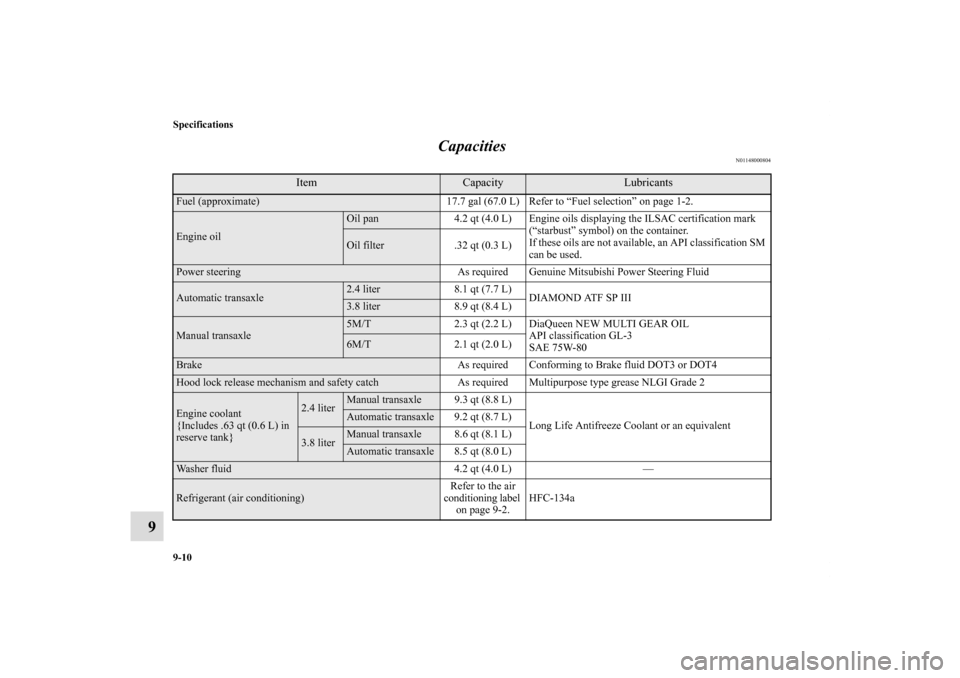
9Capacities
N01148000804
Item
Capacity
Lubricants
Fuel (approximate) 17.7 gal (67.0 L) Refer to “Fuel selection” on page 1-2.Engine oil
Oil pan 4.2 qt (4.0 L) Engine oils displaying the ILSAC certification mark
(“starbust” symbol) on the container.
If these oils are not available, an API classification SM
can be used.Oil filter .32 qt (0.3 L)
Power steering As required Genuine Mitsubishi Power Steering Fluid Automatic transaxle
2.4 liter 8.1 qt (7.7 L)
DIAMOND ATF SP III 3.8 liter 8.9 qt (8.4 L)
Manual transaxle
5M/T 2.3 qt (2.2 L) DiaQueen NEW MULTI GEAR OIL
API classification GL-3
SAE 75W-806M/T 2.1 qt (2.0 L)
Brake As required Conforming to Brake fluid DOT3 or DOT4 Hood lock release mechanism and safety catch As required Multipurpose type grease NLGI Grade 2 Engine coolant
{Includes .63 qt (0.6 L) in
reserve tank}
2.4 liter
Manual transaxle 9.3 qt (8.8 L)
Long Life Antifreeze Coolant or an equivalentAutomatic transaxle 9.2 qt (8.7 L)
3.8 liter
Manual transaxle 8.6 qt (8.1 L)Automatic transaxle 8.5 qt (8.0 L)
Washer fluid 4.2 qt (4.0 L) — Refrigerant (air conditioning)Refer to the air
conditioning label
on page 9-2.HFC-134a BK0098300US.book 10 ページ 2008年12月8日 月曜日 午前11時37分
