2010 MERCEDES-BENZ ML350 Rotation
[x] Cancel search: RotationPage 9 of 368

Coolant
Anticorrosion/antifreeze ...............363
Capacities ...................................... 358
Checking level ............................... 216
Messages in the multifunction
display ........................................... 288
Corner-illuminating front fog
lamps .................................................... 96
Cruise control .................................... 141
Activating ....................................... 142
Canceling ....................................... 142
Changing the set speed .................143
Last stored speed ..........................143
Lever .............................................. 142
Messages in the mutlifunction
display ........................................... 278
Resume function ............................ 143
Setting current speed ....................142
Cup holders ........................................ 194
Curb weight ....................................... 240
Customer Assistance Center (CAC) ... 23
Customer Relations Department ....... 24
D
Dashboard see Instrument cluster
Data recording ..................................... 24
Date, Setting ...................................... 132
Daytime running lamp mode .............. 94
Switching on or off ......................... 133
Deep water
see Standing water
Defroster
Rear window .................................. 183
Windshield ............................. 171, 181
Delayed shut-off
Exterior lamps ................................ 134
Interior lighting .............................. 135
Department of Transportation
see DOT
Diesel engine
Preglow indicator lamp ....................29
Diesel fuel
see Fuel
Difficulties
While driving .................................. 106
With starting .................................. 105
Digital clock
see Clock
Digital speedometer ......................... 123
Dimensions (vehicle) see Vehicle specification
Direction of rotation (tires) .............. 231
Displays
Digital speedometer ......................123
Distronic ........................................ 146
Maintenance service indicator .......258
Messages in the multifunction
display ........................................... 272
Multifunction display .....................121
Outside temperature .............123, 131
Symbol messages ..........................283
Text messages ............................... 273
Trip computer ................................ 138
Vehicle status message memory ...128
Vehicle system settings .................129
Distronic ............................................ 144
Cleaning system sensor cover .......263
Control system .............................. 128
Distance warning function .............151
Distance warning
lamp ...................................... 146, 302
Driving with .................................... 150
Menu ............................................. 147
Messages in the multifunction
display ........................................... 278
Resume function ............................ 149
Sensor cover .................................. 263
Speed settings ............................... 148
Door control panel .............................. 33
Door handles ........................................ 33
Doors
Child safety locks ............................ 60
Locking/unlocking (KEYLESS-GO) ...71
Locking/unlocking (SmartKey) ........70
Messages in the multifunction
display ........................................... 286
Opening from inside ......................... 74
Remote door unlock (Tele Aid) .......203
Unlocking (Mechanical key) ...........306
DOT (Department of
Transportation) .................................. 240
Downhill Speed Regulation see DSR
Drinking and driving ......................... 244Index7164_AKB; 7; 31, en-USd2ureepe,Version: 2.11.8.12009-09-11T12:07:36+02:00 - Seite 7
Page 19 of 368

Capacities fuels, coolants,
lubricants etc. ................................ 356
Coolant .......................................... 362
Engine oil additives ........................359
Engine oils ..................................... 359
Fuel requirements .......................... 360
Gasoline additives .......................... 361
Identification labels .......................346
Premium unleaded gasoline ...........360
Rims and tires ................................ 352
Spare wheel ................................... 356
Vehicle specification ML 350 ......... 348
Vehicle specification
ML 350 4MATIC ............................. 349
Vehicle specification
ML 350 BlueTEC 4MATIC ...............348
Vehicle specification
ML 550 4MATIC ............................. 350
Vehicle specification ML 63 AMG ..351
Washer and headlamp cleaning
system ................................... 358, 364
Technical data (dimensions)
see Vehicle specification
Technical data (electrical system)
see Vehicle specification
Technical data (engine)
see Vehicle specification
Technical data (weights)
see Vehicle specification
Tele Aid ............................................... 199
Emergency calls ............................. 200
Information button .........................202
Initiating an emergency call
manually ........................................ 201
Messages in the multifunction
display ........................................... 285
Remote door unlock ......................203
Roadside Assistance button ..........201
Search & Send ............................... 203
SOS button .................................... 201
Stolen Vehicle Recovery Services ..204
System self-test ............................. 199
Telephone ............................................. 30
Answering/ending a call ................140
Hands-free microphone ...................33
Menu ............................................. 139
Operation ....................................... 139Phone book .................................... 140
Redialing ........................................ 141
Temperature
Interior temperature ..............170, 179
Outside .................................. 123, 131
Tether anchorage points
see Children in the vehicle
Tie-down rings ................................... 188
Tightening torque
Wheels ........................................... 330
Time setting ....................................... 132
TIN (Tire Identification Number) ...... 241
Tire and Loading Information
placard ............................................... 227
Tire and loading terminology ........... 239
TIREFIT ............................................... 320
Tire Identification Number see TIN
Tire inflation pressure
Checking ........................................ 221
Important notes on ........................220
Label on the inside of fuel filler
flap ................................................ 220
Placard on driver’s door B-pillar .....227
Tire labeling ....................................... 235
Tire load rating .................................. 240
Tire ply composition and material
used .................................................... 241
Tire pressure loss warning system . 222
Tire repair kit see TIREFIT
Tires ........................................... 218, 352
Advanced Tire Pressure
Monitoring System (Advanced
TPMS) ............................................ 223
Air pressure ................................... 219
Care and maintenance ...................232
Cleaning ......................................... 233
Direction of rotation, spinning .......231
Important notes on tire inflation
pressure ........................................ 220
Inflation pressure ........................... 221
Information placard .......................227
Inspection ...................................... 232
Labeling ......................................... 235
Load index ............................. 236, 240
Load rating .................................... 240Index17164_AKB; 7; 31, en-USd2ureepe,Version: 2.11.8.12009-09-11T12:07:36+02:00 - Seite 17
Page 20 of 368

Messages in the multifunction
display ................................... 281, 296
MOExtended .................................. 352
Ply composition and material
used ............................................... 241
Problems under-/overinflation ......221
Retreads ........................................ 218
Rims and tires (technical data) ......352
Rotation ......................................... 234
Service life ..................................... 232
Sizes .............................................. 352
Snow chains .................................. 243
Speed rating .......................... 237, 241
Storing ........................................... 233
Temperature .......................... 220, 234
Terminology ................................... 239
TIREFIT (tire repair kit) ...................320
Tire Identification Number .............241
Tire pressure loss warning system . 222
TPMS low tire pressure/
malfunction telltale ........................304
Traction ................................. 233, 241
Tread ............................................. 242
Tread depth ........................... 232, 242
Treadwear ...................................... 233
Treadwear indicators .............232, 242
Vehicle maximum load on ..............242
Wear pattern .................................. 234
Winter tires ............................ 242, 352
Tire speed rating ....................... 237, 241
Tongue Weight Rating see TWR
Top tether
see Children in the vehicle
Total load limit ................................... 241
Towing
Towing eye bolt .............................. 339
Trailer .................................... 113, 254
Vehicle ........................................... 338
Towing eye bolt ................................. 339
Traction ...................................... 233, 241
Trailer towing ............................ 113, 254
Coupling a trailer ........................... 255
Decoupling ..................................... 257
Electrical connections .................... 254
Towing ........................................... 256
Trailer hitch ................................... 254
Weights and ratings .......................254Transfer case ..................................... 117
Transmission see Automatic transmission
Transmission fluid level .................... 216
Transmission gear selector lever see Gear selector lever
Transmission positions .................... 112
Traveling abroad ............................... 257
Tread (tires) ....................................... 242
Tread depth (tires) .................... 232, 242
Treadwear .......................................... 233
Treadwear indicators (tires) .... 232, 242
Trip computer menu ......................... 138
Trip odometer, resetting ................... 118
Turning off the engine ...................... 108
Turn signals ......................................... 95
Cleaning lenses ............................. 263
Indicator lamps ................................ 28
Messages in the multifunction
display ........................................... 296
TWR (Tongue Weight Rating) ........... 242
U
Uniform Tire Quality Grading
Standards .................................. 233, 242
Units
Selecting digital speedometer
display mode ................................. 131
Selecting speedometer/
odometer display mode .................131
Unleaded gasoline, premium ........... 360
Unlocking the vehicle
KEYLESS-GO .................................... 71
Manually ........................................ 306
SmartKey ......................................... 70
Upholstery, cleaning ......................... 265
Useful features .................................. 194
V
Vehicle
Battery ........................................... 334
Care ............................................... 260
Control system .............................. 119
Identification Number (VIN) ...........346
Locking/unlocking ........................... 70
Lowering (wheel change) ...............329
18Index164_AKB; 7; 31, en-USd2ureepe,Version: 2.11.8.12009-09-11T12:07:36+02:00 - Seite 18
Page 224 of 368

Do not overload the tires by exceeding the
specified load limit as indicated on the Tire
and Loading Information placard on the
driver’s door B-pillar. Overloading the tires
can overheat them, possibly causing a
blowout. Overloading the tires can also result
in handling or steering problems, or brake
failure.
Check the tire inflation pressure at least once
a month.
Check and adjust the tire inflation pressure
when the tires are cold ( Y page 219).
Checking tire inflation pressure
manually
Follow the steps below to achieve correct tire
inflation pressure:
XRemove the cap from the valve on one tire.XFirmly press a tire gauge onto the valve.XRead the tire inflation pressure on the tire
gauge and check against the
recommended tire inflation pressure on the
Tire and Loading Information placard on the
driver’s door B-pillar ( Y page 227). If
necessary, add air to achieve the
recommended tire inflation pressure.XIf you have overfilled the tire, release tire
inflation pressure by pushing the metal
stem of the valve with e.g. a tip of a pen.
Then recheck the tire inflation pressure
with the tire gauge.XInstall the valve cap.XRepeat this procedure for each tire.
Tire pressure loss warning system
(Canada only)
While the vehicle is being driven, the tire
pressure loss warning system monitors the
set tire inflation pressures by evaluating each
wheel’s rotational speed. This allows the
system to detect a significant loss of pressure
in a tire. If a wheel’s rotational speed changes
due to falling tire inflation pressure, you will
see a corresponding warning message in the
multifunction display.
The tire pressure loss warning system may
function in a restricted manner or with a delay
R when snow chains are mounted to the
vehicle
R in the presence of ice and snow
R when you are driving on a loose surface
(e.g. sand or gravel)
R when you are driving in a very sporty
manner (involving rapid acceleration or
high speeds in curves)GWarning!
When the multifunction display shows the
message Tire Pressure Check Tires , one
or more of your tires are significantly
underinflated. You should stop and check
your tires as soon as possible, and inflate
them to the proper tire inflation pressure as
indicated on the vehicle’s Tire and Loading
Information placard or on the tire inflation
pressure label.
Driving on a significantly underinflated tire
causes the tire to overheat and can lead to
tire failure. Underinflation also reduces fuel
efficiency and tire tread life, and may affect
the vehicle’s handling and stopping ability.
Each tire, including the spare, should be
checked at least once a month when cold.
Inflate the tires to the recommended tire
inflation pressure as specified on
R the Tire and Loading Information placard on
the driver’s door B-pillar
or
R the tire inflation pressure label located on
the inside of the fuel filler flap
222Tires and wheelsOperation
164_AKB; 7; 31, en-USd2ureepe,Version: 2.11.8.12009-09-11T12:07:36+02:00 - Seite 222
Page 233 of 368
Weight Rating (GVWR) and the Gross Axle
Weight Rating (GAWR) for either the front or
rear axle. You can obtain the GVWR and
GAWR from the certification label. The
certification label can be found on the driver’s
door B-pillar, see the “Technical data” section
(Y page 346).
Gross Vehicle Weight Rating (GVWR): The
total weight of the vehicle, all occupants, all
cargo, and the trailer tongue load (if
applicable) must never exceed the GVWR.
Gross Axle Weight Rating (GAWR): The total
allowable weight that can be carried by a
single axle (front or rear).
To assure that your vehicle does not exceed
the maximum permissible weight limits
(GVWR and GAWR for front and rear axle),
have the loaded vehicle (including driver,
passengers and all cargo and, if applicable,
trailer fully loaded) weighed on a suitable
commercial scale.
Trailer tongue load
The tongue load of any trailer is an important
weight to measure because it affects the load
you can carry in your vehicle. If a trailer is
towed, the tongue load must be added to the
weight of all occupants riding and any cargo
you are carrying in the vehicle. The tongue
load typically is between 8% and 15% of the
trailer weight and everything loaded in it.
Maximum tire load
GWarning!
Do not overload the tires by exceeding the
specified load limit as indicated on the Tire
and Loading Information placard on the
driver’s door B-pillar. Overloading the tires
can overheat them, possibly causing a
blowout. Overloading the tires can also result
in handling or steering problems, or brake
failure.
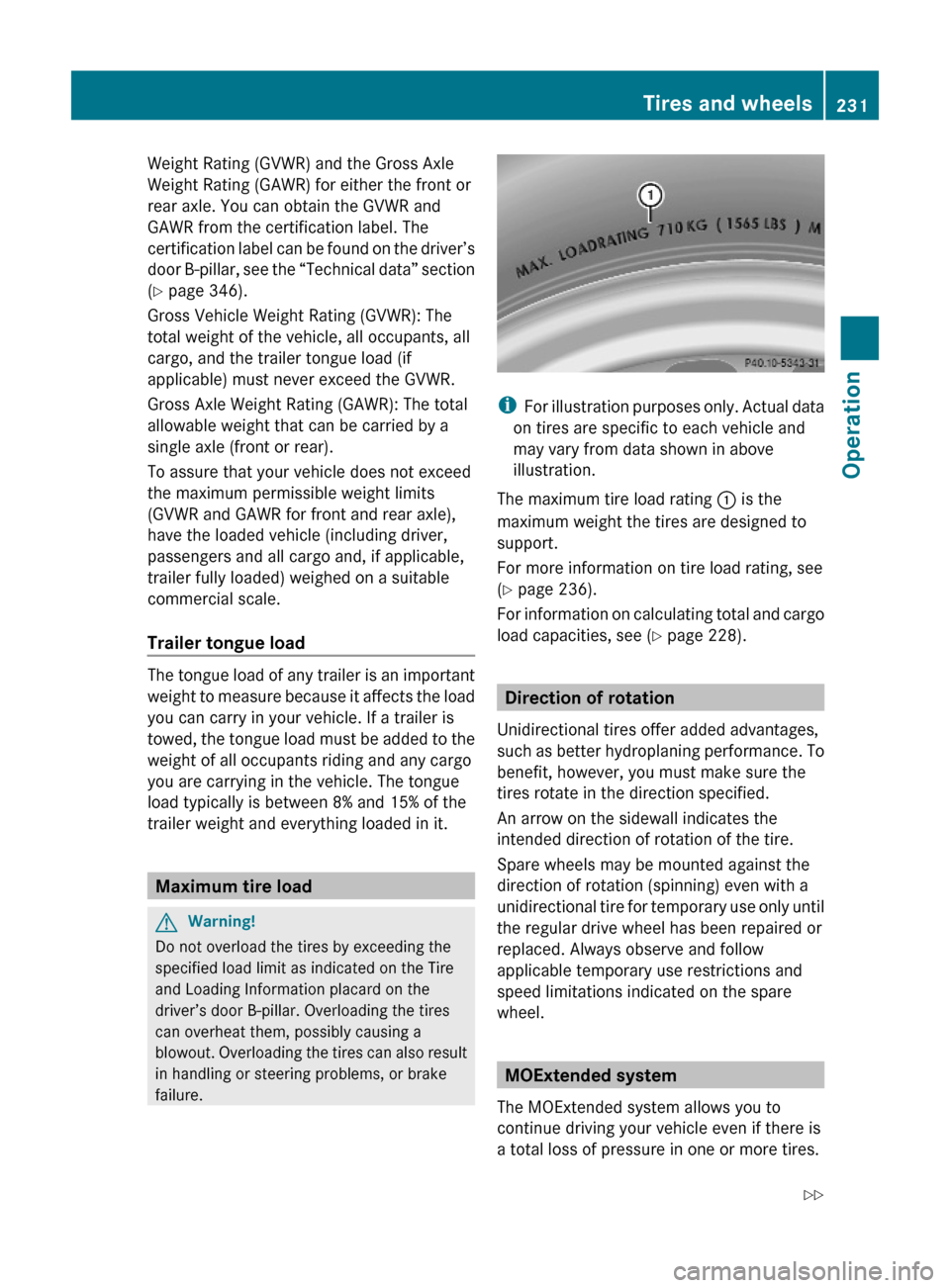
iFor illustration purposes only. Actual data
on tires are specific to each vehicle and
may vary from data shown in above
illustration.
The maximum tire load rating : is the
maximum weight the tires are designed to
support.
For more information on tire load rating, see
(Y page 236).
For information on calculating total and cargo
load capacities, see (Y page 228).
Direction of rotation
Unidirectional tires offer added advantages,
such as better hydroplaning performance. To
benefit, however, you must make sure the
tires rotate in the direction specified.
An arrow on the sidewall indicates the
intended direction of rotation of the tire.
Spare wheels may be mounted against the
direction of rotation (spinning) even with a
unidirectional tire for temporary use only until
the regular drive wheel has been repaired or
replaced. Always observe and follow
applicable temporary use restrictions and
speed limitations indicated on the spare
wheel.
MOExtended system
The MOExtended system allows you to
continue driving your vehicle even if there is
a total loss of pressure in one or more tires.
Tires and wheels231Operation164_AKB; 7; 31, en-USd2ureepe,Version: 2.11.8.12009-09-11T12:07:36+02:00 - Seite 231Z
Page 236 of 368

tests, and does not include acceleration,
cornering, hydroplaning, or peak traction
characteristics.
The traction grades, from highest to lowest,
are AA, A, B, and C. Those grades represent
the tire’s ability to stop on wet pavement as
measured under controlled conditions on
specified government test surfaces of asphalt
and concrete. A tire marked C may have poor
traction performance.GWarning!
If ice has formed on the road, tire traction will
be substantially reduced. Under such weather
conditions, drive, steer and brake with
extreme caution.
The safe speed on a wet, snow covered or icy
road is always lower than on a dry road.
You should pay particular attention to the
condition of the road whenever the outside
temperature is close to the freezing point.
Mercedes-Benz recommends winter tires
( Y page 242) with a minimum tread depth of
approximately 1
/ 6 in (4 mm) on all four wheels
for the winter season to ensure normal
balanced handling characteristics. On
packed snow, they can reduce your stopping
distance compared to summer tires.
Stopping distance, however, is still
considerably greater than when the road is
not covered with snow or ice. Exercise
appropriate caution.
! Avoid spinning of a drive wheel. This may
cause serious damage to the drivetrain
which is not covered by the Mercedes-Benz
Limited Warranty.
Temperature
GWarning!
The temperature grade for this tire is
established for a tire that is properly inflated
and not overloaded. Excessive speed,
underinflation, or excessive loading, either
separately or in combination, can cause
excessive heat build-up and possible tire
failure.
The temperature grades are A (the highest),
B, and C, representing the tire’s resistance to
the generation of heat and its ability to
dissipate heat when tested under controlled
conditions on a specified indoor laboratory
test wheel. Sustained high temperature can
cause the material of the tire to degenerate
and reduce tire life, and excessive
temperature can lead to sudden tire failure.
The grade C corresponds to a level of
performance which all passenger car tires
must meet under the Federal Motor Vehicle
Safety Standard No. 109. Grades B and A
represent higher levels of performance on the
laboratory test wheel than the minimum
required by law.
Rotating tires
GWarning!
Rotate front and rear wheels only if the tires
are of the same dimension.
If your vehicle is equipped with mixed-size
tires (different tire dimensions front vs. rear),
tire rotation is not possible.
GWarning!
Have the tightening torque checked after
changing a wheel. The wheels could come
loose if they are not tightened to a torque of
110 lb-ft (150 Nm).
Only use genuine Mercedes-Benz wheel bolts
specified for your vehicle’s rims.
Tire rotation can be performed on vehicles
with tires of the same dimension all around.
If your vehicle is equipped with tires of the
same dimension all around, tires can be
rotated, observing a front-to-rear rotation
pattern that will maintain the intended
rotation (spinning) direction of the tire
( Y page 231).
In some cases, such as when your vehicle is
equipped with mixed-size tires (different tire
234Tires and wheelsOperation
164_AKB; 7; 31, en-USd2ureepe,Version: 2.11.8.12009-09-11T12:07:36+02:00 - Seite 234
Page 237 of 368

dimension front vs. rear), tire rotation is not
possible.
If applicable to your vehicle’s tire
configuration, tires can be rotated according
to the tire manufacturer’s recommended
intervals in the tire manufacturer’s warranty
pamphlet located in your vehicle literature
portfolio. If none is available, tires should be
rotated every 3 000 to 6 000 miles (5 000 to
10 000 km), or sooner if necessary, according
to the degree of tire wear. The same rotation
(spinning) direction must be maintained.
Rotate tires before the characteristic tire
wear pattern becomes visible (shoulder wear
on front tires and tread center wear on rear
tires).
Thoroughly clean the mounting face of wheels
and brake disks, i.e. the inner side of the
wheels/tires, during each rotation. Check for
and ensure proper tire inflation pressure.
For information on wheel change, see “Flat
tire” (Y page 319).
Tire labeling
Besides tire name (sales designation) and
manufacturer name, a number of markings
can be found on a tire.
Following are some explanations for the
markings on your vehicle’s tires:
:Uniform Tire Quality Grading Standards
(Y page 233)
;DOT, Tire Identification Number
(Y page 238)
=Maximum tire load (Y page 231)?Maximum tire inflation pressure
(Y page 226)
AManufacturerBTire ply material (Y page 239)CTire size designation, load and speed
rating (Y page 236)
DLoad identification (Y page 238)ETire name
iFor illustration purposes only. Actual data
on tires are specific to each vehicle and
may vary from data shown in above
illustration.
For more information, see “Rims and tires”
(Y page 352).
Tires and wheels235Operation164_AKB; 7; 31, en-USd2ureepe,Version: 2.11.8.12009-09-11T12:07:36+02:00 - Seite 235Z