2010 MERCEDES-BENZ E350 warning light
[x] Cancel search: warning lightPage 326 of 372
iVehicles without spare wheel are not
factory-equipped with the tools required for
a wheel change such as a jack or a wheel
wrench. Some tools required for a wheel
change are specific to your vehicle.
Contact an authorized Mercedes-Benz
Center to obtain the tools approved for
your vehicle. This section describes the
wheel change using the tools approved and
recommended for your vehicle.
Lifting the vehicleGWarning!
When jacking up the vehicle, only use the jack
which has been specifically approved by
Mercedes-Benz for your vehicle.
The jack is designed exclusively for jacking up
the vehicle at the jack take-up brackets built
into both sides of the vehicle. Make sure the
jack arm is fully seated in the jack take-up
bracket. The jack must always be vertical
when in use, especially on inclines or
declines.
The jack is intended only for lifting the vehicle
briefly for wheel changes. It is not suited for
performing maintenance work under the
vehicle. To help avoid personal injury, use the
jack only to lift the vehicle during a wheel
change.
Never get beneath the vehicle while it is
supported by the jack. Keep hands and feet
away from the area under the lifted vehicle.
Always lower the vehicle onto sufficient
capacity jackstands before working under the
vehicle.
Always engage the parking brake firmly and
block the wheels with wheel chocks or other
sizeable objects before raising the vehicle
with the jack. Do not disengage the parking
brake while the vehicle is raised.
Make sure that the ground on which the
vehicle is standing and where you place the
jack is solid, level and not slippery. If
necessary, use a large underlay. On slippery
surfaces, such as tiled floors, you should use
a non-slip underlay, for example a rubber mat.
Do not use wooden blocks or similar objects
to support the jack. Otherwise the jack may
not be able to achieve its load-bearing
capacity if it is not at its full height.
Never start the engine when the vehicle is
raised.
Also observe the notes on the jack.XPrevent the vehicle from rolling away by
blocking wheels with wheel chocks or other
sizeable objects.
When your vehicle is equipped with a wheel
chock, it is included with the vehicle tool kit
( Y page 268). For information on setting up
the collapsible wheel chock, see
( Y page 270).
When changing a wheel on a level surface:
XPlace a wheel chock or other sizeable
object in front of and another wheel chock
or other sizeable object behind the wheel
that is diagonally opposite to the wheel
being changed.
Always try lifting the vehicle using the jack on
a level surface. However, should
circumstances require you to do so on a hill:
XPlace wheel chocks or other sizeable
objects on the downhill side in front of both
wheels on the side opposite to the side on
which the wheel is to be changed.GWarning!
Only jack up the vehicle on level ground or on
slight inclines/declines. Otherwise, the
vehicle could fall off the jack and injure you or
others.
324Flat tirePractical hints
212_AKB; 2; 41, en-USd2ureepe,Version: 2.11.8.12009-07-17T09:14:21+02:00 - Seite 324
Page 329 of 372
XGuide the spare wheel onto the alignment
bolt and push it on.
XInsert the wheel bolts and tighten them
slightly.
XUnscrew the alignment bolt.XInstall the last wheel bolt and tighten it
slightly.
XVehicles with spare wheel with
collapsible tire: Continue the procedure
by following the instructions under
“Inflating the collapsible tire”
(Y page 327) and then “Lowering the
vehicle” (Y page 328).
or
XVehicles with Minispare wheel: Continue
the procedure by following the instructions
under “Lowering the vehicle”
(Y page 328).
Inflating the collapsible tire
GWarning!
Inflate collapsible tire only after the wheel is
properly attached.
Inflate the collapsible tire using the electric
air pump before lowering the vehicle.
GWarning!
Observe safety instructions on air pump label.
! Do not lower the vehicle before inflating
the collapsible tire. Otherwise the rim may
be damaged.
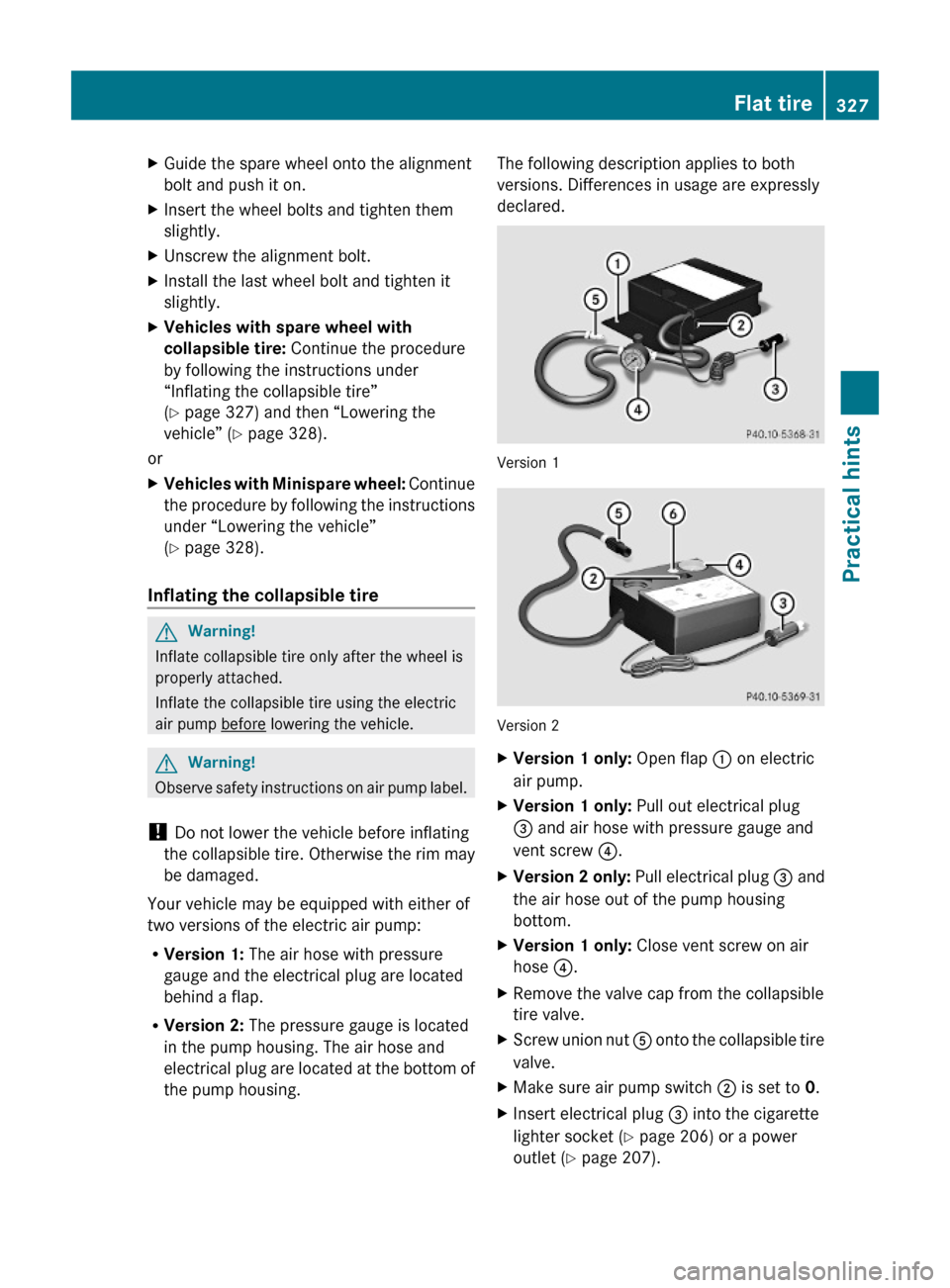
Your vehicle may be equipped with either of
two versions of the electric air pump:
RVersion 1: The air hose with pressure
gauge and the electrical plug are located
behind a flap.
RVersion 2: The pressure gauge is located
in the pump housing. The air hose and
electrical plug are located at the bottom of
the pump housing.
The following description applies to both
versions. Differences in usage are expressly
declared.
Version 1
Version 2
XVersion 1 only: Open flap : on electric
air pump.
XVersion 1 only: Pull out electrical plug
= and air hose with pressure gauge and
vent screw ?.
XVersion 2 only: Pull electrical plug = and
the air hose out of the pump housing
bottom.
XVersion 1 only: Close vent screw on air
hose ?.
XRemove the valve cap from the collapsible
tire valve.
XScrew union nut A onto the collapsible tire
valve.
XMake sure air pump switch ; is set to 0.XInsert electrical plug = into the cigarette
lighter socket (Y page 206) or a power
outlet (Y page 207).
Flat tire327Practical hints212_AKB; 2; 41, en-USd2ureepe,Version: 2.11.8.12009-07-17T09:14:21+02:00 - Seite 327Z
Page 333 of 372
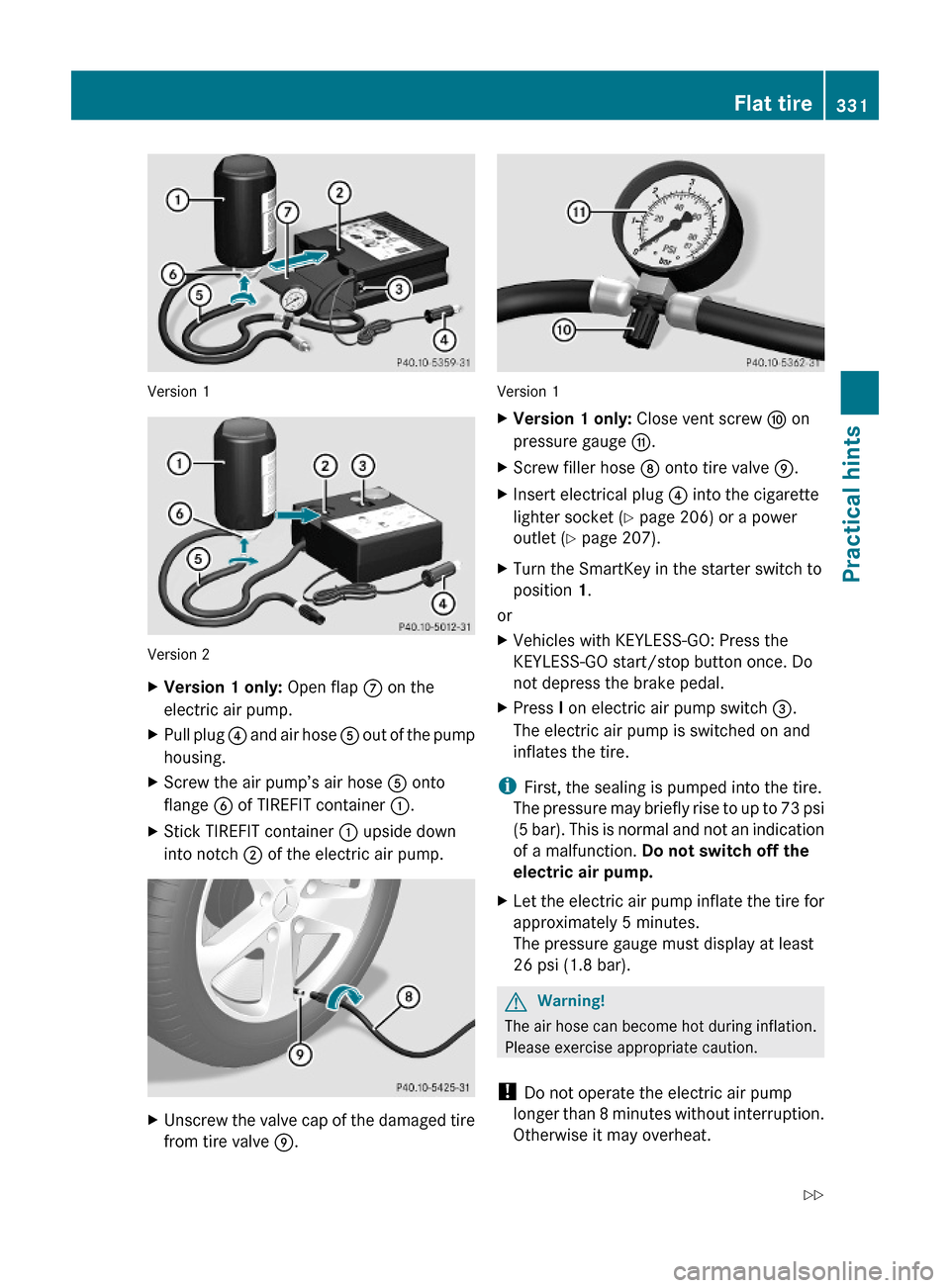
Version 1
Version 2
XVersion 1 only: Open flap C on the
electric air pump.
XPull plug ? and air hose A out of the pump
housing.
XScrew the air pump’s air hose A onto
flange B of TIREFIT container :.
XStick TIREFIT container : upside down
into notch ; of the electric air pump.
XUnscrew the valve cap of the damaged tire
from tire valve E.
Version 1
XVersion 1 only: Close vent screw F on
pressure gauge G.
XScrew filler hose D onto tire valve E.XInsert electrical plug ? into the cigarette
lighter socket (Y page 206) or a power
outlet (Y page 207).
XTurn the SmartKey in the starter switch to
position 1.
or
XVehicles with KEYLESS-GO: Press the
KEYLESS-GO start/stop button once. Do
not depress the brake pedal.
XPress I on electric air pump switch =.
The electric air pump is switched on and
inflates the tire.
iFirst, the sealing is pumped into the tire.
The pressure may briefly rise to up to 73 psi
(5 bar). This is normal and not an indication
of a malfunction. Do not switch off the
electric air pump.
XLet the electric air pump inflate the tire for
approximately 5 minutes.
The pressure gauge must display at least
26 psi (1.8 bar).
GWarning!
The air hose can become hot during inflation.
Please exercise appropriate caution.
! Do not operate the electric air pump
longer than 8 minutes without interruption.
Otherwise it may overheat.
Flat tire331Practical hints212_AKB; 2; 41, en-USd2ureepe,Version: 2.11.8.12009-07-17T09:14:21+02:00 - Seite 331Z
Page 357 of 372
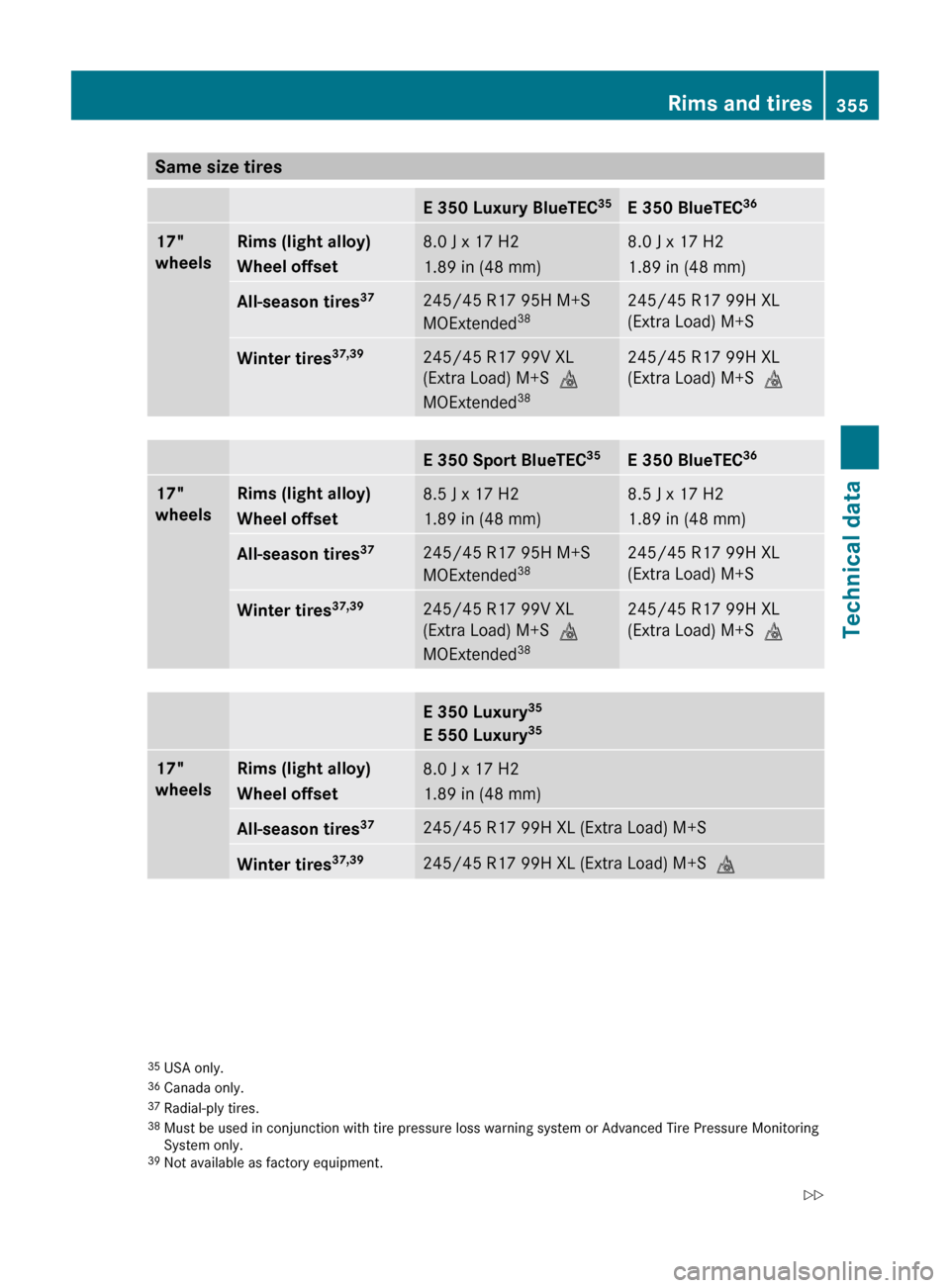
Same size tiresE 350 Luxury BlueTEC35E 350 BlueTEC3617"
wheelsRims (light alloy)
Wheel offset8.0 J x 17 H2
1.89 in (48 mm)8.0 J x 17 H2
1.89 in (48 mm)All-season tires 37245/45 R17 95H M+S
MOExtended 38245/45 R17 99H XL
(Extra Load) M+SWinter tires 37,39245/45 R17 99V XL
(Extra Load) M+S i
MOExtended 38245/45 R17 99H XL
(Extra Load) M+S iE 350 Sport BlueTEC 35E 350 BlueTEC3617"
wheelsRims (light alloy)
Wheel offset8.5 J x 17 H2
1.89 in (48 mm)8.5 J x 17 H2
1.89 in (48 mm)All-season tires 37245/45 R17 95H M+S
MOExtended 38245/45 R17 99H XL
(Extra Load) M+SWinter tires 37,39245/45 R17 99V XL
(Extra Load) M+S i
MOExtended 38245/45 R17 99H XL
(Extra Load) M+S iE 350 Luxury35
E 550 Luxury 3517"
wheelsRims (light alloy)
Wheel offset8.0 J x 17 H2
1.89 in (48 mm)All-season tires 37245/45 R17 99H XL (Extra Load) M+SWinter tires37,39245/45 R17 99H XL (Extra Load) M+S
i35
USA only.
36 Canada only.
37 Radial-ply tires.
38 Must be used in conjunction with tire pressure loss warning system or Advanced Tire Pressure Monitoring
System only.
39 Not available as factory equipment.Rims and tires355Technical data212_AKB; 2; 41, en-USd2ureepe,Version: 2.11.8.12009-07-17T09:14:21+02:00 - Seite 355Z
Page 361 of 372
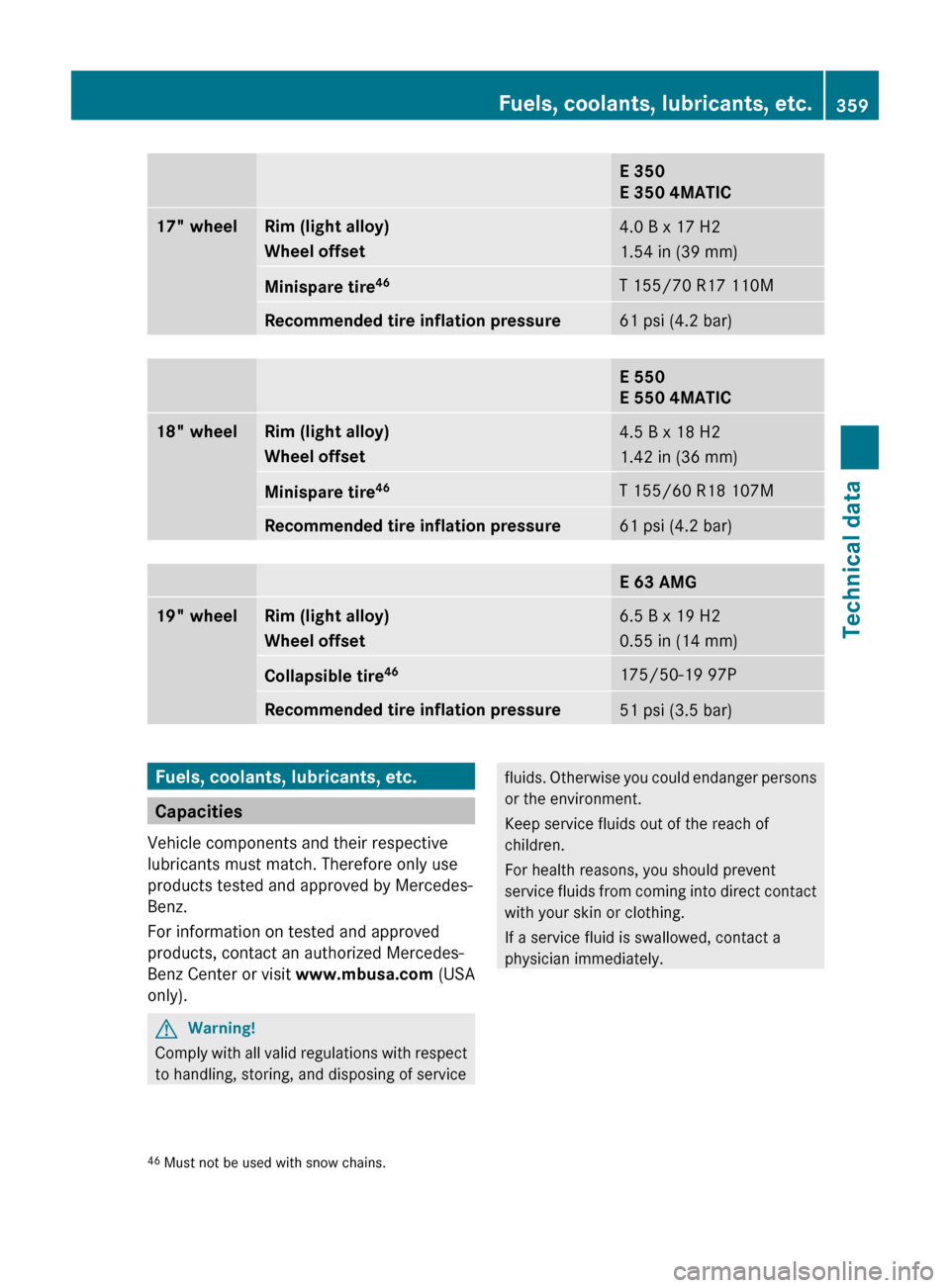
E 350
E 350 4MATIC17" wheelRim (light alloy)
Wheel offset4.0 B x 17 H2
1.54 in (39 mm)Minispare tire 46T 155/70 R17 110MRecommended tire inflation pressure61 psi (4.2 bar)E 550
E 550 4MATIC18" wheelRim (light alloy)
Wheel offset4.5 B x 18 H2
1.42 in (36 mm)Minispare tire 46T 155/60 R18 107MRecommended tire inflation pressure61 psi (4.2 bar)E 63 AMG19" wheelRim (light alloy)
Wheel offset6.5 B x 19 H2
0.55 in (14 mm)Collapsible tire 46175/50-19 97PRecommended tire inflation pressure51 psi (3.5 bar)Fuels, coolants, lubricants, etc.
Capacities
Vehicle components and their respective
lubricants must match. Therefore only use
products tested and approved by Mercedes-
Benz.
For information on tested and approved
products, contact an authorized Mercedes-
Benz Center or visit www.mbusa.com (USA
only).
GWarning!
Comply with all valid regulations with respect
to handling, storing, and disposing of service
fluids. Otherwise you could endanger persons
or the environment.
Keep service fluids out of the reach of
children.
For health reasons, you should prevent
service fluids from coming into direct contact
with your skin or clothing.
If a service fluid is swallowed, contact a
physician immediately.46 Must not be used with snow chains.Fuels, coolants, lubricants, etc.359Technical data212_AKB; 2; 41, en-USd2ureepe,Version: 2.11.8.12009-07-17T09:14:21+02:00 - Seite 359Z
Page 366 of 372
not meeting Mercedes-Benz approved fuel
standards.
Gasoline additives
A major concern among engine
manufacturers is carbon build-up caused by
gasoline. Mercedes-Benz recommends only
the use of quality gasoline containing
additives that prevent the build-up of carbon
deposits.
After an extended period of using fuels
without such additives carbon deposits can
build up, especially on the intake valves and
in the combustion area, leading to engine
performance problems such as:
R Warm-up hesitation
R Unstable idle
R Knocking/pinging
R Misfire
R Power loss
In areas where carbon deposits may be
encountered due to lack of availability of
gasoline which contains these additives, the
use of Mercedes-Benz approved additives is
recommended.
Contact an authorized Mercedes-Benz Center
or visit www.mbusa.com (USA only) for a
listing of approved products. Follow
directions on the product label.
Do not blend other fuel additives with fuel.
This only results in unnecessary cost and may
be harmful to the engine operation.
! Damage or malfunction resulting from
poor fuel quality or from blending additional
fuel additives other than those tested and
approved by us for use on Mercedes-Benz
vehicles are not covered by the Mercedes-
Benz Limited Warranty or by any pre-owned
or Extended Limited Warranties.
AdBlue ®
AdBlue ®
is a non-flammable, non-toxic,
colorless and odorless, water-soluble liquid.
! Only use AdBlue ®
complying with
ISO 22241. Do not blend with additives.
! Rinse surfaces that have come into
contact with AdBlue ®
, or remove AdBlue ®
with a moist cloth and cold water
immediately. If AdBlue ®
has crystallized
already, use cold water and a sponge.
AdBlue ®
residues will crystallize and soil
the affected surfaces.
High ambient temperatures
If AdBlue ®
in the reservoir heats up to above
122‡ (50†) for a long period of time, for
example due to direct sunlight, ammonia gas
vapors may escape when opening the
AdBlue ®
tank.
GWarning!
When opening the filler cap of the AdBlue ®
tank ammonia gas vapors may escape. Refill
AdBlue ®
in a well ventilated area only.
Ammonia gas vapors have a pungent odor and
are particularly irritating for your skin,
mucous membranes, and eyes. Inhaling
ammonia gas vapors will cause burning eyes,
nose, and throat, as well as coughing and
watering eyes.
Low ambient temperatures
AdBlue ®
freezes at a temperature of
approximately 12‡ (-11†). Your vehicle is
factory equipped with an AdBlue ®
preheating
system. The vehicle can thus be operated at
temperatures below 12‡ (-11†).
Special additives
! Only use AdBlue ®
complying with
ISO 22241. Do not add additives to
AdBlue ®
and do not dilute AdBlue ®
with
364Fuels, coolants, lubricants, etc.Technical data
212_AKB; 2; 41, en-USd2ureepe,Version: 2.11.8.12009-07-17T09:14:21+02:00 - Seite 364