2010 Lexus GS350 interior
[x] Cancel search: interiorPage 37 of 648

37
1-2. Opening, closing and locking the doors and trunk
1
Before driving
GS_G_U (OM30C80U)
June 29, 2011 10:30 am
●Gripping the door handle when wearing a glove may not unlock the door.
●If the wireless remote control is used to lock the doors when the electronic key
is near the vehicle, there is a possibility that the door may not be unlocked by the
smart access system with push-button start. (Use the wireless remote control to
unlock the doors.)
●A sudden approach to the effective range or door handle operation may pre-
vent the doors from being unlocked. In this case, return the door handle to the
original position and check that the doors unlock before pulling the door handle
again.
■When the vehicle is not driven for extended periods
To prevent theft of the vehicle, do not leave the electronic key within 6 ft. (2 m) of
the vehicle.
■Security feature
If a door is not opened within approximately 60 seconds after the vehicle is
unlocked, the theft deterrent system automatically locks the vehicle again.
■Alarms and warning indicators
A combination of exterior and interior alarms as well as warnings displayed on the
multi-information display are used to prevent theft of the vehicle and unforeseeable
accidents resulting from erroneous operation. Take appropriate measures in
response to any warning indications on the multi-information display. (P. 5 5 3 )
The following table describes circumstances and correction procedures when only
alarms are sounded.
Page 38 of 648

38
1-2. Opening, closing and locking the doors and trunk
GS_G_U (OM30C80U)
June 29, 2011 10:30 am
AlarmSituationCorrection procedure
Exterior alarm
sounds once for
2 seconds
Tried to lock the doors using
the entry function while the
electronic key is still inside
the passenger compartmentRetrieve the electronic
key from the passenger
compartment and lock
the doors again.
Closed the trunk while the
electronic key is still inside
and all doors are lockedRetrieve the electronic
key from the trunk and
close the trunk lid.
Exterior alarm
sounds once for
60 seconds
Tried to exit the vehicle with
the electronic key and lock
the doors without first turning
the “ENGINE START STOP”
switch OFFTu r n t h e “ E N G I N E
START STOP” switch
OFF and lock the doors
again.
Exterior alarm
sounds once for
10 secondsTried to lock the vehicle using
the entry function while a
door is openClose all of the doors
and lock the doors
again.
Interior alarm
sounds continu-
ouslyTried to open the door and
exit the vehicle without shift-
ing the shift lever to “P”Shift the shift lever to
“P”.
Interior alarm rings
continuously
Switched to ACCESSORY
mode while the driver’s door
is open (Opened the driver’s
door when the “ENGINE
START STOP” switch is in
ACCESSORY mode.)
Tu r n t h e “ E N G I N E
START STOP” switch
OFF and close the
driver’s door.
Turned the “ENGINE START
STOP” switch OFF while the
driver’s door is open
Close the driver’s door.
Page 69 of 648

69
1-3. Adjustable components (seats, mirrors, steering wheel)
1
Before driving
GS_G_U (OM30C80U)
June 29, 2011 10:30 am
CAUTION
■Using a seat belt extender
●Do not wear the seat belt extender, if you can fasten the seat belt without the
extender.
●Do not use the seat belt extender when installing a child restraint system, because
the belt will not securely hold the child restraint system, increasing the risk of
death or serious injury in the event of a sudden stop, sudden swerve or accident.
●The personalized extender may not be safe on another vehicle, when used by
another person, or at a different seating position other than the one originally
intended.
■Precaution for pre-collision seat belts
Do not rely solely on the pre-collision system to avoid accidents. Always pay atten-
tion to the surrounding conditions, and drive safely and responsibly.
NOTICE
■When using a seat belt extender
When releasing the seat belt, press on the buckle release button on the extender,
not on the seat belt.
This helps prevent damage to the vehicle interior and the extender itself.
Page 93 of 648

93
1
1-7. Safety information
Before driving
GS_G_U (OM30C80U)
June 29, 2011 10:30 am
SRS airbags
The SRS airbags inflate when the vehicle is subjected to certain types of
severe impacts that may cause significant injury to the occupants. They
work together with the seat belts to help reduce the risk of death or serious
injury.
Front airbags
Driver airbag/front passenger airbag
Can help protect the head and chest of the driver and front passen-
ger from impact with interior components.
Knee airbag
Can help provide driver and front passenger protection.
Side and curtain shield airbags
Front side airbag/rear side airbag (rear side airbags are optional)
Can help protect the torso of the front occupants and rear out-
board occupants.
Page 112 of 648

112
1-7. Safety information
GS_G_U (OM30C80U)
June 29, 2011 10:30 am
■Selecting an appropriate child restraint system
●Use a child restraint system appropriate for the child until the child becomes
large enough to properly wear the vehicle’s seat belt.
●If a child is too large for a child restraint system, sit the child on a rear seat and
use the vehicle’s seat belt. (P. 6 3 )
CAUTION
■Using a child restraint system
The use of a child restraint system not suitable for the vehicle may not properly
secure the infant or child, resulting in death or serious injury.
■Child restraint precautions
●For effective protection in automobile accidents and sudden stops, a child must
be properly restrained, using a seat belt or child restraint system depending on
the age and size of the child. Holding a child in your arms is not a substitute for a
child restraint system. In an accident, the child can be crushed against the wind-
shield, or between you and the vehicle’s interior.
●Lexus strongly urges the use of a proper child restraint system that conforms to
the size of the child, installed on the rear seat. According to accident statistics, the
child is safer when properly restrained in the rear seat than in the front seat.
●Never install a rear-facing child restraint system on the front passenger seat even
if the “AIR BAG OFF” indicator light is illuminated. In the event of an accident, the
force of the rapid inflation of the front passenger airbag can cause death or seri-
ous injury to the child if the rear-facing child restraint system is installed on the
front passenger seat.
●A forward-facing child restraint system may be installed on the front passenger
seat only when it is unavoidable. A child restraint system that requires a top tether
strap should not be used in the front passenger seat since there is no top tether
strap anchor for the front passenger seat. Adjust the seatback as upright as possi-
ble and always move the seat as far back as possible even if the “AIR BAG OFF”
indicator light is illuminated, because the front passenger airbag could inflate with
considerable speed and force. Otherwise, the child may be killed or seriously
injured.
Page 130 of 648

130
2-1. Driving procedures
GS_G_U (OM30C80U)
June 29, 2011 10:30 am
CAUTION
■When driving on slippery road surfaces
●Sudden braking, acceleration and steering may cause tire slippage and reduce
your ability to control the vehicle, resulting in an accident.
●Sudden changes in engine speed, such as engine braking caused by up-shifting
or down-shifting, may cause the vehicle to skid, resulting in an accident.
●After driving through a puddle, lightly depress the brake pedal to make sure that
the brakes are functioning properly. Wet brake pads may prevent the brakes from
functioning properly. If the brakes on only one side are wet and not functioning
properly, steering control may be affected, resulting in an accident.
■When shifting the shift lever
Be careful not to shift the shift lever with the accelerator pedal depressed.
This may lead to unexpected rapid acceleration of the vehicle that may cause an
accident and result in death or serious injury.
■When the vehicle is stopped
●Do not race the engine.
If the vehicle is in any positions other than “P” or “N” the vehicle may accelerate
suddenly and unexpectedly, and may cause an accident.
●Do not leave the vehicle with the engine on for a long time.
If such a situation cannot be avoided, park the vehicle in an open space and
check that exhaust fumes do not enter the vehicle interior.
●In order to prevent accidents due to the vehicle rolling away, always keep
depressing the brake pedal while the engine is running, and apply the parking
brake as necessary.
●If the vehicle is stopped on an incline, in order to prevent accidents caused by the
vehicle rolling forward or backward, always depress the brake pedal and securely
apply the parking brake as needed.
●Avoid revving or racing the engine. Running the engine at high speed while the
vehicle is stopped may cause the exhaust system to overheat, which could result
in a fire if combustible material is nearby.
Page 131 of 648

131
2-1. Driving procedures
2
When driving
GS_G_U (OM30C80U)
June 29, 2011 10:30 am
CAUTION
■When the vehicle is parked
●Do not leave glasses, cigarette lighters, spray cans, or soft drink cans in the vehi-
cle when it is in the sun.
Failure to do so may result in the following:
• Gas may leak from a cigarette lighter or spray can, and may lead to a fire.
• The temperature inside the vehicle may cause the plastic lenses and plastic
material of eye glasses to deform or crack.
• Soft drink cans may fracture, causing the contents to spray over the interior of
the vehicle, and may also cause a short circuit in the vehicle’s electrical com-
ponents.
●Always apply the parking brake, shift the shift lever to “P”, stop the engine and
lock the vehicle.
Do not leave the vehicle unattended while the engine is running.
●Do not touch the exhaust pipe while the engine is running or immediately after
turning the engine off.
Doing so may cause burns.
●Do not leave the engine running in an area with snow build-up, or where it is
snowing. If snowbanks build up around the vehicle while the engine is running,
exhaust gases may collect and enter the vehicle. This may lead to death or a seri-
ous health hazard.
■Exhaust gases
Exhaust gases include harmful carbon monoxide (CO) that is colorless and odor-
less. Inhaling exhaust gases may lead to death or a serious health hazard.
●If the vehicle is in a poorly ventilated area, stop the engine. In a closed area, such
as a garage, exhaust gases may collect and enter the vehicle. This may lead to
death or a serious health hazard.
●The exhaust should be checked occasionally. If there is a hole or crack caused by
corrosion, damage to a joint or abnormal exhaust noise, be sure to have the vehi-
cle inspected and repaired by your Lexus dealer. Failure to do so may allow
exhaust gases to enter the vehicle, resulting in death or a serious health hazard.
Page 156 of 648
156
2-2. Instrument cluster
GS_G_U (OM30C80U)
June 29, 2011 10:30 am
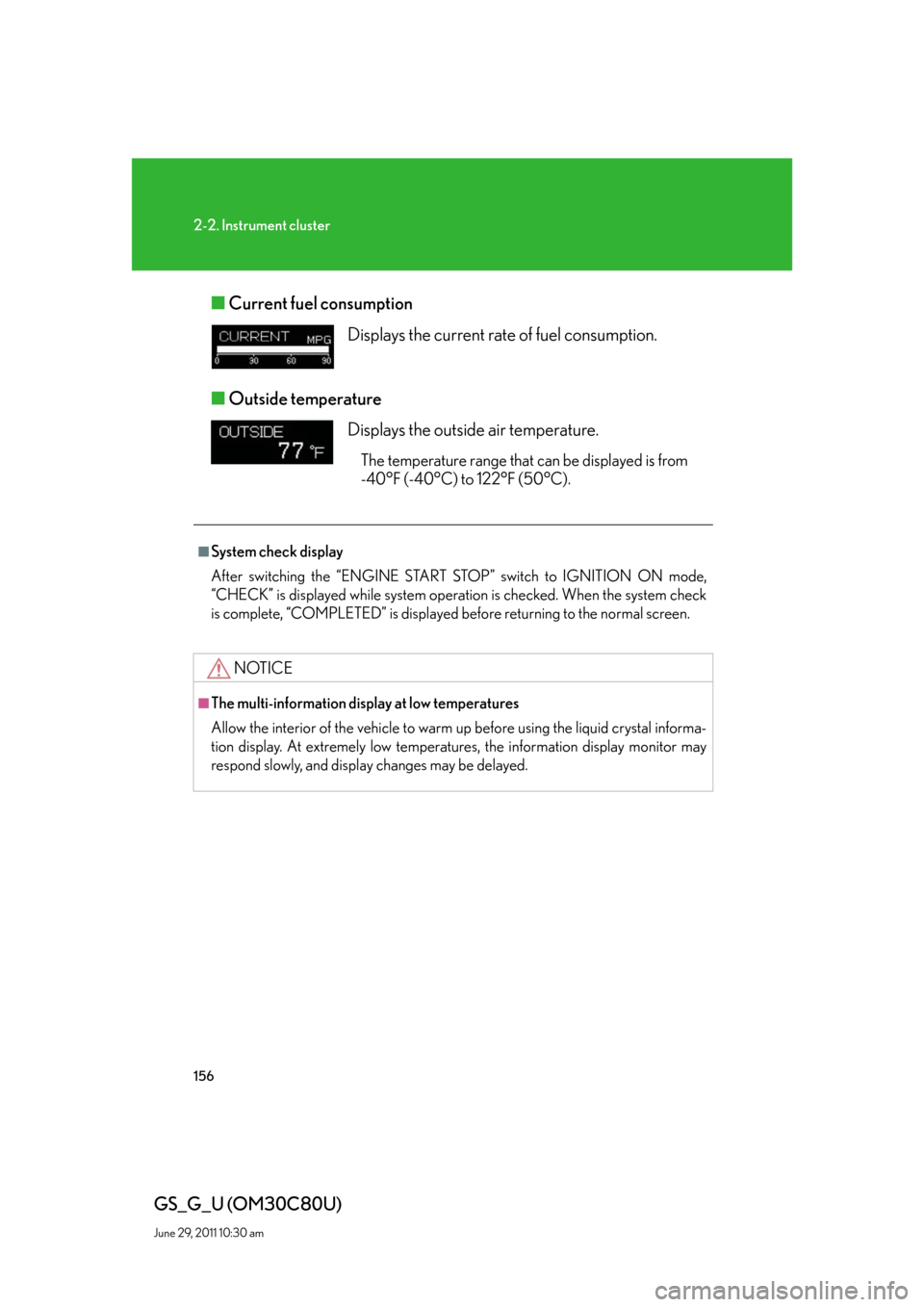
■Current fuel consumption
■Outside temperature
Displays the current rate of fuel consumption.
Displays the outside air temperature.
The temperature range that can be displayed is from
-40°F (-40°C) to 122°F (50°C).
■System check display
After switching the “ENGINE START STOP” switch to IGNITION ON mode,
“CHECK” is displayed while system operation is checked. When the system check
is complete, “COMPLETED” is displayed before returning to the normal screen.
NOTICE
■The multi-information display at low temperatures
Allow the interior of the vehicle to warm up before using the liquid crystal informa-
tion display. At extremely low temperatures, the information display monitor may
respond slowly, and display changes may be delayed.