Page 119 of 543
117
2-1. Driving procedures
2
When driving
ES350_U
■Driving in the rain
●Drive carefully when it is raining, because visibility will be reduced, the windows
may become fogged-up, and the road will be slippery.
●Drive carefully when it starts to rain, because the road surface will be especially
slippery.
●Refrain from high speeds when driving on an expressway in the rain, because
there may be a layer of water between the tires and the road surface, preventing
the steering and brakes from operating properly.
■Breaking in your new Lexus
To extend the life of the vehicle, the following precautions are recommended to
observe:
●For the first 200 miles (300 km):
Avoid sudden stops.
●For the first 600 miles (1000 km):
• Do not drive at extremely high speeds.
• Avoid sudden acceleration.
• Do not drive continuously in the low gears.
• Do not drive at a constant speed for extended periods.
■Drum-in-disc type parking brake system
Your vehicle has a drum-in-disc type parking brake system. This type of brake sys-
tem needs bedding-down of the brake shoes periodically or whenever the parking
brake shoes and/or drum are replaced. Have your Lexus dealer perform the bed-
ding down.
■Operating your vehicle in a foreign country
Comply with the relevant vehicle registration laws and confirm the availability of the
correct fuel. (oP. 488)
Page 124 of 543

122
2-1. Driving procedures
ES350_U
CAUTION
●If the power brake assist function does not operate, do not follow other vehicles
closely and avoid downhills or sharp turns that require braking.
In this case, braking is still possible, but it will require more force on the pedal than
usual. Braking distance may also increase.
●Do not pump the brake pedal if the engine stalls.
Each push on the brake pedal uses up the reserve for the power-assisted brakes.
●The brake system consists of 2 individual hydraulic systems: if one of the systems
fails, the other will still operate. In this case, the brake pedal should be depressed
more firmly than usual and braking distance becomes longer.
Do not drive your vehicle with only a single brake system. Have your brakes fixed
immediately.
NOTICE
■While driving the vehicle
Do not use the accelerator pedal or depress accelerator and brake pedals together
to hold the vehicle on a hill.
■When parking the vehicle
Always put the shift lever in P. Failure to do so may cause the vehicle to move or the
vehicle may accelerate suddenly if the accelerator pedal is accidentally depressed.
■Avoiding damage to vehicle parts
●Do not turn the steering wheel fully in either direction and hold it there for a long
time.
Doing so may damage the power steering pump
●When driving over bumps in the road, drive as slowly as possible to avoid damag-
ing the wheels, underside of the vehicle, etc.
■If you hear a squealing or scraping noise (brake pad wear limit indicators)
Have your Lexus dealer check and replace the brake pads as soon as possible.
The rotor damage can result if the pads are not replaced when needed.
It is dangerous to drive the vehicle when the wear limits of the brake pads and/or
that of the brake discs are exceeded.
Page 128 of 543
126
2-1. Driving procedures
ES350_U
■Auto power OFF function
If the vehicle is left in ACCESSORY mode for more than an hour with the shift lever
in P, the “ENGINE START STOP” switch will automatically turn off.
■Electronic key battery depletion
oP. 3 2
■When the electronic key battery is discharged
oP. 4 0 4
■Conditions affecting operation
oP. 3 0
■Note for the entry function
oP. 3 3
CAUTION
■When starting the engine
Always start the engine while sitting in the driver’s seat. Do not press the accelera-
tor pedal while starting the engine under any circumstances.
Doing so may cause an accident resulting in death or serious injury.
■Stopping the engine in an emergency
If you want to stop the engine in an emergency while driving the vehicle, push and
hold the “ENGINE START STOP” switch for more than 3 seconds.
However, do not touch the “ENGINE START STOP” switch while driving except in
an emergency. If the engine stops while the vehicle is being driven, this could lead to
an unexpected accident.
Page 129 of 543
127
2-1. Driving procedures
2
When driving
ES350_U
NOTICE
■To prevent battery discharge
Do not leave the “ENGINE START STOP” switch in ACCESSORY or IGNITION
ON mode for long periods without the engine running.
■When starting the engine
●Do not race a cold engine.
●If the engine becomes difficult to start or stalls frequently, have the engine
checked immediately.
Page 131 of 543
129
2-1. Driving procedures
2
When driving
ES350_U
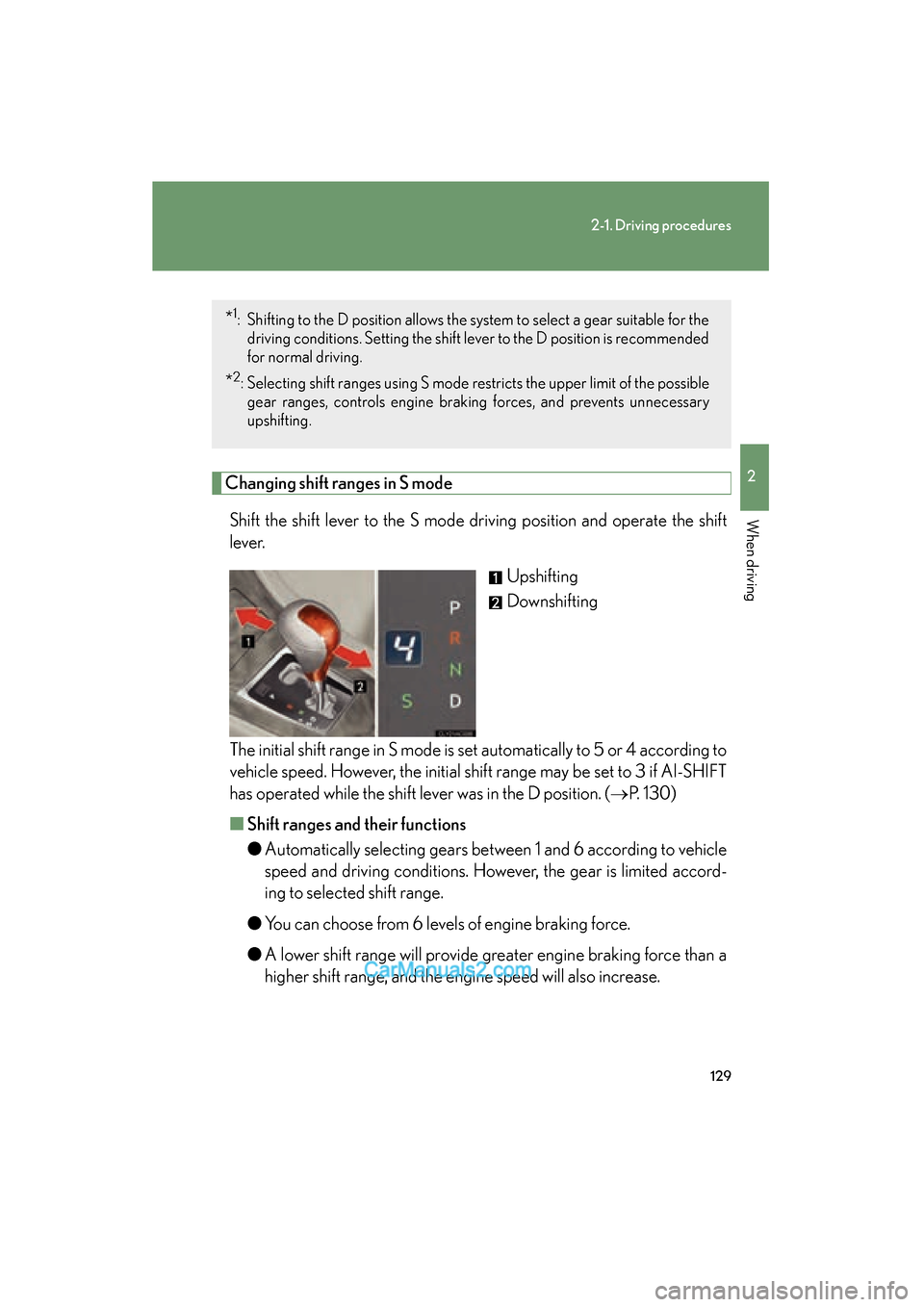
Changing shift ranges in S modeShift the shift lever to the S mode driving position and operate the shift
l e v e r. Upshifting
Downshifting
The initial shift range in S mode is set automatically to 5 or 4 according to
vehicle speed. However, the initial shift range may be set to 3 if AI-SHIFT
has operated while the shift lever was in the D position. ( oP. 1 3 0 )
■ Shift ranges and their functions
●Automatically selecting gears between 1 and 6 according to vehicle
speed and driving conditions. However, the gear is limited accord-
ing to selected shift range.
● You can choose from 6 levels of engine braking force.
● A lower shift range will provide greater engine braking force than a
higher shift range, and the engine speed will also increase.
*1: Shifting to the D position allows the system to select a gear suitable for the
driving conditions. Setting the shift le ver to the D position is recommended
for normal driving.
*2: Selecting shift ranges using S mode restricts the upper limit of the possible gear ranges, controls engine brak ing forces, and prevents unnecessary
upshifting.
Page 132 of 543
130
2-1. Driving procedures
ES350_U
■Downshifting restrictions warning buzzer (in the S mode)
To help ensure safety and driving performance, downshifting operation may some-
times be restricted. In some circumstances, downshifting may not be possible even
when the shift lever is operated. (The warning buzzer will sound twice.)
■When driving with the cruise control system or dynamic radar cruise control sys-
tem
The engine brake will not operate in the S mode, even when downshifting to 5 or 4.
( o P. 152, 155)
■If the shift lever cannot be shifted from P
oP. 4 7 3
■If the indicator does not come on even after shifting the shift lever to S
mode driving position
This may indicate a malfunction in the automatic transmission system. Have the
vehicle inspected by your Lexus dealer immediately.
(In this situation, the transmission will operate in the same as manner as when the
shift lever is in D.)
■S mode
●When the shift range is 5 or lower, holding the shift lever toward “+” sets the shift
range to 6.
●To prevent excessive engine speed, a function was adopted that automatically
selects a higher shift range before engine speed becomes too high.
●To protect the automatic transmission, a function is adopted that automatically
selects a higher shift range when the fluid temperature is high.
■AI-SHIFT
AI-SHIFT automatically selects the suitable gear according to driver performance
and driving conditions.
AI-SHIFT automatically operates when the shift lever is in the D position. (Shifting
the shift lever to the S mode driving position cancels the function.)
Page 137 of 543

135
2-2. Instrument cluster
2
When driving
ES350_U
Instrument panel light controlThe brightness of the instrument panel lights can be adjusted. Brighter
Darker
When the headlight switch is
turned to ON, the brightness will
be reduced slightly unless the con-
trol dial is turned fully up.
Odometer and trip meter
●Odometer
Displays the total distance the vehicle has been driven.
●Trip meter
Displays the distance the vehicle has been driven since the meter was
last reset. Trip meters A and B can be used to record and display differ-
ent distances independently.
Engine coolant temperature gauge
Displays the engine coolant temperature.
NOTICE
■To prevent damage to the engine and its components
●Do not let the indicator needle of the tachometer enter the red zone, which indi-
cates the maximum engine speed.
●The engine may be overheating if the temperature gauge is in the red zone (H). In
this case, immediately stop the vehicle in a safe place, and check the engine after
it has cooled completely. ( oP. 4 8 0 )
Page 140 of 543
138
2-2. Instrument cluster
ES350_U
■Indicators
The indicators inform the driver of the operating state of the vehi-
cle’s various systems.
Turn signal indicator
(o P. 131)
(if equipped)
AFS OFF indicator light
(o P. 146)
Headlight high beam indi-
cator ( oP. 1 4 5 )Slip indicator ( oP. 171)
(USA)
Headlight indicator
(o P. 1 4 5 )VSC off indicator
(o P. 1 7 2 )
(Canada)
Tail light indicator
(o P. 1 4 5 )
(without
navigation
system)
SRS airbag on-off indica-
tor (o P. 9 6 )
Front fog light indicator
(o P. 1 4 8 )
(with navi-
gation sys-
tem)
SRS airbag on-off indica-
tor (o P. 9 6 )
Eco Driving Indicator
Light (oP. 1 4 4 )
Shift position and shift range indica-
tors ( o
P. 1 2 8)
Cruise control indicator
(o P. 152, 155)
Cruise control “SET” indi-
cator ( oP. 152, 155)
(if equipped)
Radar cruise control indi-
cator ( oP. 1 5 5 )
*
*
*
*
*
*

