Page 245 of 314
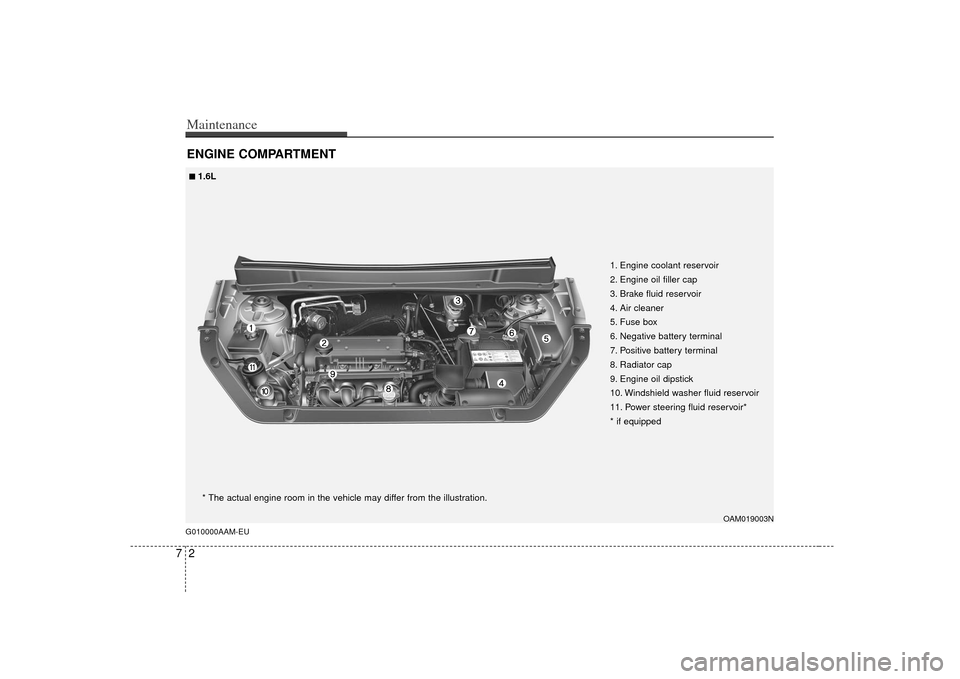
Maintenance27ENGINE COMPARTMENT G010000AAM-EU
OAM019003N
1. Engine coolant reservoir
2. Engine oil filler cap
3. Brake fluid reservoir
4. Air cleaner
5. Fuse box
6. Negative battery terminal
7. Positive battery terminal
8. Radiator cap
9. Engine oil dipstick
10. Windshield washer fluid reservoir
11. Power steering fluid reservoir*
* if equipped
* The actual engine room in the vehicle may differ from the illustration.
■ ■1.6L
Page 246 of 314
73
Maintenance
OAM079039N
1. Engine coolant reservoir
2. Engine oil filler cap
3. Brake fluid reservoir
4. Air cleaner
5. Fuse box
6. Negative battery terminal
7. Positive battery terminal
8. Automatic transaxle fluid dipstick*
9. Radiator cap
10. Engine oil dipstick
11. Windshield washer fluid reservoir
12. Power steering fluid reservoir*
* if equipped
■ ■2.0L* The actual engine room in the vehicle may differ from the illustration.
Page 249 of 314
Maintenance67G030102AAMWhile operating your vehicle: Note any changes in the sound of theexhaust or any smell of exhaust fumes
in the vehicle.
Check for vibrations in the steering wheel. Notice any increased steering
effort or looseness in the steering
wheel, or change in its straight-ahead
position.
Notice if your vehicle constantly turns slightly or “pulls” to one side when trav-
eling on smooth, level road.
When stopping, listen and check for unusual sounds, pulling to one side,
increased brake pedal travel or “hard-
to-push” brake pedal.
If any slipping or changes in the oper- ation of your transaxle occurs, check
the transaxle fluid level.
Check the automatic transaxle P (Park) function.
Check the parking brake.
Check for fluid leaks under your vehicle (water dripping from the air condition-
ing system during or after use is nor-
mal).
G030103AHMAt least monthly: Check the coolant level in the enginecoolant reservoir.
Check the operation of all exterior lights, including the stoplights, turn sig-
nals and hazard warning flashers.
Check the inflation pressures of all tires including the spare.G030104AHMAt least twice a year (i.e., every Spring and Fall): Check the radiator, heater and air con- ditioning hoses for leaks or damage.
Check the windshield washer spray and wiper operation. Clean the wiper
blades with clean cloth dampened with
washer fluid.
Check the headlight alignment.
Check the muffler, exhaust pipes, shields and clamps.
Check the lap/shoulder belts for wear and function.
Check for worn tires and loose wheel lug nuts.
G030105AHM-C1At least once a year: Clean the body and door drain holes.
Lubricate the door hinges and checks,and hood hinges.
Lubricate the door and hood locks and latches.
Lubricate the door rubber weather- strips.
Check the air conditioning system.
Check the power steering fluid level.
Inspect and lubricate the automatic transaxle linkage and controls.
Clean the battery and terminals.
Check the brake/clutch fluid level.
Page 252 of 314
79
Maintenance
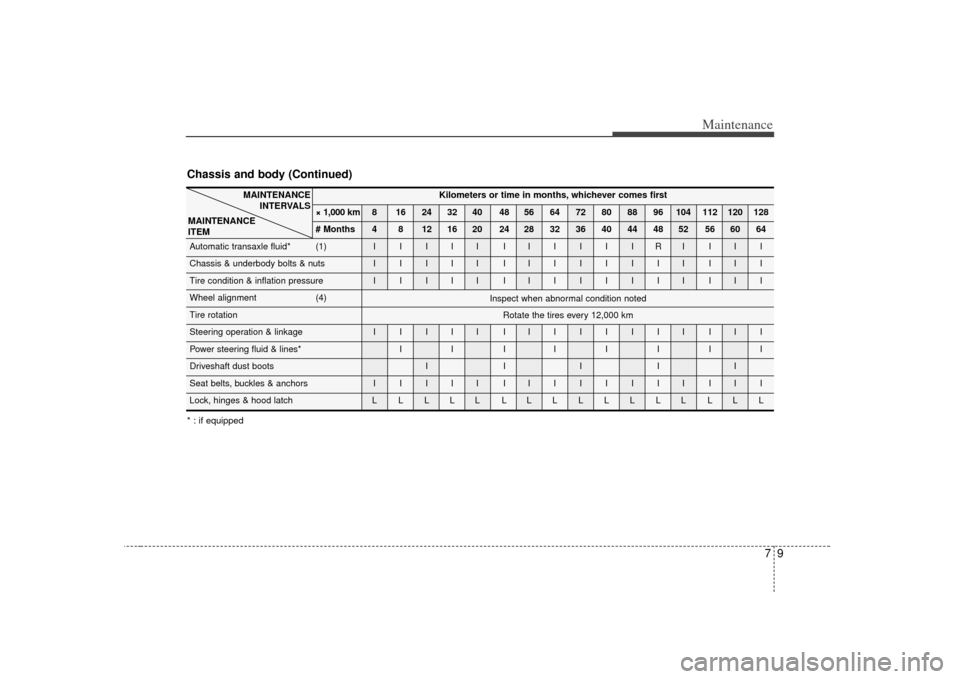
Chassis and body (Continued)
Kilometers or time in months, whichever comes first
× 1,000 km 8 16 24 32 40 48 56 64 72 80 88 96 104 112 120 128
# Months 4 8 12 16 20 24 28 32 36 40 44 48 52 56 60 64
Automatic transaxle fluid* (1) I I I I I I IIIIIRI III
Chassis & underbody bolts & nuts I I I I I I IIIIIII III
Tire condition & inflation pressure I I I I I I IIIIIII III
Wheel alignment (4)
Tire rotation
Steering operation & linkage I I I I I I IIIIIII III
Power steering fluid & lines* I I I IIIII
Driveshaft dust boots I I I I I
Seat belts, buckles & anchors I I I I I I IIIIIII III
Lock, hinges & hood latch L L L L L L LLLLLLL LLL
MAINTENANCE
INTERVALS
MAINTENANCE
ITEM
Inspect when abnormal condition noted
Rotate the tires every 12,000 km
* : if equipped
Page 256 of 314
713
Maintenance
G051800APARear brake drums and linings
(if equipped)Check the rear brake drums and linings
for scoring, burning, leaking fluid, broken
parts, and excessive wear.G052000AUNExhaust pipe and mufflerVisually inspect the exhaust pipes, muf-
fler and hangers for cracks, deterioration,
or damage. Start the engine and listen
carefully for any exhaust gas leakage.
Tighten connections or replace parts as
necessary.G052100AUNSuspension mounting boltsCheck the suspension connections for
looseness or damage. Retighten to the
specified torque.
G052200AUNSteering gear box, linkage &
boots/lower arm ball jointWith the vehicle stopped and engine off,
check for excessive free-play in the
steering wheel.
Check the linkage for bends or damage.
Check the dust boots and ball joints for
deterioration, cracks, or damage.
Replace any damaged parts.G052300AENPower steering pump, belt and
hoses (if equipped)Check the power steering pump and
hoses for leakage and damage. Replace
any damaged or leaking parts immedi-
ately. Inspect the power steering belt (or
drive belt) for evidence of cuts, cracks,
excessive wear, oiliness and proper ten-
sion. Replace or adjust it if necessary.
G052400AUNDrive shafts and bootsCheck the drive shafts, boots and clamps
for cracks, deterioration, or damage.
Replace any damaged parts and, if nec-
essary, repack the grease.G052500AUNAir conditioning refrigerant Check the air conditioning lines and con-
nections for leakage and damage.
Page 262 of 314
719
Maintenance
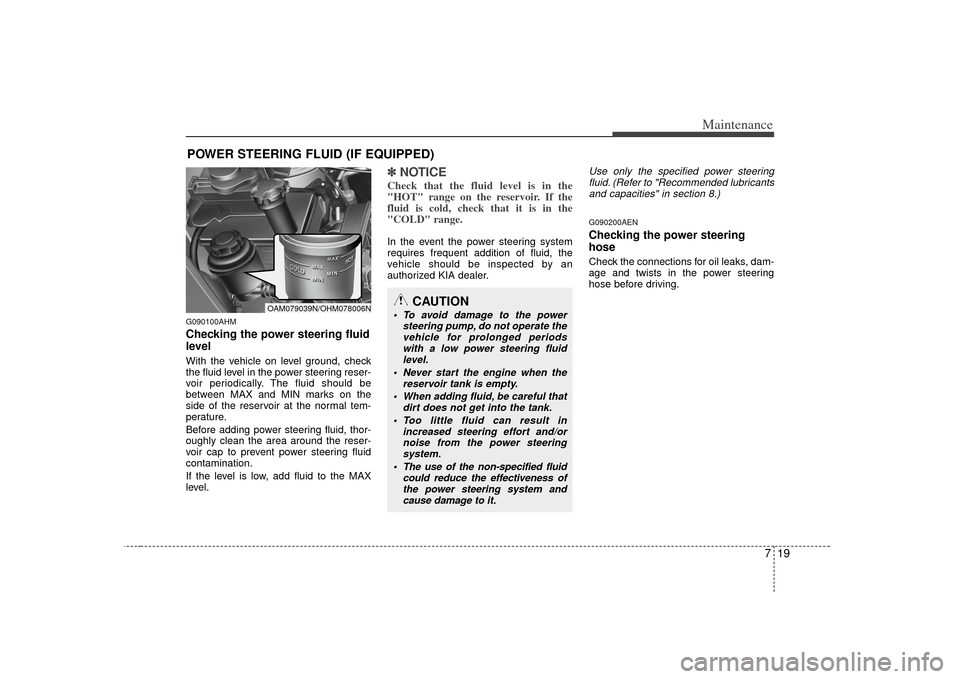
POWER STEERING FLUID (IF EQUIPPED)G090100AHMChecking the power steering fluid
level With the vehicle on level ground, check
the fluid level in the power steering reser-
voir periodically. The fluid should be
between MAX and MIN marks on the
side of the reservoir at the normal tem-
perature.
Before adding power steering fluid, thor-
oughly clean the area around the reser-
voir cap to prevent power steering fluid
contamination.
If the level is low, add fluid to the MAX
level.
✽ ✽NOTICECheck that the fluid level is in the
"HOT" range on the reservoir. If the
fluid is cold, check that it is in the
"COLD" range.In the event the power steering system
requires frequent addition of fluid, the
vehicle should be inspected by an
authorized KIA dealer.
Use only the specified power steering
fluid. (Refer to "Recommended lubricants and capacities" in section 8.)G090200AENChecking the power steering
hoseCheck the connections for oil leaks, dam-
age and twists in the power steering
hose before driving.
CAUTION
To avoid damage to the power steering pump, do not operate thevehicle for prolonged periods with a low power steering fluidlevel.
Never start the engine when the reservoir tank is empty.
When adding fluid, be careful that dirt does not get into the tank.
Too little fluid can result in increased steering effort and/ornoise from the power steeringsystem.
The use of the non-specified fluid could reduce the effectiveness ofthe power steering system andcause damage to it.
OAM079039N/OHM078006N
Page 292 of 314
749
Maintenance
Description Fuse ratingProtected component
ABS10AABS Control Module, ESC Control Module, ESC Switch, Steering Angle Sensor,
E/R Fuse & Relay Box (Multipurpose Check Connector)
IGN 1 10A Tire Pressure Monitoring Module, Multifunction Switch (Remocon), Audio
AUDIO 15A Audio
MEMORY 10A BCM, Instrument Cluster (IND.), A/C Control Module, Tire Pressure Monitoring Module,
Door Warning Switch, Overhead Console Assembly (Map Lamp), Center Room Lamp, Luggage Lamp
P/OUTLET. RR 15A Rear Power Outlet A/BAG 15A SRS Control Module, Weight Classification Module
IGN COIL 15A Condenser, Ignition Coil #1 ~ #4
T/SIG 10A Hazard Switch
CLUSTER 10A BCM, Instrument Cluster (IND.), A/C Control Module
ECU 10A ECM, PCM
START 10A E/R Fuse & Relay Box (Start Relay)
B/UP LP 10A Back-up Lamp Switch (M/T), Transaxle Range Switch (A/T), Cruise Control Module
A/BAG W/LP 10A Instrument Cluster (Air Bag IND.)
POWER
CONNECTOR
Page 307 of 314
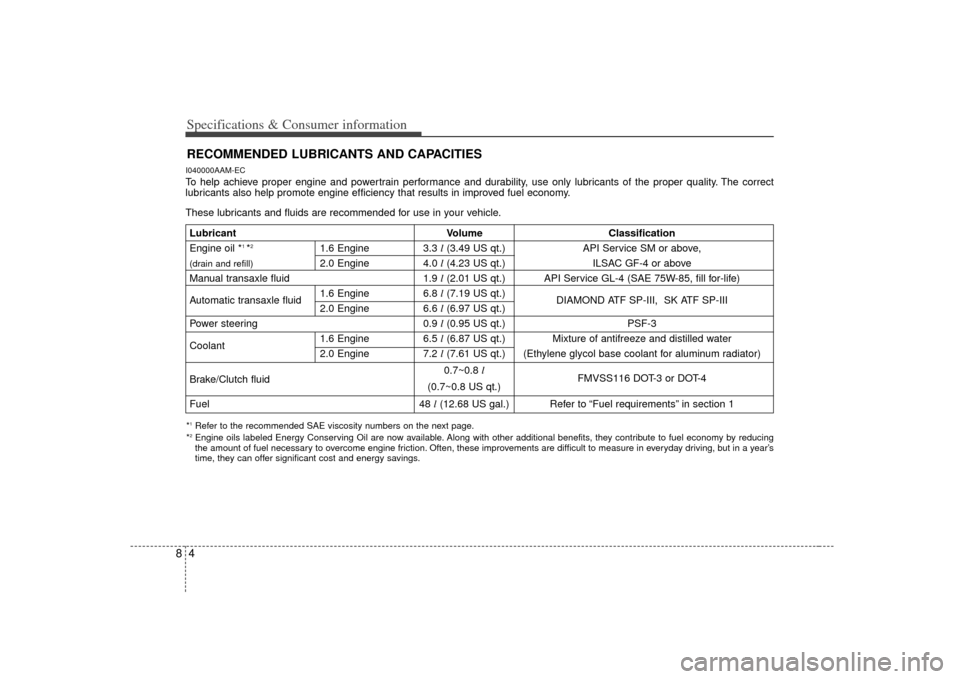
Specifications & Consumer information48RECOMMENDED LUBRICANTS AND CAPACITIESI040000AAM-ECTo help achieve proper engine and powertrain performance and durability, use only lubricants of the proper quality. The correct
lubricants also help promote engine efficiency that results in improved fuel economy.
These lubricants and fluids are recommended for use in your vehicle.*1Refer to the recommended SAE viscosity numbers on the next page.
*2Engine oils labeled Energy Conserving Oil are now available. Along with other additional benefits, they contribute to fuel econo my by reducing
the amount of fuel necessary to overcome engine friction. Often, these improvements are difficult to measure in everyday driving, but in a year’s
time, they can offer significant cost and energy savings.Lubricant Volume Classification
Engine oil *
1 *2
1.6 Engine 3.3 l (3.49 US qt.) API Service SM or above,
(drain and refill)
2.0 Engine4.0 l(4.23 US qt.) ILSAC GF-4 or above
Manual transaxle fluid 1.9 l(2.01 US qt.) API Service GL-4 (SAE 75W-85, fill for-life)
Automatic transaxle fluid 1.6 Engine 6.8 l
(7.19 US qt.)
DIAMOND ATF SP-III, SK ATF SP-III
2.0 Engine 6.6 l(6.97 US qt.)
Power steering 0.9 l(0.95 US qt.) PSF-3
1.6 Engine 6.5 l (6.87 US qt.) Mixture of antifreeze and distilled water
Coolant
2.0 Engine7.2 l(7.61 US qt.) (Ethylene glycol base coolant for aluminum radiator)
Brake/Clutch fluid 0.7~0.8
l
FMVSS116 DOT-3 or DOT-4
(0.7~0.8 US qt.)
Fuel 48 l(12.68 US gal.) Refer to “Fuel requirements” in section 1