2010 KIA Cerato Door
[x] Cancel search: DoorPage 8 of 321

15
Introduction
INDICATOR SYMBOLS ON THE INSTRUMENT CLUSTERA050000ATD-EC
Seat belt warning lightHigh beam indicatorTurn signal indicator
ABS warning light*Parking brake & Brake fluid
warning lightEngine oil pressure warning lightCharging system warning light
ESC indicator*ESC OFF indicator*
Malfunction indicator*Air bag warning light*Cruise indicator*Cruise SET indicator*
Low fuel level warning light
❈ For more detailed explanations, refer to “Instrument cluster” in section 4.
Door ajar warning lightTrunk lid open warning lightFront fog light indicator*
Engine coolant temperature
warning light*Electric power steering (EPS)
system warning light*Shift pattern indicator
* : if equipped ECO indicator*
ECO
Immobilizer indicator
Page 10 of 321
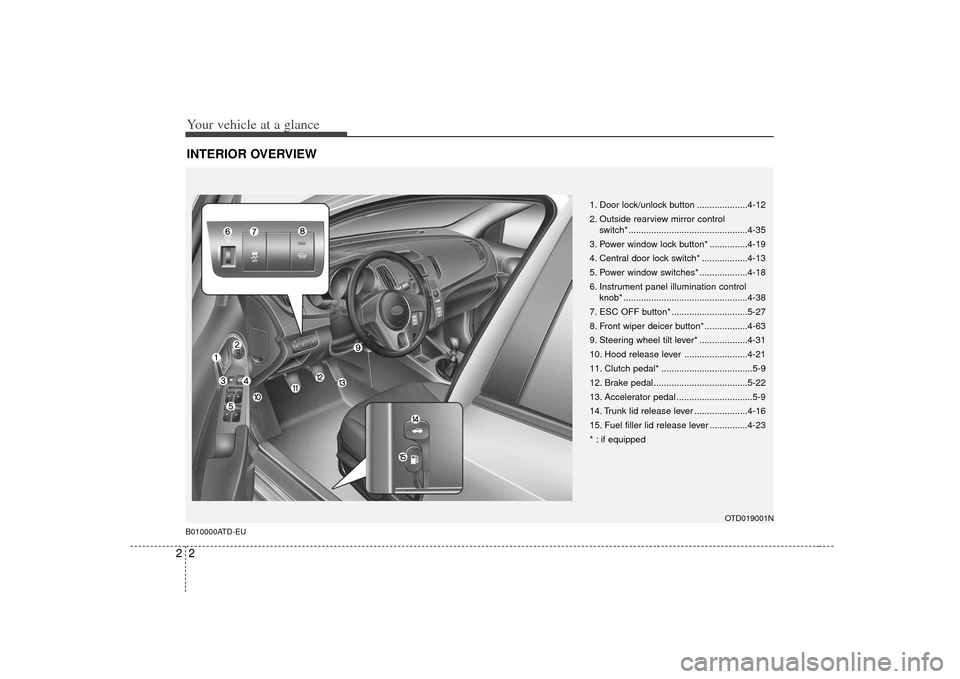
Your vehicle at a glance22INTERIOR OVERVIEWB010000ATD-EU
1. Door lock/unlock button ....................4-12
2. Outside rearview mirror control switch* ...............................................4-35
3. Power window lock button* ...............4-19
4. Central door lock switch* ..................4-13
5. Power window switches* ...................4-18
6. Instrument panel illumination control knob* .................................................4-38
7. ESC OFF button* ..............................5-27
8. Front wiper deicer button*.................4-63
9. Steering wheel tilt lever* ...................4-31
10. Hood release lever .........................4-21
11. Clutch pedal* ....................................5-9
12. Brake pedal .....................................5-22
13. Accelerator pedal ..............................5-9
14. Trunk lid release lever .....................4-16
15. Fuel filler lid release lever ...............4-23
* : if equipped
OTD019001N
Page 14 of 321

Safety features of your vehicle23C010000ATD-EU
Driver’s seat(1) Seat adjustment, forward / backward
(2)Seatback recliner
(3) Seat adjustment, height*
(4) Seat warmer switch*
(5) Headrest adjustmentFront passenger’s seat(6) Seat adjustment, forward / backward
(7) Seatback recliner
(8) Seat warmer switch*
(9) Walk-in seat (for 3door vehicle only)
(10) Headrest adjustmentRear seat(11) Armrest*
(12) Headrest adjustment*
(13) Seatback folding lever
* : if equipped
SEAT
OTDC039001N
Page 20 of 321

Safety features of your vehicle83✽
✽NOTICEWith the seat warmer switch in the ON
position, the heating system in the seat
turns off or on automatically depending
on the seat temperature.
C010110ATDRear seat entry
(for 3door vehicle only)The front passenger's seatback should
be tilted to enter the rear seat.
OTD039042N
CAUTION
When cleaning the seats, do not
use an organic solvent such asthinner, benzene, alcohol andgasoline. Doing so may damagethe surface of the heater or seats.
To prevent overheating the seat warmer, do not place blankets,cushions or seat covers on theseats while the seat warmer is inoperation.
Do not place heavy or sharp objects on seats equipped withseat warmers. Damage to the seatwarming components could occur.
WARNING
- Seat warmer burns
Passengers should use extreme
caution when using seat warmers
due to the possibility of excess
heating or burns. In particular, the
driver must exercise extreme care
for the following types of passen-
gers:
1. Infants, children, elderly or hand-
icapped persons, or hospital out-
patients
2. Persons with sensitive skin or those that burn easily
3. Fatigued individuals
4. Intoxicated individuals
5. Individuals taking medication that can cause drowsiness or
sleepiness (sleeping pills, cold
tablets, etc.)
Page 28 of 321

Safety features of your vehicle16
3C020102ATD-EUSeat belt - Driver's 3-point system
with emergency locking retractorTo fasten your seat belt:
To fasten your seat belt, pull it out of the
retractor and insert the metal tab (1) into
the buckle (2). There will be an audible
"click" when the tab locks into the buckle.
The seat belt automatically adjusts to the
proper length only after the lap belt por-
tion is adjusted manually so that it fits
snugly around your hips. If you lean for-
ward in a slow, easy motion, the belt will
extend and let you move around. If there
is a sudden stop or impact, however, the
belt will lock into position. It will also lock
if you try to lean forward too quickly.
✽ ✽ NOTICEIf you are not able to pull out the seat
belt from the retractor, firmly pull the
belt out and release it. Then you will be
able to pull the belt out smoothly.
Height adjustment (if equipped)
You can adjust the height of the shoulder
belt anchor to one of the 4 positions for
maximum comfort and safety.
The height of the adjusting seat belt
should not be too close to your neck. The
shoulder portion should be adjusted so
that it lies across your chest and midway
over your shoulder near the door and not
your neck.
To adjust the height of the seat belt
anchor, lower or raise the height adjuster
into an appropriate position.
B180A01NF
12
OMG035038
Page 29 of 321

317
Safety features of your vehicle
To raise the height adjuster, pull it up (1).
To lower it, push it down (3) while press-
ing the height adjuster button (2).
Release the button to lock the anchor
into position. Try sliding the height
adjuster to make sure that it has locked
into position.
C020106AUNSeat belts - Front passenger and rearseat 3-point system with combinationlocking retractorTo fasten your seat belt:
Combination retractor type seat belts are
installed in the rear seat positions to help
accommodate the installation of child
restraint systems. Although a combina-
tion retractor is also installed in the front
passenger seat position, it is strongly
recommended that children always be
seated in the rear seat. NEVER place
any infant restraint system in the front
seat of the vehicle.
This type of seat belt combines the fea-
tures of both an emergency locking
retractor seat belt and an automatic lock-
ing retractor seat belt. To fasten your seat
belt, pull it out of the retractor and insert
the metal tab into the buckle. There will
be an audible "click" when the tab locks
into the buckle. When not securing a
child restraint, the seat belt operates in
the same way as the driver's seat belt
(Emergency Locking Retractor Type). It
automatically adjusts to the proper length
only after the lap belt portion of the seat
belt is adjusted manually so that it fits
snugly around your hips.
WARNING
Verify the shoulder belt anchor is locked into position at the appro-
priate height. Never position the
shoulder belt across your neck or
face. Improperly positioned seat
belts can cause serious injuries
in an accident.
Failure to replace seat belts after an accident could leave you with
damaged seat belts that will not
provide protection in the event of
another collision leading to per-
sonal injury or death. Replace
your seat belts after being in an
accident as soon as possible.
B200A01NF
WARNING
You should place the lap belt por-
tion as low as possible and snugly
across your hips, not on your waist.
If the lap belt is located too high on
your waist, it may increase the
chance of injury in the event of a
collision. Both arms should not be
under or over the belt. Rather, one
should be over and the other under,
as shown in the illustration.
Never wear the seat belt under the
arm that is near the door.
Page 37 of 321

325
Safety features of your vehicle
C020400AENCare of seat beltsSeat belt systems should never be disas-
sembled or modified. In addition, care
should be taken to assure that seat belts
and belt hardware are not damaged by
seat hinges, doors or other abuse.
C020401AENPeriodic inspectionAll seat belts should be inspected peri-
odically for wear or damage of any kind.
Any damaged parts should be replaced
as soon as possible.C020402AUNKeep belts clean and drySeat belts should be kept clean and dry.
If belts become dirty, they can be
cleaned by using a mild soap solution
and warm water. Bleach, dye, strong
detergents or abrasives should not be
used because they may damage and
weaken the fabric.C020403ASAWhen to replace seat beltsThe entire in-use seat belt assembly or
assemblies should be replaced if the
vehicle has been involved in an accident.
This should be done even if no damage
is visible. Additional questions concern-
ing seat belt operation should be directed
to an authorized KIA dealer.
WARNING
When you return the rear seatback
to its upright position after the rear
seatback has been folded down, be
careful not to damage the seat belt
webbing or buckle. Be sure that the
webbing or buckle does not get
caught or pinched in the rear seat.
A seat belt with damaged webbing
or buckle could fail during a colli-
sion or sudden stop, resulting in
serious injury. If the webbing or
buckles are damaged, get them
replaced immediately.
Page 48 of 321

Safety features of your vehicle36
3C040902APBNoise and smokeWhen the air bags inflate, they make a
loud noise and they leave smoke and
powder in the air inside of the vehicle.
This is normal and is a result of the igni-
tion of the air bag inflator. After the air
bag inflates, you may feel substantial dis-
comfort in breathing due to the contact of
your chest to both the seat belt and the
air bag, as well as from breathing the
smoke and powder. Open your doors
and/or windows as soon as possible
after the impact in order to reduce dis-
comfort and prevent prolonged expo-
sure to smoke and powder.
Though smoke and powder are non-
toxic, it may cause irritation to the skin
(eyes, nose and throat etc). If this is the
case, wash and rinse with the cold water
immediately and consult the doctor if the
symptom persists.
C040903AUNInstalling a child restraint on a front passenger’s seat is forbiddenNever place a rear-facing child restraint
in the front passenger’s seat. If the air
bag deploys, it would impact the rear-fac-
ing child restraint, causing serious or
fatal injury.
In addition, do not place front-facing child
restraint in the front passenger’s seat
either. If the front passenger air bag
inflates, it would cause serious or fatal
injuries to the child.
1JBH3051
WARNING
When the air bags deploy, the air
bag related parts in the steering
wheel and/or instrument panel
and/or in both sides of the roof rails
above the front and rear doors are
very hot. To prevent injury, do not
touch the air bag storage area’s
internal components immediately
after an air bag has inflated.