Page 252 of 321

What to do in an emergency18
6F080301AUN-EUEmergency towing precautions Turn the ignition switch to ACC so the
steering wheel isn’t locked.
Place the transaxle shift lever in N (Neutral).
Release the parking brake.
Press the brake pedal with more force than normal since you will have
reduced brake performance.
More steering effort will be required because the power steering system
will be disabled.
If you are driving down a long hill, the brakes may overheat and brake per-
formance will be reduced. Stop often
and let the brakes cool off.
F080400ATDTie-down hook
(for flatbed towing, if equipped)
CAUTION
- Automatictransaxle
If the vehicle is being towed with
all four wheels on the ground, itcan be towed only from the front.Be sure that the transaxle is in neutral. Do not tow at speedsgreater than 40 km/h (25 mph) and for more than 25 km (15 miles). Besure the steering wheel is unlocked by placing the ignitionswitch in the ACC position. A driv-er must be in the towed vehicle to operate the steering wheel andbrakes.
Before towing, check the level of the automatic transaxle fluid. If itis below the "HOT" range on the dipstick, add fluid. If you cannotadd fluid, a towing dolly must be used.
WARNING
Do not use the tie-down hooks for
towing purposes. These hooks are
designed ONLY for transport tie-
down. If the tie-down hooks are
used for towing, the tie-down hooks
or front bumper will be damaged
and this could lead to serious
injury.
OTD069013N
Page 253 of 321
7
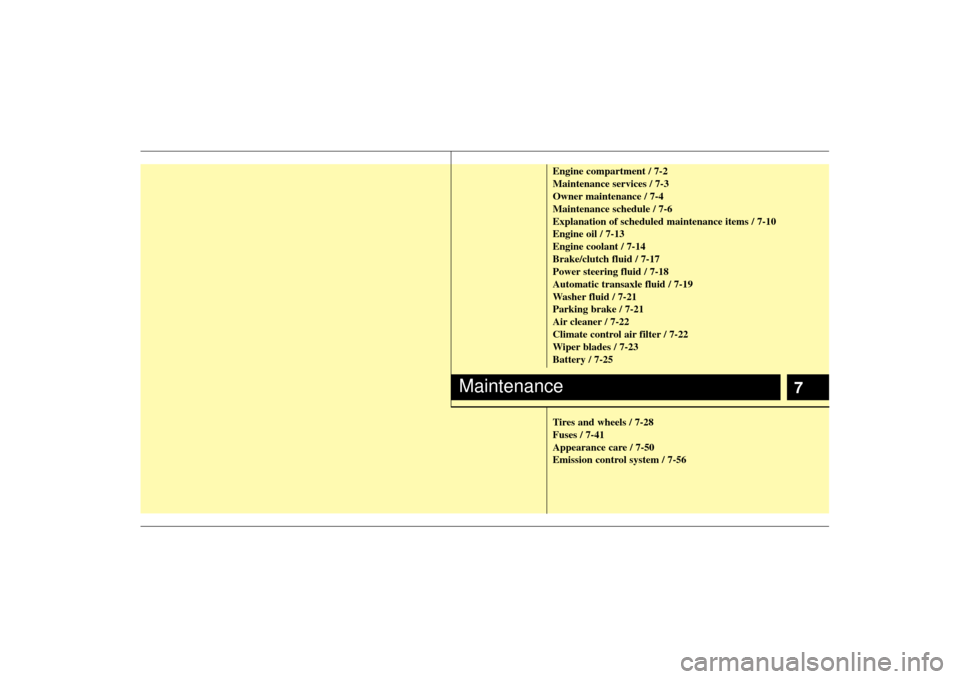
Engine compartment / 7-2
Maintenance services / 7-3
Owner maintenance / 7-4
Maintenance schedule / 7-6
Explanation of scheduled maintenance items / 7-10
Engine oil / 7-13
Engine coolant / 7-14
Brake/clutch fluid / 7-17
Power steering fluid / 7-18
Automatic transaxle fluid / 7-19
Washer fluid / 7-21
Parking brake / 7-21
Air cleaner / 7-22
Climate control air filter / 7-22
Wiper blades / 7-23
Battery / 7-25
Tires and wheels / 7-28
Fuses / 7-41
Appearance care / 7-50
Emission control system / 7-56
Maintenance
Page 254 of 321
Maintenance27ENGINE COMPARTMENT
1. Engine coolant reservoir
2. Engine oil filler cap
3. Brake/clutch* fluid reservoir
4. Air cleaner
5. Fuse box
6. Positive battery terminal
7. Negative battery terminal
8. Windshield washer fluid reservoir
9. Radiator cap
10. Engine oil dipstick
11. Automatic transaxle dipstick*
12. Power steering fluid reservoir*
* : if equipped
OTD079055N
B010000ATD
* The actual engine room in the vehicle may differ from the illustration.
Page 257 of 321

75
Maintenance
G030102ATDWhile operating your vehicle: Note any changes in the sound of theexhaust or any smell of exhaust fumes
in the vehicle.
Check for vibrations in the steering wheel. Notice any increased steering
effort or looseness in the steering
wheel, or change in its straight-ahead
position.
Notice if your vehicle constantly turns slightly or “pulls” to one side when trav-
eling on smooth, level road.
When stopping, listen and check for unusual sounds, pulling to one side,
increased brake pedal travel or “hard-
to-push” brake pedal.
If any slipping or changes in the oper- ation of your transaxle occurs, check
the transaxle fluid level.
Check the automatic transaxle P (Park) function.
Check the parking brake.
Check for fluid leaks under your vehicle (water dripping from the air condition-
ing system during or after use is nor-
mal).
G030103AHMAt least monthly: Check the coolant level in the enginecoolant reservoir.
Check the operation of all exterior lights, including the stoplights, turn sig-
nals and hazard warning flashers.
Check the inflation pressures of all tires including the spare.G030104AHMAt least twice a year (i.e., every Spring and Fall) : Check the radiator, heater and air con- ditioning hoses for leaks or damage.
Check the windshield washer spray and wiper operation. Clean the wiper
blades with clean cloth dampened with
washer fluid.
Check the headlight alignment.
Check the muffler, exhaust pipes, shields and clamps.
Check the lap/shoulder belts for wear and function.
Check for worn tires and loose wheel lug nuts.
G030105ATD At least once a year : Clean the body and door drain holes.
Lubricate the door hinges and checks,and hood hinges.
Lubricate the door and hood locks and latches.
Lubricate the door rubber weather- strips.
Check the air conditioning system.
Check the power steering fluid level.
Inspect and lubricate automatic transaxle linkage and controls.
Clean the battery and terminals.
Check the brake/clutch fluid level.
Page 260 of 321
Maintenance87Chassis and body (Continued)
Kilometers or time in months, whichever comes first
× 1,000 km 8 16 24 32 40 48 56 64 72 80 88 96 104 112 120 128
# Months 4 8 12 16 20 24 28 32 36 40 44 48 52 56 60 64
Automatic transaxle fluid* (1) I I I I I I IIIIIRI III
Chassis & underbody bolts & nuts I I I I I I IIIIIII III
Tire condition & inflation pressure I I I I I I IIIIIII III
Wheel alignment (4)
Tire rotation
Steering operation & linkage I I I I I I IIIIIII III
Power steering fluid & lines* I I I IIIII
Driveshaft dust boots I I I I I
Seat belts, buckles & anchors I I I I I I IIIIIII III
Lock, hinges & hood latch L L L L L L LLLLLLL LLL
MAINTENANCE
INTERVALS
MAINTENANCE
ITEM
Inspect when abnormal condition noted
Rotate the tires every 12,000 km
* : if equipped
Page 263 of 321

711
Maintenance
G050800AUNAir cleaner filterA Genuine KIA air cleaner filter is recom-
mended when the filter is replaced.G050900AUNSpark plugs Make sure to install new spark plugs of
the correct heat range.G051000AHMValve clearance (if equipped)Inspect for excessive valve noise and/or
engine vibration and adjust if necessary.
An authorized KIA dealer should perform
the operation.G051100AHMCooling systemCheck the cooling system components,
such as the radiator, coolant reservoir,
hoses and connections for leakage and
damage. Replace any damaged parts.
G051200AUNCoolantThe coolant should be changed at the
intervals specified in the maintenance
schedule.G051300AUNManual transaxle fluid
(if equipped)Inspect the manual transaxle fluid
according to the maintenance schedule.G051400AUNAutomatic transaxle fluid
(if equipped)The fluid level should be in the "HOT"
range of the dipstick, after the engine
and transaxle are at normal operating
temperature. Check the automatic
transaxle fluid level with the engine run-
ning and the transaxle in neutral, with the
parking brake properly applied.
G051500AUNBrake hoses and linesVisually check for proper installation,
chafing, cracks, deterioration and any
leakage. Replace any deteriorated or
damaged parts immediately.G051600AAMBrake/Clutch (if equipped) fluid Check the brake fluid level in the brake
fluid reservoir. The level should be
between “MIN” and “MAX” marks on the
side of the reservoir. Use only hydraulic
brake fluid conforming to DOT 3 or DOT
4 specification.G051700ATDParking brakeInspect the parking brake system includ-
ing the parking brake lever and cables.
Page 271 of 321

719
Maintenance
AUTOMATIC TRANSAXLE FLUID (IF EQUIPPED)G100100AFD-EUChecking the automatic transaxle
fluid level The automatic transaxle fluid level
should be checked regularly.
Keep the vehicle on the level ground with
the parking brake applied and check the
fluid level according to the following pro-
cedure.
1. Place the shift lever in N (Neutral)position and confirm the engine is run-
ning at normal idle speed.
2. After the transaxle is warmed up suffi- ciently (fluid temperature 70~80°C
(158~176°F), for example by 10 min-
utes usual driving, move the shift lever
through all positions then place the
shift lever in N (Neutral) or P (Park)
position. 3. Confirm that the fluid level is in the
“HOT” range on the level gauge. If the
fluid level is lower, add the specified
fluid in the fill hole. If the fluid level is
higher, drain the fluid from the drain
hole. 4. If the fluid level is checked in cold con-
dition (fluid temperature 20~30°C
(68~86°F) add the fluid to “C” (COLD)
line and then recheck the fluid level
according to the above step 2.
✽ ✽NOTICE“C” (COLD) range is for reference only
and should NOT be used to determine
the transaxle fluid level.
OTD079010
OTD079038OSA077009
■ Type A■ Type B
HOT
COLD
WARNING -
Transaxle fluid
The transaxle fluid level should be
checked when the engine is at nor-
mal operating temperature. This
means that the engine, radiator,
radiator hose and exhaust system
etc., are very hot. Exercise great
care not to burn yourself during
this procedure.
Page 272 of 321

Maintenance20
7
✽
✽
NOTICEA new automatic transaxle fluid should
be red. The red dye is added so the
assembly plant can identify it as auto-
matic transaxle fluid and distinguish it
from engine oil or antifreeze. The red
dye, which is not an indicator of fluid
quality, is not permanent. As the vehicle
is driven, the automatic transaxle fluid
will begin to look darker. The color may
eventually appear light brown.
Therefore, have an authorized KIA
dealer change the automatic transaxle
fluid according to the Scheduled
Maintenance at the beginning of this
section.Use only the specified automatic
transaxle fluid. (Refer to “Recommended
lubricants and capacities” in section 8.)
G100200ATDChanging the automatic transaxle
fluidHave the automatic transaxle fluid
changed by an authorized KIA dealer
according to the Maintenance Schedule
at the beginning of this section.
WARNING
- Parking brake
To avoid sudden movement of the
vehicle, apply the parking brake
and depress the brake pedal before
moving the shift lever.
CAUTION
Low fluid level causes transaxle
slippage. Overfilling can causefoaming, loss of fluid and transaxle malfunction.
The use of a non-specified fluid could result in transaxle malfunc-tion and failure.