Page 217 of 554
5. Before unzipping the rear window, release the first 3 in
(7.6 cm) of both sail panels from the channel. Remove the
swing gate bar by pulling it straight rearward out of the
swing gate brackets.•Unzip the rear window starting at the right lower
corner of the window. Pull the zipper up, across the
top and down to the left lower corner.Zipper pulls
will stay on the rear window. Pull down on the rear
window to disengage it from the zipper on the top
cover. Stow the windows carefully to avoid scratch-
ing.
216 UNDERSTANDING THE FEATURES OF YOUR VEHICLE
Page 219 of 554
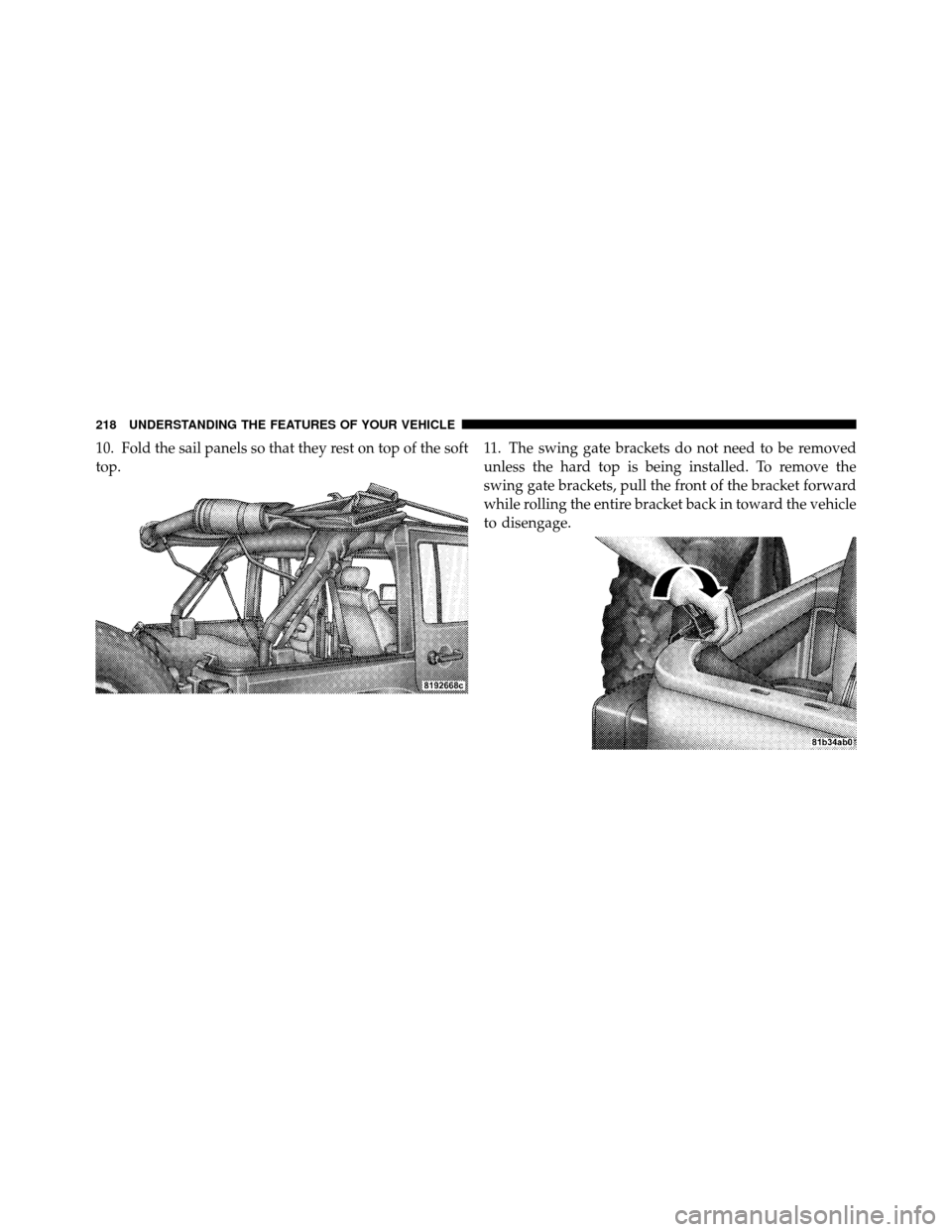
10. Fold the sail panels so that they rest on top of the soft
top.11. The swing gate brackets do not need to be removed
unless the hard top is being installed. To remove the
swing gate brackets, pull the front of the bracket forward
while rolling the entire bracket back in toward the vehicle
to disengage.
218 UNDERSTANDING THE FEATURES OF YOUR VEHICLE
Page 227 of 554
11. Ensure that the straps are positioned correctly before
pulling the sail panels over the rear roof bow (4–bow).Partially install the sail panel retainers into the body side
channel, leaving the last 3 in (7.6 cm) toward the rear
window loose (on both sides). Pulling down on the rear
roof bow (4–bow) will aid in reaching the channel with
the retainers.
226 UNDERSTANDING THE FEATURES OF YOUR VEHICLE
Page 248 of 554

7. Seat Belt Reminder LightA warning chime and an indicator light will alert
you to buckle the seat belts. When the belt is
buckled, the chime will stop, but the light will stay
on for about six seconds, until it times out. Refer to
“Occupant Restraints” in “Things To Know Before Start-
ing Your Vehicle” for further information.
8. Turn Signal Indicators The arrows will flash with the exterior turn signals
when the turn signal lever is operated. A tone will
chime if the turn signals are left on for more than 1 mile
(1.6 km).
9. Oil Pressure Warning Light This light indicates low engine oil pressure. The
light should turn on momentarily when the engine
is started, if the bulb does not come on, have the system
checked by an authorized dealer. If the light turns on while driving, stop the vehicle and shut off the engine as
soon as possible. A chime will sound when this light
turns on.
Do not operate the vehicle until the cause is corrected.
This light does not indicate how much oil is in the engine.
The engine oil level must be checked under the hood.
10. High Beam Indicator
This indicator shows that the high beam head-
lights are on. Push the multifunction control lever
away from you to switch the headlights to high beam.
Pull the lever towards you to switch the headlights back
to low beam. If the driver’s door is open, and the
headlights or park lights are left on, the high beam
indicator light will remain illuminated and a chime will
sound.
4
UNDERSTANDING YOUR INSTRUMENT PANEL 247
Page 252 of 554

18. Temperature Gauge
The temperature gauge shows engine coolant tempera-
ture. Any reading within the normal range indicates that
the engine cooling system is operating satisfactorily.
The gauge pointer will likely indicate a higher tempera-
ture when driving in hot weather, up mountain grades,
or when towing a trailer. It should not be allowed to
exceed the upper limits of the normal operating range.
CAUTION!
Driving with a hot engine cooling system could
damage your vehicle. If temperature gauge reads “H”
pull over and stop the vehicle. Idle the vehicle with
the air conditioner turned off until the pointer drops
back into the normal range. If the pointer remains on
the “H” and you hear continuous chimes, turn the
engine off immediately, and call an authorized deal-
ership for service.
WARNING!
A hot engine cooling system is dangerous. You or
others could be badly burned by steam or boiling
coolant. You may want to call an authorized dealer-
ship for service if your vehicle overheats. If you
decide to look under the hood yourself, see “Main-
taining Your Vehicle”. Follow the warnings under the
Cooling System Pressure Cap paragraph.
19. Cruise Indicator This indicator shows when the electronic speed
control system is turned on.
20. 4WD Indicator Light — If Equipped This light alerts the driver that the vehicle is in
the four-wheel drive mode, and the front and
rear driveshafts are mechanically locked to-
gether forcing the front and rear wheels to
rotate at the same speed.
4
UNDERSTANDING YOUR INSTRUMENT PANEL 251
Page 256 of 554

The ECO display will toggle between ECO and ECO-ON
depending on driving habits and vehicle usage. Press the
Odometer / Trip Odometer / ECO (Fuel Saver Indicator)
button to change the display from odometer to either of
the two trip odometer settings or the “ECO” display.
LoW tirE
When the appropriate condition exists, the odometer
display will toggle between LoW and tirE for three
cycles.
“HOTOIL” Transmission Temperature Warning
Message
The “HOTOIL” cluster message will appear in the odom-
eter accompanied with a chime to indicate that there is
excessive transmission fluid temperature that might oc-
cur with severe usage such as trailer towing. It may also
occur when operating the vehicle in a high torque
converter slip condition, such as 4-wheel drive operation(e.g., snow plowing, off- road operation). If this “HOT-
OIL” message turns on, stop the vehicle and run the
engine at idle or faster, with the transmission in NEU-
TRAL until the message turns off.
CAUTION!
Continuous driving with the Transmission Tempera-
ture “HOTOIL” Warning message illuminated will
eventually cause severe transmission damage or
transmission failure.
WARNING!
Continued operation with the Transmission Tem-
perature “HOTOIL” Warning message illuminated
could cause the fluid to boil over, come in contact
with hot engine or exhaust components causing a fire
that may result in personal injury.
4
UNDERSTANDING YOUR INSTRUMENT PANEL 255
Page 258 of 554

1. Turn the ignition switch to the ON position (Do not
start the engine).
2. Fully depress the accelerator pedal slowly three
times within 10 seconds.
3. Turn the ignition switch to the OFF/LOCK position.
NOTE: If the indicator message illuminates when you
start the vehicle, the oil change indicator system did not
reset. If necessary repeat this procedure.
25. Malfunction Indicator Light (MIL) The Malfunction Indicator Light (MIL) is a part of
an Onboard Diagnostic System called OBD II that
monitors engine and automatic transmission con-
trol systems. The light will illuminate when the ignition
is in the ON position, before engine start. If the bulb does
not come on when turning the key from OFF to ON, have
the condition checked promptly. Certain conditions such as a loose or missing gas cap,
poor quality fuel, etc. may illuminate the light after
engine start. The vehicle should be serviced if the light
stays on through several typical driving styles. In most
situations, the vehicle will drive normally and will not
require towing.
When the engine is running, the MIL may flash to alert
serious conditions that could lead to immediate loss of
power or severe catalytic converter damage. The vehicle
should be serviced as soon as possible if this occurs.
CAUTION!
Prolonged driving with the MIL on could cause
damage to the engine control system. It also could
affect fuel economy and drivability. If the MIL is
flashing, severe catalytic converter damage and
power loss will soon occur. Immediate service is
required.
4
UNDERSTANDING YOUR INSTRUMENT PANEL 257
Page 261 of 554

WARNING!
If a warning light remains on the system may not be
working and you will not have the benefit of ESP or
BAS. Under certain driving conditions, where ESP or
BAS would be beneficial, you - if you have not
adjusted your driving speeds and stopping in or to
account for the lack of the feature, may be in acci-
dent.
30. Electronic Throttle Control (ETC) Light This light informs you of a problem with the
Electronic Throttle Control (ETC) system. If a
problem is detected while the engine is run-
ning, the light will either stay on or flash
depending on the nature of the problem. Cycle the
ignition key when the vehicle is safely and completely
stopped and the shift lever is placed in the PARK
position. The light should turn off. If the light remains on with the engine running, your vehicle will usually be
drivable; however, see an authorized dealer for service as
soon as possible.
If the light continues to flash when the engine is running,
immediate service is required and you may experience
reduced performance, an elevated/rough idle, or engine
stall and your vehicle may require towing. The light will
come on when the ignition is first turned ON and remain
on briefly as a bulb check. If the light does not come on
during starting, have the system checked by an autho-
rized dealer.
31. Compass / Mini-Trip Computer Display — If
Equipped
When the appropriate conditions exist, this display
shows the Mini-Trip Computer messages. Refer to “Mini-
Trip Computer”.
260 UNDERSTANDING YOUR INSTRUMENT PANEL