2010 JEEP LIBERTY airbag
[x] Cancel search: airbagPage 76 of 522
1. Used for research purposes, such as to match data
with a particular crash record in an aggregate database,
provided confidentiality of personal data is thereafter
preserved.
2. Used in defense of litigation involving a Chrysler
Group LLC product.
3. Requested by police under a legal warrant.
4. Otherwise required by law.
Data parameters that are recorded:
•Diagnostic trouble code(s) and warning light status for
electronically-controlled safety systems, including the
airbag system
•Vehicle speed
•Engine RPM
•Brake switch status
•Pedal position
•And other parameters depending on vehicle
configuration
Child Restraint
Everyone in your vehicle needs to be buckled up all the
time, including babies and children. Every state in the
United States and all Canadian provinces require that
small children ride in proper restraint systems. This is the
law, and you can be prosecuted for ignoring it.
Children 12 years and younger should ride properly
buckled up in a rear seat, if available. According to crash
statistics, children are safer when properly restrained in
the rear seats rather than in the front.
2
THINGS TO KNOW BEFORE STARTING YOUR VEHICLE 75
Page 78 of 522
“LATCH — Child Seat Anchorage System (Lower
Anchors and Tether for CHildren)” in this section.
•Rearward-facing child seats mustNEVERbe used in
the front seat of a vehicle with the front passenger
airbag unless the airbag is turned off. An airbag
deployment could cause severe injury or death to
infants in this position.
Older Children and Child Restraints
Children who weigh more than 20 lbs (9 kg) and who are
older than one year can ride forward-facing in the
vehicle. Forward-facing child seats and convertible child
seats used in the forward-facing direction are for children
who weigh 20 to 40 lbs (9 to 18 kg) and who are older
than one year. These child seats are also held in the
vehicle by the lap/shoulder belt or the LATCH child
restraint anchorage system. Refer to “LATCH — Child
Seat Anchorage System (Lower Anchors and Tether for
CHildren)” in this section.
The belt-positioning booster seat is for children weighing
more than 40 lbs (18 kg), but who are still too small to fit
the vehicle’s seat belts properly. If the child cannot sit
with knees bent over the vehicle’s seat cushion while the
child’s back is against the seatback, they should use a
belt-positioning booster seat. The child and belt-
positioning booster seat are held in the vehicle by the
lap/shoulder belt.
Children Too Large for Booster Seats
Children who are large enough to wear the shoulder belt
comfortably, and whose legs are long enough to bend
over the front of the seat when their back is against the
seat back, should use the lap/shoulder belt in a rear seat.
•Make sure that the child is upright in the seat.
•The lap portion of the seat belt should be low on the
hips and as snug as possible.
2
THINGS TO KNOW BEFORE STARTING YOUR VEHICLE 77
Page 79 of 522
•Check belt fit periodically. A child’s squirming or
slouching can move the belt out of position.
•If the shoulder belt contacts the face or neck, move the
child closer to the center of the vehicle. Never allow a
child to put the shoulder belt under an arm or behind
their back.
NOTE: For additional information, refer to
www.seatcheck.org or call 1–866–SEATCHECK. Cana-
dian residents, should refer to Transport Canada’s web-
site for additional information. http://www.tc.gc.ca/
roadsafety/safedrivers/childsafety/index.htm
WARNING!
•Improper installation can lead to failure of an
infant or child restraint. It could come loose in a
collision. The child could be badly injured or
killed. Follow the manufacturer’s directions ex-
actly when installing an infant or child restraint.
•A rearward- facing infant restraint should only be
used in a rear seat. A rearward-facing infant re-
straint in the front seat may be struck by a deploy-
ing passenger airbag, which may cause severe or
fatal injury to the infant.
78 THINGS TO KNOW BEFORE STARTING YOUR VEHICLE
Page 85 of 522
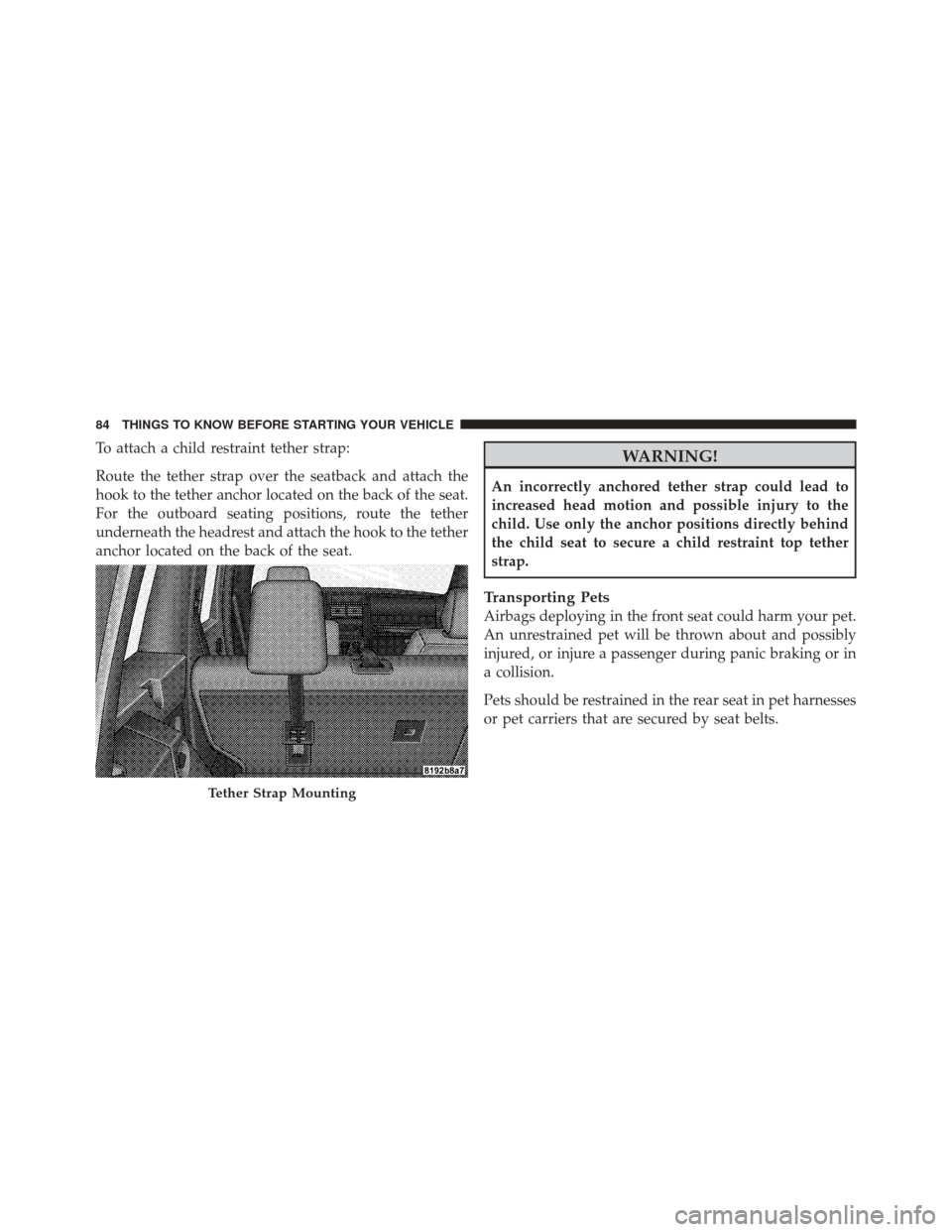
To attach a child restraint tether strap:
Route the tether strap over the seatback and attach the
hook to the tether anchor located on the back of the seat.
For the outboard seating positions, route the tether
underneath the headrest and attach the hook to the tether
anchor located on the back of the seat.WARNING!
An incorrectly anchored tether strap could lead to
increased head motion and possible injury to the
child. Use only the anchor positions directly behind
the child seat to secure a child restraint top tether
strap.
Transporting Pets
Airbags deploying in the front seat could harm your pet.
An unrestrained pet will be thrown about and possibly
injured, or injure a passenger during panic braking or in
a collision.
Pets should be restrained in the rear seat in pet harnesses
or pet carriers that are secured by seat belts.
Tether Strap Mounting
84 THINGS TO KNOW BEFORE STARTING YOUR VEHICLE
Page 88 of 522
damaged, have a competent mechanic inspect the com-
plete exhaust system and adjacent body areas for broken,
damaged, deteriorated, or mispositioned parts. Open
seams or loose connections could permit exhaust fumes
to seep into the passenger compartment. In addition,
inspect the exhaust system each time the vehicle is raised
for lubrication or oil change. Replace as required.
Safety Checks You Should Make Inside the
Vehicle
Seat Belts
Inspect the belt system periodically, checking for cuts,
frays, and loose parts. Damaged parts must be replaced
immediately. Do not disassemble or modify the system.
Front seat belt assemblies must be replaced after a
collision. Rear seat belt assemblies must be replaced after
a collision if they have been damaged (i.e., bent retractor,
torn webbing, etc.). If there is any question regarding belt
or retractor condition, replace the belt.
Airbag Warning Light
The light should come on and remain on for six to eight
seconds as a bulb check when the ignition switch is first
turned ON. If the light is not lit during starting, see your
authorized dealer. If the light stays on, flickers, or comes
on while driving, have the system checked by an autho-
rized dealer.
Defroster
Check operation by selecting the defrost mode and place
the blower control on high speed. You should be able to
feel the air directed against the windshield. See your
authorized dealer for service if your defroster is
inoperable.
2
THINGS TO KNOW BEFORE STARTING YOUR VEHICLE 87
Page 223 of 522
If brake failure is indicated, immediate repair is neces-
sary.
WARNING!
Driving a vehicle with the red brake light on is
dangerous. Part of the brake system may have failed.
It will take longer to stop the vehicle. You could have
an accident. Have the vehicle checked immediately.
Vehicles equipped with the Anti-Lock Brake System
(ABS), are also equipped with Electronic Brake Force
Distribution (EBD). In the event of an EBD failure, the
Brake Warning Light will turn on along with the ABS
Light. Immediate repair to the ABS system is required.
Operation of the Brake Warning Light can be checked by
turning the ignition switch from the OFF position to the
ON position. The light should illuminate for approxi-
mately two seconds. The light should then turn off unless the parking brake is applied or a brake fault is detected.
If the light does not illuminate, have the light inspected
by an authorized dealer.
The light also will turn on when the parking brake is
applied with the ignition switch in the ON position.
NOTE:
This light shows only that the parking brake is
applied. It does not show the degree of brake application.
32. Vehicle Security Light — If Equipped This light will flash rapidly for approximately
16 seconds when the vehicle security system is
arming and then flash slowly when the system
is armed. The light will also turn on for about
three seconds when the ignition is first turned ON.
33. Airbag Warning Light This light turns on and remains on for six to
eight seconds as a bulb check when the ignition
switch is first turned ON. If the light does not
222 UNDERSTANDING YOUR INSTRUMENT PANEL
Page 501 of 522
About Your Brakes....................... 327
ABS (Anti-Lock Brake System) ............329,332
Adding Engine Coolant (Antifreeze) .......... 437
Adding Fuel ........................... 378
Additives, Fuel ......................... 375
Air Cleaner, Engine (Engine Air Cleaner Filter) . . . 427
Air Conditioner Maintenance ............... 429
Air Conditioning ........................ 281
Air Conditioning Controls ................. 281
Air Conditioning Filter .................293,430
Air Conditioning, Operating Tips ............ 294
Air Conditioning Refrigerant .............429,430
Air Conditioning System .............281,285,429
Air Filter .............................. 427
Air Pressure, Tires ....................... 353
Airbag ................................ 56
Airbag Deployment ....................... 70
Airbag Light ....................... 73,87,222
Airbag Maintenance ....................... 72 Airbag, Window (Side Curtain)
............... 60
Alarm, Panic ............................ 24
Alarm (Security Alarm) .................17,222
Alarm System (Security Alarm) ............... 17
Alterations/Modifications, Vehicle ............. 8
Antenna, Satellite Radio ................... 275
Antifreeze (Engine Coolant) ...........436,437,465
Disposal ............................ 439
Anti-Lock Brake System (ABS) ............329,332
Anti-Lock Warning Light .................. 213
Anti-Theft Security Alarm (Theft Alarm) ........ 17
Anti-Theft System ....................... 222
Appearance Care ........................ 448
Arming Theft System (Security Alarm) ......... 17
Assist, Hill Start ........................ 334
Assistance Towing ....................... 112
Auto Down Power Windows ................ 35
Auto Unlock, Doors ....................... 31
Automatic Dimming Mirror ................. 94
500 INDEX
Page 510 of 522
Introduction............................. 4
Jack Location ........................... 406
Jack Operation ....................... 405,408
Jacking Instructions ...................... 408
Jump Starting .......................... 412
Key, Programming ........................ 16
Key, Replacement ........................ 15
Key, Sentry (Immobilizer) ................... 14
Key-In Reminder ......................... 14
Keyless Entry System ...................... 19
Keys ................................. 12
Lane Change and Turn Signals .............. 152
Lane Change Assist ...................... 153
Lap/Shoulder Belts ....................... 42
LATCH
(Lower Anchors and Tether for CHildren) .....79,80 Latches
................................ 88
Hood .............................. 146
Lead Free Gasoline ...................... 373
Leaks, Fluid ............................ 88
Life of Tires ............................ 358
Liftgate ................................ 38
Liftgate Flipper Glass ...................... 39
Light Bulbs .......................... 88,461
Lights .............................. 88,148
Airbag .......................... 73,87,222
Anti-Lock ........................... 213
Automatic Headlights ................... 149
Back-Up ............................ 464
Battery Saver ......................... 154
Brake Warning ........................ 221
Bulb Replacement ...................... 461
Cargo .............................. 154
Cruise .............................. 220
Daytime Running ...................... 151
10
INDEX 509