Page 412 of 522
WARNING!
Raising the vehicle higher than necessary can make
the vehicle less stable and cause an accident. It could
slip off the jack and hurt someone near it. Raise the
vehicle only enough to remove the tire.
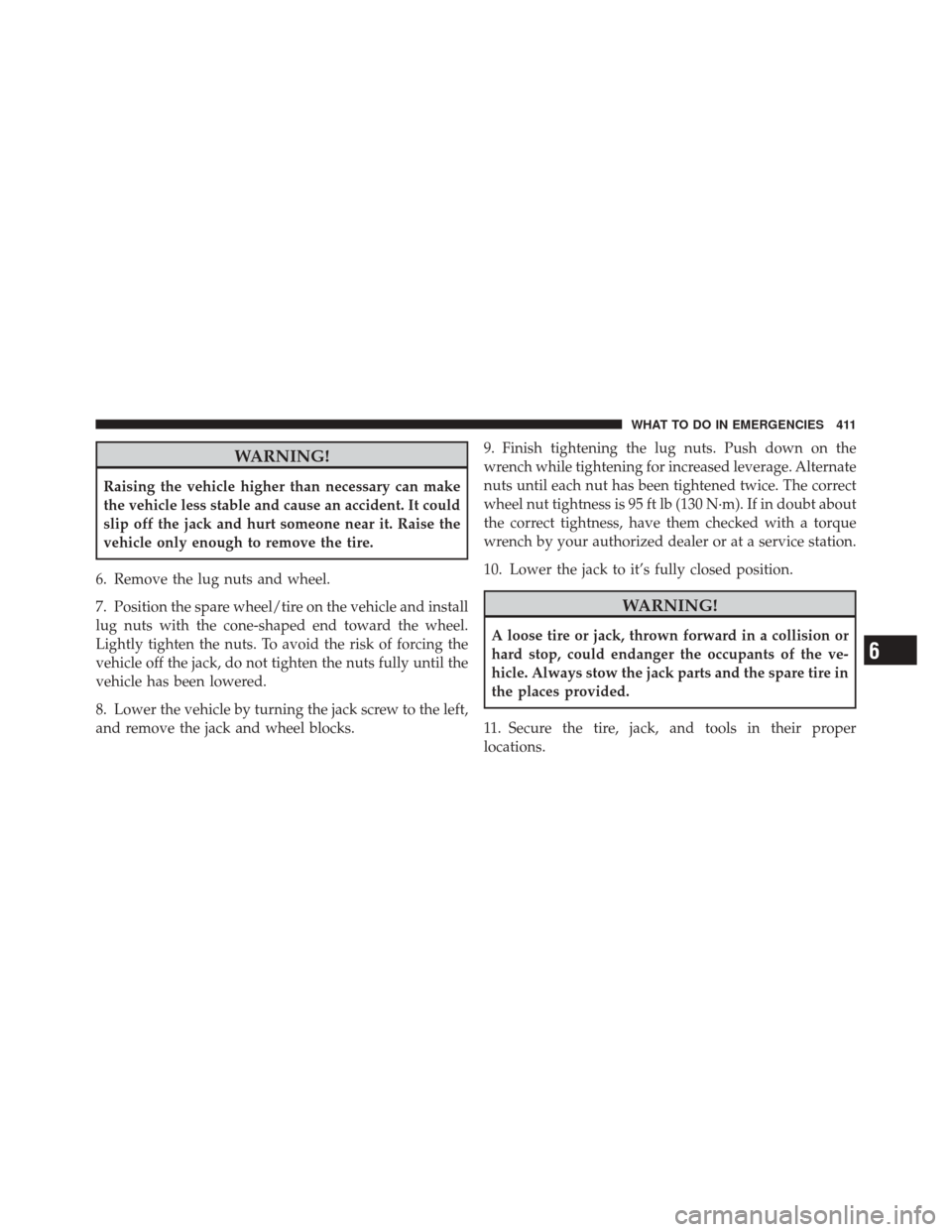
6. Remove the lug nuts and wheel.
7. Position the spare wheel/tire on the vehicle and install
lug nuts with the cone-shaped end toward the wheel.
Lightly tighten the nuts. To avoid the risk of forcing the
vehicle off the jack, do not tighten the nuts fully until the
vehicle has been lowered.
8. Lower the vehicle by turning the jack screw to the left,
and remove the jack and wheel blocks. 9. Finish tightening the lug nuts. Push down on the
wrench while tightening for increased leverage. Alternate
nuts until each nut has been tightened twice. The correct
wheel nut tightness is 95 ft lb (130 N·m). If in doubt about
the correct tightness, have them checked with a torque
wrench by your authorized dealer or at a service station.
10. Lower the jack to it’s fully closed position.
WARNING!
A loose tire or jack, thrown forward in a collision or
hard stop, could endanger the occupants of the ve-
hicle. Always stow the jack parts and the spare tire in
the places provided.
11. Secure the tire, jack, and tools in their proper
locations.
6
WHAT TO DO IN EMERGENCIES 411
Page 421 of 522
ONBOARD DIAGNOSTIC SYSTEM — OBD II
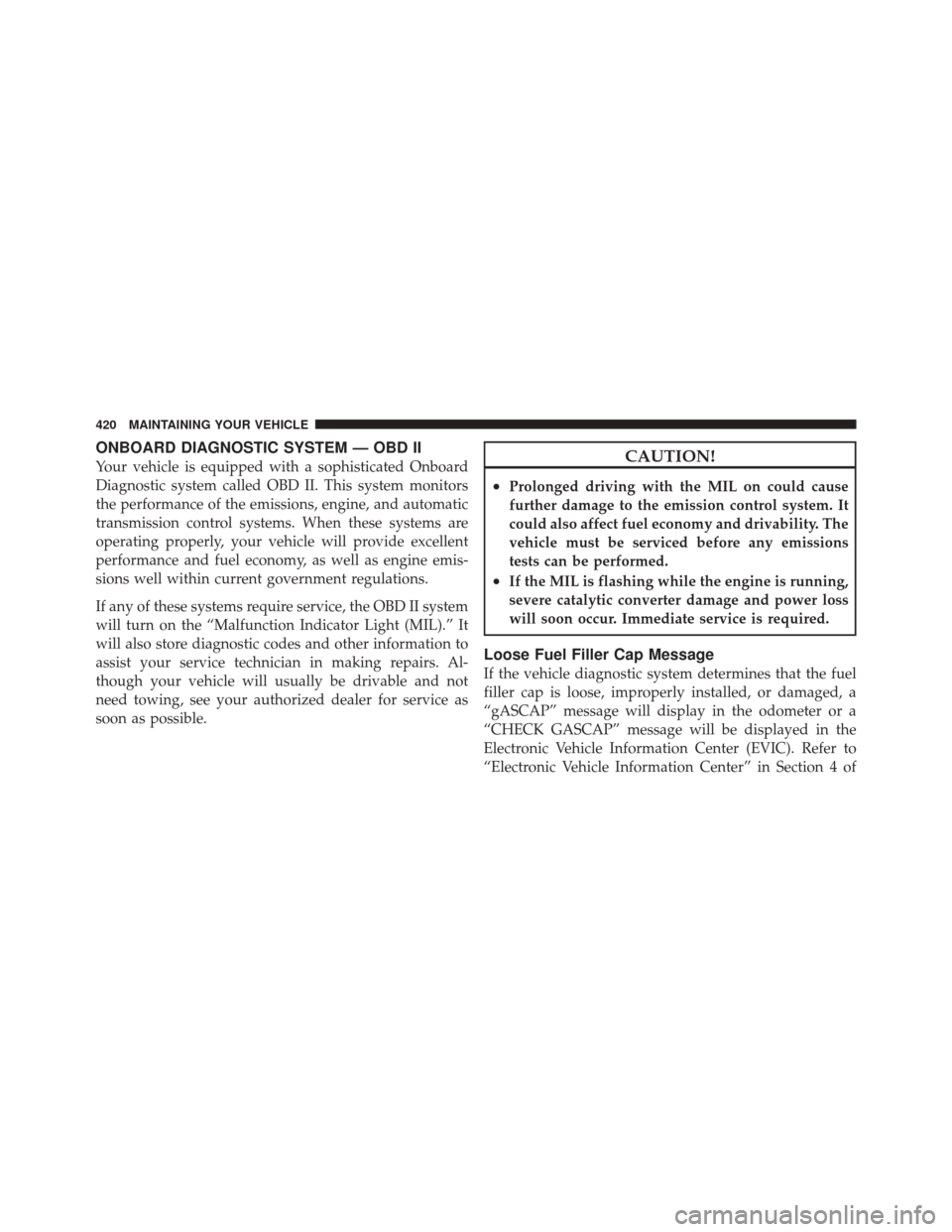
Your vehicle is equipped with a sophisticated Onboard
Diagnostic system called OBD II. This system monitors
the performance of the emissions, engine, and automatic
transmission control systems. When these systems are
operating properly, your vehicle will provide excellent
performance and fuel economy, as well as engine emis-
sions well within current government regulations.
If any of these systems require service, the OBD II system
will turn on the “Malfunction Indicator Light (MIL).” It
will also store diagnostic codes and other information to
assist your service technician in making repairs. Al-
though your vehicle will usually be drivable and not
need towing, see your authorized dealer for service as
soon as possible.CAUTION!
•Prolonged driving with the MIL on could cause
further damage to the emission control system. It
could also affect fuel economy and drivability. The
vehicle must be serviced before any emissions
tests can be performed.
•If the MIL is flashing while the engine is running,
severe catalytic converter damage and power loss
will soon occur. Immediate service is required.
Loose Fuel Filler Cap Message
If the vehicle diagnostic system determines that the fuel
filler cap is loose, improperly installed, or damaged, a
“gASCAP” message will display in the odometer or a
“CHECK GASCAP” message will be displayed in the
Electronic Vehicle Information Center (EVIC). Refer to
“Electronic Vehicle Information Center” in Section 4 of
420 MAINTAINING YOUR VEHICLE
Page 422 of 522
this manual. Tighten the gas cap until a�clicking�sound
is heard. This is an indication that the gas cap is properly
tightened.
Press the odometer reset button to turn the message off.
If the problem persists, the message will appear the next
time the vehicle is started. This might indicate a damaged
cap. If the problem is detected twice in a row, the system
will turn on the MIL. Resolving the problem will turn the
MIL light off.
EMISSIONS INSPECTION AND MAINTENANCE
PROGRAMS
In some localities, it may be a legal requirement to pass
an inspection of your vehicle’s emissions control system.
Failure to pass could prevent vehicle registration.
For states that require an Inspection and Mainte-
nance (I/M), this check verifies the “Malfunction Indicator Light (MIL)” is functioning and is not on when
the engine is running, and that the OBD II system is
ready for testing.
Normally, the OBD II system will be ready. The OBD II
system may
notbe ready if your vehicle was recently
serviced, recently had a dead battery or a battery replace-
ment. If the OBD II system should be determined not
ready for the I/M test, your vehicle may fail the test.
Your vehicle has a simple ignition key-actuated test,
which you can use prior to going to the test station. To
check if your vehicle’s OBD II system is ready, you must
do the following:
1. Insert your ignition key into the ignition switch.
2. Turn the ignition switch to the ON position, but do not
crank or start the engine.
3. If you crank or start the engine, you will have to start
this test over.7
MAINTAINING YOUR VEHICLE 421
Page 442 of 522
•Do not change the thermostat for Summer or Winter
operation. If replacement is ever necessary, install
ONLY the correct type thermostat. Other designs may
result in unsatisfactory cooling performance, poor gas
mileage, and increased emissions.
Brake System
In order to assure brake system performance, all brake
system components should be inspected periodically.
Refer to the “Maintenance Schedule” in Section 8 for the
proper maintenance intervals.
WARNING!
Riding the brakes can lead to brake failure and
possibly an accident. Driving with your foot resting
or riding on the brake pedal can result in abnormally
high brake temperatures, excessive lining wear, and
possible brake damage. You would not have your full
braking capacity in an emergency.
Brake Master Cylinder
The fluid in the master cylinder should be checked when
performing under hood services or immediately if the
“Brake Warning Light” is illuminated.
Be sure to clean the top of the master cylinder area before
removing the cap. If necessary, add fluid to bring the
fluid level up to the requirements described on the brake
fluid reservoir. With disc brakes, fluid level can be
expected to fall as the brake pads wear. Brake fluid level
should be checked when pads are replaced. However,
low fluid level may be caused by a leak and a checkup
may be needed.
Use only manufacturer’s recommended brake fluid. Re-
fer to “Fluids, Lubricants, and Genuine Parts” in this
section for the correct fluid type.
7
MAINTAINING YOUR VEHICLE 441
Page 453 of 522
Cleaning Interior Trim
Clean interior trim with a damp cloth and MOPAR�Total
Clean or equivalent, and if necessary, follow with MO-
PAR Spot & Stain Remover or equivalent. Do not use
harsh cleaners or Armor All�. Use MOPAR� Total Clean
or equivalent to clean vinyl upholstery.
Cleaning Leather Upholstery
MOPAR� Total Clean or equivalent is specifically recom-
mended for leather upholstery.
Your leather upholstery can be best preserved by regular
cleaning with a damp soft cloth. Small particles of dirt
can act as an abrasive and damage the leather upholstery
and should be removed promptly with a damp cloth.
Stubborn soils can be removed easily with a soft cloth
and MOPAR� Total Clean or equivalent. Care should be
taken to avoid soaking leather upholstery with any
liquid. Please do not use polishes, oils, cleaning fluids,
solvents, detergents, or ammonia-based cleaners to clean leather upholstery. Application of a leather conditioner is
not required to maintain the original condition.
WARNING!
Do not use volatile solvents for cleaning purposes.
Many are potentially flammable, and if used in
closed areas they may cause respiratory harm.
Cleaning Headlights
Your vehicle has plastic headlights that are lighter and
less susceptible to stone breakage than glass headlights.
Plastic is not as scratch resistant as glass and therefore
different lens cleaning procedures must be followed.
To minimize the possibility of scratching the lenses and
reducing light output, avoid wiping with a dry cloth. To
remove road dirt, wash with a mild soap solution fol-
lowed by rinsing.
452 MAINTAINING YOUR VEHICLE
Page 457 of 522
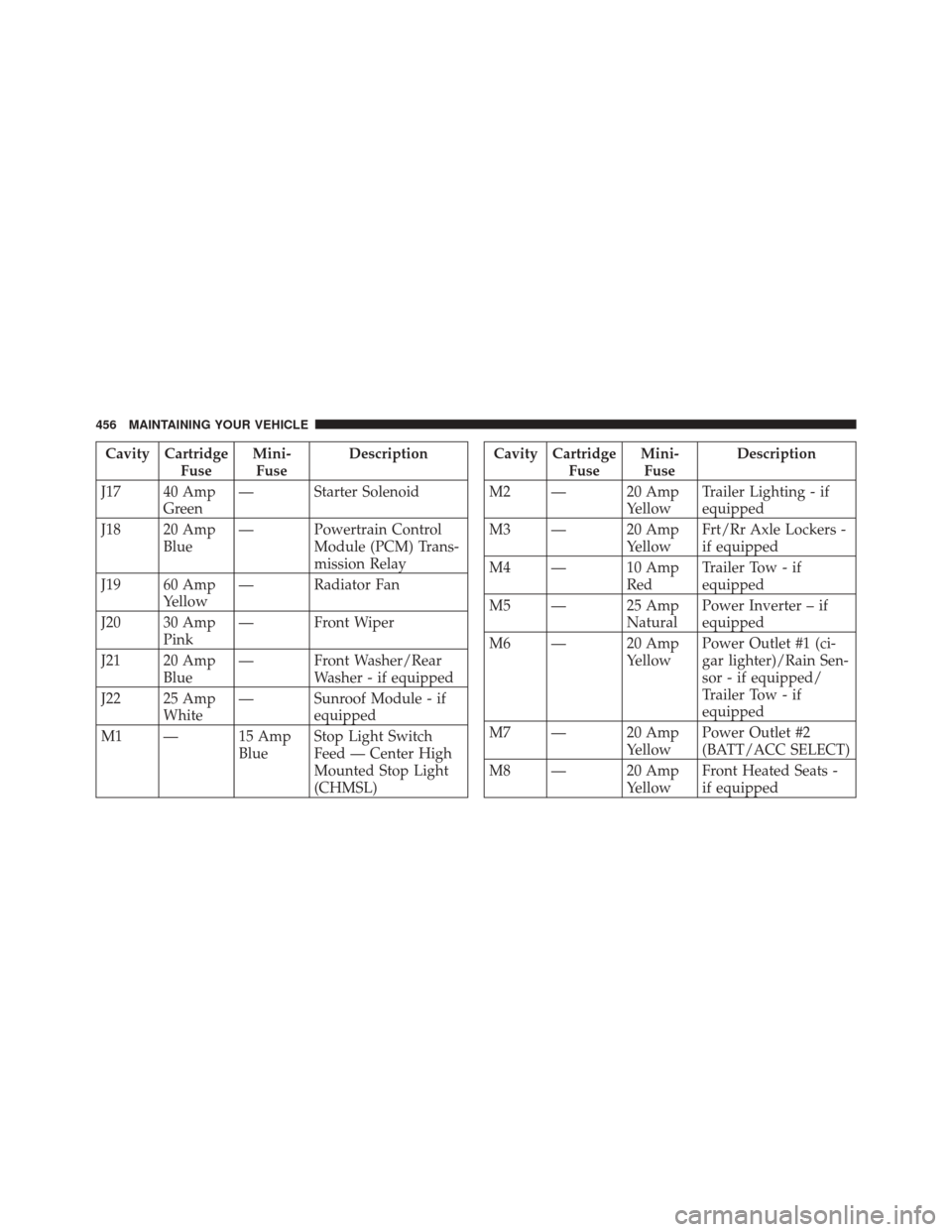
Cavity CartridgeFuseMini-
Fuse Description
J17 40 Amp Green — Starter Solenoid
J18 20 Amp Blue — Powertrain Control
Module (PCM) Trans-
mission Relay
J19 60 Amp Yellow — Radiator Fan
J20 30 Amp Pink — Front Wiper
J21 20 Amp Blue — Front Washer/Rear
Washer - if equipped
J22 25 Amp White — Sunroof Module - if
equipped
M1 — 15 Amp BlueStop Light Switch
Feed — Center High
Mounted Stop Light
(CHMSL)Cavity Cartridge
FuseMini-
Fuse Description
M2 — 20 Amp YellowTrailer Lighting - if
equipped
M3 — 20 Amp YellowFrt/Rr Axle Lockers -
if equipped
M4 — 10 Amp RedTrailer Tow - if
equipped
M5 — 25 Amp NaturalPower Inverter – if
equipped
M6 — 20 Amp YellowPower Outlet #1 (ci-
gar lighter)/Rain Sen-
sor - if equipped/
Trailer Tow - if
equipped
M7 — 20 Amp YellowPower Outlet #2
(BATT/ACC SELECT)
M8 — 20 Amp YellowFront Heated Seats -
if equipped
456 MAINTAINING YOUR VEHICLE
Page 458 of 522
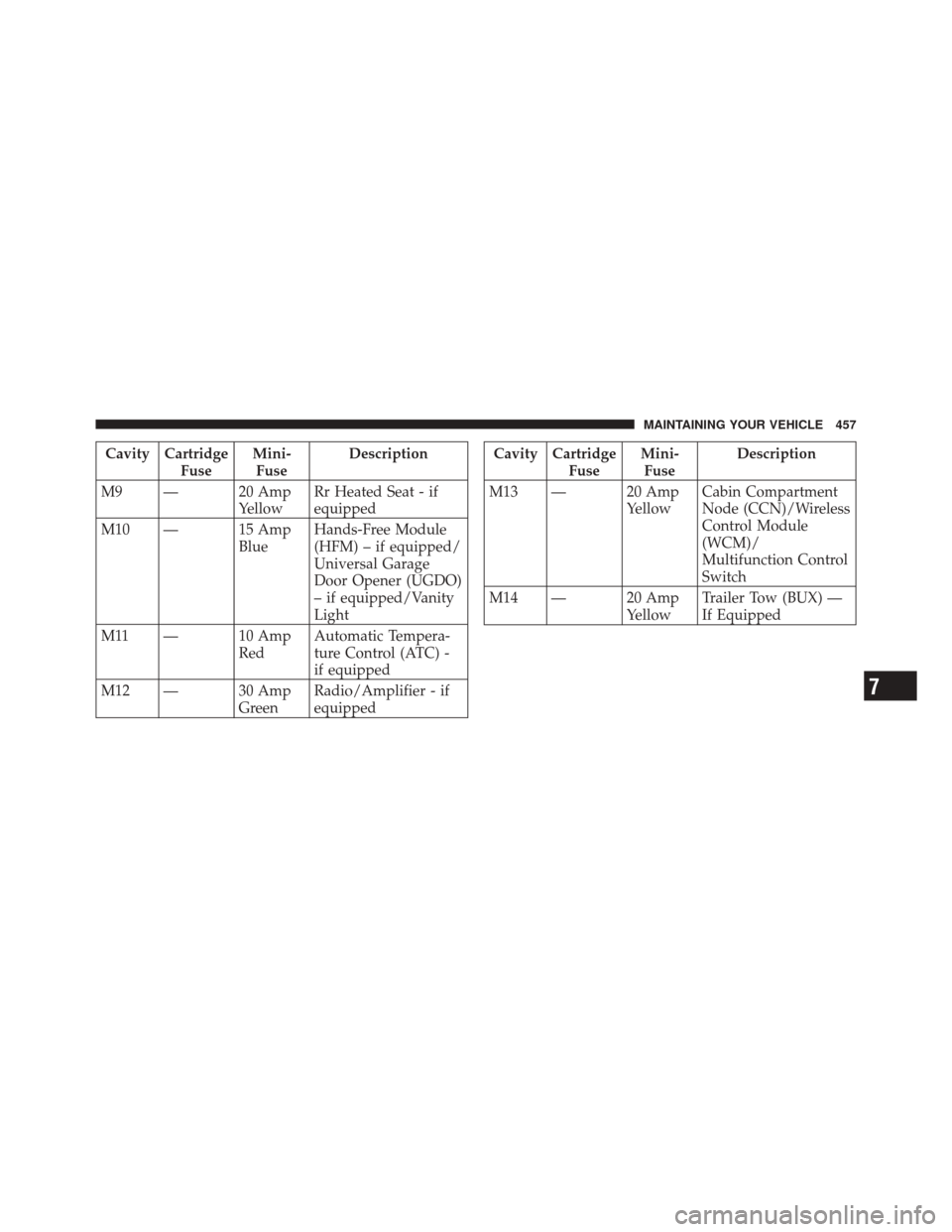
Cavity CartridgeFuseMini-
Fuse Description
M9 — 20 Amp YellowRr Heated Seat - if
equipped
M10 — 15 Amp BlueHands-Free Module
(HFM) – if equipped/
Universal Garage
Door Opener (UGDO)
– if equipped/Vanity
Light
M11 — 10 Amp RedAutomatic Tempera-
ture Control (ATC) -
if equipped
M12 — 30 Amp GreenRadio/Amplifier - if
equippedCavity Cartridge
FuseMini-
Fuse Description
M13 — 20 Amp YellowCabin Compartment
Node (CCN)/Wireless
Control Module
(WCM)/
Multifunction Control
Switch
M14 — 20 Amp YellowTrailer Tow (BUX) —
If Equipped
7
MAINTAINING YOUR VEHICLE 457
Page 459 of 522
Cavity CartridgeFuseMini-
Fuse Description
M15 — 20 Amp YellowMultifunction Control
Switch/Cabin Com-
partment Node
(CCN)/Steering Col-
umn Control Module
(SCM)/Rear View
Mirror/Tire Pressure
Monitor (TPM) - if
equipped/IR Sensor -
if equipped/Transfer
Case Module - if
equipped
M16 — 10 Amp RedOccupant Restraint
Controller (ORC)Cavity Cartridge
FuseMini-
Fuse Description
M17 — 15 Amp BlueExterior Lighting —
Left Front Park and
Side Marker, Left Tail
and Running, License
Lights
M18 — 15 Amp BlueExterior Lighting —
Right Front Park and
Side Marker, Right
Tail and Running
Lights
M19 — 25 Amp NaturalAuto Shut Down
(ASD) #1 and #2
458 MAINTAINING YOUR VEHICLE