Page 196 of 474

25. Front Fog Light Indicator — If EquippedThis indicator will illuminate when the front fog
lights are on.
26. Electronic Stability Control (ESC) OFF Indicator
Light — If Equipped This light indicates the Electronic Stability Con-
trol system (ESC) has been turned off by the
driver.
27. Electronic Stability Control (ESC) Indicator
Light — If Equipped The “ESC Indicator Light” in the instrument
cluster will come on when the ignition switch
is turned to the ON position. It should go out
with the engine running. If the “ESC Indicator
Light” comes on continuously with the engine running, a
malfunction has been detected in the ESC system. If this
light remains on after several ignition cycles, and the
vehicle has been driven several miles (kilometers) at speeds greater than 30 mph (48 km/h), see your autho-
rized dealer as soon as possible to have the problem
diagnosed and corrected.
NOTE:
•The “ESC Indicator Light” come on momentarily each
time the ignition switch is turned ON.
•Each time the ignition is turned ON, the ESC system
will be ON even if it was turned off previously.
•The ESC system will make buzzing or clicking sounds
when it is active. This is normal; the sounds will stop
when ESC becomes inactive following the maneuver
that caused the ESC activation.
28. 4WD! Warning Light — If Equipped This light monitors the 4-Wheel Drive (4WD)
system. The light will come on, for a bulb
check, when the ignition key is turned to the
ON position and may stay on for as long as
three seconds.
4
UNDERSTANDING YOUR INSTRUMENT PANEL 195
Page 299 of 474

required. However, the conventional brake system will
continue to operate normally if the “Brake Warning
Light” is not on.
If the “ABS Warning Light” is on, the brake system
should be serviced as soon as possible to restore the
benefits of anti-lock brakes. If the “ABS Warning Light”
does not come on when the ignition switch is turned to
the ON position, have the bulb repaired as soon as
possible.
If both the “Brake Warning Light” and the “ABS Warning
Light” remain on, the ABS and Electronic Brake Force
Distribution (EBD) systems are not functioning. Immedi-
ate repair to the ABS is required.
When the vehicle is driven over 7 mph (11 km/h), you
may also hear a slight clicking sound as well as some
related motor noises. These noises are the system per-
forming its self-check cycle to ensure that the ABSworking properly. This self-check occurs each time the
vehicle is started and accelerated past 7 mph (11 km/h).
ABS is activated during braking under certain road or
stopping conditions. ABS-inducing conditions can in-
clude ice, snow, gravel, bumps, railroad tracks, loose
debris, or panic stops.
You may also experience the following when the brake
system goes into anti-lock mode:
•the ABS motor running (it may continue to run for a
short time after the stop)
•the clicking sound of solenoid valves
•brake pedal pulsations
•a slight drop or fall away of the brake pedal at the end
of the stop
These are all normal characteristics of ABS.
298 STARTING AND OPERATING
Page 377 of 474
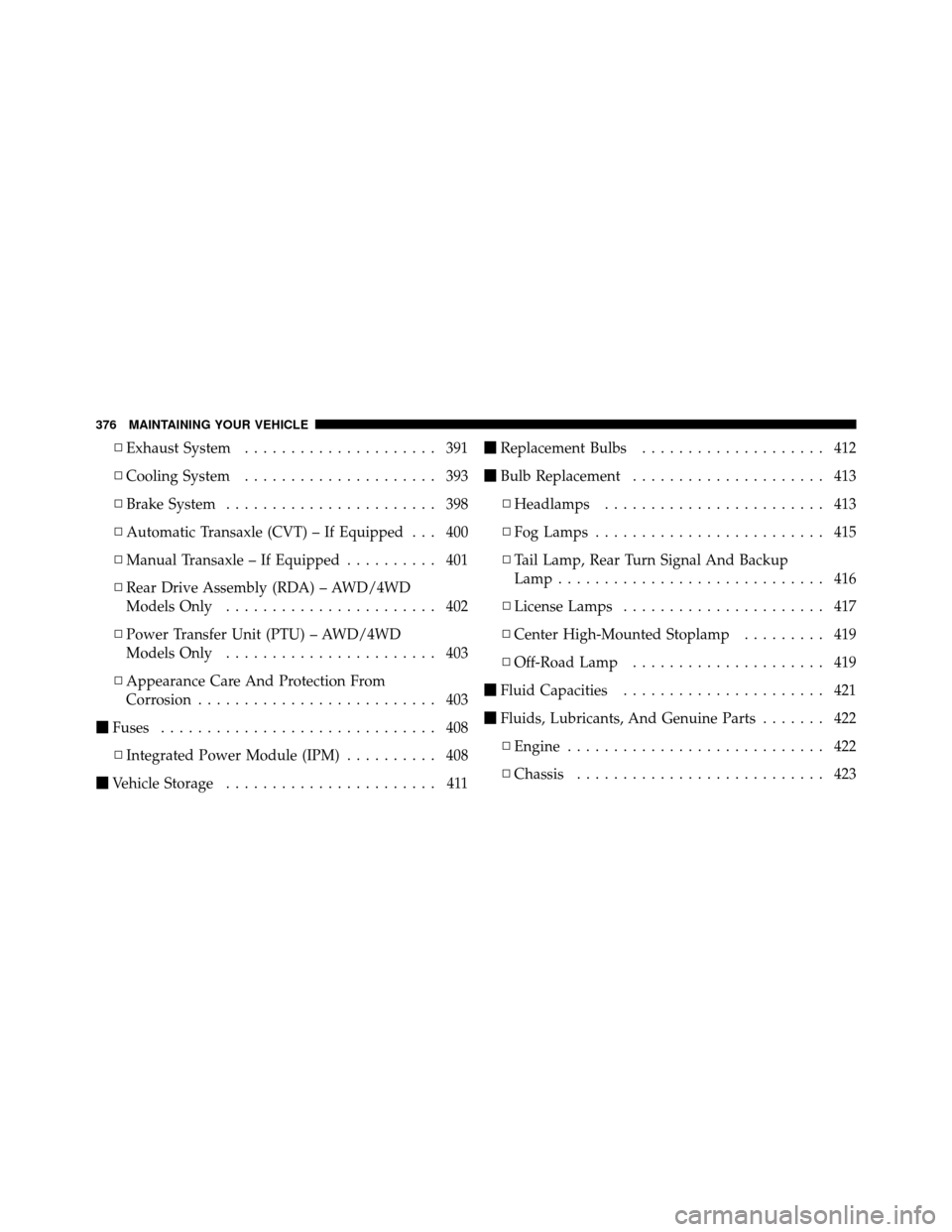
▫Exhaust System ..................... 391
▫ Cooling System ..................... 393
▫ Brake System ....................... 398
▫ Automatic Transaxle (CVT) – If Equipped . . . 400
▫ Manual Transaxle – If Equipped .......... 401
▫ Rear Drive Assembly (RDA) – AWD/4WD
Models Only ....................... 402
▫ Power Transfer Unit (PTU) – AWD/4WD
Models Only ....................... 403
▫ Appearance Care And Protection From
Corrosion .......................... 403
� Fuses .............................. 408
▫ Integrated Power Module (IPM) .......... 408
� Vehicle Storage ....................... 411 �
Replacement Bulbs .................... 412
� Bulb Replacement ..................... 413
▫ Headlamps ........................ 413
▫ Fog Lamps ......................... 415
▫ Tail Lamp, Rear Turn Signal And Backup
Lamp ............................. 416
▫ License Lamps ...................... 417
▫ Center High-Mounted Stoplamp ......... 419
▫ Off-Road Lamp ..................... 419
� Fluid Capacities ...................... 421
� Fluids, Lubricants, And Genuine Parts ....... 422
▫ Engine ............................ 422
▫ Chassis ........................... 423
376 MAINTAINING YOUR VEHICLE
Page 381 of 474

persists, the message will appear the next time the
vehicle is started. This might indicate a damaged cap. If
the problem is detected twice in a row, the system will
turn on the MIL. Resolving the problem will turn the MIL
light off.
EMISSIONS INSPECTION AND MAINTENANCE
PROGRAMS
In some localities, it may be a legal requirement to pass
an inspection of your vehicle’s emissions control system.
Failure to pass could prevent vehicle registration.For states that require an Inspection and Mainte-
nance (I/M), this check verifies the “Malfunction
Indicator Light (MIL)” is functioning and is not
on when the engine is running, and that the OBD II
system is ready for testing. Normally, the OBD II system will be ready. The OBD II
system may
notbe ready if your vehicle was recently
serviced, recently had a dead battery or a battery replace-
ment. If the OBD II system should be determined not
ready for the I/M test, your vehicle may fail the test.
Your vehicle has a simple ignition key-actuated test,
which you can use prior to going to the test station. To
check if your vehicle’s OBD II system is ready, you must
do the following:
1. Turn the ignition switch to the ON position, but do not
crank or start the engine.
2. If you crank or start the engine, you will have to start
this test over.
3. As soon as you turn the ignition switch to the ON
position, you will see the MIL symbol come on as part of
a normal bulb check.
380 MAINTAINING YOUR VEHICLE
Page 413 of 474
•Disengage the mini-fuse in the Power Distribution
Center labeled IOD (Ignition Off-Draw).
•Disconnect the negative cable from the battery.
REPLACEMENT BULBS
All the inside bulbs are brass or glass wedge base.
Aluminum base bulbs are not approved and should not
be used for replacement.
LIGHT BULBS – Interior Bulb Number
Front Header Lamp...................... T578
Center Dome Lamp ...................... T578
Rear Cargo Lamp/Flashlight .............8–A35LFLIGHTS BULBS – Exterior
Bulb No.
Low Beam/High Beam Headlamp ............ H13
Front Park/Turn Signal/Side Marker Lamp . . . 3757KA
Front Fog Lamp ...................... PSX24W
Center High Mounted Stop Lamp
(CHMSL) ...................... LED Assembly
Rear Tail/Stop Lamp ..................... 3157
Rear Turn Lamp ............... 3157AK or 3157A
Backup Lamp ..................... W16W (921)
License Lamp .......................... W5W
Off-Road Lamp .......................... H3
412 MAINTAINING YOUR VEHICLE
Page 414 of 474
BULB REPLACEMENT
Headlamps
1. Raise the hood and locate the connector behind the
headlamp.2. Reach into the engine compartment and pull the red
lock out at the green connector.
7
MAINTAINING YOUR VEHICLE 413
Page 415 of 474
3. Remove green connector from back of bulb by pulling
straight back.4. Twist the bulb to the left.
414 MAINTAINING YOUR VEHICLE
Page 416 of 474
5. Pull bulb outward from assembly.NOTE:These are halogen bulbs. Take care not to touch
the bulb with your fingers. Body oils from your fingers
could cause excessive heat buildup which reduces bulb
life.
Fog Lamps
1. Access lamp through the lower fascia cutout.
2. Remove electrical connector from bulb.
3. Remove bulb from housing.
7
MAINTAINING YOUR VEHICLE 415


