Page 381 of 460

WARNING! (Continued)
•To avoid contamination from foreign matter or
moisture, use only new brake fluid or fluid that
has been in a tightly closed container. Keep the
master cylinder reservoir cap secured at all times.
Brake fluid in a open container absorbs moisture
from the air resulting in a lower boiling point.
This may cause it to boil unexpectedly during hard
or prolonged braking, resulting in sudden brake
failure. This could result in a accident.
•Overfilling the brake fluid reservoir can result in
spilling brake fluid on hot engine parts, causing
the brake fluid to catch fire. Brake fluid can also
damage painted and vinyl surfaces, care should be
taken to avoid its contact with these surfaces.(Continued)
WARNING! (Continued)
•Do not allow petroleum based fluid to contami-
nate the brake fluid. Brake seal components could
be damaged, causing partial or complete brake
failure. This could result in an accident.
Front/Rear Axle Fluid
Front Axle Fluid Level Check
Lubricant should be to the bottom of the oil fill hole.
Rear Axle Fluid Level Check
Lubricant should be 1/2 inch (1 cm) below the oil fill
hole.
Adding Fluid
Add lubricant only at the fill hole and only to the level
specified above.
7
MAINTAINING YOUR VEHICLE 381
Page 385 of 460

Fluid Level Check (5.7L Engine)
Check the fluid level while the transmission is at normal
operating temperature. This occurs after at least 15 miles
(25 km) of driving. At normal operating temperature the
fluid cannot be held comfortably between the fingertips.
To check the fluid level properly, the following procedure
must be used:
1. Operate the engine at idle speed and normal operating
temperature.
2. The vehicle must be on level ground.
3. Fully apply the parking brake, and press the brake
pedal.
4. Place the shift lever momentarily in each gear position
ending with the shift lever in PARK.
5. Remove the dipstick, wipe it clean and reinsert it until
seated.6. Remove the dipstick again, and note the fluid level on
both sides. The fluid level should be between the “HOT”
(upper) reference holes on the dipstick at normal operat-
ing temperature. The fluid level is only valid if there is a
solid coating of oil on both sides of the dipstick. If the
fluid is low, add as required into the dipstick tube.
Do
not overfill. After adding any quantity of oil through the
oil fill tube, wait a minimum of two minutes for the oil to
fully drain into the transmission before rechecking the
fluid level.
NOTE: If it is necessary to check the transmission below
the operating temperature, the fluid level should be
between the two “COLD” (lower) holes on the dipstick
with the fluid at approximately 70°F (21°C) (room tem-
perature). If the fluid level is correctly established at
room temperature, it should be between the “HOT”
(upper) reference holes when the transmission reaches
180°F (82°C). Remember it is best to check the level at the
normal operating temperature.
7
MAINTAINING YOUR VEHICLE 385
Page 389 of 460

•If your vehicle is damaged due to an accident or
similar cause which destroys the paint and protective
coating, have your vehicle repaired as soon as pos-
sible. The cost of such repairs is considered the respon-
sibility of the owner.
•If you carry special cargo such as chemicals, fertilizers,
de-icer salt, etc., assure that such materials are well
packaged and sealed.
•If a lot of driving is done on gravel roads, consider
mud or stone shields behind each wheel.
•Use MOPAR�Touch Up Paint or equivalent on
scratches or chips as soon as possible. Your authorized
dealer has touch up paint to match the color of your
vehicle.
Wheel and Wheel Trim Care
All wheels and wheel trim, especially aluminum and
chrome-plated wheels should be cleaned regularly with a mild soap and water to prevent corrosion. To remove
heavy soil, use MOPAR�
Wheel Cleaner or select a
nonabrasive, non-acidic cleaner. Do not use scouring
pads, steel wool, a bristle brush or metal polishes. Only
MOPAR� cleaners or equivalent are recommended. Do
not use oven cleaner. Avoid automatic car washes that
use acidic solutions or harsh brushes that may damage
the wheels’ protective finish.
Stain Repel Fabric Cleaning Procedure — If
Equipped
Stain Repel seats may be cleaned in the following man-
ner:
•Remove as much of the stain as possible by blotting
with a clean, dry towel.
•Blot any remaining stain with a clean, damp towel.
7
MAINTAINING YOUR VEHICLE 389
Page 390 of 460

•For tough stains, apply MOPAR�Total Clean or a mild
soap solution to a clean, damp cloth and remove the
stain. Use a fresh, damp towel to remove soap residue.
•For grease stains, apply MOPAR� Multi-Purpose
Cleaner or equivalent to a clean, damp cloth and
remove the stain. Use a fresh, damp towel to remove
soap residue.
•Do not use any harsh solvents or any other form of
protectants on Stain Repel products.
Interior Care
Use MOPAR� Total Clean or equivalent to clean fabric
upholstery and carpeting.
Interior Trim should be cleaned starting with a damp
cloth, a damp cloth with MOPAR� Total Clean or equiva-
lent, then MOPAR� Spot & Stain Remover or equivalent, if absolutely necessary. Do not use harsh cleaners or
Armor All�. Use MOPAR�
Total Clean or equivalent to
clean vinyl upholstery.
Leather Seat Care And Cleaning
MOPAR� Total Clean or equivalent is specifically recom-
mended for leather upholstery.
Your leather upholstery can be best preserved by regular
cleaning with a damp soft cloth. Small particles of dirt
can act as an abrasive and damage the leather upholstery
and should be removed promptly with a damp cloth.
Stubborn soils can be removed easily with a soft cloth
and MOPAR� Total Clean or equivalent. Care should be
taken to avoid soaking your leather upholstery with any
liquid. Please do not use polishes, oils, cleaning fluids,
solvents, detergents, or ammonia-based cleaners to clean
your leather upholstery. Application of a leather condi-
tioner is not required to maintain the original condition.
390 MAINTAINING YOUR VEHICLE
Page 398 of 460
Cav-ity Cartridge
Fuse Mini-Fuse Description
43 25 Amp
NaturalCoils, Actuators
44 — Spare
Underhood Fuses (Integrated Power Module)
Cav-
ity Cartridge
Fuse Mini-Fuse Description
8 10 Amp
RedLt Park Lamps
9 10 Amp
RedTrailer-Tow Park
Lamps
10 10 Amp
RedRt Park Lamps
12 20 Amp
YellowFront Control Module
(FCM) Batt #4
13 20 Amp
YellowFront Control Module
(FCM) Batt #2
14 20 Amp
YellowAdjustable Pedal
15 20 Amp
YellowFt Fog Lamps
16 20 Amp
YellowHorn
Integrated Power Module
398 MAINTAINING YOUR VEHICLE
Page 402 of 460
CAUTION!
Do not touch the new bulb with your fingers. Oil
contamination will severely shorten bulb life. If the
bulb comes in contact with any oily surface, clean the
bulb with rubbing alcohol.
Front Turn Signal
1. Turn the steering wheel all the way to the left or right.
2. Reach into the front wheel house ahead of the front
wheel to unsnap and lift the cover over the access hole in
the front of the wheel house splash shield. Access to the
bulb can be gained through the wheel liner hole.3. Reach through the access hole to access the park/turn
signal bulb socket on the bottom of the front lamp unit
housing.
402 MAINTAINING YOUR VEHICLE
Page 403 of 460
4. Turn the socket on the bottom of the front lamp unit
housing 1/4 turn counterclockwise to unlock it.5. Pull the socket and bulb straight out from the opening
in the housing.
6. Disconnect the electrical connector.
7. Pull the base of the bulb straight out of the socket.
CAUTION!
Do not touch the new bulb with your fingers. Oil
contamination will severely shorten bulb life. If the
bulb comes in contact with any oily surface, clean the
bulb with rubbing alcohol.
Front Fog Lamp
1. Turn the steering wheel all the way to the left or right.
1 — Low Beam Bulb
2 — High Beam Bulb
3 — Front Park/Turn Signal Bulb
7
MAINTAINING YOUR VEHICLE 403
Page 404 of 460
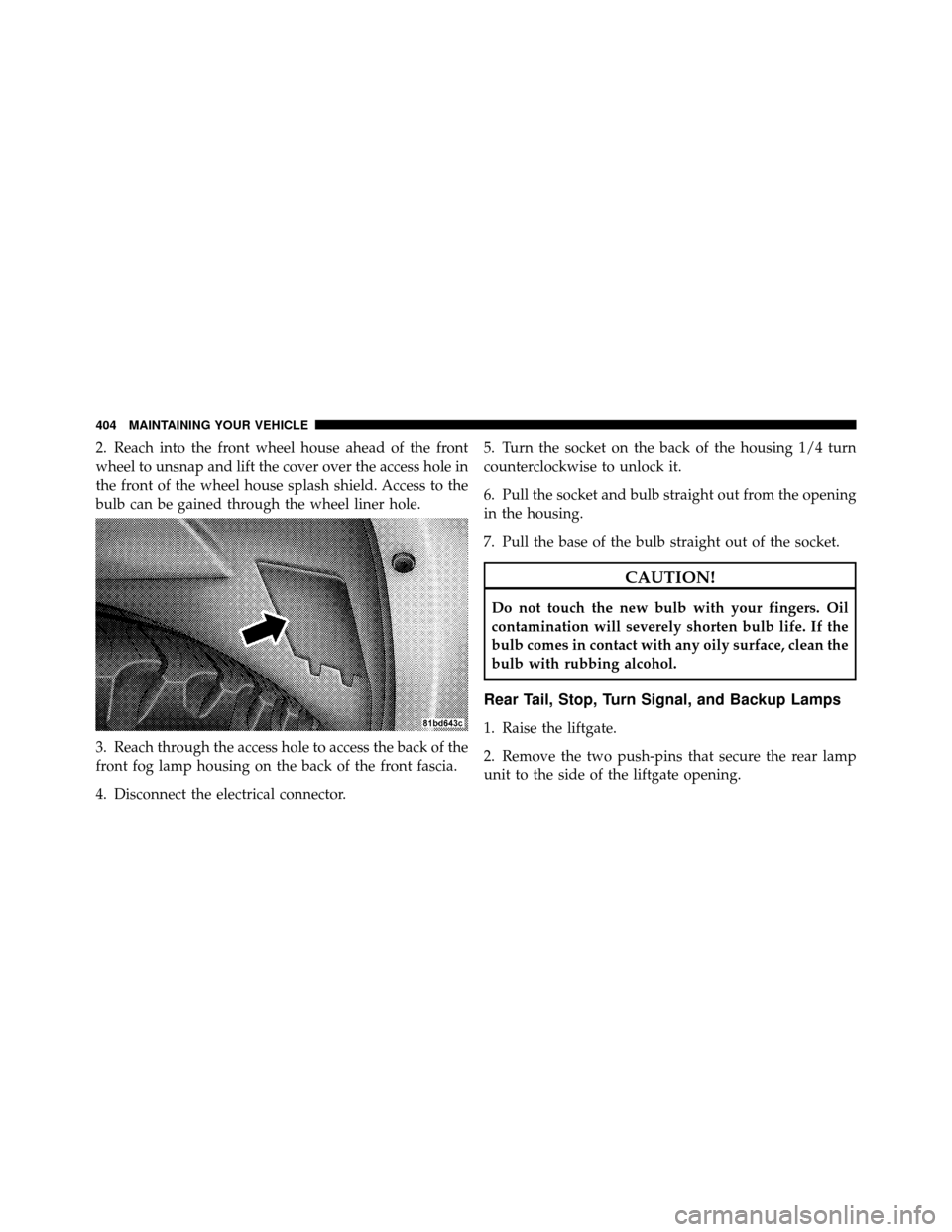
2. Reach into the front wheel house ahead of the front
wheel to unsnap and lift the cover over the access hole in
the front of the wheel house splash shield. Access to the
bulb can be gained through the wheel liner hole.
3. Reach through the access hole to access the back of the
front fog lamp housing on the back of the front fascia.
4. Disconnect the electrical connector.5. Turn the socket on the back of the housing 1/4 turn
counterclockwise to unlock it.
6. Pull the socket and bulb straight out from the opening
in the housing.
7. Pull the base of the bulb straight out of the socket.
CAUTION!
Do not touch the new bulb with your fingers. Oil
contamination will severely shorten bulb life. If the
bulb comes in contact with any oily surface, clean the
bulb with rubbing alcohol.
Rear Tail, Stop, Turn Signal, and Backup Lamps
1. Raise the liftgate.
2. Remove the two push-pins that secure the rear lamp
unit to the side of the liftgate opening.
404 MAINTAINING YOUR VEHICLE