Page 12 of 408
15
Introduction
VEHICLE BREAK-IN PROCESS
A030000AUN
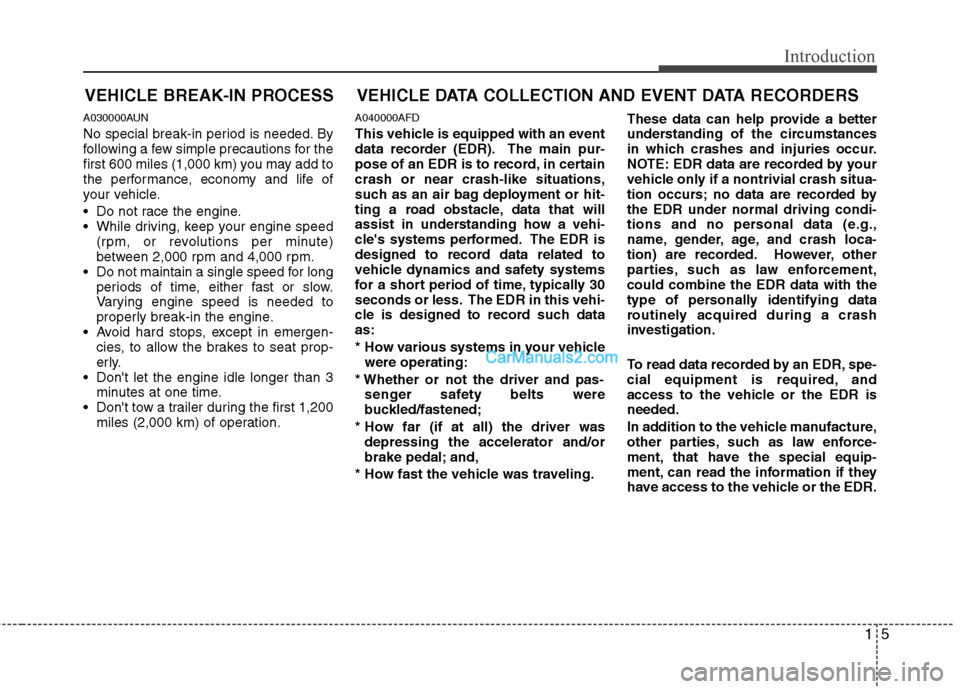
No special break-in period is needed. By
following a few simple precautions for the
first 600 miles (1,000 km) you may add to
the performance, economy and life of
your vehicle.
Do not race the engine.
While driving, keep your engine speed(rpm, or revolutions per minute)
between 2,000 rpm and 4,000 rpm.
Do not maintain a single speed for long periods of time, either fast or slow.
Varying engine speed is needed to
properly break-in the engine.
Avoid hard stops, except in emergen- cies, to allow the brakes to seat prop-
erly.
Don't let the engine idle longer than 3 minutes at one time.
Don't tow a trailer during the first 1,200 miles (2,000 km) of operation.
A040000AFD
This vehicle is equipped with an event
data recorder (EDR). The main pur-
pose of an EDR is to record, in certain
crash or near crash-like situations,
such as an air bag deployment or hit-
ting a road obstacle, data that will
assist in understanding how a vehi-
cle's systems performed. The EDR is
designed to record data related to
vehicle dynamics and safety systems
for a short period of time, typically 30
seconds or less. The EDR in this vehi-
cle is designed to record such data
as:
* How various systems in your vehiclewere operating:
* Whether or not the driver and pas- senger safety belts were
buckled/fastened;
* How far (if at all) the driver was depressing the accelerator and/or
brake pedal; and,
* How fast the vehicle was traveling. These data can help provide a better
understanding of the circumstances
in which crashes and injuries occur.
NOTE: EDR data are recorded by your
vehicle only if a nontrivial crash situa-
tion occurs; no data are recorded by
the EDR under normal driving condi-
tions and no personal data (e.g.,
name, gender, age, and crash loca-
tion) are recorded. However, other
parties, such as law enforcement,
could combine the EDR data with the
type of personally identifying data
routinely acquired during a crash
investigation.
To read data recorded by an EDR, spe-
cial equipment is required, and
access to the vehicle or the EDR is
needed.
In addition to the vehicle manufacture,
other parties, such as law enforce-
ment, that have the special equip-
ment, can read the information if they
have access to the vehicle or the EDR.
VEHICLE DATA COLLECTION AND EVENT DATA RECORDERS
Page 13 of 408
Introduction
6
1
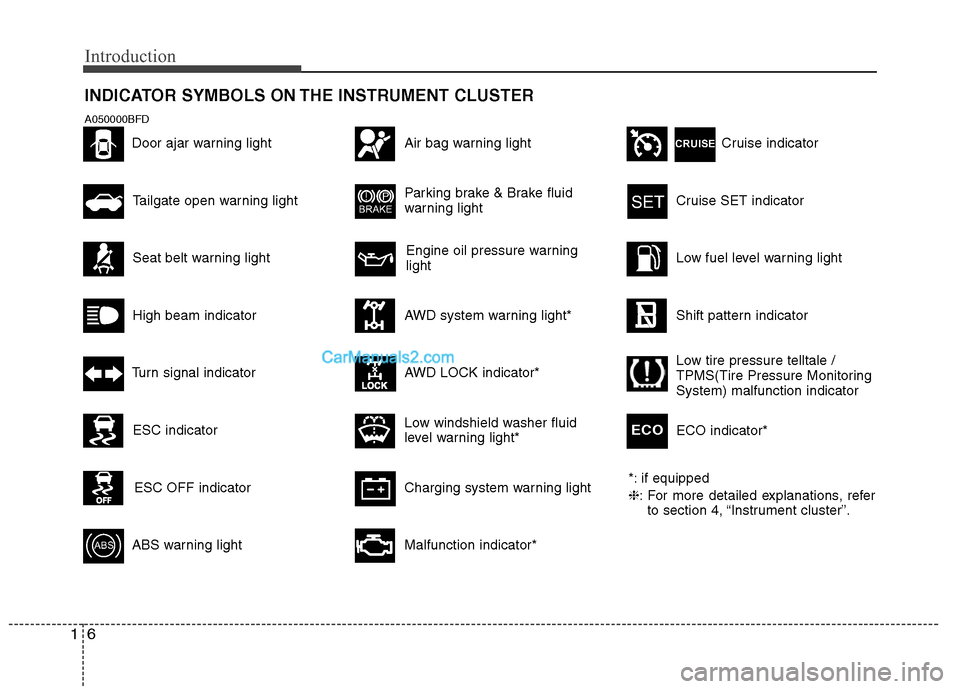
INDICATOR SYMBOLS ON THE INSTRUMENT CLUSTER
Engine oil pressure warning
light
*: if equipped
❈: For more detailed explanations, refer
to section 4, “Instrument cluster”.
Seat belt warning light
Tailgate open warning light
High beam indicator
Turn signal indicator
ABS warning light
Parking brake & Brake fluid
warning light
AWD system warning light*
AWD LOCK indicator*
Malfunction indicator*
Air bag warning light
Cruise SET indicator
Low fuel level warning light
Shift pattern indicator
Charging system warning light
Low windshield washer fluid
level warning light*
Door ajar warning light
ESC indicator
ESC OFF indicator
Low tire pressure telltale /
TPMS(Tire Pressure Monitoring
System) malfunction indicator
A050000BFD
ECO indicator*ECO
Cruise indicator
Page 15 of 408
Your vehicle at a glance
2
2
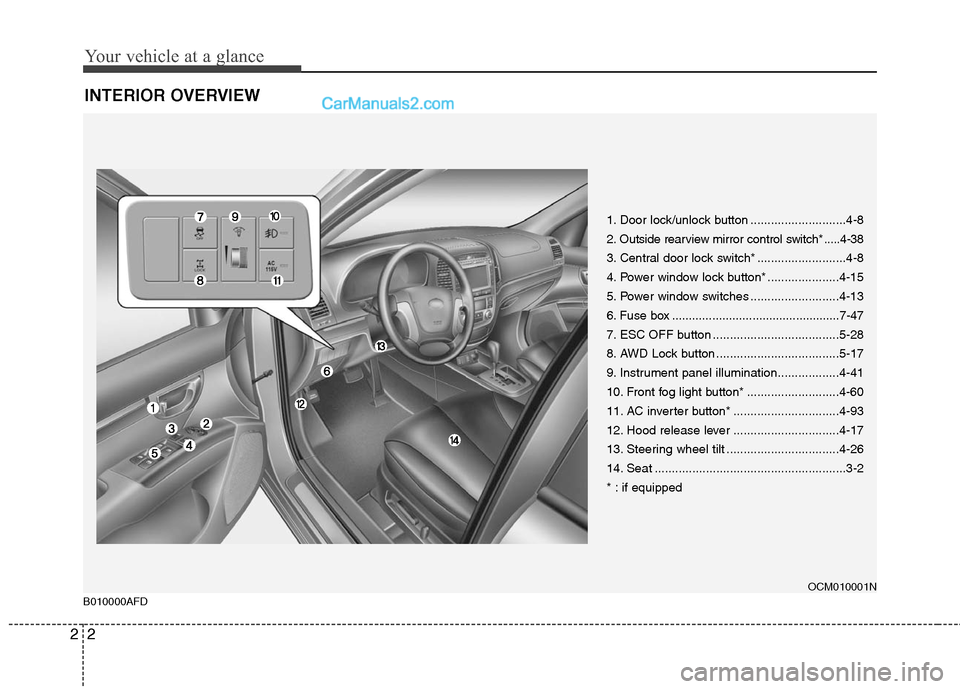
INTERIOR OVERVIEW
1. Door lock/unlock button ............................4-8
2. Outside rearview mirror control switch* .....4-38
3. Central door lock switch* ..........................4-8
4. Power window lock button* .....................4-15
5. Power window switches ..........................4-13
6. Fuse box ..................................................7-47
7. ESC OFF button .....................................5-28
8. AWD Lock button ....................................5-17
9. Instrument panel illumination..................4-41
10. Front fog light button* ...........................4-60
11. AC inverter button* ...............................4-93
12. Hood release lever ...............................4-17
13. Steering wheel tilt .................................4-26
14. Seat ........................................................3-2
* : if equipped
OCM010001N
B010000AFD
Page 16 of 408
23
Your vehicle at a glance
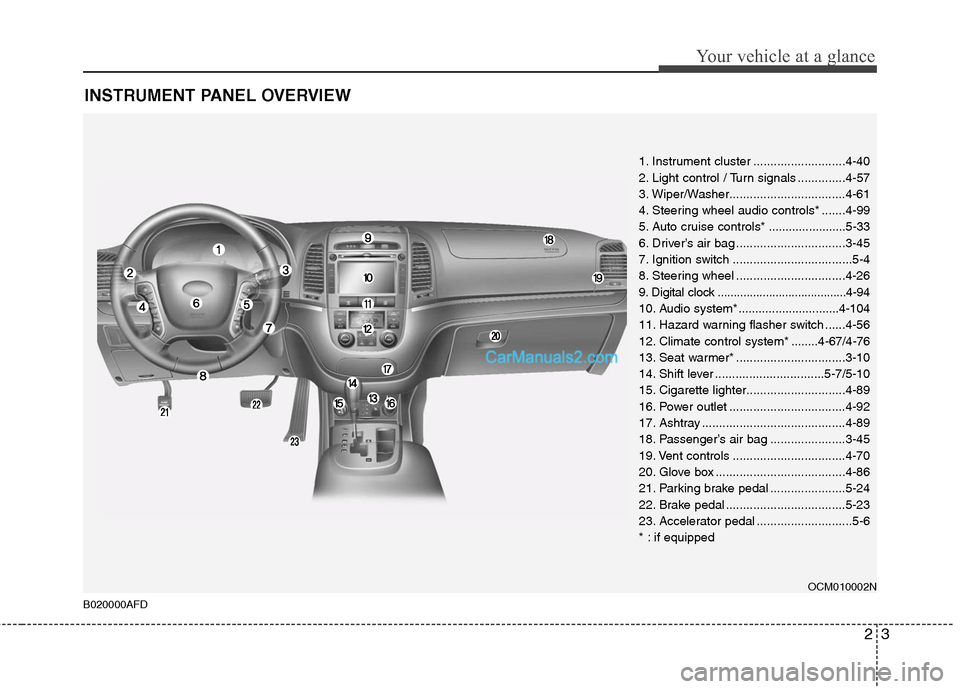
INSTRUMENT PANEL OVERVIEW
1. Instrument cluster ...........................4-40
2. Light control / Turn signals ..............4-57
3. Wiper/Washer..................................4-61
4. Steering wheel audio controls* .......4-99
5. Auto cruise controls* .......................5-33
6. Driver’s air bag ................................3-45
7. Ignition switch ...................................5-4
8. Steering wheel ................................4-26
9. Digital clock ........................................4-94
10. Audio system*..............................4-104
11. Hazard warning flasher switch ......4-56
12. Climate control system * ........4-67/4-76
13. Seat warmer* ................................3-10
14. Shift lever ................................5-7/5-10
15. Cigarette lighter.............................4-89
16. Power outlet ..................................4-92
17. Ashtray ..........................................4-89
18. Passenger’s air bag ......................3-45
19. Vent controls .................................4-70
20. Glove box ......................................4-86
21. Parking brake pedal ......................5-24
22. Brake pedal ...................................5-23
23. Accelerator pedal ............................5-6
* : if equipped
OCM010002N
B020000AFD
Page 18 of 408
3
Seat / 3-2
Seat belts / 3-17
Child restraint system / 3-28
Airbag-supplemental restraint system / 3-36
Safety system of your vehicle
Page 19 of 408
Safety system of your vehicle
2
3
C010000AFD
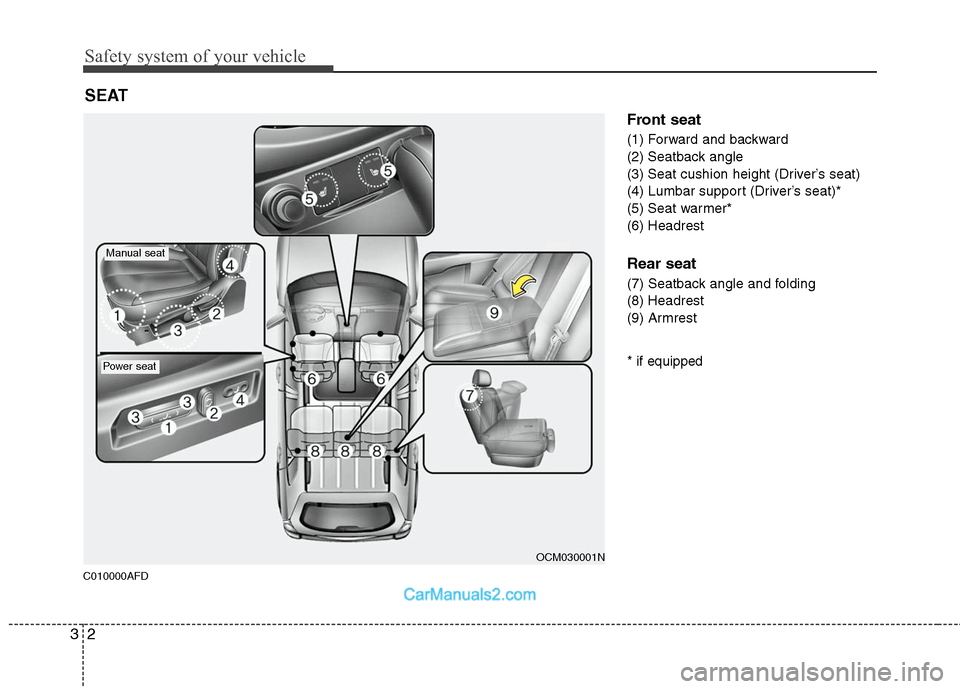
Front seat
(1) Forward and backward
(2) Seatback angle
(3) Seat cushion height (Driver’s seat)
(4) Lumbar support (Driver’s seat)*
(5) Seat warmer*
(6) Headrest
Rear seat
(7) Seatback angle and folding
(8) Headrest
(9) Armrest
* if equipped
SEAT
Manual seat
Power seat
OCM030001N
Page 20 of 408
33
Safety system of your vehicle
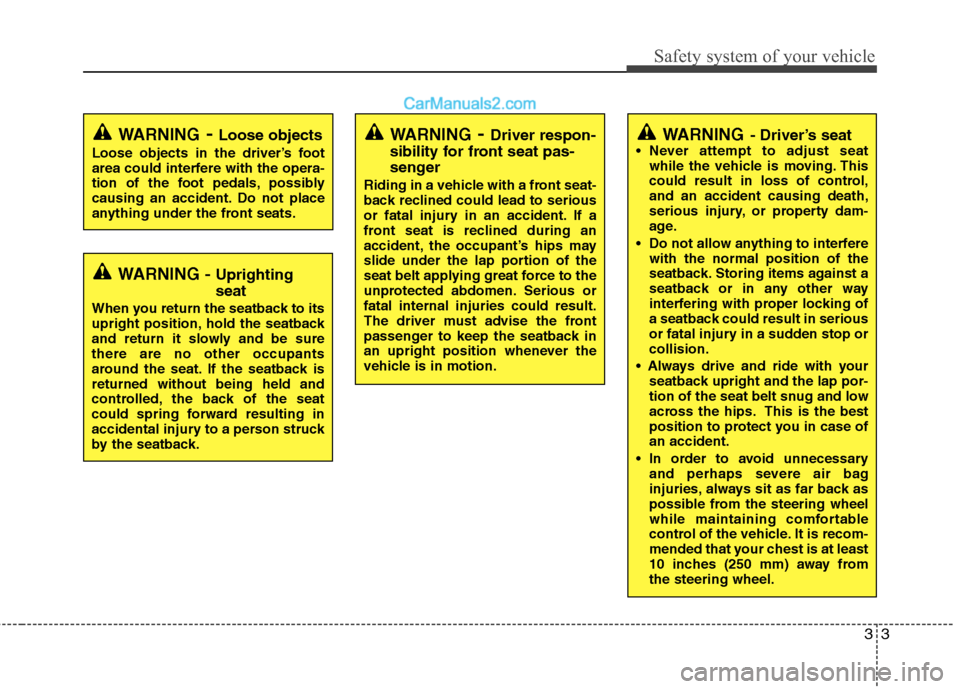
WARNING- Driver’s seat Never attempt to adjust seatwhile the vehicle is moving. This
could result in loss of control,
and an accident causing death,
serious injury, or property dam-
age.
Do not allow anything to interfere with the normal position of the
seatback. Storing items against a
seatback or in any other way
interfering with proper locking of
a seatback could result in serious
or fatal injury in a sudden stop or
collision.
seatback upright and the lap por-
tion of the seat belt snug and low
across the hips. This is the best
position to protect you in case of
an accident.
In order to avoid unnecessary and perhaps severe air bag
injuries, always sit as far back as
possible from the steering wheel
while maintaining comfortable
control of the vehicle. It is recom-
mended that your chest is at least
10 inches (250 mm) away from
the steering wheel.
WARNING - Uprighting
seat
When you return the seatback to its
upright position, hold the seatback
and return it slowly and be sure
there are no other occupants
around the seat. If the seatback is
returned without being held and
controlled, the back of the seat
could spring forward resulting in
accidental injury to a person struck
by the seatback.
WARNING- Loose objects
Loose objects in the driver’s foot
area could interfere with the opera-
tion of the foot pedals, possibly
causing an accident. Do not place
anything under the front seats.
WARNING- Driver respon-
sibility for front seat pas-
senger
Riding in a vehicle with a front seat-
back reclined could lead to serious
or fatal injury in an accident. If a
front seat is reclined during an
accident, the occupant’s hips may
slide under the lap portion of the
seat belt applying great force to the
unprotected abdomen. Serious or
fatal internal injuries could result.
The driver must advise the front
passenger to keep the seatback in
an upright position whenever the
vehicle is in motion.
Page 21 of 408
WARNING
After adjusting the seat, always
check that it is securely locked into
place by attempting to move the
seat forward or reverse without
using the lock release lever.
Sudden or unexpected movement
of the driver's seat could cause you
to lose control of the vehicle result-
ing in an accident.
Safety system of your vehicle
4
3
(Continued)
When resetting the seatback to
the upright position, make sure it
is securely latched by pushing it
forward and backwards.
To avoid the possibility of burns, do not remove the carpet in the
cargo area. Emission control
devices beneath this floor gener-
ate high temperatures.WARNING- Rear seat-backs
The rear seatback must be
securely latched. If not, passen-
gers and objects could be thrown
forward resulting in serious
injury or death in the event of a
sudden stop or collision.
Luggage and other cargo should be laid flat in the cargo area. If
objects are large, heavy, or must
be piled, they must be secured.
Under no circumstances should
cargo be piled higher than the
seatbacks. Failure to follow these
warnings could result in serious
injury or death in the event of a
sudden stop, collision or rollover.
No passenger should ride in the cargo area or sit or lie on folded
seatbacks while the vehicle is
moving. All passengers must be
properly seated in seats and
restrained properly while riding.
(Continued)