Page 185 of 421
To use the console lid as an armrest,
slide it to the desired position.The rear seat armrest is in the
center of the rear seats. Pivot it
down to use it.Your vehicle is equipped with head
restraints in all seating positions to
help protect you and your
passengers f rom the likelihood of
whiplash and other injuries.
Make sure your passenger’s hands
and f ingers are away f rom the
armrest bef ore moving it.
See page f or important saf ety inf ormation and a warning aboutimproperly positioning head restraints. 15
Armrests
Head Restraints
Seats
122
FRONTREAR
Table of Contents
Page 314 of 421
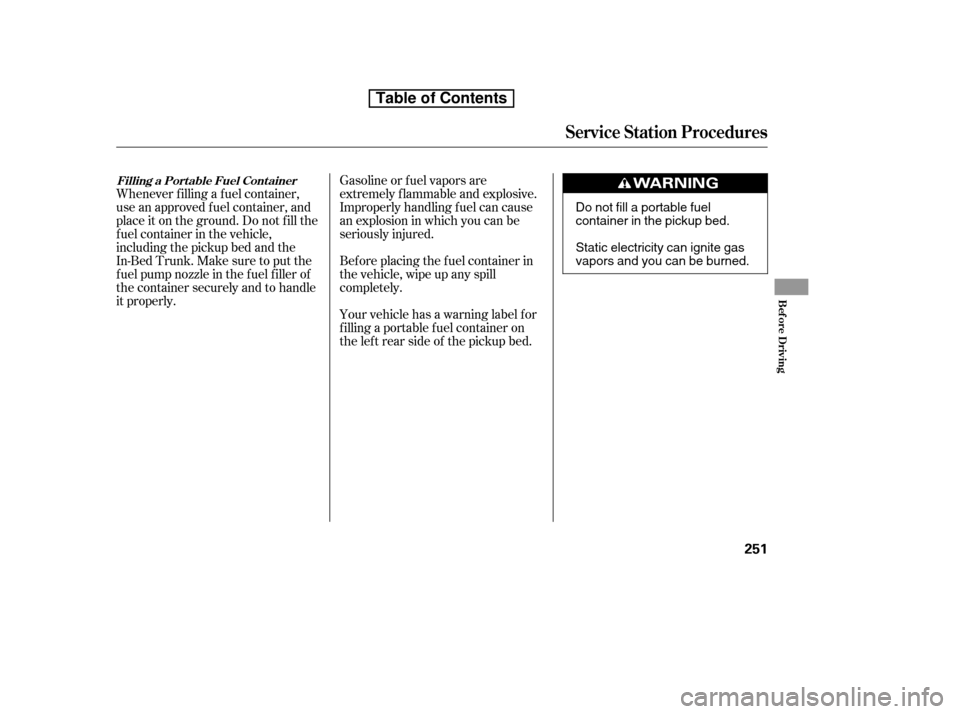
Whenever f illing a f uel container,
use an approved f uel container, and
place it on the ground. Do not f ill the
f uel container in the vehicle,
including the pickup bed and the
In-Bed Trunk. Make sure to put the
f uel pump nozzle in the f uel f iller of
the container securely and to handle
it properly.Gasoline or f uel vapors are
extremely f lammable and explosive.
Improperly handling f uel can cause
anexplosioninwhichyoucanbe
seriously injured.
Before placing the fuel container in
the vehicle, wipe up any spill
completely.
Your vehicle has a warning label f or
f illing a portable f uel container on
the lef t rear side of the pickup bed.
Filling a Port able Fuel Cont ainer
Service Station Procedures
Bef ore Driving
251
Do not fill a portable fuel
container in the pickup bed.
Static electricity can ignite gas
vapors and you can be burned.
Table of Contents
Page 346 of 421
If there is a problem with the TPMS,
thetirepressuremonitorshowsa
‘‘SYSTEM FUNCTION ERROR’’
message and the tire pressure
readings are not displayed. If this
happens, you will f irst see a system
warning message ‘‘CHECK TPMS
SYSTEM’’ on the multi-inf ormation
display.If there is a problem with the TPMS,
youwillseetheabovemessageon
the multi-information display.
If you see this message, the system
is of f and is not monitoring the tire
pressures. Have the system checked
by your dealer as soon as possible.Also, the low tire pressure/TPMS
indicator begins to f lash, then stays
on (see page ).
281
Tire Pressure Monitoring System (TPMS)
TPMS System Failure
284
Table of Contents
Page 347 of 421

If the low tire pressure/TPMS
indicator comes on, or the multi-
inf ormation display shows a
‘‘CHECK TPMS SYSTEM’’ message,
the VSA system automatically turns
on even when the VSA system is
turned of f by pressing the VSA OFF
switch (see page ). If this
happens, you cannot turn the VSA
system of f by pressing the VSA OFF
switch again.
When you restart the vehicle with
thecompactsparetire,theTPMS
system message will also be
displayed on the multi-inf ormation
display af ter several miles
(kilometers) driving.This indicator and the warning
message on the multi-information
display will go of f , af ter several miles
(kilometers) driving, when the spare
tire is replaced with the specified
regular tire equipped with the tire
pressure monitor sensor.
Each wheel is equipped with a tire
pressure sensor mounted inside the
tire behind the valve stem. You must
use TPMS specif ic wheels. It is
recommended that you always have
your tires serviced by your dealer or
a qualif ied technician.
Never use a puncture-repairing agent
in a f lat tire. If used, you will have to
replace the tire pressure sensor.
Havetheflattirerepairedbyyour
dealer as soon as possible.
If you have a f lat tire, the low tire
pressure/TPMS and tire monitor
indicators will come on. Replace the
indicated f lat tire with the compact
sparetire(seepage ).
After the flat tire is replaced with the
spare tire, the low tire pressure/
TPMS indicator stays on while
driving. Af ter several miles
(kilometers) driving, this indicator
begins to f lash, then stays on again.
You will also see a ‘‘CHECK TPMS
SYSTEM’’ message on the multi-
inf ormation display. This is normal;
the system cannot monitor the spare
tire pressure. Manually check the
spare tire pressure to be sure it is
correct.
292
361
CONT INUED
Tire Pressure Monitoring System (TPMS)
Changing a T ire with T PMS
Driving
285
Table of Contents
Page 375 of 421

Turn on the hazard warning lights,
and turn the ignition switch to the
LOCK (0) position. Have all
passengers get out of the vehicle
while you change the tire.
Park the vehicle on f irm, level, and
non-slippery ground. Put the
transmission in Park. Apply the
parking brake.
If you are towing a trailer, unhitch
it.
If you have a f lat tire while driving,
stop in a saf e place to change it.
Drive slowly along the shoulder until
you get to an exit or an area to stop
that is far away from the traffic lanes.
If you tow a trailer f requently, we
recommend that you use a regular
tire as a spare. You can store the
regular size spare tire on the tire tray,
but store the tool kit at the side of
the In-Bed Trunk (see page ),
and secure it.
2.
1.
367
CONT INUED
Changing a Flat T ire
T aking Care of t he Unexpect ed
361
TOOL BOX SPARE TIRE
The vehicle can easily roll off
the jack, seriously injuring
anyone underneath.
Follow the directions for
changing a tire exactly, and
never get under the vehicle
when it is supported only by thejack.
Table of Contents
Page 386 of 421

If you see steam and/or spray
coming f rom under the hood, turn
of f the engine. Wait until you see
no more signs of steam or spray,
then open the hood.
If you do not see steam or spray,
leave the engine running and
watch the temperature gauge. If
the high heat is due to overloading,
the engine should start to cool
down almost immediately. If it
does, wait until the temperature
gauge comes down to the midpoint,
then continue driving.
Saf ely pull to the side of the road.
Put the transmission in Park, and
set the parking brake. Turn of f all
the accessories, and turn on the
hazard warning lights.
The pointer of your vehicle’s
temperature gauge should stay in
the midrange under most conditions.
If it climbs to the red mark, you
should determine the reason (hot
day, driving up a steep hill, etc.).
If the vehicle overheats, you should
take immediate action. The only
indication may be the temperature
gauge climbing to or above the red
mark. Or you may see steam or
spray coming f rom under the hood. 1.
2.
3.
If theEngineOverheats
372
Steam and spray from an
overheated engine can
seriously scald you.
Do not open the hood if steam
is coming out.
Driving with the temperature gauge
pointer at the red mark can cause
serious damage to the engine.
Table of Contents
Page 388 of 421

Saf ely pull of f the road, and shut
of f the engine. Turn on the hazard
warning indicators.
Let the vehicle sit f or a minute.
Open the hood, and check the oil
level (see page ). An engine
very low on oil can lose pressure
during cornering and other driving
maneuvers.
If necessary, add oil to bring the
level back to the full mark on the
dipstick (see page ).If the charging system
indicator comes on brightly
when the engine is running, the
battery is not being charged.
This indicator should never
come on when the engine is
running. If it starts f lashing or stays
on, the oil pressure has dropped very
low or lost pressure. Serious engine
damage is possible, and you should
take immediate action.
Start the engine, and watch the oil
pressure indicator. If it does not go
out within 10 seconds, turn of f the
engine. There is a mechanical
problem that needs to be repaired
bef ore you can continue driving
(see on page).
You will also see a ‘‘CHECK
ENGINE OIL LEVEL’’ message on
the multi-information display when
this indicator comes on.
Go to a service station or garage
where you can get technical
assistance.
Immediately turn of f all electrical
accessories. Try not to use other
electrically operated controls such as
the power windows. Keep the engine
running; starting the engine will
discharge the battery rapidly.
You will also see a ‘‘CHECK
CHARGING SYSTEM’’ message on
the multi-information display (see
page ).
1. 2. 3. 4.
253
326
383 90
On models with navigation system
On models with navigation system
L ow Oil Pressure Indicator
Charging System Indicator
Emergency T owing
L ow Oil Pressure Indicator, Charging System Indicator
374
Running the engine with low oil
pressure can cause serious mechanical
damage almost immediately. Turn of f
the engine as soon as you can saf ely get
the vehicle stopped.
Table of Contents
Page 404 of 421

The tires on your vehicle meet all
U.S. Federal Saf ety Requirements.
All tires are also graded f or
treadwear, traction, and temperature
perf ormance according to
Department of Transportation
(DOT) standards. The f ollowing
explains these gradings.The treadwear grade is a compara-
tive rating based on the wear rate of
the tire when tested under controlled
conditions on a specif ied government
test course. For example, a tire
graded 150 would wear one and one-
half (1 1/2) times as well on the
government course as a tire graded
100. The relative perf ormance of
tires depends upon the actual condi-
tions of their use, however, and may
depart signif icantly f rom the norm
due to variations in driving habits,
service practices and dif f erences in
road characteristics and climate.The traction grades, f rom highest to
lowest, are AA, A, B, and C. Those
grades represent the tire’s ability to
stop on wet pavement as measured
under controlled conditions on
specif ied government test surf aces
of asphalt and concrete. A tire
marked C may have poor traction
perf ormance.
Warning: The traction grade
assignedtothistireisbasedon
straight-ahead braking traction tests,
and does not include acceleration,
cornering, hydroplaning, or peak
traction characteristics.
Quality grades can be f ound where
applicable on the tire sidewall
between tread shoulder and
maximum section width. For
example:
All passenger car tires must conf orm
to Federal Saf ety Requirements in
addition to these grades.
Unif orm T ire Quality Grading
T readwear T raction
T readwear 200
Traction AA
Temperature A
DOT T ire Quality Grading (U.S. Vehicles)
390
Table of Contents