Page 460 of 526
Tires
Maint enance
457
Using the wrong chains, or not
properly installing chains, can
damage the brake lines and
cause a crash in which you can
be seriously injured or killed.
Follow all instructions in this
owner’s manual regarding the
selection and use of tire chains.Traction devices that are the wrong
size or improperly installed can
damage your vehicle’s brake lines,
suspension, body, and wheels. Stop
driving if they are hitting any part of
the vehicle.
�����—�����—�
���y�
�������������y���
�(�����������y���������y
2010 Odyssey
Page 465 of 526
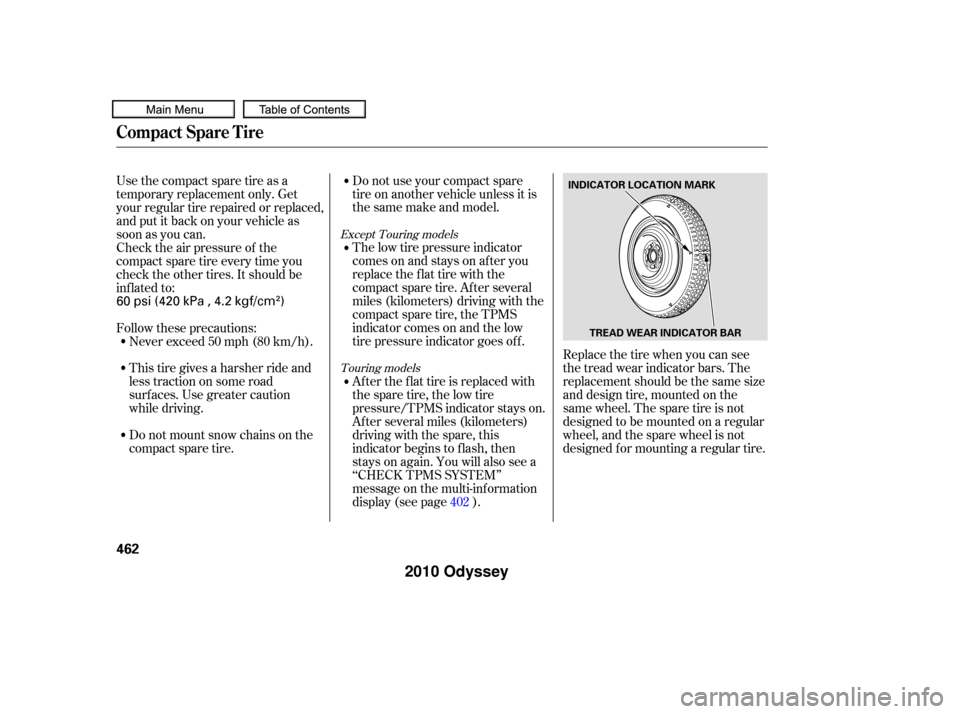
Replace the tire when you can see
the tread wear indicator bars. The
replacement should be the same size
and design tire, mounted on the
same wheel. The spare tire is not
designed to be mounted on a regular
wheel, and the spare wheel is not
designed f or mounting a regular tire.
Do not use your compact spare
tire on another vehicle unless it is
thesamemakeandmodel.
The low tire pressure indicator
comes on and stays on af ter you
replace the flat tire with the
compact spare tire. Af ter several
miles (kilometers) driving with the
compact spare tire, the TPMS
indicator comes on and the low
tire pressure indicator goes of f .
After the flat tire is replaced with
the spare tire, the low tire
pressure/TPMS indicator stays on.
Af ter several miles (kilometers)
driving with the spare, this
indicator begins to f lash, then
stays on again. You will also see a
‘‘CHECK TPMS SYSTEM’’
message on the multi-inf ormation
display (see page ).
Use the compact spare tire as a
temporary replacement only. Get
your regular tire repaired or replaced,
and put it back on your vehicle as
soon as you can.
Check the air pressure of the
compact spare tire every time you
check the other tires. It should be
inf lated to:
Follow these precautions:
Never exceed 50 mph (80 km/h).
This tire gives a harsher ride and
less traction on some road
surf aces. Use greater caution
while driving.
Do not mount snow chains on the
compact spare tire.
402
Except Touring models
Touring models
Compact Spare Tire
462
INDICATOR LOCATION MARK
TREAD WEAR INDICATOR BAR
60 psi (420 kPa , 4.2 kgf/cm)
�����—�����—�
���y�
������
������y���
�(�����������y���������y
2010 Odyssey
Page 492 of 526

�µ
Thediagramsinthissectiongive
you the dimensions and capacities of
your vehicle and the locations of the
identif ication numbers. It also
includes inf ormation you should
know about your vehicle’s tires and
emissions control systems.
................
Identif ication Numbers . 490
................................
Specif ications .492
DOT Tire Quality Grading ......................
(U.S. Vehicles) .494
Unif orm Tire Quality ..................................
Grading .494
.................................
Treadwear .494
......................................
Traction .494
.............................
Temperature .495
.................................
Tire Labeling .496
Tire Pressure Monitoring System (TPMS) Required Federal ............................
Explanation .498
.......................
Emissions Controls .501
.....................
The Clean Air Act .501
Crankcase Emissions Control ....................................
System .501
Evaporative Emissions Control ....................................
System .501
Onboard Ref ueling Vapor ................................
Recovery .501
...
Exhaust Emissions Controls . 502
....................
PGM-FI System .502
Ignition Timing Control ................................
System .502 Exhaust Gas Recirculation
...................
(EGR) System . 502
Three Way Catalytic ...........................
Converter .502
....................
Replacement Parts . 502
..
Three Way Catalytic Converter . 503
........................
Emissions Testing .504
....
Testing of Readiness Codes . 504
T echnical Inf ormation
Technical Inf ormation
489
�����—�����—�
���y�
�������������y���
�(�����������y���������y
2010 Odyssey
Page 497 of 526

The tires on your car meet all U.S.
Federal Saf ety Requirements. All
tires are also graded for treadwear,
traction, and temperature perform-
ance according to
Department of Transportation
(DOT) standards. The f ollowing
explains these gradings.
Quality grades can be f ound where
applicable on the tire sidewall
between tread shoulder and
maximum section width. For
example:
All passenger car tires must conf orm
to Federal Saf ety Requirements in
addition to these grades.The treadwear grade is a compara-
tive rating based on the wear rate of
the tire when tested under controlled
conditions on a specif ied government
test course. For example, a tire
graded 150 would wear one and one-
half (1 1/2) times as well on the
government course as a tire graded
100. The relative perf ormance of
tires depends upon the actual condi-
tions of their use, however, and may
depart signif icantly f rom the norm
due to variations in driving habits,
service practices and dif f erences in
road characteristics and climate.
The traction grades, f rom highest to
lowest, are AA, A, B, and C. Those
grades represent the tire’s ability to
stop on wet pavement as measured
under controlled conditions on
specif ied government test surf aces
of asphalt and concrete. A tire
marked C may have poor traction
perf ormance.
Warning: The traction grade
assignedtothistireisbasedon
straight-ahead braking traction tests,
and does not include acceleration,
cornering, hydroplaning, or peak
traction characteristics.
DOT Tire Quality Grading (U.S. Vehicles)
Unif orm T ire Quality Grading
T readwear 200
Traction AA
Temperature A T readwear
T raction
494
�����—�����—�
���y�
�������������y���
�(�����������y���������y
2010 Odyssey