Page 288 of 450

CONT INUED
Stop f illing the tank af ter the f uel
nozzle automatically clicks of f . Do
not try to ‘‘top off’’ the tank. This
leaves some room in the f uel tank
for the fuel to expand with
temperature changes.
Park with the driver’s side closest
to the service station pump. Removethefuelfillcapslowly.
You may hear a hissing sound as
pressure inside the tank equalizes.
The fuel fill cap is attached to the
f uel f iller with a tether. Place the
cap in the holder on the f uel f ill
door.
even though the tank is not f ull,
there may be a problem with your
vehicle’s fuel vapor recovery
system. The system helps keep
f uel vapor f rom going into the
atmosphere. Try f illing at another
pump. If this does not f ix the
problem, consult your dealer.
Push on the right edge of the f uel
f ill door and release it so that it
pops open. Pull it out to open it
f ully.
1.
2. 3.
4.
If the f uel nozzle keeps clicking of f
Service Station Procedures
Ref ueling
Bef ore Driving
285
Push
HOLDERFUEL FILL CAP
TETHER
FUEL FILL DOOR
Gasoline is highly flammable
and explosive. You can be
burned or seriously injured
when handling fuel.
Stop the engine, and keep
heat, sparks, and flame away.
Handle fuel only outdoors.
Wipe up spills immediately.
�����—�
���—�����y�
�������������y���
�)�"���������y���������y
2010 Insight
Page 289 of 450

Push the f uel f ill door closed until
it latches. Screw the fuel fill cap back on
until it clicks at least once. If you
do not properly tighten the cap,
you will see a ‘‘TIGHTEN FUEL
CAP’’ message on the multi-
inf ormation display. If the system
still detects an evaporative system
leak af ter retightening the cap, the
malf unction indicator lamp may
come on (see page ).Your vehicle’s on board diagnostic
system will detect a loose or missing
f uel f ill cap as an evaporative system
leak. The f irst time a leak is detected
a ‘‘TIGHTEN FUEL CAP’’ message
appears on the multi-inf ormation
display. Turn the engine of f , and conf irm the
f uel f ill cap is installed. If it is, loosen
it, then retighten it until it clicks at
least once. The message should go
off after several days of normal
driving once you tighten or replace
thefuelfillcap.Toscrolltoanother
message, press the INFO button.
The ‘‘TIGHTEN FUEL CAP’’
message will appear each time you
restart the engine until the system
turns the message off.
5.
6.
403
Service Station Procedures
Tighten Fuel Cap Message
286
�����—�
���—�����y�
�������������y���
�)�"���������y�������
�y
2010 Insight
Page 290 of 450

Park the vehicle, and set the
parking brake. Pull the hood
release handle located under the
lower lef t corner of the dashboard.
The hood will pop up slightly.
If the system still detects a leak in
the vehicle’s evaporative emissions
system, the malf unction indicator
lamp (MIL) comes on. If the f uel f ill
cap was not already tightened, turn
the engine of f , and check or
retighten the f uel f ill cap until it
clicks at least once. The MIL should
go off after several days of normal
driving once the cap is tightened or
replaced. If the MIL does not go of f ,
have your vehicle inspected by a
dealer. For more inf ormation, see
page .
If the hood latch handle moves
stif f ly, or if you can open the hood
without lifting the handle, the
mechanism should be cleaned and
lubricated. Put your f ingers under the f ront
edge of the hood near the center.
Slide your hand to the lef t until
you f eel the hood latch handle.
Push this handle to the lef t to
release the hood. Lif t up the hood.
1.
2.
403
CONT INUED
Opening and Closing the Hood
Service Station Procedures
Bef ore Driving
287
LATCH
HOOD RELEASE HANDLE
Pull
�����—�
���—�����y�
�����������
�y���
�)�"���������y���������y
2010 Insight
Page 291 of 450
Insert the dipstick all the way back
into its hole. Wipe of f the dipstick with a clean
cloth or paper towel. Remove the dipstick (orange loop).
Wait a f ew minutes af ter turning the
engine of f bef ore you check the oil.
To close the hood, lif t it up slightly to
remove the support rod f rom the
hole. Put the support rod back into
its holding clip. Lower the hood to
about a f oot (30 cm) above the
f ender, then let it drop. Make sure it
is securely latched.
Holding the grip, pull the support
rod out of its clip. Insert the end
into the designated hole in the
hood. 2.
3. 1.
3. Oil Check
Service Station Procedures
288
DIPSTICK
SUPPORT ROD CLIP
GRIP
�����—�
���—�����y�
���������
���y���
�)�"���������y���������y
2010 Insight
Page 292 of 450
Refer toon page f or inf ormation
about checking other items on your
vehicle.
Look at the coolant level in the
radiator reserve tank. Make sure it is
between the MAX and MIN lines. If
it is below the MIN line, see on page f or
inf ormation on adding the proper
coolant.
Remove the dipstick again, and
check the level. It should be
between the upper and lower
marks.
If it is near or below the lower mark,
see on page .
4.
348 353345
Owner’s Maintenance
Checks
Engine Coolant Check
A dding
Engine Coolant
A dding Engine Oil
Service Station Procedures
Bef ore Driving
289
MAX
MIN
LOWER MARK
UPPER MARK RESERVE TANK
�����—�
���—�����y�
���������
���y���
�)�"���������y���������y
2010 Insight
Page 294 of 450

�µ�µ
�µ
�µ�µ�µ
Aggressive driving (hard
acceleration and braking)
Excessive idling, accelerating and
braking in stop-and-go traf f ic
Cold engine operation (engines
aremoreefficientwhenwarmed
up)
Driving with a heavy load or the
air conditioner running
Improperly inf lated tires
The f ollowing f actors can lower your
vehicle’s f uel economy:
A properly maintained vehicle
maximizes f uel economy. Poor
maintenance can signif icantly reduce
f uel economy. Always maintain your
vehicle according to the maintenance
messages displayed on the multi-
inf ormation display (see
on page ).
For example: Rapid
acceleration, abrupt cornering,
and hard braking increase fuel
consumption.
Aerodynamic drag has a big ef f ect
on f uel economy at speeds above
45 mph (75 km/h). Reduce your
speed and you reduce the drag.
Trailers, car top carriers, roof
racks and bike racks are also big
contributors to increased drag.
An underinf lated tire increases
‘‘rolling resistance,’’ which reduces
f uel economy.
It puts a heavier
load on the engine, increasing f uel
consumption.
In
particular, a build-up of snow or
mud on your vehicle’s underside
adds weight and rolling resistance.
Frequent cleaning helps your f uel
economy. Idling
results in 0 miles per gallon (0 kms
per liter).
Use the ECON ON mode as much
as possible.
345
CONT INUED
Fuel Economy Factors Use the recommended viscosity
motor oil, displaying the A PI
Certif ication Seal (see page ).
Improving Fuel Economy Owner’s
Maintenance Checks Drive moderately
Observe the speed limit
Maintain proper tire inf lation
A void carrying excess weight in
your vehicle
K eep your vehicle clean
A void excessive idling
348
Vehicle Maint enance Drive Ef f icient ly
Fuel Economy
Bef ore Driving
291
�����—�
���—�����y�
�������������y���
�)�"���������y���������y
2010 Insight
Page 295 of 450
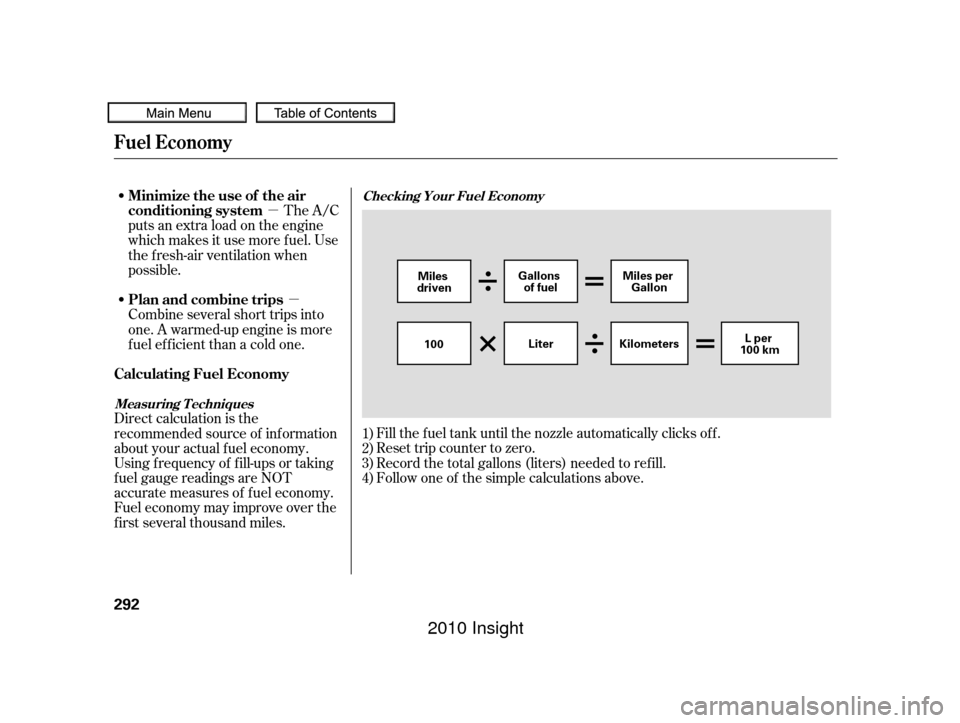
�µ�µ
Fill the f uel tank until the nozzle automatically clicks of f .
Reset trip counter to zero.
Record the total gallons (liters) needed to ref ill.
Follow one of the simple calculations above.
The A/C
puts an extra load on the engine
which makes it use more f uel. Use
the f resh-air ventilation when
possible.
Direct calculation is the
recommended source of inf ormation
about your actual f uel economy.
Using f requency of f ill-ups or taking
f uel gauge readings are NOT
accurate measures of f uel economy.
Fuel economy may improve over the
f irst several thousand miles. Combine several short trips into
one. A warmed-up engine is more
f uel ef f icient than a cold one.
1)
2)
3)
4)
Checking Your Fuel Economy
Measuring T echniquesMinimize the use of the air
conditioning system
Calculating Fuel Economy Plan and combine trips
Fuel Economy
292
Miles
driven Gallons
of fuel Miles per
Gallon
100 KilometersLper
100 km
Liter
�����—�
���—�����y�
�������������y���
�)�"���������y���������y
2010 Insight
Page 304 of 450

This section gives you tips on
starting the engine under various
conditions, and how to operate the
automatic transmissions (CVT). It
also includes important inf ormation
on parking your vehicle, the braking
system, the vehicle stability assist
(VSA
) system, and the tire pressure
monitoring system (TPMS). ........................
Preparing to Drive .302
.......................
Starting the Engine .303
Ecological Drive Assist System ............................
(Eco Assist .304
.
Automatic Transmission (CVT) . 311
Driving with the Paddle .......................................
Shif ters .316
................................
Auto Idle Stop .321
...........................................
Parking .323
.............................
Braking System .324
...............
Anti-lock Brakes (ABS) . 326
Tire Pressure Monitoring System ......................................
(TPMS) .328
Vehicle Stability Assist (VSA
),
aka Electronic Stability ........
Control (ESC), System . 332
...........................
Towing a Trailer .334
Driving
Driving
301
TM)
�����—�
���—�����y�
�����������
�y���
�)�"���������y���������y
2010 Insight

