2010 HONDA FIT ABS
[x] Cancel search: ABSPage 1 of 351

A
Accessories andModifications ..........................
206
ACCESSORY (Ignition Key Position) ...................................
80
Accessory Power Socket ............
106
Additives, Engine Oil .................
254
Adjusting the Steering Wheel ......
77
Advanced Airbags ........................
27
Airbag (SRS) ............................
9, 22
Air Conditioning System ............
110
Usage ......................................
112
Air Pressure, Tires ..............
273, 274
Alcohol in Gasoline ....................
198
Antifreeze ...................................
256
Anti-lock Brakes (ABS) Indicator ............................
62, 231
Operation ................................
231
Anti-theft, Audio System .............
191
Anti-theft Steering Column Lock .........................................
80
Audio Antenna ...........................
268
Auto Door Locking .......................
83
Auto Door Locking/Unlocking ....
83 Auto Door Unlocking
...................
85
Automatic Seat Belt Tensioners ...
20
Automatic Speed Control ...........
194
Automatic Transmission ............
219
Capacity, Fluid ........................
319
Checking Fluid Level ..............
259
Paddle Shifters ........................
224
Shifting ...................................
219
Shift Lever Position Indicators ............................
219
Shift Lever Positions ...............
220
Shift Lock Release ...................
223
Automatic Transmission Fluid ...
259
Auxiliary Input Jack ...................
190
Average Fuel Economy ................
70
B
Battery Charging System Indicator ........................
60, 303
Jump Starting ..........................
299
Maintenance ...........................
279
Specifications ..........................
320
Before Driving ...........................
197Belts, Seat
................................ 8, 18
Beverage Holders ......................
106
Booster Seats ...............................
50
Brakes Anti-lock Brakes (ABS) ...........
231
Break-in, New Linings .............
198
Bulb Replacement ...................
266
Fluid .......................................
261
Parking ...................................
102
System Design ........................
230
System Indicator ...............
60, 305
Wear Indicators .......................
230
Braking System ..........................
230
Break-in, New Vehicle ................
198
Brightness Control, Instruments ..............................
76
CONTINUED
Index
I
INDEX
Page 5 of 351

Manual Transmission..............217
Glove Box .................................. 105
Gross Vehicle Weight Rating (GVWR) ................................. 210
H
Halogen Headlight Bulbs ...........262
Hazard Warning Flashers ............76
Headlights ............................. 74, 75
Aiming .................................... 262
Daytime Running Lights (Canada only) ..................................... 75
High Beam Indicator ................65
High Beams, Turning on ..........74
Lights On Indicator ..................64
Low Beams, Turning on ...........74
Reminder Chime .................74, 75
Replacing Halogen Bulbs ........262
Turning on ............................... 74
Head Restraints ............................ 94
Heated Mirror ............................ 102
Heating and Cooling ..................110
High Altitude, Starting at ............216
High Beam Lever .........................75High-Low Beam Switch
................74
Hood, Opening and Closing
the .......................................... 200
Horn ........................................ 4, 72
Hydraulic Clutch ........................261
I
Identification Number, Vehicle ................................... 316
Ignition Keys ......................................... 78
Switch ...................................... 80
Timing Control System ...........327
Immobilizer System .....................79
Important Safety Precautions .........6
Indicators, Instrument Panel ........59
ABS (Anti-lock Brake) .......62, 231
Brake (Parking and Brake
System) ......................... 60, 305
Charging System ..............60, 303
Check Fuel Cap .......................70
Cruise Control .......................... 65
Cruise Main ............................. 65
Door and Tailgate Open ...........62DRL (Daytime Running
Lights) ..................................
65
Electric Power Steering ............62
Fog Lights ................................ 64
High Beam ............................... 65
High Temperature ...................63
Key (Immobilizer System) .......66
Lights On ................................. 64
Low Fuel .................................. 62
Low Oil Pressure ..............60, 303
Low Temperature .....................63
Low Tire Pressure .............64, 235
Maintenance Minder .........66, 245
Malfunction Indicator Lamp ............................. 60, 304
Passenger Airbag Off ...............31
Seat Belt Reminder .............18, 60
Security System .......................66
Side Airbag Off ....................31, 61
SRS ..................................... 30, 61
TPMS ................................ 64, 236
Turn Signal and Hazard
Warning ............................... 63
VSA Off .................................... 67
VSA System ............................. 67
CONTINUED
Index
V
INDEX
Page 78 of 351

Anti-lock Brake System
(ABS) Indicator
This indicator normally comes on for
a few seconds when you turn the
ignition switch to the ON (II)
position, and when the ignition
switch is turned to the START (III)
position. If it comes on at any other
time, there is a problem with the
ABS. If this happens, have your
vehicle checked at a dealer. With this
indicator on, your vehicle still has
normal braking ability but no anti-
lock function. For more information,
see page 231.Electric Power Steering
(EPS) Indicator
This indicator normally comes on when
you turn the ignition switch to the ON
(II) position and goes off after the
engine starts. If it comes on at any
other time, there is a problem in the
electric power steering system. If this
happens, stop the vehicle in a safe
place and turn off the engine. Reset the
system by restarting the engine. The
indicator will not turn off immediately.
If it does not go off after driving a short
distance, or comes back on again while
driving, take the vehicle to your dealer
to have it checked. With the indicator
on, the EPS may be turned off, making
the vehicle harder to steer.
If you turn the steering wheel to the
full left or right position repeatedly
while stopping or driving at very low
speed, you may feel slightly harder
steering in order to prevent damage to
the steering box caused by overheating.Low Fuel Indicator
This indicator comes on as a
reminder that you must refuel soon.
When the indicator comes on, there
is about 1.64 US gal (6.2 L) of fuel
remaining in the tank before the
needle reaches E. There is a small
reserve of fuel remaining in the tank
when the needle does reach E.
Door and Tailgate Open Indicator
This indicator comes on if any door
or the tailgate is not closed tightly.
Instrument Panel Indicators
62
Table of Contents
Page 117 of 351
AUTO-To open or close the
driver's window, push or pull the
window switch firmly down or up to
the second detent, and release it.
The window will automatically go
down or up all the way. To stop the
window, pull or push the window
switch briefly.
AUTO REVERSE -If the driver's
window senses any obstacle while it
is closing automatically, it will
reverse direction, and then stop. To
close the window, remove the
obstacle, then use the window switchagain.
Auto reverse stops sensing when the
window is almost closed. You should
always check that all passengers and
objects are away from the window
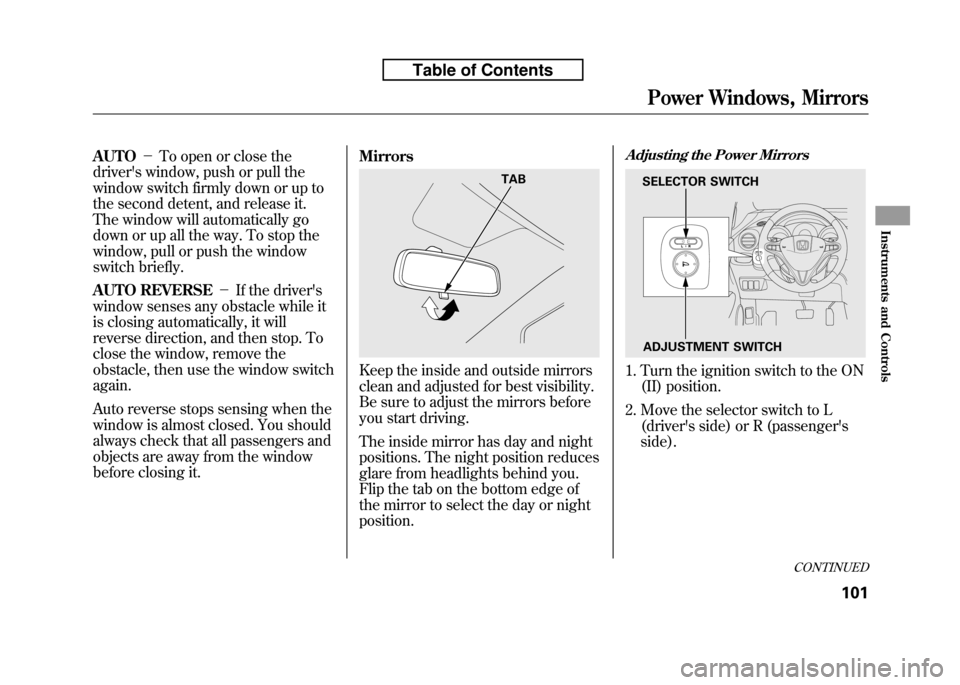
before closing it. Mirrors
Keep the inside and outside mirrors
clean and adjusted for best visibility.
Be sure to adjust the mirrors before
you start driving.
The inside mirror has day and night
positions. The night position reduces
glare from headlights behind you.
Flip the tab on the bottom edge of
the mirror to select the day or nightposition.
Adjusting the Power Mirrors
1. Turn the ignition switch to the ON
(II) position.
2. Move the selector switch to L (driver's side) or R (passenger's side).
TABSELECTOR SWITCH
ADJUSTMENT SWITCH
CONTINUED
Power Windows, Mirrors
101
Instruments and Controls
Table of Contents
Page 228 of 351

This section gives you tips on
starting the engine under various
conditions, and how to operate the
manual and automatic transmissions.
It also includes important information
on parking your vehicle, the braking
system, the vehicle stability assist(VSA
®), and the tire pressure
monitoring system (TPMS).
Driving Guidelines ......................214
Preparing to Drive ......................
215
Starting the Engine .....................
216
Manual Transmission .................
217
Automatic Transmission .............
219
Driving with the Paddle Shifters
(Sport only) .............................
224
Parking .......................................
229
Braking System ..........................
230
Anti-lock Brakes (ABS) ...............
231
Vehicle Stability Assist (VSA
®),
aka Electronic Stability Control
(ESC), System .....................
233
Tire Pressure Monitoring System (TPMS) ...................................
235
Towing a Trailer ..........................
238
Towing Your Vehicle Behind a
Motorhome .............................
238
Driving
213
Driving
Page 245 of 351

Your vehicle is equipped with front
disc brakes. The brakes on the rear
wheels are drum. A power assist
helps reduce the effort needed on the
brake pedal. The anti-lock brake
system (ABS) helps you retain
steering control when braking veryhard.
Resting your foot on the pedal keeps
the brakes applied lightly, builds up
heat, and reduces their effectiveness
and reduces brake pad life. In
addition, fuel economy can be
reduced. It also keeps your brake
lights on all the time, confusing
drivers behind you.
Constant application of the brakes
when going down a long hill builds
up heat and reduces their
effectiveness. Use the engine to
assist the brakes by taking your foot
off the accelerator and downshifting
to a lower gear.Check your brakes after driving
through deep water. Apply the
brakes moderately to see if they feel
normal. If not, apply them gently and
frequently until they do. Be extra
cautious and alert in your driving.
Braking System Design
The hydraulic system that operates
the brakes has two separate circuits.
Each circuit works diagonally across
the vehicle (the left-front brake is
connected with the right-rear brake,
etc.). If one circuit should develop a
problem, you will still have braking
at two wheels.
Brake Pad Wear Indicators
If the front brake pads need
replacing, you will hear a distinctive,
metallic screeching sound when you
apply the brake pedal. If you do not
have the brake pads replaced, they
will screech all the time. It is normal
for the brakes to occasionally squeal
or squeak when you apply them.
Braking System
230
Table of Contents
Page 246 of 351

The anti-lock brake system (ABS)
helps prevent the wheels from
locking up, and helps you retain
steering control by pumping the
brakes rapidly, much faster than a
person can do it.
The electronic brake distribution
(EBD) system, which is part of the
ABS, also balances the front-to-rear
braking distribution according to
vehicle loading.
You should never pump the brake pedal.
Let the ABS work for you by always
keeping firm, steady pressure on the
brake pedal. This is sometimes
referred to as‘‘stomp and steer. ’’You will feel a pulsation in the brake
pedal when the ABS activates, and
you may hear some noise. This is
normal: it is the ABS rapidly
pumping the brakes. On dry
pavement, you will need to press on
the brake pedal very hard before the
ABS activates. However, you may
feel the ABS activate immediately if
you are trying to stop on snow or ice.
ABS Indicator
If the ABS indicator comes on, the
anti-lock function of the braking
system has shut down. The brakes
still work like a conventional system,
but without anti-lock. You should
have your dealer inspect your vehicle
as soon as possible.
If the ABS indicator comes on while
driving, test the brakes as shown on
page 305.
CONTINUED
Anti-lock Brakes (ABS)
231
Driving
Table of Contents
Page 247 of 351

If the ABS indicator and the brake
system indicator come on together,
and the parking brake is fully
released, the EBD system may also
be shut down.
Test your brakes as instructed on
page 305. If the brakes feel normal,
drive slowly and have your vehicle
repaired by your dealer as soon as
possible. Avoid sudden hard braking
which could cause the rear wheels to
lock up and possibly lead to a loss ofcontrol.
On vehicles with VSA system
The VSA indicator will come on
along with the ABS indicator.Important Safety Reminders
ABS does not reduce the time or
distance it takes to stop thevehicle.
It only helps with the
steering control during braking.
ABS will not prevent a skid that
results from changing directionabruptly, such as trying to take a
corner too fast or making a sudden
lane change. Always drive at a safe
speed for the road and weatherconditions.
ABS cannot prevent a loss of stability. Always steer moderately
when you are braking hard. Severe
or sharp steering wheel movement
can still cause your vehicle to veer
into oncoming traffic or off the road. A vehicle with ABS may require a
longer distance to stop
on loose or
uneven surfaces, such as gravel or
snow, than a vehicle without anti-lock.
Anti-lock Brakes (ABS)
232
Table of Contents