Page 381 of 441

If you remove a f loor mat, make sure
tore-anchoritwhenyouputitback
in your vehicle.
If you use a non-Honda f loor mat,
make sure it f its properly and that it
canbeusedwiththefloormat
anchors. Do not put additional f loor
mats on top of the anchored mats.This f ilter removes the dust and
pollenthatisbroughtinfromthe
outside through the heating and
cooling system/climate control
system.
Have your dealer replace this filter
when this service is indicated by a
maintenance message on the
inf ormation display. It should be
replaced every 15,000 miles (24,000
km) if you drive primarily in urban
areas that have high concentrations
of soot in the air, or if the airf low
from the heating and cooling
system/climate control system
becomeslessthanusual.
Dust and Pollen Filter
A udio A ntenna
Floor Mats, Audio Antenna, Dust and Pollen Filter
366
Your vehicle is equipped with an
antenna at the rear of the roof . Bef ore
using a ‘‘drive-through’’ car wash,
remove the antenna by unscrewing it by
hand. This prevents the antenna f rom
being damaged by the car wash brushes.
Table of Contents
Page 385 of 441
To saf ely operate your vehicle, your
tires must be the proper type and
size, in good condition with adequate
tread, and correctly inf lated.
The f ollowing pages give more
detailed inf ormation on how to take
care of your tires and what to do
when they need to be replaced.Keeping the tires properly inf lated
provides the best combination of
handling, tread lif e, and riding
comf ort.
Underinf lated tires wear unevenly,
adversely affect handling and fuel
economy, and are more likely to
fail from being overheated.
Overinf lated tires can make your
vehicleridemoreharshly,are
more prone to damage f rom road
hazards, and wear unevenly. The tire pressure monitoring system
(TPMS) warns you when a tire
pressure is low. See page f or
more inf ormation.
Even though your vehicle is
equipped with TPMS, we
recommend that you visually check
your tires every day. If you think a
tire might be low, check it
immediately with a tire gauge.
326
Inf lation Guidelines
Tires
370
Using tires that are excessively
worn or improperly inflated can
cause a crash in which you can
be seriously hurt or killed.
Follow all instructions in this
owner’s manual regarding tire
inflation and maintenance.
Table of Contents
Page 387 of 441

Every time you check inf lation, you
should also examine the tires f or
damage, f oreign objects, and wear.
Youshouldlookfor:Bumps or bulges in the tread or
side of the tire. Replace the tire if
youfindeitherof theseconditions.
Cuts, splits, or cracks in the side
of the tire. Replace the tire if you
can see f abric or cord.
Excessive tread wear. Your tires have wear indicators
molded into the tread. When the
tread wears down, you will see a 1/2
inch (12.7 mm) wide band across the
tread. This shows there is less than
1/16 inch (1.6 mm) of tread lef t on
the tire.
A tire this worn gives very little
traction on wet roads. You should
replace the tire if you can see three
or more tread wear indicators. The service lif e of your tires is
dependent on many f actors,
including, but not limited to, driving
habits, road conditions, vehicle
loading, inf lation pressure,
maintenance history, speed, and
environmental conditions (even
when the tires are not in use).
Tires
Tire Inspection
Tire Service Lif e
372
INDICATOR LOCATION MARKS
TREAD WEAR INDICATOR
Table of Contents
Page 388 of 441
In addition to your regular
inspections and inf lation pressure
maintenance, it is recommended that
you have annual inspections
perf ormed once the tires reach f ive
years old. It is also recommended
that all tires, including the spare, be
removed f rom service af ter 10 years
from the date of manufacture,
regardless of their condition or state
of wear.
The last f our digits of the TIN (tire
identif ication number) are f ound on
the sidewall of the tire and indicate
the date of manufacture (Seeon page ). In addition to proper inf lation,
correct wheel alignment helps to
decrease tire wear. If you f ind a tire
is worn unevenly, have your dealer
check the wheel alignment.
Have your dealer check the tires if
you f eel a consistent vibration while
driving. A tire should always be
rebalanced if it is removed f rom the
wheel. When you have new tires
installed, make sure they are
balanced. This increases riding
comf ort and tire lif e. For best results,
have the installer perform a dynamic
balance.
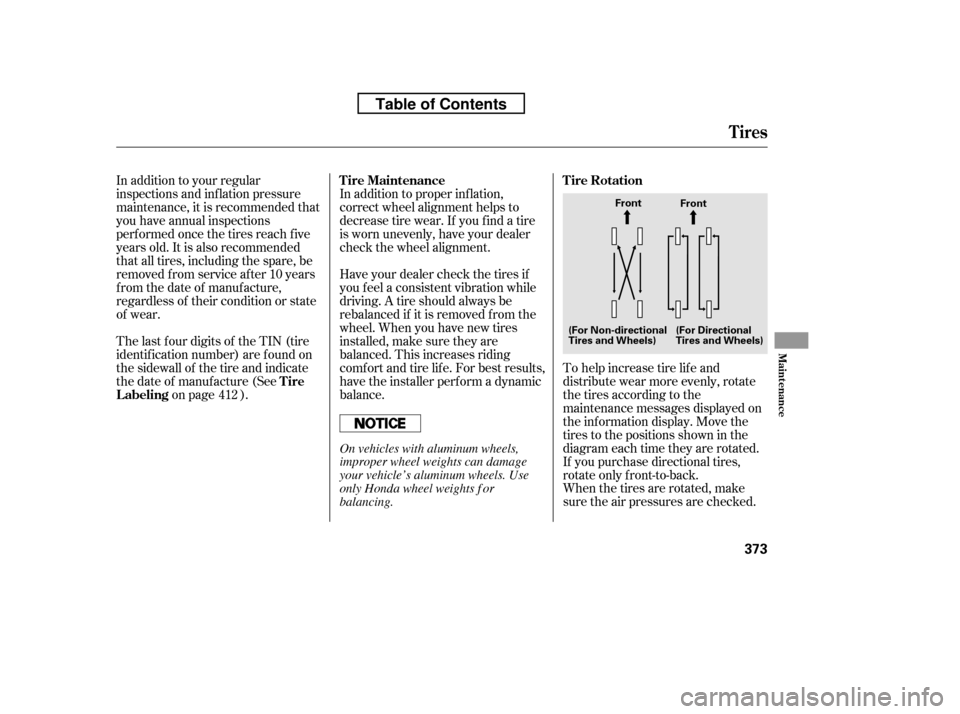
To help increase tire lif e and
distribute wear more evenly, rotate
the tires according to the
maintenance messages displayed on
the information display. Move the
tires to the positions shown in the
diagram each time they are rotated.
If you purchase directional tires,
rotate only front-to-back.
When the tires are rotated, make
sure the air pressures are checked.
412
Tires
Tire
Labeling T ire Maintenance T ire Rotation
Maint enance
373
(For Non-directional
Tires and Wheels)
Front
(For Directional
Tires and Wheels)Front
On vehicles with aluminum wheels,
improper wheel weights can damage
your vehicle’s aluminum wheels. Use
only Honda wheel weights f or
balancing.
Table of Contents
Page 392 of 441
�µ
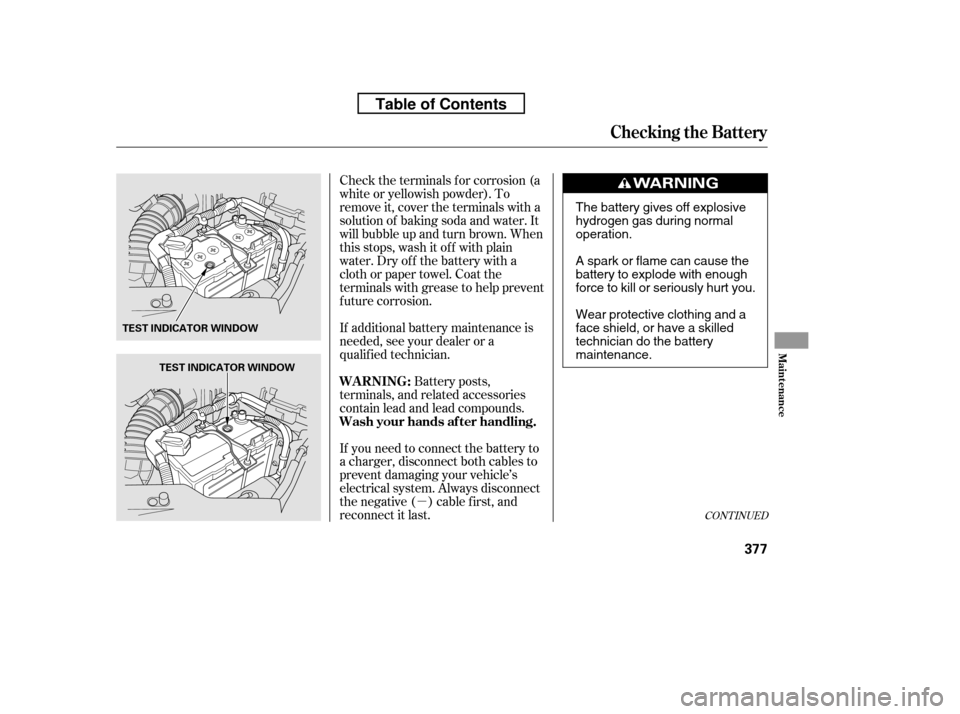
Check the terminals f or corrosion (a
white or yellowish powder). To
remove it, cover the terminals with a
solution of baking soda and water. It
will bubble up and turn brown. When
this stops, wash it of f with plain
water. Dry off the battery with a
cloth or paper towel. Coat the
terminals with grease to help prevent
f uture corrosion.
If you need to connect the battery to
a charger, disconnect both cables to
prevent damaging your vehicle’s
electrical system. Always disconnect
the negative ( ) cable first, and
reconnect it last.
Battery posts,
terminals, and related accessories
contain lead and lead compounds.
If additional battery maintenance is
needed, see your dealer or a
qualif ied technician.
CONT INUED
Checking the Battery
WARNING:
Wash your hands af ter handling.
Maint enance
377
TEST INDICATOR WINDOW
TEST INDICATOR WINDOW
The battery gives off explosive
hydrogen gas during normaloperation.
A spark or flame can cause the
battery to explode with enough
force to kill or seriously hurt you.
Wear protective clothing and a
face shield, or have a skilled
technician do the batterymaintenance.
Table of Contents
Page 430 of 441

�µ
Each tire, including the spare (if
provided), should be checked
monthly when cold and inf lated to
the inf lation pressure recommended
by the vehicle manuf acturer on the
vehicle placard or tire inf lation
pressure label.
(If your vehicle has tires of a
dif f erent size than the size indicated
on the vehicle placard or tire
inf lation pressure label, you should
determine the proper tire inf lation
pressure f or those tires.)Accordingly, when the low tire
pressure telltale illuminates, you
should stop and check your tires as
soon as possible, and inf late them to
the proper pressure.Driving on a signif icantly under-
inf lated tire causes the tire to
overheat and can lead to tire failure.
Under-inf lation also reduces f uel
efficiency and tire tread life, and may
af f ect the vehicle’s handling and
stopping ability.
Please note that the TPMS is not a
substitute for proper tire
maintenance, and it is the driver’s
responsibility to maintain correct tire
pressure, even if under-inf lation has
not reached the level to trigger
illumination of the TPMS low tire
pressure telltale.
As an added safety feature, your
vehicle has been equipped with a tire
pressure monitoring system (TPMS)
that illuminates a low tire pressure
telltale
when one or more of your tires is
signif icantly under-inf lated.
Tire Pressure Monitoring System (TPMS) Required Federal Explanat
ion
414
Table of Contents
Page 441 of 441

Call Helm Inc. at 1-800-782-4356 (credit card orders only)
Go online at
T he publications shown below can be purchased f rom Helm
Incorporated. You can order by phone or online:
If you are interested in other years or models, contact Helm Inc.
at 1-800-782-4356.
Covers maintenance and recommended procedures f or
repair to engine and chassis components. It is written
f or the journeyman mechanic, but it is simple enough
f or most mechanically inclined owners to understand.
Complements the Service Manual by providing in-depth
troubleshooting inf ormation f or each electrical circuit
in your vehicle.
Describes the procedures involved in the replacement
of damaged body parts.
Authorized Manuals
Service Manual:
Electrical T roubleshooting Manual:
Body Repair Manual:
Purchasing Factory Authorized Manuals (U.S. only)
Authorized Manuals
425
Publication
Form Number 61SWA03
61SWA03EL
61SWA30
31SWA630
31SWA830
31SWAM30 31SWAQ30 HON-R Form Description
2007-2010 Honda CR-V Service Manual 2007-2010 Honda CR-V
Electrical Troubleshooting Manual
2007 Honda CR-V Body Repair Manual 2010 Honda CR-V Owner’s Manual
2010 Honda CR-V
Navigation System Owner’s Manual
2010 Honda CR-V Honda Service History
2010 Honda CR-V Technology Reference Guide Order Form for Previous Years-Indicate
Year and Model Desired
www. helminc. com
Table of Contents