Page 117 of 441
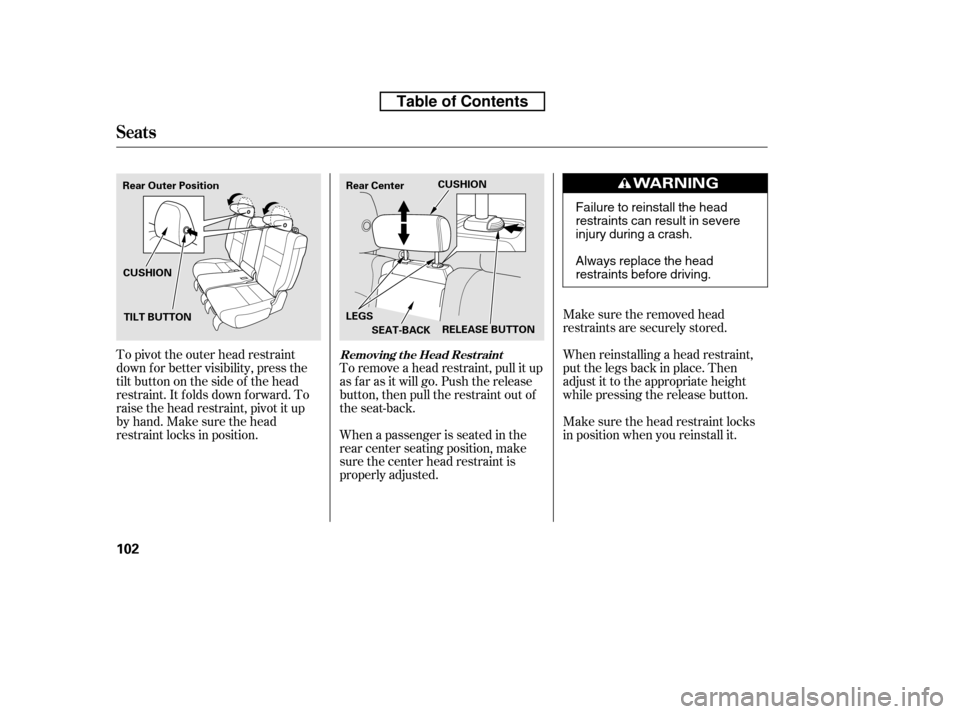
Make sure the removed head
restraints are securely stored.
Make sure the head restraint locks
in position when you reinstall it.
When reinstalling a head restraint,
put the legs back in place. Then
adjust it to the appropriate height
while pressing the release button.
When a passenger is seated in the
rear center seating position, make
sure the center head restraint is
properly adjusted.
To remove a head restraint, pull it up
as f ar as it will go. Push the release
button, then pull the restraint out of
the seat-back.
To pivot the outer head restraint
down f or better visibility, press the
tilt button on the side of the head
restraint. It f olds down f orward. To
raise the head restraint, pivot it up
by hand. Make sure the head
restraint locks in position.
Seats
Removing t he Head Rest raint
102
RELEASE BUTTON
Rear Outer Position Rear Center
CUSHION
LEGS SEAT-BACK
CUSHION
TILT BUTTON
Failure to reinstall the head
restraints can result in severe
injury during a crash.
Always replace the head
restraints before driving.
Table of Contents
Page 348 of 441

Crosswinds and air turbulence
caused by passing trucks can disrupt
your steering and cause the trailer to
sway. When being passed by a large
vehicle, keep a constant speed, and
steer straight ahead. Do not try to
make quick steering or braking
corrections.
If youmuststopwhenfacinguphill,
use the f oot brake or parking brake.
Do not try to hold the vehicle in
place by pressing on the accelerator,
as this can cause the automatic
transmission to overheat.
When driving down hills, reduce
your speed and use the D3 position.
Do not ‘‘ride’’ the brakes, and
remember it will take longer to slow
downandstopwhentowingatrailer.
When climbing hills, closely watch
your temperature gauge. If it nears
the red (Hot) mark, turn the air conditioning of f , reduce speed and, if
necessary, pull to the side of the
road to let the engine cool.
Maketurnsmoreslowlyandwider
than normal. The trailer tracks a
smaller arc than your vehicle, and it
canhitorrunoversomethingthe
vehicle misses. Allow more time and
distance f or braking. Do not brake or
turn suddenly as this could cause the
trailer to jackknif e or turn over.
Drive slower than normal in all
driving situations, and obey posted
speed limits f or vehicles with trailers.
Use the D position when towing a
trailer on level roads. D is the
proper shif t lever position to use
when towing a trailer in hilly terrain.
(See ‘‘ ’’ in the
f ollowing column f or additional gear
inf ormation.)
The lights and brakes on your
vehicle and the trailer are working
properly.
Your vehicle tires and spare are
properly inf lated, and the trailer
tires and spare are inf lated as
recommended by the trailer
maker.
The added weight, length, and
height of a trailer will af f ect your
vehicle’s handling and perf ormance,
so driving with a trailer requires
some special driving skills and
techniques.
Foryoursafetyandthesafetyof
others,taketimetopracticedriving
maneuvers bef ore heading f or the
open road, and f ollow the guidelines
in this section.
3
CONT INUED
Towing a Trailer
Handling Crosswinds and Buf f et ing
Driving on Hills
Making T urns and Braking
Driving on Hills
T owing Speeds and Gears
Driving Saf ely With a T railerDriving
333
Table of Contents
Page 424 of 441

�Î �Î
�Î�Î
Specif ications
408
Dimensions
Weights
Engine
Capacities
Capacities
179.3 in (4,555 mm)
Length
Width
Height
Wheelbase
Track 66.1 in (1,680 mm)
103.1 in (2,620 mm)
61.6 in (1,565 mm)
61.6 in (1,565 mm)
Gross vehicle weight rating See the certification label attached to the driver’s doorjamb.
Type
BorexStroke
Displacement
Compression ratio
Spark plugs Water cooled 4-stroke DOHC
i-VTEC 4-cylinder gasoline engine
3.43 x 3.90 in (87.0 x 99.0 mm) 144 cu-in (2,354 cm
)
10.5 : 1
ILZKR7B-11S SXU22HCR11S
Fuel tank
Engine oil 15.3 US gal (58
)
4.4 US qt (4.2
)
4.2 US qt (4.0)
5.6 US qt (5.3) 1.56 US gal (5.9
)
1.85 US gal (7.0)
Engine
coolantAutomatic
transmission
fluid Rear
differential
fluid (4WD)
Windshield
washer
reservoir 2.6 US qt (2.5
)
7.4 US qt (7.0
)
2.6 US qt (2.5
)
1.3 US qt (1.2
)
1.5 US qt (1.4)
6.71 US qt (6.35
)
Excluding the oil remaining in the engine
Including the coolant in the reserve tank and that remaining in the
engine
Reserve tank capacity:
0.16 US gal (0.6
) 2.6 US qt (2.5
)
4.8 US qt (4.5)
Approx.
Front Rear
1:2:
71.6 in (1,820 mm)
Change Including filter
Without filter
Total (NGK)
(DENSO) ChangeTotal
Change
4WD
2WD
Total
4WD
2WD
ChangeTotal
U.S. Vehicles
Canadian
Vehicles
1 2
Table of Contents
Page 428 of 441

�µ �µ
�µ
�µ
�µ �µ �µ �µ
The tires that came on your vehicle
have a number of markings. Those
you should be aware of are described
below.
Load index (a numerical code
associated with the maximum
load the tire can carry).
Speed symbol (an
alphabetical code indicating
the maximum speed rating).
The tire identif ication number (TIN)
is a group of numbers and letters
that look like the f ollowing example.
TIN is located on the sidewall of the
tire.
This indicates that the tire
meets all requirements of
the U.S. Department of
Transportation.
Whenever tires are replaced, they
should be replaced with tires of the
same size. Below is an example of
tire size with an explanation of what
each component means.
Tire width in millimeters.
Aspect ratio (the tire’s section
height as a percentage of its
width).
Tire construction code (R
indicates radial).
Rim diameter in inches. Manuf acturer’s
identification mark.
R
DOT B97R
65
T
102
225 17
Tire Labeling
T ire Ident if icat ion Number (T IN)
Tire Size
412
(1)
(1)
(3) (2)
TIRE LABELING EXAMPLE
(1)
(2)
(3)
(4)
Tire Size
Tire Identification Number (TIN)
Maximum Tire Pressure
Maximum Tire Load
(4)
DOT B97R FW6X 2202
225/65R17 102T
Table of Contents