Page 317 of 368
Loosen each wheel nut 1/2 turn
with the wheel nut wrench.
Remove the center cap from the
wheel with the extension. Place the jack under the jacking
point nearest the tire you need to
change. Turn the end bracket
clockwise until the top of the jack
contacts the jacking point. Make
sure the jacking point tab is
restinginthejacknotch.
6.
7.8.
Changing a Flat Tire
314
WHEEL NUT WRENCH JACKING POINTS
09/07/15 11:12:31 31SNC640_319
2010 Civic Hybrid
Page 318 of 368
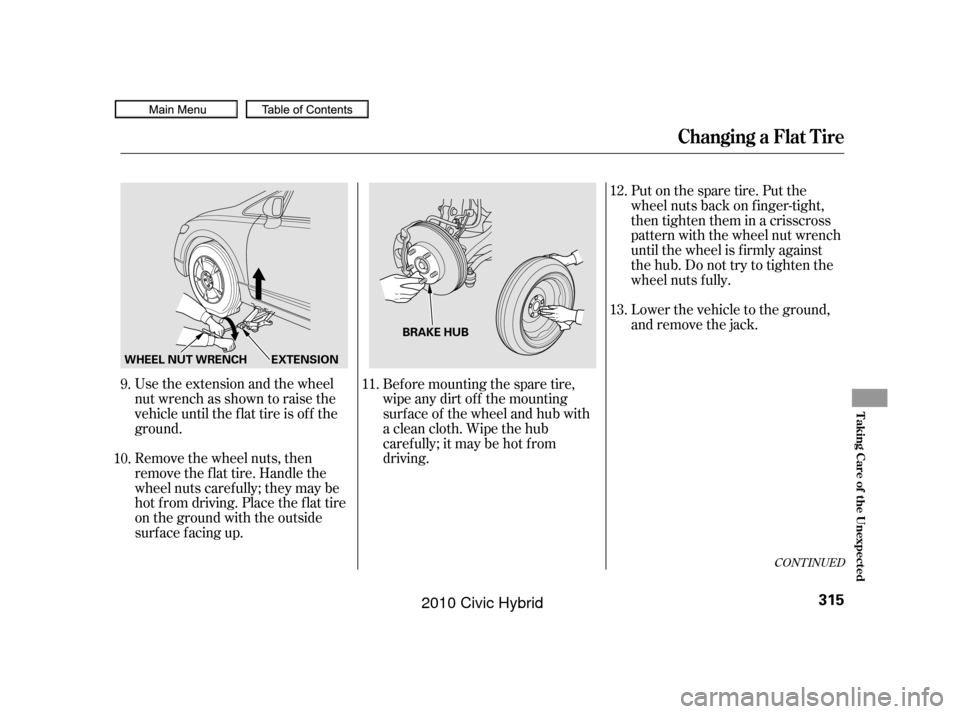
Use the extension and the wheel
nut wrench as shown to raise the
vehicle until the f lat tire is of f the
ground.
Remove the wheel nuts, then
remove the f lat tire. Handle the
wheel nuts caref ully; they may be
hot from driving. Place the flat tire
on the ground with the outside
surface facing up.Bef ore mounting the spare tire,
wipeanydirtoff themounting
surface of the wheel and hub with
a clean cloth. Wipe the hub
carefully;itmaybehotfrom
driving.Put on the spare tire. Put the
wheel nuts back on f inger-tight,
then tighten them in a crisscross
pattern with the wheel nut wrench
until the wheel is f irmly against
the hub. Do not try to tighten the
wheel nuts f ully.
Lower the vehicle to the ground,
and remove the jack.
9.
10. 11.12.
13.
CONT INUED
Changing a Flat Tire
T aking Care of t he Unexpect ed
315
BRAKE HUB
WHEEL NUT WRENCH EXTENSION
09/07/15 11:12:39 31SNC640_320
2010 Civic Hybrid
Page 319 of 368
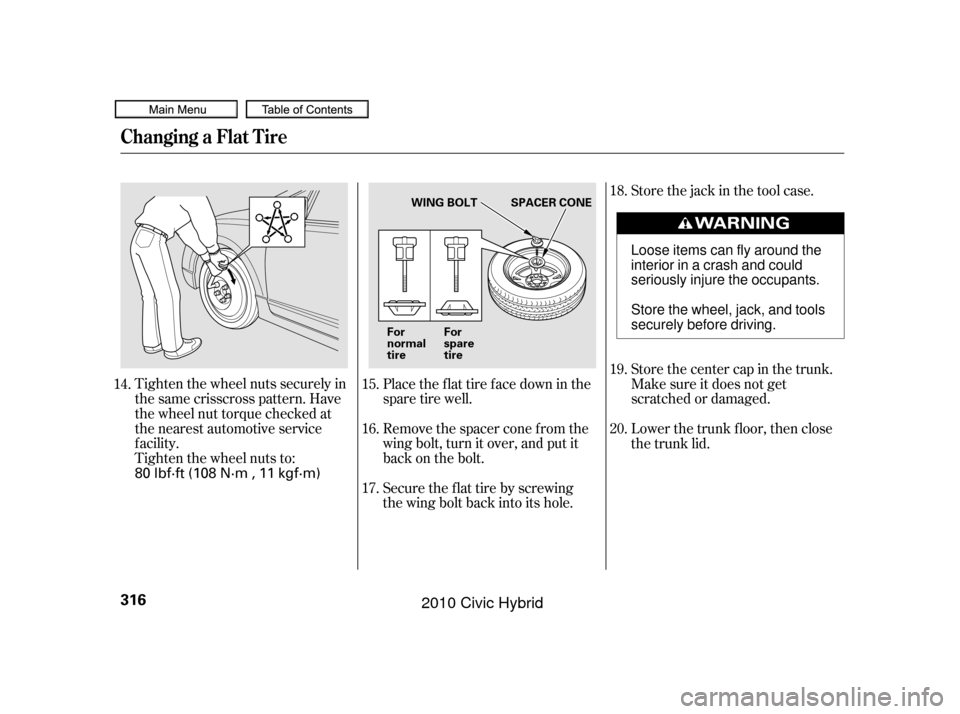
Tighten the wheel nuts securely in
the same crisscross pattern. Have
the wheel nut torque checked at
the nearest automotive service
f acility.
Tighten the wheel nuts to:Place the flat tire face down in the
spare tire well.
Remove the spacer cone f rom the
wing bolt, turn it over, and put it
back on the bolt.
Securetheflattirebyscrewing
the wing bolt back into its hole.Store the jack in the tool case.
Store the center cap in the trunk.
Make sure it does not get
scratched or damaged.
Lower the trunk f loor, then close
the trunk lid.
14.
15.
16.
17.18.
19.
20.
Changing a Flat Tire
316
SPACER CONE
WING BOLT
For
spare
tire
For
normal
tire
80 lbf·ft (108 N·m , 11 kgf·m) Loose items can fly around the
interior in a crash and could
seriously injure the occupants.
Store the wheel, jack, and tools
securely before driving.
09/07/15 11:12:48 31SNC640_321
2010 Civic Hybrid
Page 329 of 368

If the ABS indicator comes on with
the brake system indicator, have
your vehicle inspected by your
dealer immediately.
However, if the brake pedal does not
f eel normal, you should take
immediate action. A problem in one
part of the system’s dual circuit
design will still give you braking at
two wheels. You will f eel the brake
pedal go down much f arther bef ore
the vehicle begins to slow down, and
you will have to press harder on the
pedal.
Slow down by shif ting to a lower
gear, and pull to the side of the road
when it is saf e. Because of the long
distance needed to stop, it is
hazardous to drive the vehicle. You
should have it towed and repaired as
soon as possible (see
on page ).
If you must drive the vehicle a short
distance in this condition, drive
slowly and caref ully.
The brake system
indicator normally
comes on when
you turn the ignition switch to the
ON (II) position and as a reminder to
check the parking brake. It will stay
on if you do not f ully release the
parking brake.
If the brake system indicator comes
on while driving, the brake f luid level
is probably low. Press lightly on the
brake pedal to see if it f eels normal.
If it does, check the brake f luid level
thenexttimeyoustopataservice
station (see page ).
If the f luid level is low, take your
vehicle to a dealer, and have the
brake system inspected f or leaks or
worn brake pads. If the brake system indicator
(amber) comes on with the parking
brake system indicator (red) with
the parking brake released, there
may be a malfunction with the
power-assist f eature. When the
power-assist f eature malf unctions,
the brake indicator (red) comes on
and a buzzer sounds f or a second.
The power-assist f eature may stop
when the brake ef f ect is weak. Stop
your vehicle immediately at a saf e
place and contact a dealer.
292
333Emergency
Towing
Brake System Indicator
326
U.S. Canada
09/07/15 11:14:00 31SNC640_331
2010 Civic Hybrid
Page 336 of 368

�µ
�µ
CONT INUED
If , due to damage, your vehicle must
be towed with the f ront wheels on
the ground, do this:
With the f ront wheels on the ground,
it is best to tow the vehicle no farther
than 50 miles (80 km), and keep the
speedbelow35mph(55km/h).
If your vehicle needs to be towed,
call a prof essional towing service or
organization. Never tow your vehicle
with just a rope or chain. It is very
dangerous.
Therearetwowaystotowyour
vehicle:
The tow
truck uses two pivoting arms that go
under the tires (f ront) and lif t them
of f the ground. The other two tires
remain on the ground. The operator
loads your vehicle on the back of a
truck. Start the engine.
Press on the brake pedal. Move
the shif t lever through all its
positions.
Shif t to D position and hold f or 5
seconds, then to N.
Turn of f the engine.
Release the parking brake.
Leave the ignition switch in the
ACCESSORY (I) position so the
steering wheel does not lock.
Wheel-lif t Equipment
Flat -bed Equipment
T his is an
acceptable way to tow your
vehicle. T his is the best way to
transport your vehicle.
Emergency Towing
T aking Care of t he Unexpect ed
333
Improper towing preparation will
damage the transmission. Follow the
above procedure exactly. If you cannot
shif t the transmission or start the
engine, your vehicle must be
transported with the f ront wheels of f
the ground.
09/07/15 11:14:50 31SNC640_338
2010 Civic Hybrid
Page 337 of 368
Emergency Towing
334
The steering system can be damaged if
the steering wheel is locked. Leave the
ignition switch in the ACCESSORY (I)
position, and make sure the steering
wheel turns f reely bef ore you begin
towing.
Trying to lif t or tow your vehicle by the
bumpers will cause serious damage.
The bumpers are not designed to
support the vehicle’s weight.
09/07/15 11:14:54 31SNC640_339
2010 Civic Hybrid
Page 341 of 368

�Î
�Î
�Î
�Î
Specif ications
338
Dimensions
Weights
Engine Seating CapacitiesCapacities
176.7 in (4,489 mm)
69.0 in (1,752 mm)
56.3 in (1,430 mm)
106.3 in (2,700 mm)
59.1 in (1,501 mm)
60.2 in (1,529 mm)
Length
Width
Height
Wheelbase
Track
Gross vehicle weight rating See the certification label attached
to the driver’s doorjamb. 3.0 US qt (2.8
)
5.4 US qt (5.1)
1.255 US gal (4.75
)
1.59 US gal (6.0)
3.4 US qt (3.2
)
3.2 US qt (3.0)
4.0 US qt (3.8)
12.3 US gal (46.6
)
Type
BorexStroke
Displacement
Compression ratio
Spark plugs SK20HPR-L11 ILFR6J-11K10.8
82 cu-in (1,339 cm
)
2.87 x 3.15 in (73.0 x 80.0 mm)
Water cooled 4-stroke SOHC i-VTEC
gasoline engine with Hybrid Electric
Total
Front
Rear
5
2
3Fuel tank
Engine
coolant
Engine oil
Automatic
transmission
fluid
Windshield
washer
reservoir
Excluding the oil remaining in the engine Including the coolant in the reserve tank and that remaining in the
engine
Reserve tank capacity: 0.11 US gal (0.4
)
2.6 US qt (2.5
)
4.8 US qt (4.5)
Front
Rear
Approx.
1:
2:
(NGK) (DENSO) Change
Total
Change
Including filter
Without filter
Total
Change
Total
U.S. Vehicles
Canada Vehicles
1
2
09/07/15 11:15:23 31SNC640_343
2010 Civic Hybrid
Page 344 of 368
The temperature grades are A (the
highest), B, and C, representing the
tire’s resistance to the generation of
heat and its ability to dissipate heat
when tested under controlled
conditions on a specif ied indoor
laboratory test wheel. Sustained high
temperature can cause the material
of the tire to degenerate and reduce
tire life, and excessive temperature
can lead to sudden tire f ailure. The
grade C corresponds to a level of
perf ormance which all passenger car
tires must meet under the Federal
Motor Vehicle Saf ety Standard No.
109. Grades B and A represent
higher levels of perf ormance on the
laboratory test wheel than the
minimum required by law.Warning: The temperature grade f or
this tire is established f or a tire that
is properly inf lated and not
overloaded. Excessive speed,
underinf lation, or excessive loading,
either separately or in combination,
can cause heat buildup and possible
tire f ailure.
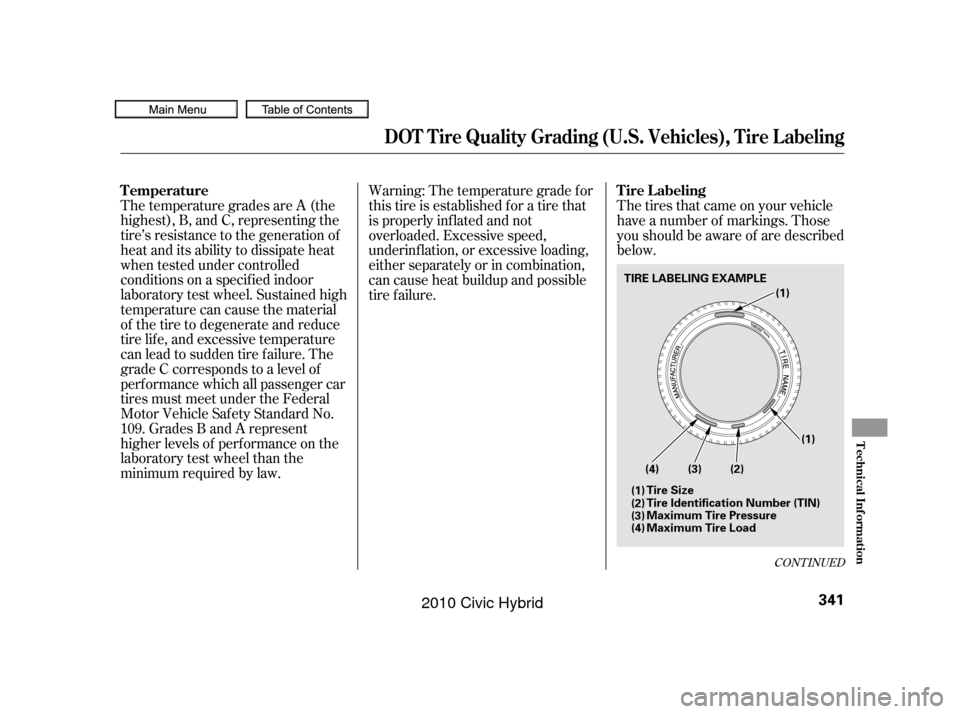
The tires that came on your vehicle
have a number of markings. Those
you should be aware of are described
below.
CONT INUED
Temperature
Tire L abeling
DOT Tire Quality Grading (U.S. Vehicles), Tire L abeling
Technical Inf ormation
341
(4) (3) (2)(1)
(1)
(1)
(2)
(3)
(4)
TIRE LABELING EXAMPLE
Tire Size
Maximum Tire Pressure
Maximum Tire Load Tire Identification Number (TIN)
09/07/15 11:15:59 31SNC640_346
2010 Civic Hybrid