Page 52 of 368
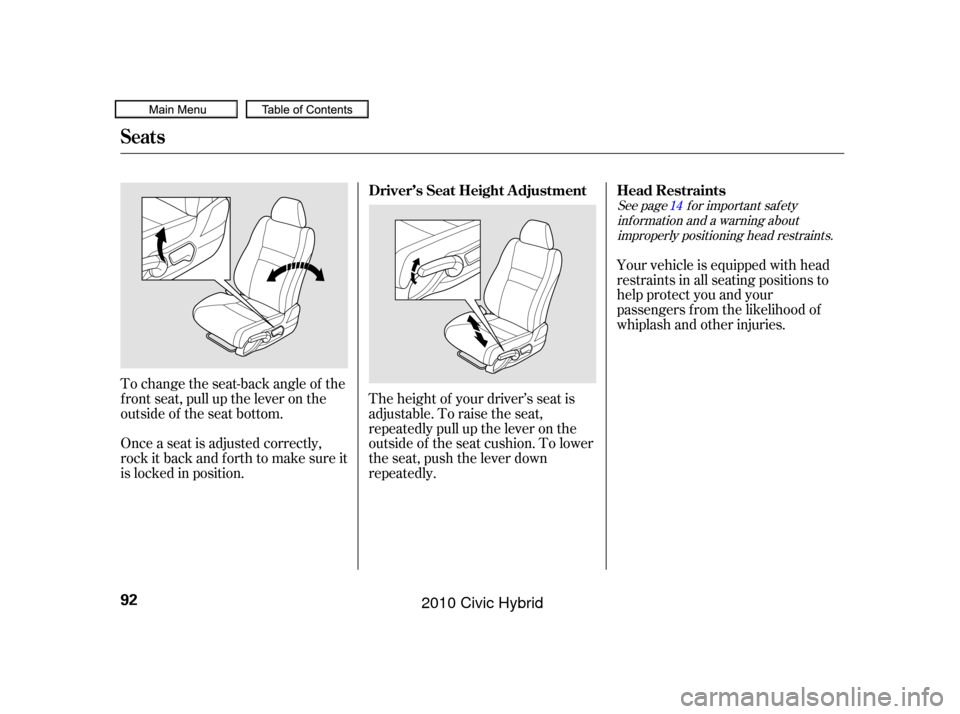
Does the shoulder belt cross
between the child’s neck and arm?
Is the lap part of the belt as low as
possible, touching the child’s
thighs?
Will the child be able to stay
seated like this f or the whole trip?
If you answer yes to all these
questions, the child is ready to wear
the lap/shoulder belt correctly. If
you answer no to any question, the
child needs to ride on a booster seat. A child who has outgrown a f orward- f acing child seat should ride in a
back seat and use a booster seat
until the lap/shoulder belt f its them
properly without the booster.Some states, Canadian provinces and
territories also require children to
use a booster seat until they reach a
given age or weight (e.g., 6 years or
60lbs).Besuretocheckcurrent
laws in the states, provinces or
territories where you intend to drive.
Booster seats can be high-back or
low-back. Whichever style you select,
make sure the booster seat meets
f ederal saf ety standards (see page
) and that you f ollow the booster
seat maker’s instructions.
3.
4.
5.
41
CONT INUED
Using a Booster Seat
Protecting L arger Children
Driver and Passenger Saf ety
49
09/07/15 10:36:03 31SNC640_054
2010 Civic Hybrid
Page 58 of 368

This section gives inf ormation about
the controls and displays that
contribute to the daily operation of
your vehicle. All the essential
controls are within easy reach............................
Control Locations .56
............................
Instrument Panel .57
..........
Instrument Panel Indicators . 58
.............................................
Gauges .65
.....................................
Odometer .65
..............
Display Change Button . 66
................
Instant Fuel Economy . 66
...................
Temperature Gauge . 66
...................................
Trip Meter .67
..............
Average Fuel Economy . 67
..................................
Fuel Gauge .67
Outside Temperature ...................................
Indicator .68
..........
Check Fuel Cap Message . 69
..................
Maintenance Minder . 69
.........
IMA Battery Level Gauge . 70
................
Charge/Assist Gauge . 71
Controls Near the Steering ...........................................
Wheel .72
.
Windshield Wipers and Washers . 73
.........
Turn Signals and Headlights . 74
............
Daytime Running Lights . 75
........
Instrument Panel Brightness . 75
.................
Hazard Warning Button . 76
.................
Rear Window Def ogger . 76
..........
Steering Wheel Adjustment . 77...............................
Keys and Locks .78
........................
Immobilizer System .79
................................
Ignition Switch .80
......................................
Door Locks .81
......................
Power Door Locks .81
..............
Childproof Door Locks . 82
.
Auto Door Locking/Unlocking . 82
.....................
Auto Door Locking .82
.................
Auto Door Unlocking . 85
................................................
Trunk .88
........
Emergency Trunk Opener . 88
.......................
Remote Transmitter .89
.................................................
Seats .91
....................................
Seat Heaters .96
..............................
Power Windows .97
.............................................
Mirrors .98
.................................
Parking Brake .99
.........
Interior Convenience Items . 100
.....................
Beverage Holders .101
.........
Accessory Power Socket . 101
..................................
Glove Box .101
.............
Console Compartment . 101
...............................
Interior Lights .102
Instruments and Controls
Inst rument s and Cont rols
55
09/07/15 10:37:00 31SNC640_060
2010 Civic Hybrid
Page 94 of 368
�µ
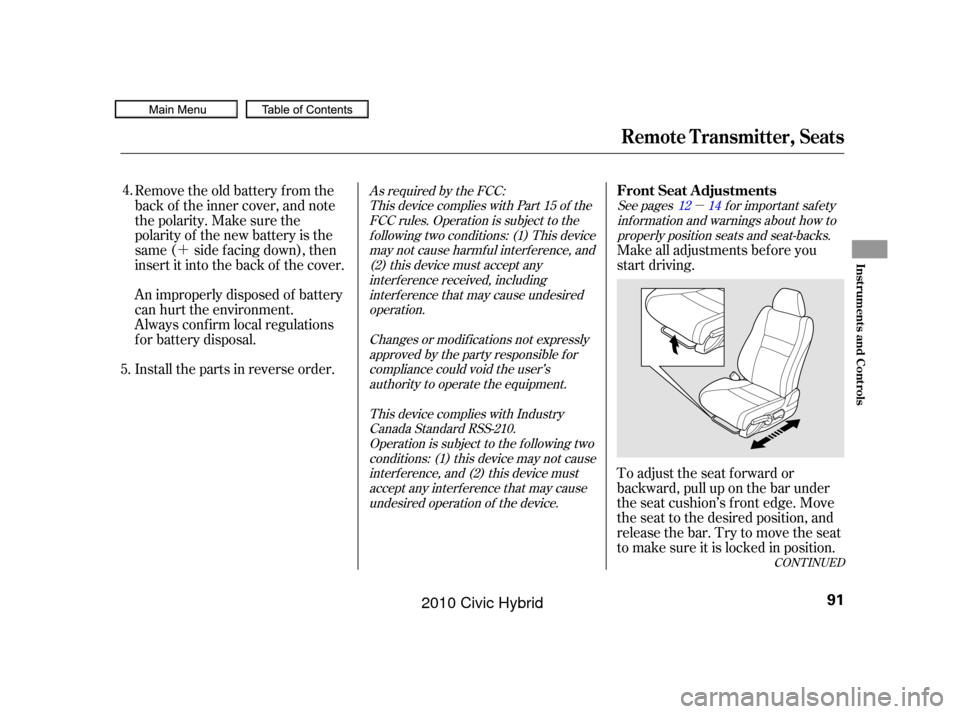
�´To adjust the seat f orward or
backward, pull up on the bar under
the seat cushion’s f ront edge. Move
the seat to the desired position, and
releasethebar.Trytomovetheseat
to make sure it is locked in position.
Remove the old battery from the
back of the inner cover, and note
the polarity. Make sure the
polarity of the new battery is the
same ( side f acing down), then
insert it into the back of the cover.
An improperly disposed of battery
can hurt the environment.
Always conf irm local regulations
for battery disposal.
Install the parts in reverse order.
Make all adjustments bef ore you
start driving.
4.
5.
See pages f or important saf ety inf ormation and warnings about how toproperly position seats and seat-backs.
As required by the FCC:
This device complies with Part 15 of theFCC rules. Operation is subject to thef ollowing two conditions: (1) This devicemay not cause harmf ul interf erence, and(2) this device must accept anyinterf erence received, includinginterf erence that may cause undesiredoperation.
Changes or modif ications not expresslyapproved by the party responsible f orcompliance could void the user’sauthority to operate the equipment.
This device complies with IndustryCanada Standard RSS-210.Operation is subject to the f ollowing twoconditions: (1) this device may not causeinterf erence, and (2) this device mustaccept any interf erence that may causeundesired operation of the device. 12 14
CONT INUED
FrontSeatAdjustments
Remote Transmitter, Seats
Inst rument s and Cont rols
91
09/07/15 10:42:03 31SNC640_096
2010 Civic Hybrid
Page 95 of 368
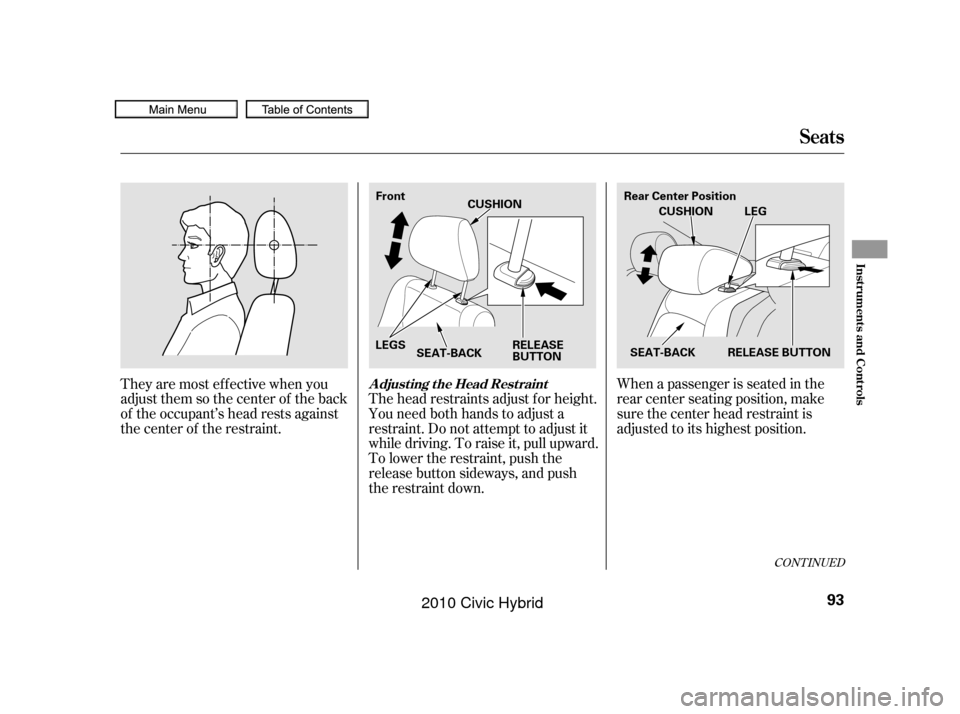
To change the seat-back angle of the
f ront seat, pull up the lever on the
outside of the seat bottom.
Once a seat is adjusted correctly,
rock it back and f orth to make sure it
is locked in position.The height of your driver’s seat is
adjustable. To raise the seat,
repeatedly pull up the lever on the
outside of the seat cushion. To lower
the seat, push the lever down
repeatedly.Your vehicle is equipped with head
restraints in all seating positions to
help protect you and your
passengers f rom the likelihood of
whiplash and other injuries.
See page f or important saf ety
inf ormation and a warning aboutimproperly positioning head restraints. 14
Driver’s Seat Height Adjustment Head Restraints
Seats
92
09/07/15 10:42:10 31SNC640_097
2010 Civic Hybrid
Page 96 of 368
When a passenger is seated in the
rear center seating position, make
sure the center head restraint is
adjusted to its highest position.
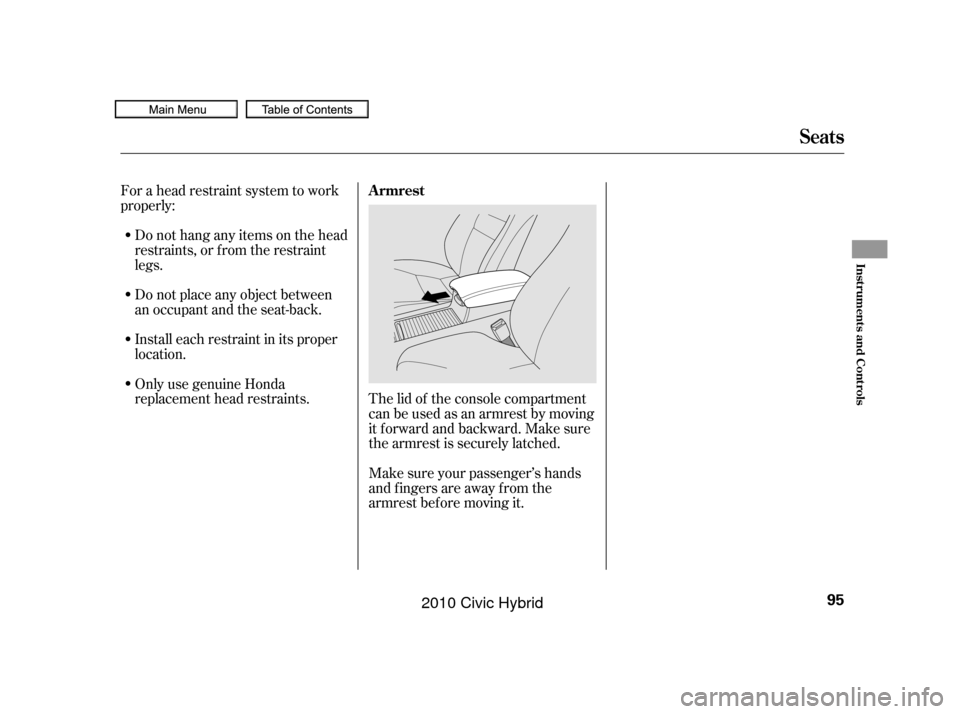
The head restraints adjust f or height.
You need both hands to adjust a
restraint. Do not attempt to adjust it
while driving. To raise it, pull upward.
To lower the restraint, push the
release button sideways, and push
the restraint down.
Theyaremosteffectivewhenyou
adjust them so the center of the back
of the occupant’s head rests against
the center of the restraint.
CONT INUED
A djust ing t he Head Rest raint
Seats
Inst rument s and Cont rols
93
Rear Center Position
CUSHION CUSHION LEG
LEGS RELEASE
BUTTON
SEAT-BACK
SEAT-BACK RELEASE BUTTON
Front
09/07/15 10:42:17 31SNC640_098
2010 Civic Hybrid
Page 97 of 368
This reduces the distance between
the restraint and the occupant’s head.
It also helps protect the occupants
against the likelihood of whiplash
and injuries to the neck and upper
spine.
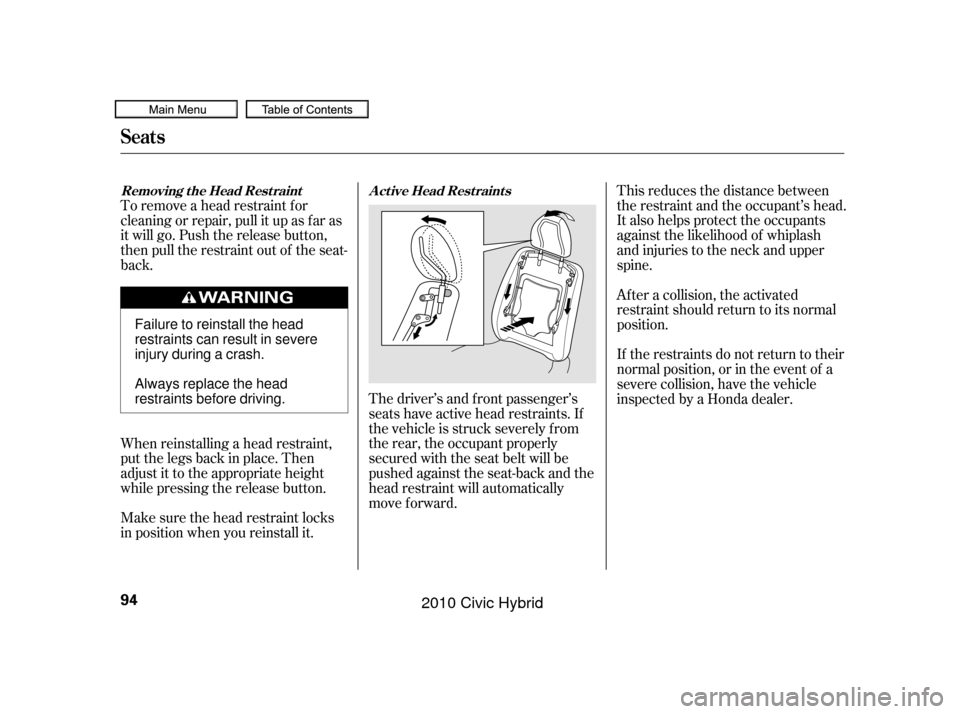
The driver’s and f ront passenger’s
seats have active head restraints. If
the vehicle is struck severely f rom
the rear, the occupant properly
secured with the seat belt will be
pushed against the seat-back and the
head restraint will automatically
move forward.
To remove a head restraint f or
cleaning or repair, pull it up as f ar as
it will go. Push the release button,
then pull the restraint out of the seat-
back.
When reinstalling a head restraint,
put the legs back in place. Then
adjust it to the appropriate height
while pressing the release button.
Make sure the head restraint locks
in position when you reinstall it.
If the restraints do not return to their
normal position, or in the event of a
severe collision, have the vehicle
inspected by a Honda dealer. Af ter a collision, the activated
restraint should return to its normal
position.A ct ive Head Rest raint s
Removing t he Head Rest raint
Seats
94
Failure to reinstall the head
restraints can result in severe
injury during a crash.
Always replace the head
restraints before driving.
09/07/15 17:38:59 31SNC640_099
2010 Civic Hybrid
Page 98 of 368
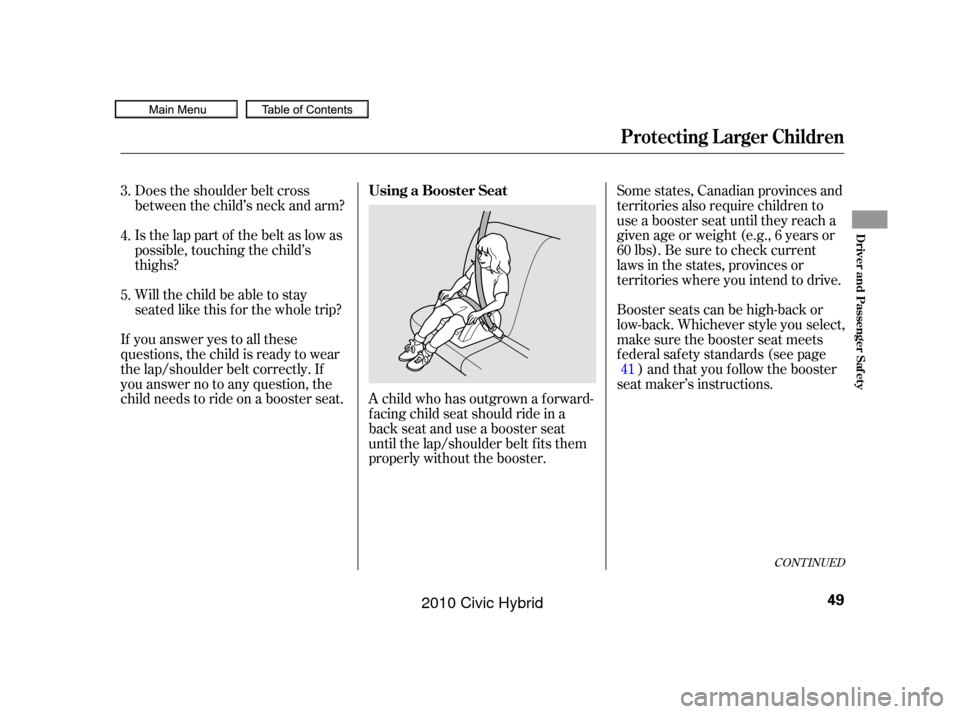
The lid of the console compartment
canbeusedasanarmrestbymoving
it f orward and backward. Make sure
the armrest is securely latched.
Make sure your passenger’s hands
and fingers are away from the
armrest bef ore moving it.
For a head restraint system to work
properly:
Do not hang any items on the head
restraints, or f rom the restraint
legs.
Do not place any object between
an occupant and the seat-back.
Install each restraint in its proper
location.
Only use genuine Honda
replacement head restraints. Armrest
Seats
Inst rument s and Cont rols
95
09/07/15 10:42:32 31SNC640_100
2010 Civic Hybrid
Page 99 of 368
In the HI setting, the heater turns off
when the seat gets warm, and turns
back on after the seat’s temperature
drops.
In the LO setting, the heater runs
continuously. It does not cycle with
temperature changes.
Follow these precautions whenever
you use the seat heaters:If the engine is lef t idling f or an
extended period, do not use the
seat heaters even on the LO
setting. It can weaken the battery,
causing hard starting. Use the HI setting only to heat the
seats quickly, because it draws
large amounts of current f rom the
battery.
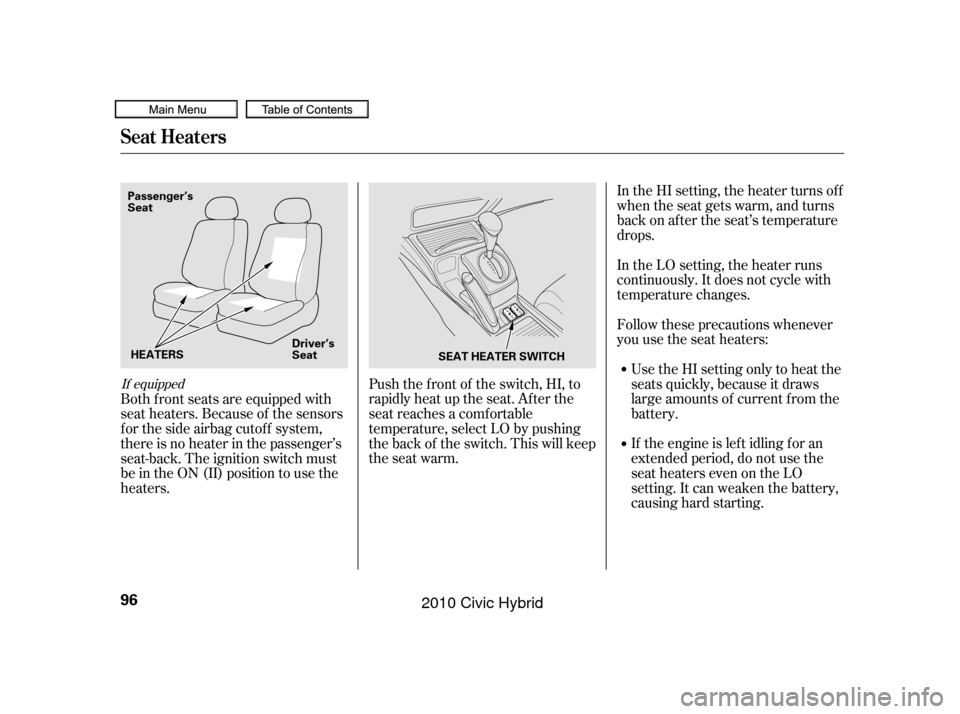
Push the front of the switch, HI, to
rapidly heat up the seat. Af ter the
seat reaches a comfortable
temperature, select LO by pushing
the back of the switch. This will keep
the seat warm.
Both f ront seats are equipped with
seat heaters. Because of the sensors
f or the side airbag cutof f system,
there is no heater in the passenger’s
seat-back. The ignition switch must
be in the ON (II) position to use the
heaters.
If equipped
Seat Heaters
96
Passenger’s
Seat
Driver’s
Seat
HEATERS
SEAT HEATER SWITCH
09/07/15 10:42:40 31SNC640_101
2010 Civic Hybrid