Page 215 of 416

To replay the current disc
continuously, select DISC REPEAT,
andpressENTERontheinterface
selector. As a reminder, you will see
REPEAT next to DISC on the screen.
To turn this feature off, highlight
DISC REPEAT (if not already
highlighted), and press ENTER on
the interf ace selector again.To play the tracks on the current
disc in random order, select TRACK
RANDOM, and press ENTER on the
interf ace selector. As a reminder,
you will see RANDOM next to
TRACKonthescreen.Toturnthis
feature off, highlight TRACK
RANDOM (if not already
highlighted), and press ENTER on
the interf ace selector again.To take the system out of disc mode,
press the FM/AM button, the
button, or the AUX button (if
an appropriate unit is connected). To
return to disc mode, press the CD
button.
You can also press the MODE
buttononthesteeringwheelto
change modes.
If you turn the system of f while a
disc is playing, either with the
power/volume knob or the ignition
switch, play will continue at the same
point when you turn it back on.
Disc Repeat Random Play To Stop Playing a Disc
Playing Discs (Models with navigat ion syst em)
200
�����—�����—�
���y�
���������
���y���
�)�����������y���������y
Table of Contents
Page 291 of 416

Youshoulddothefollowingchecks
and adjustments bef ore you drive
your vehicle.Make sure all windows, mirrors,
and outside lights are clean and
unobstructed. Remove f rost, snow,
or ice.
Check that the hood is f ully closed.
Check that the trunk is f ully
closed.
Visually check the tires. If a tire
looks low, use a gauge to check its
pressure.
Check that any items you may be
carrying are stored properly or
f astened down securely. When you start the engine, check
the gauges and indicators in the
instrument panel (see page ).
Fasten your seat belt. Check that
your passengers have f astened
their seat belts (see page ).
Make sure the doors are securely
closed and locked.
Check the steering wheel
adjustment (see page ).
Check the seat adjustment (see
page ).
Check the seat adjustment (see
page ).
Check the adjustment of the
inside and outside mirrors (see
pages and ).
3.
2. 1.
4. 5. 6. 7. 8. 9.
10. 92
93
7514 55
11.
101 102On models with power adjustable seats
On models with manual adjustableseats
Preparing to Drive
276
�����—�����—�
���y�
�������������y���
�)�����������y�������
�y
Table of Contents
Page 301 of 416

The hydraulic system that operates
the brakes has two separate circuits.
Each circuit works diagonally across
the vehicle (the lef t-f ront brake is
connected with the right-rear brake,
etc.). If one circuit should develop a
problem, you will still have braking
at two wheels.
Your vehicle is equipped with disc
brakes at all f our wheels. A power
assist helps reduce the ef f ort needed
on the brake pedal. The emergency
brake assist system increases the
stopping f orce when you depress the
brake pedal hard in an emergency
situation. The anti-lock brake system
(ABS) helps you retain steering
control when braking very hard.
Resting your f oot on the pedal keeps
the brakes applied lightly, builds up
heat, reduces their ef f ectiveness and
reduces brake pad lif e. In addition,
f uel economy can be reduced. It also
keeps your brake lights on all the
time, conf using drivers behind you. Check the brakes after driving
through deep water. Apply the
brakes moderately to see if they f eel
normal. If not, apply them gently and
f requently until they do. Be extra
cautious in your driving.
Constant application of the brakes
when going down a long hill builds
up heat and reduces their ef f ective-
ness. Use the engine to assist the
brakes by taking your f oot of f the
accelerator and downshif ting to a
lower gear.
The f ront and rear disc brakes on all
models have audible brake pad wear
indicators.
If the brake pads need replacing, you
will hear a distinctive, metallic
screeching sound when you apply
the brake pedal. If you do not have
the brake pads replaced, they will
screech all the time. It is normal f or
the brakes to occasionally squeal or
squeak when you apply them.
Braking System Design
Brake Pad Wear Indicators
Braking System
286
�����—�����—�
���y�
�������������y���
�)�����������y�������
�y
Table of Contents
Page 316 of 416

This section explains why it is
important to keep your vehicle well
maintained and how to f ollow basic
maintenance saf ety precautions.
This section also includes
instructions on how to read the
maintenance minder messages on
the information display, and
instructions f or simple maintenance
tasks you may want to take care of
yourself .
If you have the skills and tools to
perf orm more complex maintenance
tasks on your vehicle, you may want
to purchase the service manual. See
page f or inf ormation on how to
obtain a copy, or see your dealer.......................Maintenance Saf ety . 302
....................
Maintenance Minder . 303
..............................
Fluid Locations . 310
........................
Adding Engine Oil . 312
Changing the Engine Oil and
...........................................
Filter . 314
..............................
Engine Coolant . 316
....................
Windshield Washers . 318
.......................
Transmission Fluid . 319
..........
Automatic Transmission . 319
..............
Manual Transmission . 321
................
Brake and Clutch Fluid . 322
................................
Brake Fluid . 322
...............................
Clutch Fluid . 323
....................
Power Steering Fluid . 323
....................................
Timing Belt . 324
.............................................
Lights . 325
................
Cleaning the Seat Belts . 334
.....................................
Floor Mats . 334
..................
Dust and Pollen Filter . 335
.................................
Wiper Blades . 336
...............................................
Tires . 339
...................
Checking the Battery . 347
.............................
Vehicle Storage . 348
399
Maintenance
Maint enance
301
�����—�����—�
���y�
�������������y���
�)�����������y���������y
Page 324 of 416

�Î �Î
�Ì �Ì
�µ
�µ
�Ì
�Î
Maintenance Minder
309
Maintenance Main Items
Replace engine oil
Replace engine oil and oil filter
Inspect front and rear brakes
Check parking brake adjustment
Inspect these items: Tie rod ends, steering gear box, and boots
Suspension components
Driveshaft boots
Brake hoses and lines (including ABS/VSA)
All fluid levels and condition of fluids
Exhaust system
Fuel lines and connections Maintenance Sub Items
Rotate tires
Replace air cleaner element
Replace dust and pollen filter
Inspect drive belt
Replace transmission fluid
Replace spark plugs
Replace timing belt and inspect water pump
(V6 engine only)
Inspect valve clearance
Replace engine coolant
:
AB
Symbol
12 3 4 5
Symbol1 1
Inspect idle speed every 160,000 miles (256,000 km).
Adjust the valves during services A, B, 1, 2, or 3 only if they are noisy.
If the message ‘‘SERVICE’’ does not appear more than 12 months after the
display is reset, change the engine oil every year.
Independent of the maintenance messages in the information display,
replace the brake fluid every 3 years.
See information on maintenance and emissions warranty in the center
column on page .
NOTE: 1:
308
If you drive in dusty conditions, replace every 15,000
miles (24,000 km).
If you drive primarily in urban areas that have high
concentrations of soot in the air from industry and from
diesel-powered vehicles, replace every 15,000 miles
(24,000 km).
If you drive regularly in very high temperatures (over
110°F, 43°C), or in very low temperatures (under 20°F,29°C), replace every 60,000 miles (U.S.)/100,000 km
(Canada).
Maintenance Minder
�����—�����—�
���y�
�������������y���
�)�����������y�����
���y
Table of Contents
Page 325 of 416
Fluid Locations
4-cylinder models
310
ENGINE OIL
FILL CAP
CLUTCH FLUID
(Manual
Transmission only)
(Light gray cap)
AUTOMATIC
TRANSMISSION
FLUID DIPSTICK
(Yellow loop)
BRAKE FLUID
(Black cap)
ENGINE OIL DIPSTICK
(Orange handle)
POWER STEERING FLUID
(Red cap)
WASHER FLUID
(Blue cap)
RADIATOR CAP
ENGINE COOLANT
RESERVOIR
�����—�����—�
���y�
�������������y���
�)�����������y�����
���y
Table of Contents
Page 326 of 416
Fluid Locations
V6 models
Maint enance
311
ENGINE OIL FILL CAPBRAKE FLUID
(Black cap)
AUTOMATIC
TRANSMISSION
FLUID DIPSTICK
(Yellow loop)
RADIATOR CAP
ENGINE OIL DIPSTICK
(Orange loop)
POWER STEERING FLUID
(Red cap)
WASHER FLUID
(Blue cap)
ENGINE COOLANT
RESERVOIR
�����—�����—�
���y�
�������������y���
�)�����������y�����
���y
Table of Contents
Page 338 of 416
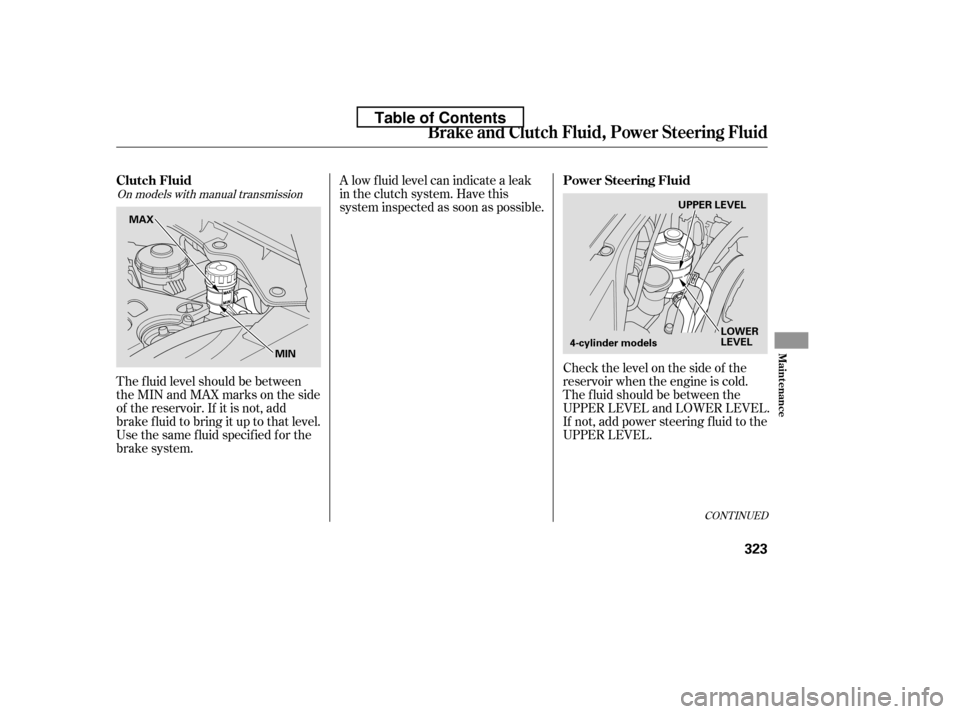
Check the level on the side of the
reservoir when the engine is cold.
The f luid should be between the
UPPER LEVEL and LOWER LEVEL.
If not, add power steering f luid to the
UPPER LEVEL.
The f luid level should be between
theMINandMAXmarksontheside
of the reservoir. If it is not, add
brake f luid to bring it up to that level.
Use the same fluid specified for the
brake system. A low f luid level can indicate a leak
in the clutch system. Have this
system inspected as soon as possible.
CONT INUED
On models with manual transmission
Power Steering Fluid
Clutch Fluid
Brake and Clutch Fluid, Power Steering Fluid
Maint enance
323
MAX UPPER LEVEL
MIN LOWER
LEVEL
4-cylinder models
�����—�����—�
���y�
�������������y���
�)�����������y���������y
Table of Contents