2010 GMC CANYON Front seats
[x] Cancel search: Front seatsPage 150 of 448
Storage Areas
Glove Box
Lift up on the glove box lever to open it.
Cupholders
This vehicle may have two cupholders located on the
lower part of the front doors as well as two cupholders
located at the front end of the console. Vehicles with
bench seats may have cupholders attached to the front
of the center seat.
For vehicles that are an extended cab or crew cab
model, the vehicle also has two rear cupholders.
On crew cab models, the cupholders are located at the
front end of the rear center seat cushion. On extended
cab models, the rear seat cupholders are located on top
of the rear center console.
Vehicles with ashtrays will use one of the cupholders.
Center Console Storage
For vehicles with bench seats, there may be a center
armrest storage area. Lift up on the upper tab located at
the front of the armrest to release the latch. Lift the lid
to open the storage area.
For vehicles with bucket seats or uplevel packages, the
vehicle may have a two-tiered center armrest storage
area. Lift up on the upper tab located at the front of the
armrest to release the latch. Lift the lid to the top
storage area. A second tab is located below the top one
and allows you to access the bottom storage area.
Lift up on the lower tab to release the latch. Then, raise
the lid of the lower storage area. The upper storage
area will lift up with the lid of the lower storage area.
To close the storage area(s), lower the lid(s) until
you feel the latch close.
Assist Handles
This vehicle may have assist handles to be used when
getting out of the vehicle. The assist handles are
located above the doors.
If the vehicle has roof-mounted side impact air bags,
there are assist handles located above both the
driver and front passenger doors.
3-40
Page 170 of 448

The recirculation mode cannot be used with floor/defog,
defrost, or defogging modes. If recirculation is selected in
these modes, the indicator will flash or not come on.
Outlet Adjustment
Use the thumbwheel on the outlets to change the
direction of the air flow.
Lift up or push down on the thumbwheel located in the
center of the outlet to direct the air up or down, or
slide the thumbwheel to the left or right to direct the
airflow from side-to-side.
Operation Tips
•
Clear away any ice, snow or leaves from the air
inlets at the base of the windshield that may
block the flow of air into the vehicle.
•Use of non-GM approved hood deflectors may
adversely affect the performance of the system.
•Keep the path under the front seats clear of objects
to help circulate the air inside of the vehicle more
effectively.
Warning Lights, Gages, and
Indicators
Warning lights and gages can signal that something
is wrong before it becomes serious enough to cause
an expensive repair or replacement. Paying attention
to the warning lights and gages could prevent injury.
Warning lights come on when there might be or there
is a problem with one of the vehicle’s functions. Some
warning lights come on briefly when the engine is started
to indicate they are working.
Gages can indicate when there might be or there is a
problem with one of the vehicle’s functions. Often gages
and warning lights work together to indicate a problem
with the vehicle.
When one of the warning lights comes on and stays on
while driving, or when one of the gages shows there
could be a problem, check the section that explains
what to do. Follow this manual’s advice. Waiting to
do repairs can be costly and even dangerous.
4-18
Page 255 of 448
{WARNING:
Do not load the vehicle any heavier than the
Gross Vehicle Weight Rating (GVWR), or
either the maximum front or rear Gross Axle
Weight Rating (GAWR). If you do, parts on the
vehicle can break, and it can change the way
your vehicle handles. These could cause you
to lose control and crash. Also, overloading
can shorten the life of the vehicle.
Using heavier suspension components to get
added durability might not change your weight
ratings. Ask your dealer/retailer to help you load
your vehicle the right way.
Notice
:Overloading the vehicle may cause
damage. Repairs would not be covered by the
vehicle warranty. Do not overload the vehicle.
If you put things inside your vehicle — like
suitcases, tools, packages, or anything
else — they will go as fast as the vehicle goes.
If you have to stop or turn quickly, or if there is a
crash, they will keep going.
{WARNING:
Things you put inside your vehicle can strike
and injure people in a sudden stop or turn, or
in a crash.
•Put things in the cargo area of your
vehicle. Try to spread the weight evenly.
•Never stack heavier things, like
suitcases, inside the vehicle so that some
of them are above the tops of the seats.
•Do not leave an unsecured child restraint
in your vehicle.
•When you carry something inside the
vehicle, secure it whenever you can.
•Do not leave a seat folded down unless
you need to.
There is also important loading information for
off-road driving in this manual.
See“Loading Your
Vehicle for Off-Road Driving”underOff-Road
Driving on page 5-13.
Remember not to exceed the Gross Axle Weight
rating (GAWR) of the front or rear axle.
5-39
Page 337 of 448
Tire Terminology and Denitions
Air Pressure:The amount of air inside the
tire pressing outward on each square inch of
the tire. Air pressure is expressed in pounds
per square inch (psi) or kilopascal (kPa).
Accessory Weight
:This means the combined
weight of optional accessories. Some examples of
optional accessories are, automatic transmission,
power steering, power brakes, power windows,
power seats, and air conditioning.
Aspect Ratio
:The relationship of a tire’s height
to its width.
Belt
:A rubber coated layer of cords that is
located between the plies and the tread. Cords
may be made from steel or other reinforcing
materials.
Bead
:The tire bead contains steel wires wrapped
by steel cords that hold the tire onto the rim.
Bias Ply Tire
:A pneumatic tire in which the plies
are laid at alternate angles less than 90 degrees
to the centerline of the tread.Cold Tire Pressure
:The amount of air pressure in
a tire, measured in pounds per square inch (psi) or
kilopascals (kPa) before a tire has built up heat
from driving. SeeInation - Tire Pressure on
page 6-64.
Curb Weight
:The weight of a motor vehicle
with standard and optional equipment including
the maximum capacity of fuel, oil, and coolant,
but without passengers and cargo.
DOT Markings
:A code molded into the sidewall
of a tire signifying that the tire is in compliance
with the U.S. Department of Transportation (DOT)
motor vehicle safety standards. The DOT code
includes the Tire Identification Number (TIN), an
alphanumeric designator which can also identify
the tire manufacturer, production plant, brand, and
date of production.
GVWR
:Gross Vehicle Weight Rating.
SeeLoading the Vehicle on page 5-33.
GAWR FRT
:Gross Axle Weight Rating for the
front axle. SeeLoading the Vehicle on page 5-33.
GAWR RR
:Gross Axle Weight Rating for the
rear axle. SeeLoading the Vehicle on page 5-33.
6-61
Page 358 of 448
Regular/Extended Cab
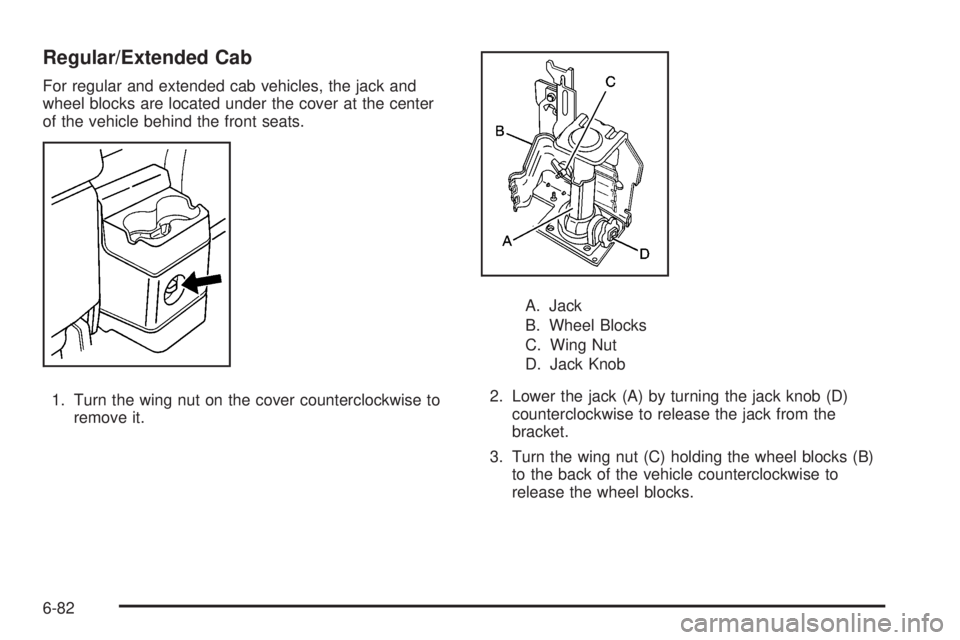
For regular and extended cab vehicles, the jack and
wheel blocks are located under the cover at the center
of the vehicle behind the front seats.
1. Turn the wing nut on the cover counterclockwise to
remove it.A. Jack
B. Wheel Blocks
C. Wing Nut
D. Jack Knob
2. Lower the jack (A) by turning the jack knob (D)
counterclockwise to release the jack from the
bracket.
3. Turn the wing nut (C) holding the wheel blocks (B)
to the back of the vehicle counterclockwise to
release the wheel blocks.
6-82
Page 407 of 448
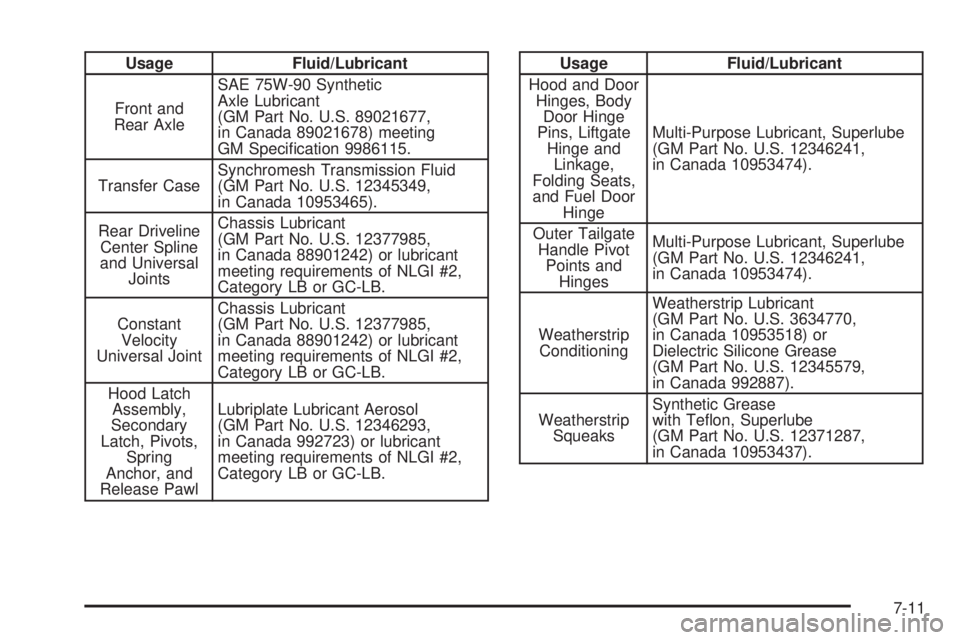
Usage Fluid/Lubricant
Front and
Rear AxleSAE 75W-90 Synthetic
Axle Lubricant
(GM Part No. U.S. 89021677,
in Canada 89021678) meeting
GM Specification 9986115.
Transfer CaseSynchromesh Transmission Fluid
(GM Part No. U.S. 12345349,
in Canada 10953465).
Rear Driveline
Center Spline
and Universal
JointsChassis Lubricant
(GM Part No. U.S. 12377985,
in Canada 88901242) or lubricant
meeting requirements of NLGI #2,
Category LB or GC-LB.
Constant
Velocity
Universal JointChassis Lubricant
(GM Part No. U.S. 12377985,
in Canada 88901242) or lubricant
meeting requirements of NLGI #2,
Category LB or GC-LB.
Hood Latch
Assembly,
Secondary
Latch, Pivots,
Spring
Anchor, and
Release PawlLubriplate Lubricant Aerosol
(GM Part No. U.S. 12346293,
in Canada 992723) or lubricant
meeting requirements of NLGI #2,
Category LB or GC-LB.Usage Fluid/Lubricant
Hood and Door
Hinges, Body
Door Hinge
Pins, Liftgate
Hinge and
Linkage,
Folding Seats,
and Fuel Door
HingeMulti-Purpose Lubricant, Superlube
(GM Part No. U.S. 12346241,
in Canada 10953474).
Outer Tailgate
Handle Pivot
Points and
HingesMulti-Purpose Lubricant, Superlube
(GM Part No. U.S. 12346241,
in Canada 10953474).
Weatherstrip
ConditioningWeatherstrip Lubricant
(GM Part No. U.S. 3634770,
in Canada 10953518) or
Dielectric Silicone Grease
(GM Part No. U.S. 12345579,
in Canada 992887).
Weatherstrip
SqueaksSynthetic Grease
with Teflon, Superlube
(GM Part No. U.S. 12371287,
in Canada 10953437).
7-11
Page 437 of 448

Front Turn Signal, Parking and Daytime
Running Lamps...........................................6-52
Fuel............................................................... 6-5
Additives...................................................... 6-6
California Fuel.............................................. 6-6
Filling a Portable Fuel Container....................6-10
Filling the Tank............................................. 6-8
Fuels in Foreign Countries.............................. 6-7
Gage .........................................................4-32
Gasoline Octane........................................... 6-5
Gasoline Specifications.................................. 6-6
FUEL CAP .....................................................4-39
Fuel Economy
Driving for Better.........................................1-19
Fuses
Engine Compartment Fuse Block.................6-112
Fuses and Circuit Breakers.........................6-111
Windshield Wiper.......................................6-111
G
Gages
Engine Coolant Temperature.........................4-27
Fuel..........................................................4-32
Speedometer..............................................4-20
Tachometer.................................................4-20
Trip Odometer.............................................4-20Gasoline
Octane........................................................ 6-5
Specifications............................................... 6-6
Getting Familiar with Off-Road Driving................5-15
Glove Box.....................................................3-40
GM Mobility Reimbursement Program.................. 8-7
H
Halogen Bulbs................................................6-50
Hazard Warning Flashers................................... 4-3
Head Restraints.........................................1-9, 2-8
Headlamps....................................................6-51
Aiming .......................................................6-50
Bulb Replacement.......................................6-50
Daytime Running Lamps (DRL).....................4-11
Exterior Lamps............................................4-10
Flash-to-Pass............................................... 4-5
High/Low Beam Changer................................ 4-5
On Reminder..............................................4-11
Range Adjustment......................................... 2-8
Heated Seats................................................... 2-4
Heater...........................................................4-16
Engine Coolant...........................................3-20
Highbeam On Light.........................................4-32
High-Speed Operation, Tires.............................6-65
Highway Hypnosis...........................................5-27
7
Page 444 of 448

Scheduled Maintenance..................................... 7-3
Scheduling Appointments.................................8-10
Seatback Latches............................................. 2-9
Seats
Heated Seats............................................... 2-4
Manual Lumbar............................................. 2-3
Power Lumbar .............................................. 2-4
Power Seats................................................. 2-3
Rear Seat Operation............................2-10, 2-11
Reclining Seatbacks...................................... 2-5
Secondary Latch System.................................6-93
Securing a Child Restraint
Center Front Seat Position............................2-60
Rear Seat Position......................................2-58
Right Front Seat Position..............................2-60
Securing an Add-On Child Restraint in the
Vehicle.......................................................2-43
Securing the Child Within the Child Restraint......2-43
Security
Light..........................................................4-32
SERV (Service) 4WD (Four-Wheel Drive)...........4-40
SERV (Service) TPM (Tire Pressure Monitor)......4-40
SERV (Service) VEH (Vehicle)..........................4-40
Service........................................................... 6-3
Accessories and Modifications......................... 6-3
Adding Equipment to the Outside of the
Vehicle..................................................... 6-5
Doing Your Own Work................................... 6-4Service (cont.)
Engine Soon Lamp......................................4-28
Parts Identification Label.............................6-110
Publications Ordering Information...................8-15
Scheduling Appointments..............................8-10
Service Bulletins.............................................8-15
SERVICE CHARG (Charge) SYS (System).........4-41
Service Manuals.............................................8-15
SERVICE STAB (Stability) SYS (System)...........4-41
Services Not Included in Roadside Assistance...... 8-9
Services Provided............................................. 8-8
Services Specific to Canadian Purchased
Vehicles....................................................... 8-9
Servicing Your Airbag-Equipped Vehicle..............2-79
Setting Preset PTYs (RDS) Only.......................4-50
Setting Preset Stations............................
1-15, 4-47
Setting the Clock....................................1-15, 4-43
Setting the Tone (Bass/Treble)..........................4-47
Sheet Metal Damage.....................................6-109
Shift Speeds..................................................3-25
Shifting
Out of Park................................................3-32
Shifting Into Park............................................3-31
Shoulder Belt Height Adjuster...........................2-29
Signals, Turn and Lane-Change.......................... 4-4
Skidding........................................................5-12
Sliding Rear Windows.....................................3-12
14