Page 310 of 448
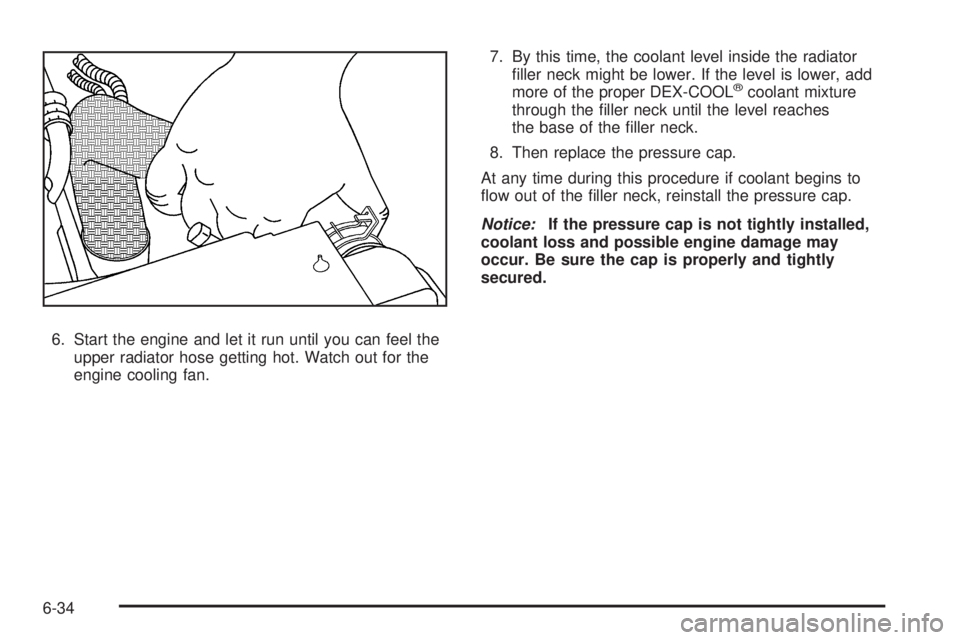
6. Start the engine and let it run until you can feel the
upper radiator hose getting hot. Watch out for the
engine cooling fan.7. By this time, the coolant level inside the radiator
filler neck might be lower. If the level is lower, add
more of the proper DEX-COOL
®coolant mixture
through the filler neck until the level reaches
the base of the filler neck.
8. Then replace the pressure cap.
At any time during this procedure if coolant begins to
flow out of the filler neck, reinstall the pressure cap.
Notice:If the pressure cap is not tightly installed,
coolant loss and possible engine damage may
occur. Be sure the cap is properly and tightly
secured.
6-34
Page 313 of 448
Power Steering Fluid
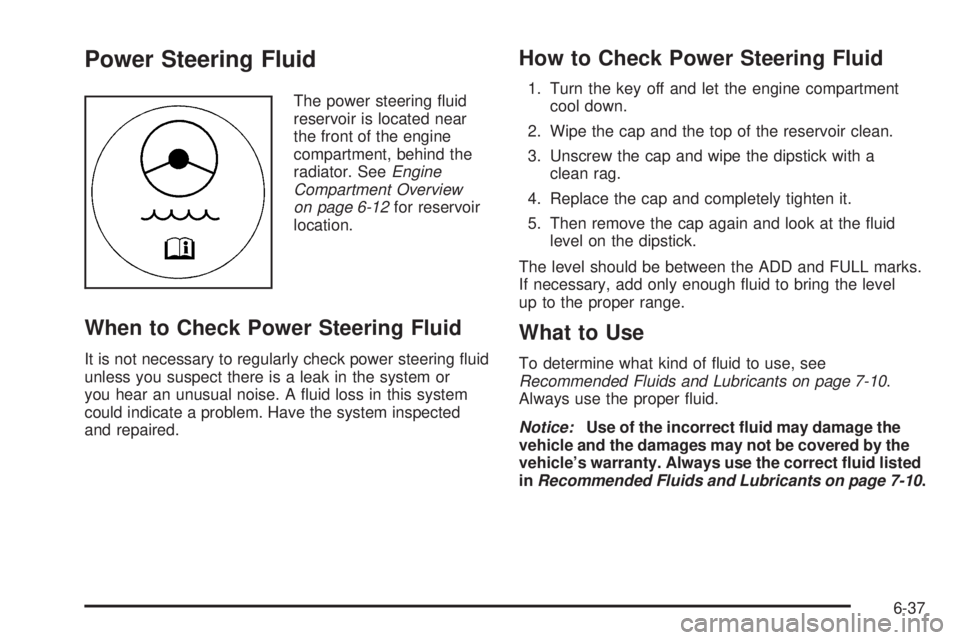
The power steering fluid
reservoir is located near
the front of the engine
compartment, behind the
radiator. SeeEngine
Compartment Overview
on page 6-12for reservoir
location.
When to Check Power Steering Fluid
It is not necessary to regularly check power steering fluid
unless you suspect there is a leak in the system or
you hear an unusual noise. A fluid loss in this system
could indicate a problem. Have the system inspected
and repaired.
How to Check Power Steering Fluid
1. Turn the key off and let the engine compartment
cool down.
2. Wipe the cap and the top of the reservoir clean.
3. Unscrew the cap and wipe the dipstick with a
clean rag.
4. Replace the cap and completely tighten it.
5. Then remove the cap again and look at the fluid
level on the dipstick.
The level should be between the ADD and FULL marks.
If necessary, add only enough fluid to bring the level
up to the proper range.
What to Use
To determine what kind of fluid to use, see
Recommended Fluids and Lubricants on page 7-10.
Always use the proper fluid.
Notice:Use of the incorrect uid may damage the
vehicle and the damages may not be covered by the
vehicle’s warranty. Always use the correct uid listed
inRecommended Fluids and Lubricants on page 7-10.
6-37
Page 401 of 448

Additional Required Services
At Each Fuel Stop
•
Engine oil level check. SeeEngine Oil on page 6-15.
•Engine coolant level check. SeeEngine Coolant on
page 6-29.
•Windshield washer fluid level check. SeeWindshield
Washer Fluid on page 6-38.
Once a Month
•
Tire inflation check. SeeInation - Tire Pressure on
page 6-64.
•Tire wear inspection. SeeTire Inspection and
Rotation on page 6-71.
Once a Year
•
Starter switch check. SeeOwner Checks and
Services on page 7-8.
•Parking brake and automatic transmission P (Park)
mechanism check. SeeOwner Checks and
Services on page 7-8.
•Automatic transmission shiftlock control system
check. SeeOwner Checks and Services on
page 7-8.
•Ignition transmission lock check. SeeOwner
Checks and Services on page 7-8.
•Engine cooling system and pressure cap pressure
check. Radiator and air conditioning condenser
outside cleaning. SeeCooling System on page 6-27.
•Exhaust system and nearby heat shields inspection
for loose or damaged components.
•Accelerator pedal check for damage, high effort, or
binding. Replace if needed.
First Engine Oil Change After Every
40 000 km/25,000 Miles
•
Fuel system inspection for damage or leaks.
7-5
Page 402 of 448
First Engine Oil Change After Every
80 000 km/50,000 Miles
•
Engine air cleaner filter replacement. SeeEngine
Air Cleaner/Filter on page 6-20.
•Automatic transmission fluid change (severe
service) for vehicles mainly driven in heavy
city traffic in hot weather, in hilly or mountainous
terrain, when frequently towing a trailer, or used for
taxi, police, or delivery service. SeeAutomatic
Transmission Fluid on page 6-21.
First Engine Oil Change After Every
160 000 km/100,000 Miles
•
Automatic transmission fluid change (normal
service). SeeAutomatic Transmission Fluid
on page 6-21.
•Spark plug replacement.An Emission Control
Service.
First Engine Oil Change After Every
240 000 km/150,000 Miles
•
Engine cooling system drain, flush, and refill,
cooling system and cap pressure check, and
cleaning of outside of radiator and air conditioning
condenser (or every 5 years, whichever occurs
first). SeeEngine Coolant on page 6-29.An
Emission Control Service.
•Engine accessory drive belt inspection for fraying,
excessive cracks, or obvious damage and
replacement, if needed.An Emission Control
Service.
7-6
Page 438 of 448
Hill and Mountain Roads..................................5-28
Hitches..........................................................5-55
Hood
Checking Things Under................................6-10
Release.....................................................6-11
Horn ............................................................... 4-3
How OnStar Service Works..............................1-21
How to Add Automatic Transmission Fluid..........6-24
How to Add Coolant to the Radiator..................6-32
How to Add Fluid............................................6-26
How to Check........................................6-25, 6-65
How to Check and Add Fluid............................6-27
How to Check Automatic Transmission Fluid.......6-22
How to Check Lubricant..........................6-47, 6-49
How to Check Power Steering Fluid..................6-37
How to Inspect the Engine Air Cleaner/Filter.......6-20
How to Reset the Engine Oil Life System...........6-19
How to Wear Safety Belts Properly...................2-18
How to Add Coolant to the Recovery Tank.............6-32
Hydraulic Clutch.............................................6-26
Hydroplaning..................................................5-26I
If a Crash Occurs...........................................8-13
If No Steam is Coming from the Engine
Compartment..............................................6-36
If Steam is Coming from the Engine
Compartment..............................................6-35
If the Off Indicator is Lit for an Adult-Size
Occupant...................................................2-78
If the On Indicator is Lit for a Child Restraint......2-77
Ignition Positions.............................................3-17
Ignition Transmission Lock Check....................... 7-9
Infants and Young Children, Restraints...............2-38
Inflation - Tire Pressure...................................6-64
Instrument Panel
Brightness..................................................4-13
Cluster.......................................................4-19
Insuring Your Vehicle.......................................8-12
Interior Mirror.................................................1-11
Introduction...................................................... 7-2
8