Page 321 of 448
{WARNING:
Fans or other moving engine parts can injure you
badly. Keep your hands away from moving parts
once the engine is running.
5. Check that the jumper cables do not have loose
or missing insulation. If they do, you could get a
shock. The vehicles could be damaged too.
Before you connect the cables, here are some
basic things you should know. Positive (+) will go
to positive (+) or to a remote positive (+) terminal
if the vehicle has one. Negative (−) will go to a
heavy, unpainted metal engine part or to a remote
negative (−) terminal if the vehicle has one.
Do not connect positive (+) to negative (−)oryou
will get a short that would damage the battery
and maybe other parts too. And do not connect the
negative (−) cable to the negative (−) terminal on
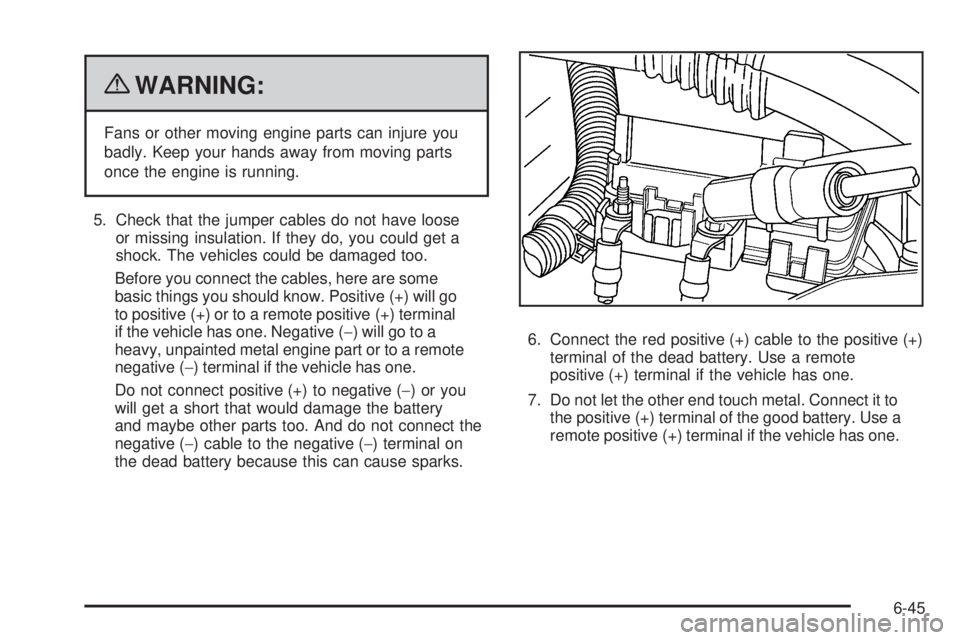
the dead battery because this can cause sparks.6. Connect the red positive (+) cable to the positive (+)
terminal of the dead battery. Use a remote
positive (+) terminal if the vehicle has one.
7. Do not let the other end touch metal. Connect it to
the positive (+) terminal of the good battery. Use a
remote positive (+) terminal if the vehicle has one.
6-45
Page 322 of 448
8. Now connect the black negative (−) cable to the
negative (−) terminal of the good battery. Use a
remote negative (−) terminal if the vehicle has one.
Do not let the other end touch anything until the
next step. The other end of the negative (−) cable
does not go to the dead battery. It goes to a heavy,
unpainted metal engine part, or to a remote
negative (−) terminal on the vehicle with the
dead battery.
9. Connect the other end of the negative (−) cable at
least 18 inches (45 cm) away from the dead battery,
but not near engine parts that move. The electrical
connection is just as good there, and the chance
of sparks getting back to the battery is much less.
Your vehicle has a remote negative (−) terminal
for this purpose.
10. Now start the vehicle with the good battery and run
the engine for a while.
11. Try to start the vehicle that had the dead battery.
If it will not start after a few tries, it probably needs
service.Notice:If the jumper cables are connected or
removed in the wrong order, electrical shorting may
occur and damage the vehicle. The repairs would
not be covered by the vehicle warranty. Always
connect and remove the jumper cables in the correct
order, making sure that the cables do not touch
each other or other metal.
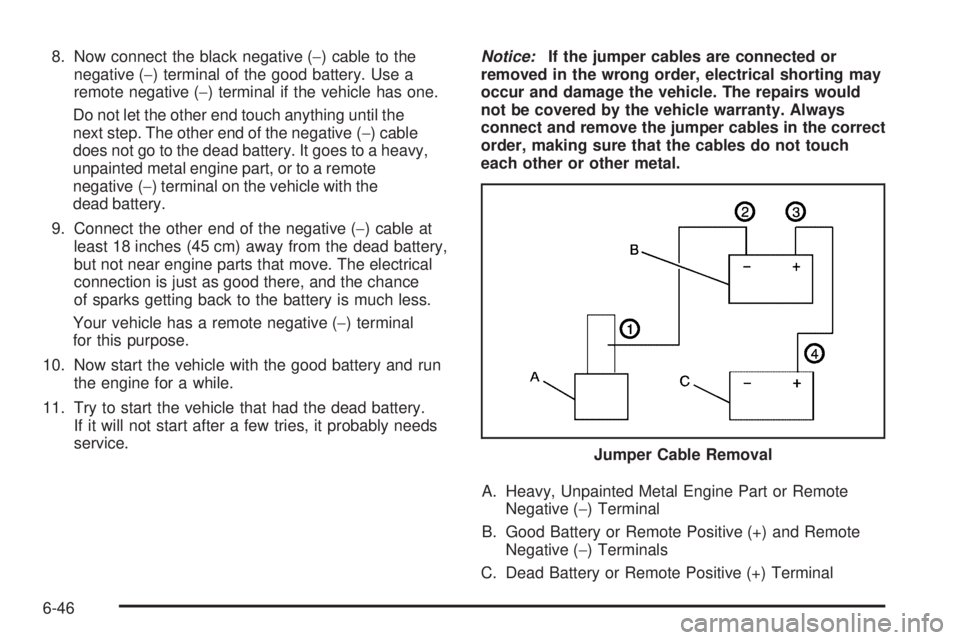
A. Heavy, Unpainted Metal Engine Part or Remote
Negative (−) Terminal
B. Good Battery or Remote Positive (+) and Remote
Negative (−) Terminals
C. Dead Battery or Remote Positive (+) TerminalJumper Cable Removal
6-46
Page 327 of 448
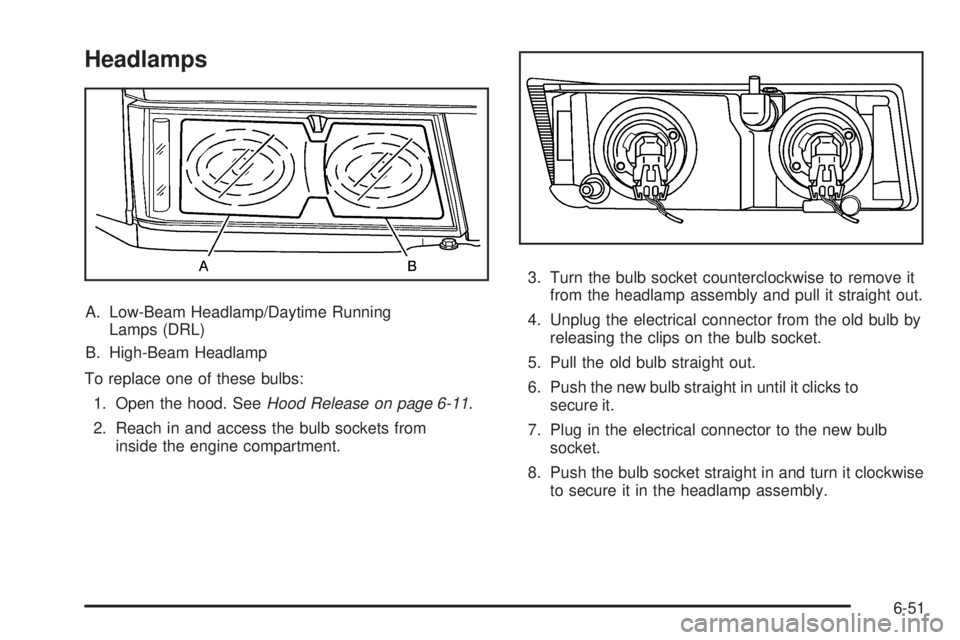
Headlamps
A. Low-Beam Headlamp/Daytime Running
Lamps (DRL)
B. High-Beam Headlamp
To replace one of these bulbs:
1. Open the hood. SeeHood Release on page 6-11.
2. Reach in and access the bulb sockets from
inside the engine compartment.3. Turn the bulb socket counterclockwise to remove it
from the headlamp assembly and pull it straight out.
4. Unplug the electrical connector from the old bulb by
releasing the clips on the bulb socket.
5. Pull the old bulb straight out.
6. Push the new bulb straight in until it clicks to
secure it.
7. Plug in the electrical connector to the new bulb
socket.
8. Push the bulb socket straight in and turn it clockwise
to secure it in the headlamp assembly.
6-51
Page 328 of 448
Front Turn Signal, Parking and
Daytime Running Lamps (DRL)
To replace one of these bulbs:
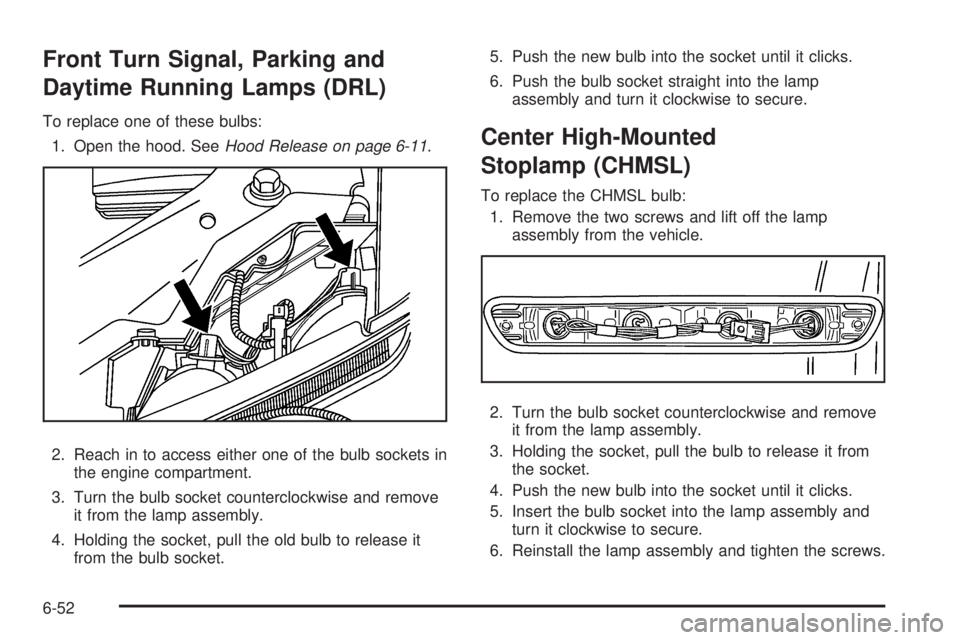
1. Open the hood. SeeHood Release on page 6-11.
2. Reach in to access either one of the bulb sockets in
the engine compartment.
3. Turn the bulb socket counterclockwise and remove
it from the lamp assembly.
4. Holding the socket, pull the old bulb to release it
from the bulb socket.5. Push the new bulb into the socket until it clicks.
6. Push the bulb socket straight into the lamp
assembly and turn it clockwise to secure.
Center High-Mounted
Stoplamp (CHMSL)
To replace the CHMSL bulb:
1. Remove the two screws and lift off the lamp
assembly from the vehicle.
2. Turn the bulb socket counterclockwise and remove
it from the lamp assembly.
3. Holding the socket, pull the bulb to release it from
the socket.
4. Push the new bulb into the socket until it clicks.
5. Insert the bulb socket into the lamp assembly and
turn it clockwise to secure.
6. Reinstall the lamp assembly and tighten the screws.
6-52
Page 336 of 448
(F) Tire Size:A combination of letters and
numbers define a tire’s width, height, aspect
ratio, construction type and service description.
The letter T as the first character in the tire
size means the tire is for temporary use only.
(G) TPC Spec (Tire Performance Criteria
Specication)
:Original equipment tires designed
to GM’s specific tire performance criteria have a
TPC specification code molded onto the sidewall.
GM’s TPC specifications meet or exceed all federal
safety guidelines.
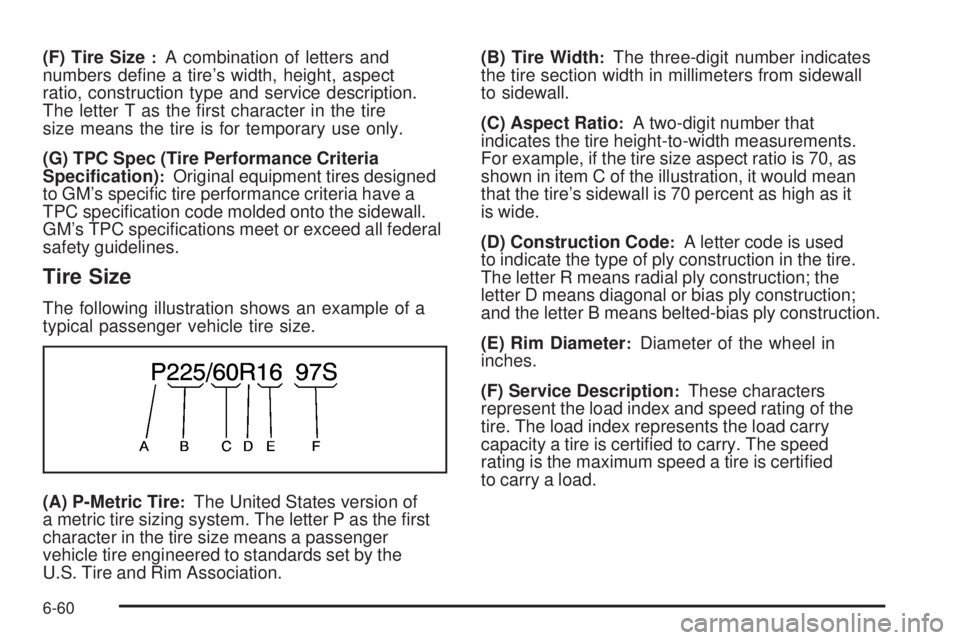
Tire Size
The following illustration shows an example of a
typical passenger vehicle tire size.
(A) P-Metric Tire
:The United States version of
a metric tire sizing system. The letter P as the first
character in the tire size means a passenger
vehicle tire engineered to standards set by the
U.S. Tire and Rim Association.(B) Tire Width
:The three-digit number indicates
the tire section width in millimeters from sidewall
to sidewall.
(C) Aspect Ratio
:A two-digit number that
indicates the tire height-to-width measurements.
For example, if the tire size aspect ratio is 70, as
shown in item C of the illustration, it would mean
that the tire’s sidewall is 70 percent as high as it
is wide.
(D) Construction Code
:A letter code is used
to indicate the type of ply construction in the tire.
The letter R means radial ply construction; the
letter D means diagonal or bias ply construction;
and the letter B means belted-bias ply construction.
(E) Rim Diameter
:Diameter of the wheel in
inches.
(F) Service Description
:These characters
represent the load index and speed rating of the
tire. The load index represents the load carry
capacity a tire is certified to carry. The speed
rating is the maximum speed a tire is certified
to carry a load.
6-60
Page 346 of 448

The TPMS sensor matching procedure is outlined
below:
1. Set the parking brake.
2. Turn the ignition switch to ON/RUN with the
engine off.
3. Turn the exterior lamp switch from AUTO to OFF
four times within three seconds. A double horn chirp
will sound and the TPMS low tire warning light starts
flashing. The double horn chirp and flashing TPMS
warning light indicates the TPMS matching process
has started. The TPMS warning light should continue
flashing throughout the matching procedure.
The LOW TIRE message displays on the Driver
Information Center (DIC).
4. Start with the driver side front tire.
5. Remove the valve cap from the valve cap stem.
Activate the TPMS sensor by increasing or
decreasing the tire’s air pressure for 10 seconds,
then stop and listen for a single horn chirp. The
single horn chirp should sound within 15 seconds,
confirming that the sensor identification code has
been matched to this tire and wheel position. If you
do not hear the confirming single horn chirp, turn the
ignition switch to LOCK and start over beginning with
Step 2.6. Proceed to the passenger side front tire, and repeat
the procedure in Step 5.
7. Proceed to the passenger side rear tire, and repeat
the procedure in Step 5.
8. Proceed to the driver side rear tire, and repeat the
procedure in Step 5.
9. After hearing the confirming horn chirp for the driver
side rear tire, check to see if the TPMS low tire
warning light and the DIC LOW TIRE messages
have turned off. If yes, the TPMS sensors have been
relearned. Turn the ignition switch to LOCK/OFF.
If the low tire warning light and the SERV TPM
message on the DIC are on after completing Step 5
for the driver side rear tire, the sensor relearn
process has not been successful. Turn the ignition
switch to LOCK/OFF and repeat the matching
process beginning with Step 2.
10. Set all four tires to the recommended air pressure
level as indicated on the Tire and Loading
Information label.
11. Put the valve caps back on the valve stems.
6-70
Page 356 of 448
Changing a Flat Tire
If a tire goes flat, avoid further tire and wheel damage
by driving slowly to a level place. Turn on the hazard
warning flashers. SeeHazard Warning Flashers
on page 4-3.
{WARNING:
Changing a tire can be dangerous. The vehicle
can slip off the jack and roll over or fall on you or
other people. You and they could be badly injured
or even killed. Find a level place to change your
tire. To help prevent the vehicle from moving:
1. Set the parking brake firmly.
2. Put an automatic transmission shift lever in
P (Park), or shift a manual transmission to
1 (First) or R (Reverse).
WARNING: (Continued)
WARNING: (Continued)
3. If you have a four-wheel-drive vehicle,
be sure the transfer case is in a drive
gear – not in Neutral.
4. Turn off the engine and do not restart while
the vehicle is raised.
5. Do not allow passengers to remain in the
vehicle.
To be even more certain the vehicle will not move,
put blocks at the front and rear of the tire farthest
away from the one being changed. That would be
the tire on the other side, at the opposite end of
the vehicle.
6-80
Page 386 of 448
Vehicle Identication
Vehicle Identication Number (VIN)
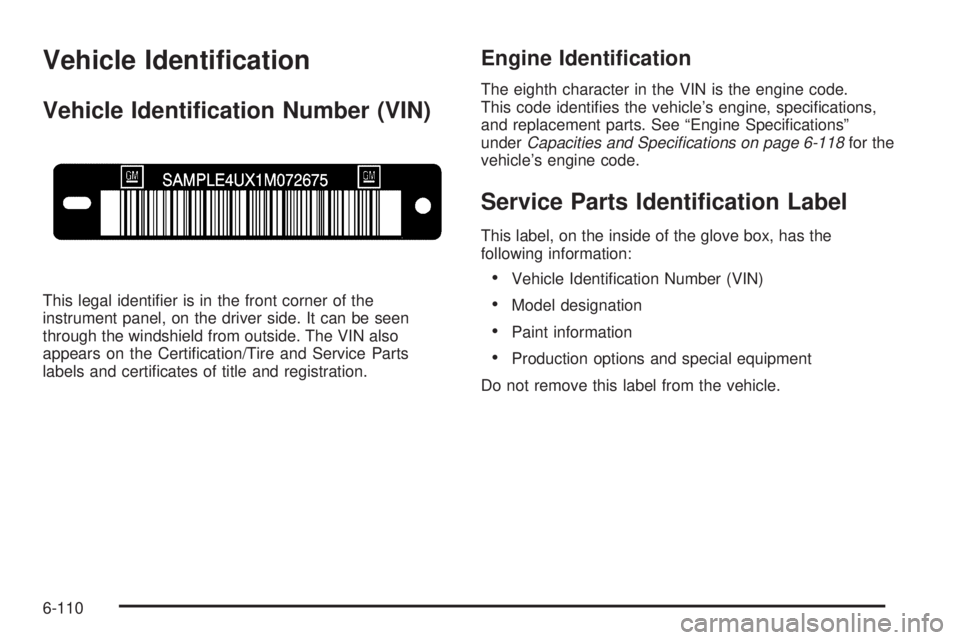
This legal identifier is in the front corner of the
instrument panel, on the driver side. It can be seen
through the windshield from outside. The VIN also
appears on the Certification/Tire and Service Parts
labels and certificates of title and registration.
Engine Identication
The eighth character in the VIN is the engine code.
This code identifies the vehicle’s engine, specifications,
and replacement parts. See “Engine Specifications”
underCapacities and Specications on page 6-118for the
vehicle’s engine code.
Service Parts Identication Label
This label, on the inside of the glove box, has the
following information:
•Vehicle Identification Number (VIN)
•Model designation
•Paint information
•Production options and special equipment
Do not remove this label from the vehicle.
6-110