2010 FORD SUPER DUTY heating
[x] Cancel search: heatingPage 296 of 407
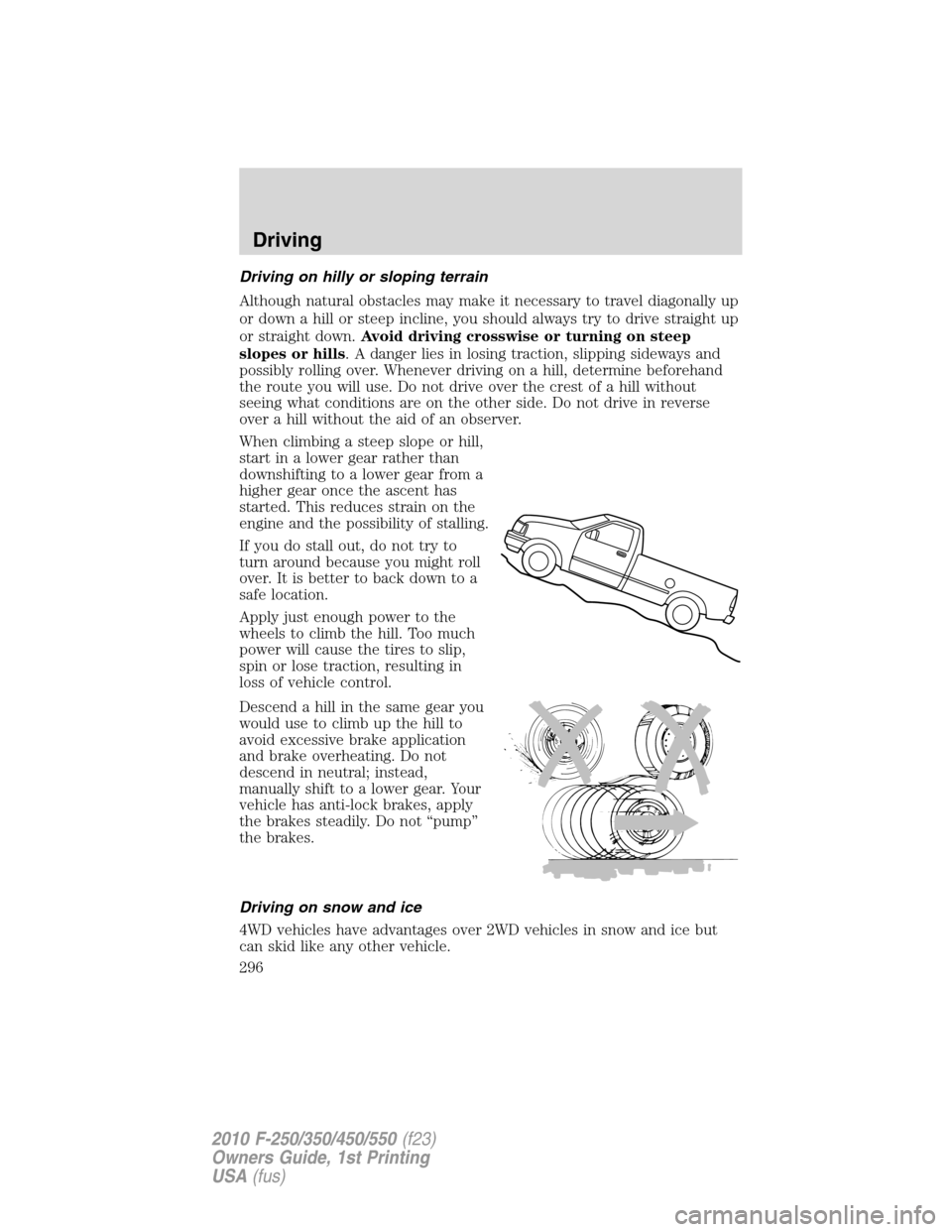
Driving on hilly or sloping terrain
Although natural obstacles may make it necessary to travel diagonally up
or down a hill or steep incline, you should always try to drive straight up
or straight down.Avoid driving crosswise or turning on steep
slopes or hills. A danger lies in losing traction, slipping sideways and
possibly rolling over. Whenever driving on a hill, determine beforehand
the route you will use. Do not drive over the crest of a hill without
seeing what conditions are on the other side. Do not drive in reverse
over a hill without the aid of an observer.
When climbing a steep slope or hill,
start in a lower gear rather than
downshifting to a lower gear from a
higher gear once the ascent has
started. This reduces strain on the
engine and the possibility of stalling.
If you do stall out, do not try to
turn around because you might roll
over. It is better to back down to a
safe location.
Apply just enough power to the
wheels to climb the hill. Too much
power will cause the tires to slip,
spin or lose traction, resulting in
loss of vehicle control.
Descend a hill in the same gear you
would use to climb up the hill to
avoid excessive brake application
and brake overheating. Do not
descend in neutral; instead,
manually shift to a lower gear. Your
vehicle has anti-lock brakes, apply
the brakes steadily. Do not “pump”
the brakes.
Driving on snow and ice
4WD vehicles have advantages over 2WD vehicles in snow and ice but
can skid like any other vehicle.
Driving
296
2010 F-250/350/450/550(f23)
Owners Guide, 1st Printing
USA(fus)
Page 366 of 407
•Do not mix coolants. Add the coolant type originally equipped
in your vehicle.Refer toMaintenance product specifications and
capacitiesin this chapter.
Note:Do not use stop leak pellets or cooling system sealants/additives
as they can cause damage to the engine cooling and/or heating systems.
This damage would not be covered under your vehicle’s warranty.
•A large amount of water without engine coolant may be added, in case
of emergency, to reach a vehicle service location. In this instance, the
cooling system must be drained and refilled with a 50/50 mixture of
engine coolant and distilled water as soon as possible. Water alone
(without engine coolant) can cause engine damage from corrosion,
overheating or freezing.
•Do not use alcohol, methanol, brine or any engine coolants
mixed with alcohol or methanol antifreeze (coolant).Alcohol
and other liquids can cause engine damage from overheating or
freezing.
•Do not add extra inhibitors or additives to the coolant.These
can be harmful and compromise the corrosion protection of the engine
coolant.
For vehicles with overflow coolant systems with a non-pressurized cap
on the coolant recovery system, add coolant to the coolant recovery
reservoir when the engine is cool. Add the proper mixture of coolant and
water to the FULL COLD level. For all other vehicles which have a
coolant degas system with a pressurized cap, or if it is necessary to
remove the coolant pressure relief cap on the radiator of a vehicle with
an overflow system, follow these steps to add engine coolant.
WARNING:To reduce the risk of personal injury, make sure the
engine is cool before unscrewing the coolant pressure relief cap.
The cooling system is under pressure; steam and hot liquid can come
out forcefully when the cap is loosened slightly.
Add the proper mixture of coolant and water to the cooling system by
following these steps:
1. Before you begin, turn the engine off and let it cool.
2. When the engine is cool, wrap a thick cloth around the coolant
pressure relief cap on the coolant reservoir (a translucent plastic bottle).
Slowly turn cap counterclockwise (left) until pressure begins to release.
3. Step back while the pressure releases.
Maintenance and Specifications
366
2010 F-250/350/450/550(f23)
Owners Guide, 1st Printing
USA(fus)
Page 367 of 407
4. When you are sure that all the pressure has been released, use the
cloth to turn it counterclockwise and remove the cap.
5. Fill the coolant reservoir slowly with the proper coolant mixture, to
within the COLD FILL RANGE or the FULL COLD level on the reservoir.
If you removed the radiator cap in an overflow system, fill the radiator
until the coolant is visible and radiator is almost full.
6. Replace the cap. Turn until tightly installed. Cap must be tightly
installed to prevent coolant loss.
After any coolant has been added, check the coolant concentration (refer
toChecking engine coolant). If the concentration is not 50/50
(protection to –34°F/–36°C), drain some coolant and adjust the
concentration. It may take several drains and additions to obtain a 50/50
coolant concentration.
Whenever coolant has been added, the coolant level in the coolant
reservoir should be checked the next few times you drive the vehicle. If
necessary, add enough 50/50 concentration of engine coolant and
distilled water to bring the liquid level to the proper level.
If you have to add more than 1.0 quart (1.0 liter) of engine coolant per
month, have your authorized dealer check the engine cooling system.
Your cooling system may have a leak. Operating an engine with a low
level of coolant can result in engine overheating and possible engine
damage.
Recycled engine coolant
Ford Motor Company does NOT recommend the use of recycled engine
coolant since a Ford-approved recycling process is not yet available.
Used engine coolant should be disposed of in an appropriate
manner. Follow your community’s regulations and standards for recycling
and disposing of automotive fluids.
Coolant refill capacity
To find out how much fluid your vehicle’s cooling system can hold, refer
toMaintenance product specifications and capacitiesin this chapter.
If your vehicle is equipped with a diesel engine,refer to the
Maintenance Product Specifications and Capacitiessection of your
6.0 and 6.4 Liter Power Stroke Direct Injection Turbo Diesel Owner’s
Guide Supplement.
Fill your engine coolant reservoir as outlined inAdding engine coolant
in this section.
Maintenance and Specifications
367
2010 F-250/350/450/550(f23)
Owners Guide, 1st Printing
USA(fus)
Page 369 of 407
•The message center will indicate the engine is overheating.
•The
indicator will illuminate.
If the engine reaches a preset over-temperature condition, the engine
will automatically switch to alternating cylinder operation. Each disabled
cylinder acts as an air pump and cools the engine.
When this occurs the vehicle will still operate. However:
•The engine power will be limited.
•The air conditioning system will be disabled.
Continued operation will increase the engine temperature and the engine
will completely shut down, causing steering and braking effort to
increase.
Once the engine temperature cools, the engine can be re-started. Take
your vehicle to a service facility as soon as possible to minimize engine
damage.
When fail-safe mode is activated
You have limited engine power when in the fail-safe mode, so drive the
vehicle with caution. The vehicle will not be able to maintain high-speed
operation and the engine will run rough. Remember that the engine is
capable of completely shutting down automatically to prevent engine
damage; therefore:
1. Pull off the road as soon as safely possible and turn off the engine.
2. Arrange for the vehicle to be taken to a service facility.
3. If this is not possible, wait a short period for the engine to cool.
4. Check the coolant level and replenish if low.
WARNING:Never remove the coolant reservoir cap while the
engine is running or hot.
5. Re-start the engine and take your vehicle to a service facility.
Driving the vehicle without repairing the engine problem
increases the chance of engine damage. Take your vehicle to a
service facility as soon as possible.
Maintenance and Specifications
369
2010 F-250/350/450/550(f23)
Owners Guide, 1st Printing
USA(fus)
Page 385 of 407
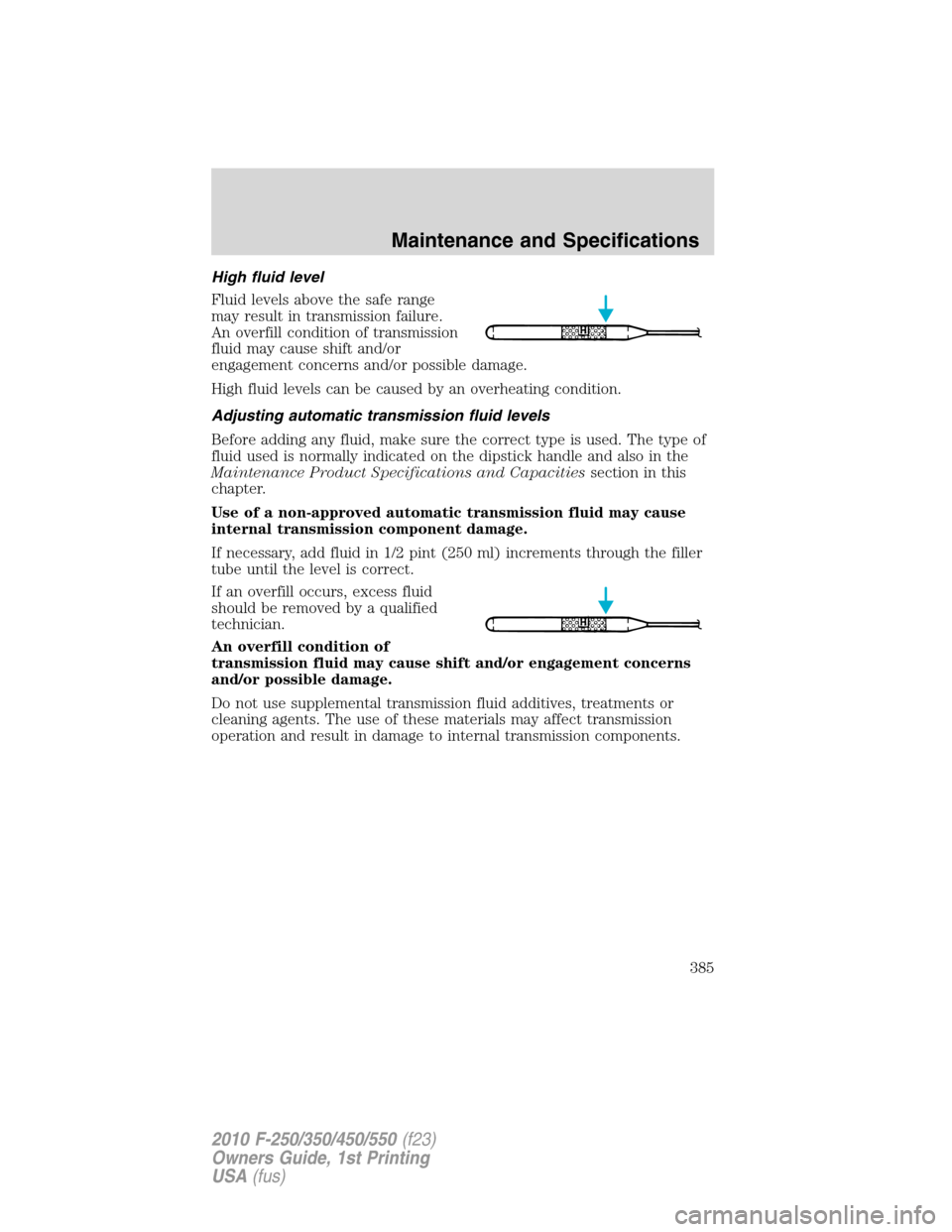
High fluid level
Fluid levels above the safe range
may result in transmission failure.
An overfill condition of transmission
fluid may cause shift and/or
engagement concerns and/or possible damage.
High fluid levels can be caused by an overheating condition.
Adjusting automatic transmission fluid levels
Before adding any fluid, make sure the correct type is used. The type of
fluid used is normally indicated on the dipstick handle and also in the
Maintenance Product Specifications and Capacitiessection in this
chapter.
Use of a non-approved automatic transmission fluid may cause
internal transmission component damage.
If necessary, add fluid in 1/2 pint (250 ml) increments through the filler
tube until the level is correct.
If an overfill occurs, excess fluid
should be removed by a qualified
technician.
An overfill condition of
transmission fluid may cause shift and/or engagement concerns
and/or possible damage.
Do not use supplemental transmission fluid additives, treatments or
cleaning agents. The use of these materials may affect transmission
operation and result in damage to internal transmission components.
Maintenance and Specifications
385
2010 F-250/350/450/550(f23)
Owners Guide, 1st Printing
USA(fus)
Page 403 of 407
safety belts ..............................349
washing ....................................344
waxing .....................................345
wheels ......................................345
wiper blades ............................347
Climate control (see Air
conditioning or Heating) ....98, 102
Clock adjust
6-CD in dash .............................54
AM/FM/CD .................................47
Clutch
fluid ..........................................383
operation while driving ..........278
recommended shift speeds ....278
Compass, electronic
set zone adjustment .................37
Console ..............................122–123
overhead ..........................121–122
Controls
power seat ...............................166
steering column ......................134
Coolant
checking and adding ..............364
refill capacities ................367, 390
Cruise control
(see Speed control) ..................131
Customer Assistance ................302
Ford accessories for your
vehicle .....................................352
Ford Extended Service
Plan ..........................................399
Getting assistance outside
the U.S. and Canada ..............341
Getting roadside assistance ...302
Getting the service you
need .........................................337
Ordering additional owner’s
literature .................................342Utilizing the
Mediation/Arbitration
Program ...................................341
D
Daytime running lamps
(see Lamps) ..............................108
Dipstick
automatic transmission
fluid ..........................................383
engine oil .................................359
Driving under special
conditions ..................277, 292, 296
sand .........................................294
snow and ice ...........................296
through water .................295, 298
DVD system .................................68
E
Electronic message center ...25, 33
Emergencies, roadside
jump-starting ..........................330
Emergency Flashers .................303
Emission control system ..........378
Engine ........................................394
cleaning ...................................346
coolant .....................................364
diesel ...........................................6
fail-safe cooling .......................368
idle speed control ...................362
refill capacities ........................390
service points ..................356–357
starting after a collision .........304
Engine oil ..................................359
checking and adding ..............359
dipstick ....................................359
filter, specifications ........361, 389
recommendations ...................361
Index
403
2010 F-250/350/450/550(f23)
Owners Guide, 1st Printing
USA(fus)
Page 404 of 407
refill capacities ........................390
Event data recording ....................8
Exhaust fumes ..........................266
F
Fail safe cooling ........................368
Family entertainment system ....68
Fluid capacities .........................390
Fog lamps ..................................107
Four-Wheel Drive vehicles .......284
description ..............................289
driving off road .......................291
electronic shift ................285, 289
indicator light .........................286
lever operated shift ................286
manual locking hubs ..............284
preparing to drive your
vehicle .....................................273
Fuel ............................................370
calculating fuel
economy ......................26, 35, 375
cap ...........................................372
capacity ...................................390
choosing the right fuel ...........373
comparisons with EPA fuel
economy estimates .................378
detergent in fuel .....................374
filling your vehicle with
fuel ...........................370, 372, 375
filter, specifications ........370, 389
fuel pump shut-off switch .....304
improving fuel economy ........375
octane rating ...................374, 394
quality ......................................374
running out of fuel .................375
safety information relating to
automotive fuels .....................370
Fuel pump shut-off switch .......304
Fuses ..................................305–306G
Gas cap (see Fuel cap) ............372
Gas mileage
(see Fuel economy) .................375
Gauges .........................................21
transmission fluid
temperature gauge ...................25
H
Hazard flashers .........................303
Head restraints .................163, 169
Headlamps .................................107
aiming ..............................109, 111
autolamp system .....................107
daytime running lights ...........108
flash to pass ............................108
high beam ...............................108
replacing bulbs ...............115–117
turning on and off ..................107
Heating
heater only system ...................98
heating and air conditioning
system ...............................99, 102
Homelink wireless control
system ........................................139
Hood ..........................................355
I
Ignition ...............................263, 394
Illuminated visor mirror ...........121
Infant seats
(see Safety seats) .....................198
Inspection/maintenance (I/M)
testing ........................................380
Index
404
2010 F-250/350/450/550(f23)
Owners Guide, 1st Printing
USA(fus)