Page 6 of 104
To determine if a coolant additive recharge is required, check the nitrite
strength of the coolant using the coolant nitrate test strip kit (Acustrip
3-way Antifreeze Test Strip). If the nitrite strength is above 800 ppm no
action is required. If the nitrite strength is between 800 ppm to 300 ppm
add 32 fl. oz. (946 ml) of engine coolant additive, Motorcraft VC-8 or
equivalent. If the nitrite strength is below 300 ppm, flush & refill the
cooling system.
Fuel and turbocharger cooling system (F-Super Duty only)
The fuel and turbocharger cooling system contains a cooler which is
mounted on the turbo interstage U-tube on the left side of the engine.
The cooler’s function is to regulate engine fuel temperature and cool the
electronics that support the turbocharger. You may hear the auxiliary
coolant pump running up to 10 minutes after the ignition is turned off in
hot weather or if you are towing heavy loads. This is to control the
temperature of the turbocharger.
Engine governed speed
The engine governor is controlled by the PCM. The PCM controls fuel
input to limit maximum engine speed. It will not, however, prevent
engine overspeeding resulting from downshifting at high vehicle speed or
by descending steep grades at too high a vehicle speed for the selected
transmission gear.
If your vehicle is equipped with a manual transmission,refer to
Manual transmission shift speedsin theDrivingchapter of your
Owner’s Guidefor maximum vehicle shift speeds in various gears. Do
not exceed 4,000 rpm. Maximum engine governed speed is 3,700 rpm.
Excessive rpm can only be achieved by manually downshifting at too
high of a vehicle speed.
Operating the engine beyond the governed speed can cause
severe engine damage.
Speed control (F-Super Duty)
If vehicle speed goes outside a predetermined range from the set speed,
the RES (Resume) function will not reset vehicle speed. Vehicle speed
will need to be reset with the SET +/- button after reaching desired
speed using accelerator pedal.
Introduction
6
2010 Econoline(eco)
Supplement(supplement), 1st Printing
USA(fus)
Page 34 of 104
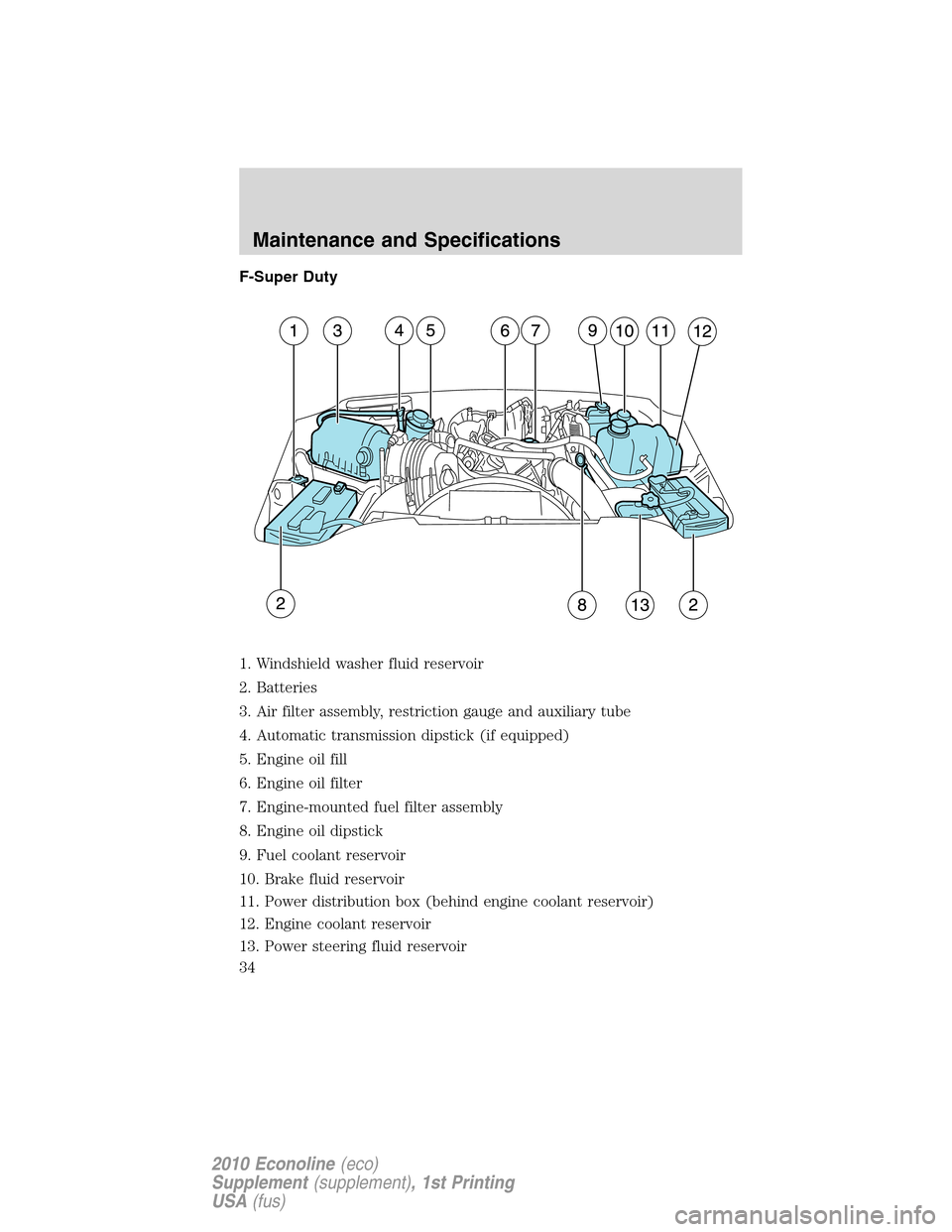
F-Super Duty
1. Windshield washer fluid reservoir
2. Batteries
3. Air filter assembly, restriction gauge and auxiliary tube
4. Automatic transmission dipstick (if equipped)
5. Engine oil fill
6. Engine oil filter
7. Engine-mounted fuel filter assembly
8. Engine oil dipstick
9. Fuel coolant reservoir
10. Brake fluid reservoir
11. Power distribution box (behind engine coolant reservoir)
12. Engine coolant reservoir
13. Power steering fluid reservoir
Maintenance and Specifications
34
2010 Econoline(eco)
Supplement(supplement), 1st Printing
USA(fus)
Page 51 of 104
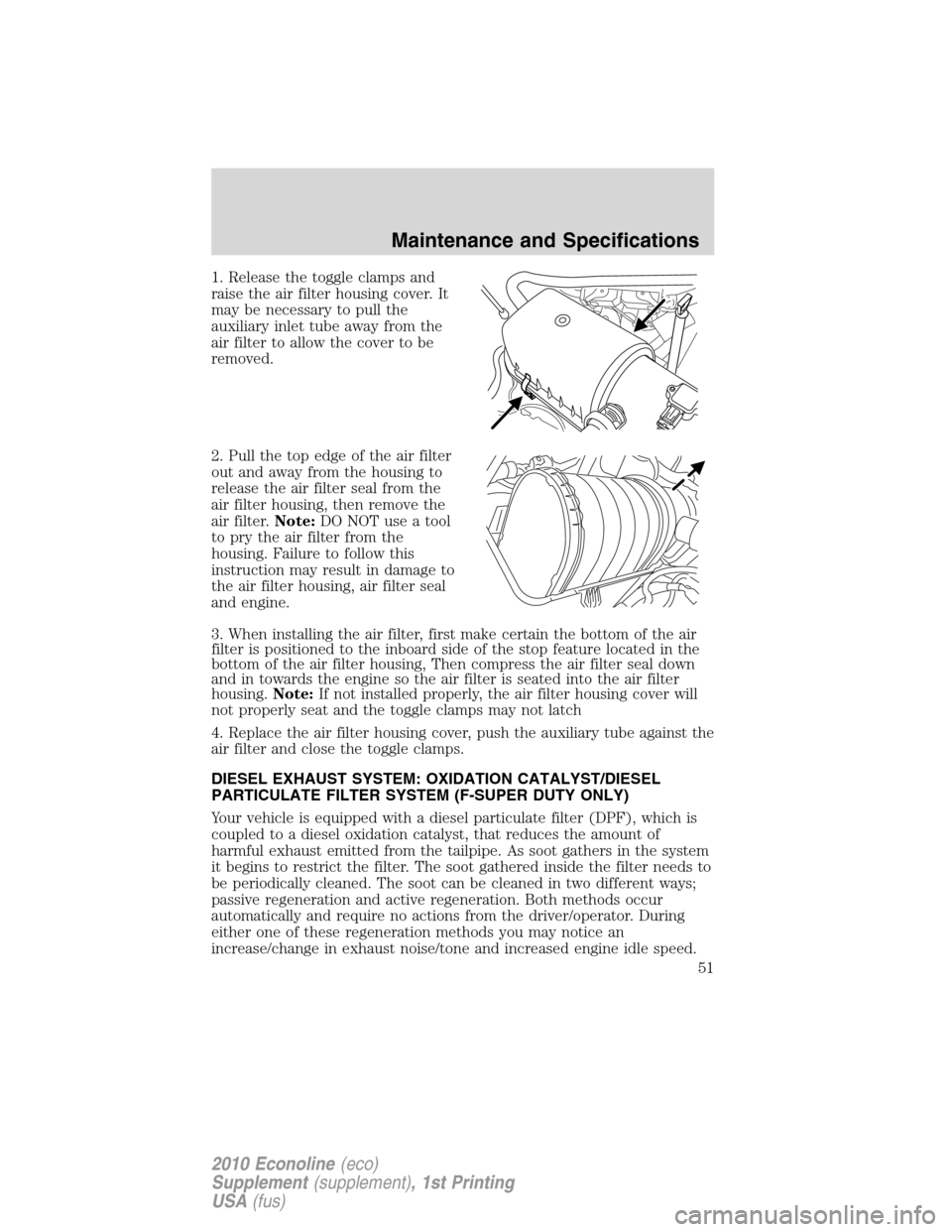
1. Release the toggle clamps and
raise the air filter housing cover. It
may be necessary to pull the
auxiliary inlet tube away from the
air filter to allow the cover to be
removed.
2. Pull the top edge of the air filter
out and away from the housing to
release the air filter seal from the
air filter housing, then remove the
air filter.Note:DO NOT use a tool
to pry the air filter from the
housing. Failure to follow this
instruction may result in damage to
the air filter housing, air filter seal
and engine.
3. When installing the air filter, first make certain the bottom of the air
filter is positioned to the inboard side of the stop feature located in the
bottom of the air filter housing, Then compress the air filter seal down
and in towards the engine so the air filter is seated into the air filter
housing.Note:If not installed properly, the air filter housing cover will
not properly seat and the toggle clamps may not latch
4. Replace the air filter housing cover, push the auxiliary tube against the
air filter and close the toggle clamps.
DIESEL EXHAUST SYSTEM: OXIDATION CATALYST/DIESEL
PARTICULATE FILTER SYSTEM (F-SUPER DUTY ONLY)
Your vehicle is equipped with a diesel particulate filter (DPF), which is
coupled to a diesel oxidation catalyst, that reduces the amount of
harmful exhaust emitted from the tailpipe. As soot gathers in the system
it begins to restrict the filter. The soot gathered inside the filter needs to
be periodically cleaned. The soot can be cleaned in two different ways;
passive regeneration and active regeneration. Both methods occur
automatically and require no actions from the driver/operator. During
either one of these regeneration methods you may notice an
increase/change in exhaust noise/tone and increased engine idle speed.
Maintenance and Specifications
51
2010 Econoline(eco)
Supplement(supplement), 1st Printing
USA(fus)
Page 56 of 104
If the engine won’t crank
Turn on the headlights. If the lights are dim, do not go on at all or when
the ignition is turned to START the lights become dim or go out, the
battery connections may be loose or corroded, or the battery may be
discharged. If there is a clicking or stuttering sound coming from the
engine compartment when you turn the key to START, this may also
indicate a loose or corroded battery connection.
Check the battery connections at the battery posts, cable connection to
the engine grounding point and at the starter connection.
If a discharged battery is suspected, have it checked and corrected.
WARNING:Battery posts, terminals and related accessories
contain lead and lead compounds.Wash hands after handling.
•For vehicles with manual transmissions,the clutch pedalmustbe
fully depressed in order for the starter to operate.
•For vehicles with automatic transmissions,the gearshift lever
must be in P (Park) or N (Neutral) in order for the starter to operate.
•Try operating the starter switch several times. Should the switch be
corroded, this operation may clean the contacts or make the switch
temporarily operable until you can reach the dealer.
•If all electrical connections are tight and you need assistance to start,
refer toJump startingin theRoadside Emergencieschapter of your
Owner’s Guide(F-Super Duty) or refer to theJump startingsection
in theRoadside Emergencieschapter of this supplement (E-Series).
If engine cranks but won’t start
Prolonged starter cranking (in excess of 10 seconds) could cause
damage to the starter motor.
•Check the fuel gauge. You may be out of fuel. If the gauge shows that
there is fuel in the tank, the trouble may be in the electrical system or
the fuel system. If equipped with an auxiliary tank, be sure that the
tank control switch is set for the tank with fuel and not on an empty
tank.
•Leaving the ignition key turned to on for over two minutes without
starting may make starting difficult because the glow plugs will cease
activation. Reset the system by turning the ignition key to off and
then back to on again.
Maintenance and Specifications
56
2010 Econoline(eco)
Supplement(supplement), 1st Printing
USA(fus)