Page 1 of 318
Introduction 4
Instrument Cluster 12
Warning lights and chimes 12
Gauges 17
Message center 20
Entertainment Systems 32
AM/FM stereo with CD/MP3 32
Auxiliary input jack (Line in) 41
USB port 43
Satellite radio information 47
Navigation system 50
SYNC�50
Climate Controls 51
Manual heating and air conditioning 51
Navigation system based climate control 54
Rear window defroster 58
Lights 59
Headlamps 59
Turn signal control 63
Bulb replacement 64
Driver Controls 72
Windshield wiper/washer control 72
Steering wheel adjustment 73
Power windows 77
Mirrors 79
Speed control 80
Locks and Security 91
Keys 91
Locks 92
Anti-theft system 103
Table of Contents
1
2010 05+ Mustang(197)
Owners Guide, 1st Printing
USA(fus)
Page 12 of 318
WARNING LIGHTS AND CHIMES
Base instrument cluster (V6 shown; V8 similar)
Optional instrument cluster (V6 shown; V8 similar)
Warning lights and gauges can alert you to a vehicle condition that may
become serious enough to cause extensive repairs. A warning light may
illuminate when a problem exists with one of your vehicle’s functions.
Many lights will illuminate when you start your vehicle to make sure the
bulbs work. If any light remains on after starting the vehicle, refer to the
respective system warning light for additional information.
2010 05+ Mustang(197)
Owners Guide, 1st Printing
USA(fus)
Instrument Cluster
12
Page 51 of 318
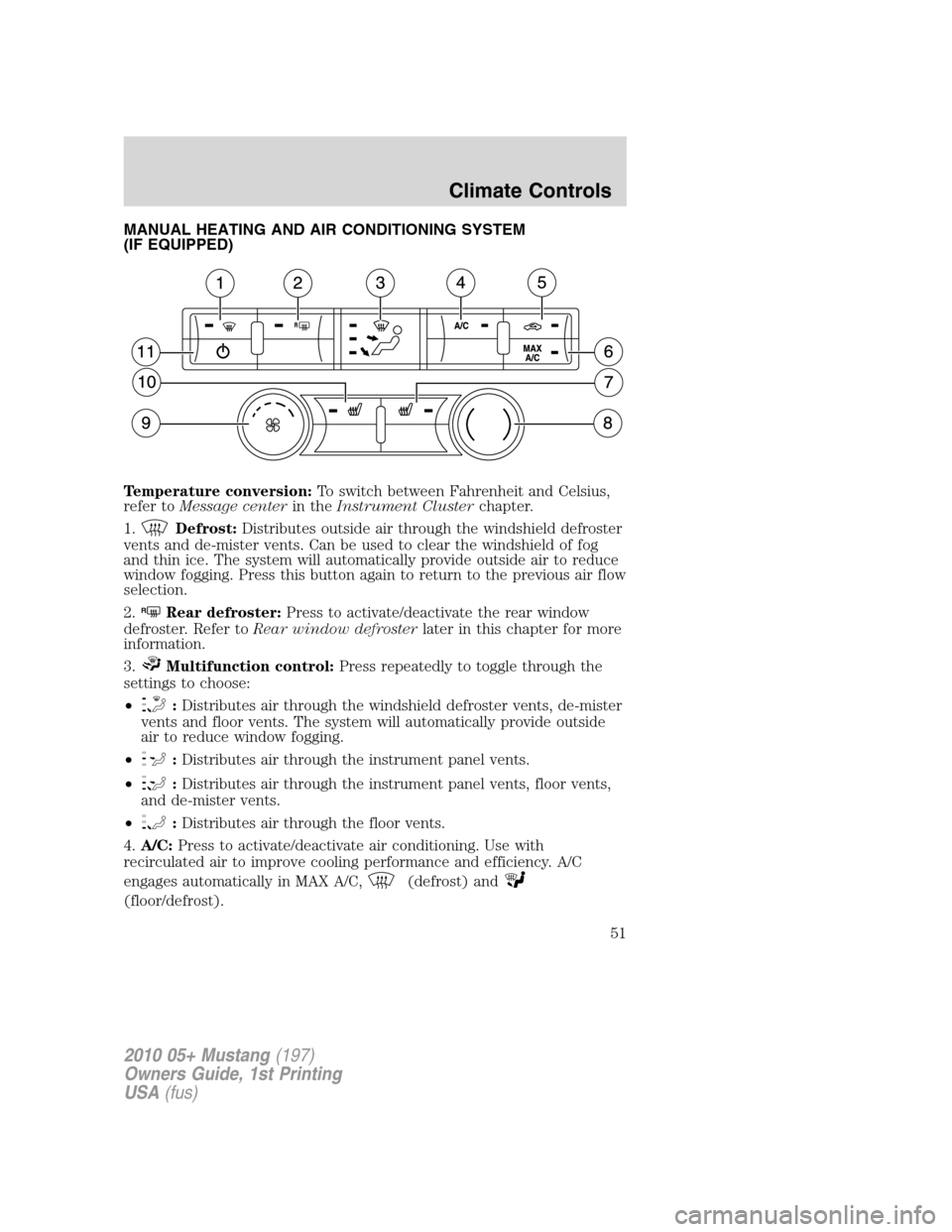
MANUAL HEATING AND AIR CONDITIONING SYSTEM
(IF EQUIPPED)
Temperature conversion:To switch between Fahrenheit and Celsius,
refer toMessage centerin theInstrument Clusterchapter.
1.
Defrost:Distributes outside air through the windshield defroster
vents and de-mister vents. Can be used to clear the windshield of fog
and thin ice. The system will automatically provide outside air to reduce
window fogging. Press this button again to return to the previous air flow
selection.
2.
RRear defroster:Press to activate/deactivate the rear window
defroster. Refer toRear window defrosterlater in this chapter for more
information.
3.
Multifunction control:Press repeatedly to toggle through the
settings to choose:
•
:Distributes air through the windshield defroster vents, de-mister
vents and floor vents. The system will automatically provide outside
air to reduce window fogging.
•
:Distributes air through the instrument panel vents.
•
:Distributes air through the instrument panel vents, floor vents,
and de-mister vents.
•
:Distributes air through the floor vents.
4.A/C:Press to activate/deactivate air conditioning. Use with
recirculated air to improve cooling performance and efficiency. A/C
engages automatically in MAX A/C,
(defrost) and
(floor/defrost).
2010 05+ Mustang(197)
Owners Guide, 1st Printing
USA(fus)
Climate Controls
51
Page 54 of 318
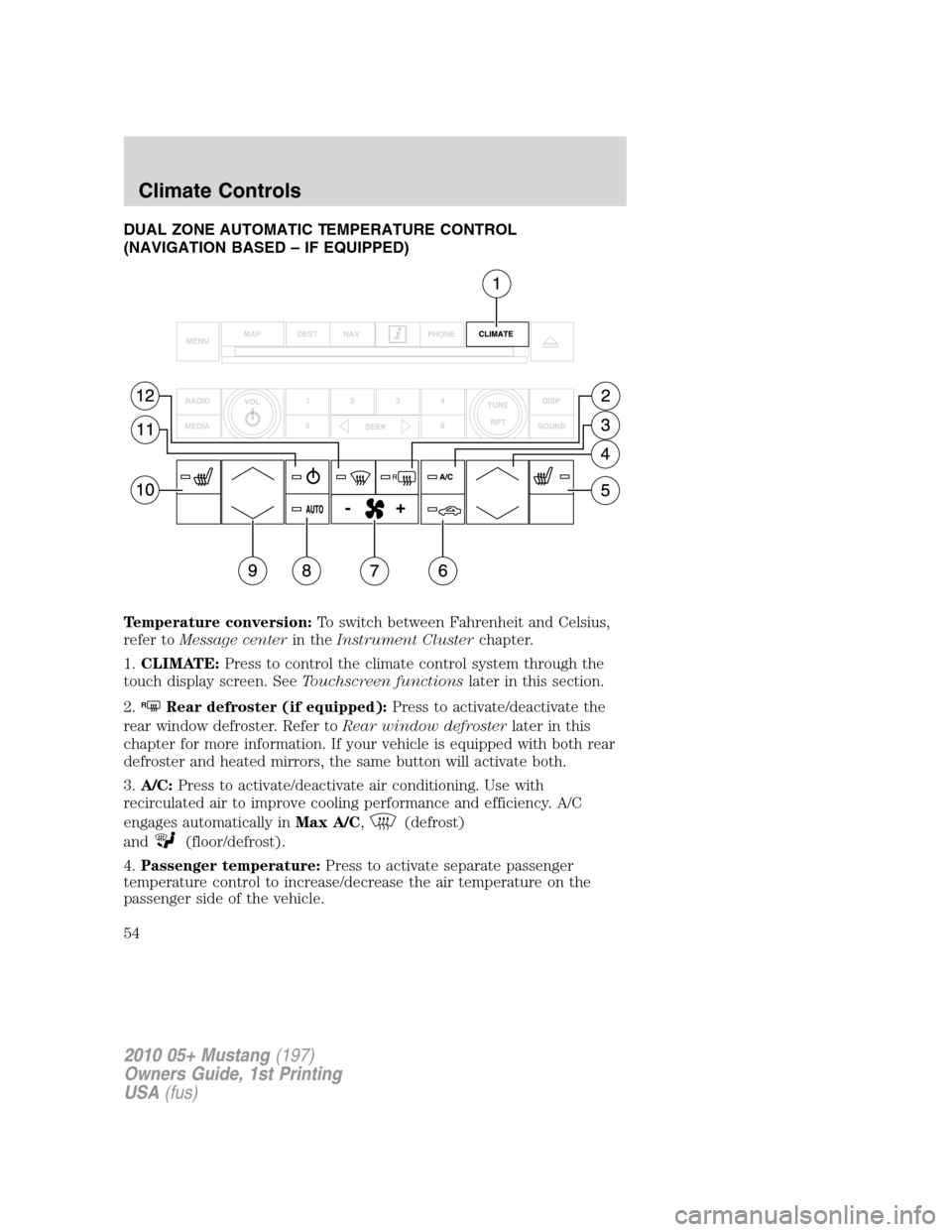
DUAL ZONE AUTOMATIC TEMPERATURE CONTROL
(NAVIGATION BASED – IF EQUIPPED)
Temperature conversion:To switch between Fahrenheit and Celsius,
refer toMessage centerin theInstrument Clusterchapter.
1.CLIMATE:Press to control the climate control system through the
touch display screen. SeeTouchscreen functionslater in this section.
2.
RRear defroster (if equipped):Press to activate/deactivate the
rear window defroster. Refer toRear window defrosterlater in this
chapter for more information. If your vehicle is equipped with both rear
defroster and heated mirrors, the same button will activate both.
3.A/C:Press to activate/deactivate air conditioning. Use with
recirculated air to improve cooling performance and efficiency. A/C
engages automatically inMax A/C,
(defrost)
and
(floor/defrost).
4.Passenger temperature:Press to activate separate passenger
temperature control to increase/decrease the air temperature on the
passenger side of the vehicle.
2010 05+ Mustang(197)
Owners Guide, 1st Printing
USA(fus)
Climate Controls
54
Page 64 of 318

INTERIOR LAMPS
Map lamps
Press the controls on either side of
the lamp to turn the light on.
BULB REPLACEMENT
Lamp assembly condensation
Exterior lamps are vented to accommodate normal changes in pressure.
Condensation can be a natural by-product of this design. When moist air
enters the lamp assembly through the vents, there is a possibility that
condensation can occur when the temperature is cold. When normal
condensation occurs, a thin film of mist can form on the interior of the
lens. The thin mist eventually clears and exits through the vents during
normal operation. Clearing time may take as long as 48 hours under dry
weather conditions.
Examples of acceptable condensation are:
•Presence of thin mist (no streaks, drip marks or droplets)
•Fine mist covers less than 50% of the lens
Examples of unacceptable moisture (usually caused by a lamp water
leak) are:
•Water puddle inside the lamp
•Large water droplets, drip marks or streaks present on the interior of
the lens
Take your vehicle to dealer for service if any of the above conditions of
unacceptable moisture are present.
2010 05+ Mustang(197)
Owners Guide, 1st Printing
USA(fus)
Lights
64
Page 74 of 318
Compass zone adjustment
1. Determine which magnetic zone
you are in for your geographic
location by referring to the zone
map.
2. Turn ignition to the on position.
3. Press and hold the 7 and 9 radio
preset buttons together for
approximately five seconds until
ZONE XX appears in the CID.
4. Press and release the 7 and 9
radio preset buttons together,
repeatedly until ZONE XX changes
to the correct zone (1–15) in the
CID.
5. The direction will display after
the buttons are released. The zone
is now updated.
Compass calibration adjustment
Perform compass calibration in an open area free from steel structures
and high voltage lines. For optimum calibration, turn off all electrical
accessories (heater/air conditioning, wipers, etc.) and make sure all
vehicle doors are shut.
1. Start the vehicle.
1 2 3
4
5
6 7 8 9 101112 13 14 15
2010 05+ Mustang(197)
Owners Guide, 1st Printing
USA(fus)
Driver Controls
74
Page 117 of 318

To lower the seatback(s) from
inside the vehicle, pull the strap to
release seatback and then fold
seatback down.
When raising the seatback(s), make sure you hear the seat latch into
place. Pull down on the seatback to ensure that it has latched.
WARNING:Before returning the seatback to its original
position, make sure that cargo or any objects are not trapped
behind the seatback. After returning the seatback to its original
position, pull on the seatback to ensure that it has fully latched. An
unlatched seat may become dangerous in the event of a sudden stop or
collision.
SAFETY RESTRAINTS
Personal Safety System�
The Personal Safety System�provides an improved overall level of
frontal crash protection to front seat occupants and is designed to help
further reduce the risk of airbag-related injuries. The system is able to
analyze different occupant conditions and crash severity before activating
the appropriate safety devices to help better protect a range of
occupants in a variety of frontal crash situations.
Your vehicle’s Personal Safety System�consists of:
•Driver and passenger dual-stage airbag supplemental restraints.
•Driver and front passenger side airbags
•Front safety belts with pretensioners, energy management retractors,
and safety belt usage sensors.
•Driver’s seat position sensor.
•Front crash severity sensor.
•Front passenger sensing system
•“Passenger airbag off” or “pass airbag off” indicator lamp
2010 05+ Mustang(197)
Owners Guide, 1st Printing
USA(fus)
Seating and Safety Restraints
117
Page 118 of 318

•Restraints Control Module (RCM) with impact and safing sensors.
•Restraint system warning light and back-up tone.
•The electrical wiring for the airbags, crash sensor(s), safety belt
pretensioners, front safety belt usage sensors, driver seat position
sensor, front passenger sensing system, and indicator lights.
How does the Personal Safety System�work?
The Personal Safety System�can adapt the deployment strategy of your
vehicle’s safety devices according to crash severity and conditions. A
collection of crash sensors provides information to the Restraints Control
Module (RCM). During a crash, the RCM may activate the safety belt
pretensioners and/or either none, one, or both stages of the dual-stage
airbag supplemental restraints based on crash severity and conditions.
The fact that the pretensioners or airbags did not activate for both front
seat occupants in a collision does not mean that something is wrong with
the system. Rather, it means the Personal Safety System�determined
the accident conditions (crash severity, belt usage, etc.) were not
appropriate to activate these safety devices. Front airbags are designed
to activate only in frontal and near-frontal collisions, not rollovers,
side-impacts, or rear-impacts unless the collision causes sufficient
longitudinal deceleration.
Driver and passenger dual-stage airbag supplemental restraints
The dual-stage airbags offer the capability to tailor the level of airbag
inflation energy. A lower, less forceful energy level is provided for more
common, moderate-severity impacts. A higher energy level is used for
the most severe impacts. Refer toAirbag supplemental restraints
(SRS)section in this chapter.
Front crash severity sensor
The front crash severity sensor enhances the ability to detect the
severity of an impact. Positioned up front, it provides valuable
information early in the crash event on the severity of the impact. This
allows your Personal Safety System�to distinguish between different
levels of crash severity and modify the deployment strategy of the
dual-stage airbags and safety belt pretensioners.
Driver’s seat position sensor
The driver’s seat position sensor allows your Personal Safety System�to
tailor the deployment level of the driver dual-stage airbag based on seat
position. The system is designed to help protect smaller drivers sitting
close to the driver airbag by providing a lower airbag output level.
2010 05+ Mustang(197)
Owners Guide, 1st Printing
USA(fus)
Seating and Safety Restraints
118


