2010 FORD FUSION cooling
[x] Cancel search: coolingPage 244 of 340

Fuse/Relay
LocationFuse Amp
RatingProtected Circuits
8 40A* Anti-lock brake system (ABS)
pump
9 20A* Wiper washer
10 30A* ABS valve
11 — Not used
12 — Not used
13 — Not used
14 — Not used
15 — Not used
16 15A** Transmission module (3.5L)
17 10A** Alternator
18 — Not used
19 — Not used
20 — Not used
21 — Not used
22 20A* Console power point
23 10A** PCM – Keep alive power, Canister
vent
24 — Not used
25 10A** A/C clutch (relay 43 power)
26 — Not used
27 — Not used
2860A* Cooling fan motor (2.5L & 3.0L)
80A* Cooling fan motor (3.5L)
29 20A* Front power point
30 30A* Fuel relay (relay 54 power)
31 30A* Passenger power seat
32 30A* Driver power seat
33 20A* Moon roof motor power feed
34 — Not used
Roadside Emergencies
244
2010 Fusion(fsn)
Owners Guide, 4th Printing
USA(fus)
ProCarManuals.com
Page 253 of 340

JUMP STARTING
WARNING:The gases around the battery can explode if
exposed to flames, sparks, or lit cigarettes. An explosion could
result in injury or vehicle damage.
WARNING:Batteries contain sulfuric acid which can burn skin,
eyes and clothing, if contacted.
Do not attempt to push-start your automatic transmission
vehicle. Automatic transmissions do not have push-start
capability. Attempting to push-start a vehicle with an automatic
transmission may cause transmission damage.
Preparing your vehicle
When the battery is disconnected or a new battery is installed, the
automatic transmission must relearn its shift strategy. As a result, the
transmission may have firm and/or soft shifts. This operation is
considered normal and will not affect function or durability of the
transmission. Over time, the adaptive learning process will fully update
transmission operation.
1.Use only a 12–volt supply to start your vehicle.
2. Do not disconnect the battery of the disabled vehicle as this could
damage the vehicle’s electrical system.
3. Park the booster vehicle close to the hood of the disabled vehicle
making sure the two vehiclesdo nottouch. Set the parking brake on
both vehicles and stay clear of the engine cooling fan and other moving
parts.
4. Check all battery terminals and remove any excessive corrosion before
you attach the battery cables. Ensure that vent caps are tight and level.
5. Turn the heater fan on in both vehicles to protect from any electrical
surges. Turn all other accessories off.
Roadside Emergencies
253
2010 Fusion(fsn)
Owners Guide, 4th Printing
USA(fus)
ProCarManuals.com
Page 290 of 340

When the engine is cold, check the
level of the engine coolant in the
reservoir.
•The engine coolant should be at the FULL COLD level or within the
COLD FILL RANGE as listed on the engine coolant reservoir
(depending upon application).
•Refer toscheduled maintenance informationfor service interval
schedules.
If the engine coolant has not been checked at the recommended interval,
the engine coolant reservoir may become low or empty. If the reservoir is
low or empty, add engine coolant to the reservoir. Refer toAdding
engine coolantin this chapter.
Note:Automotive fluids are not interchangeable; do not use engine
coolant/antifreeze or windshield washer fluid outside of its specified
function and vehicle location.
Adding engine coolant
When adding coolant, make sure it is a 50/50 mixture of engine coolant
and distilled water. Add the mixture to the coolant reservoir,when the
engine is cool,until the appropriate fill level is obtained. If coolant is
filled to the COLD FILL RANGE or the FULL COLD level when the
engine is not cool, the system will remain underfilled.
WARNING:Do not add engine coolant when the engine is hot.
Steam and scalding liquids released from a hot cooling system
can burn you badly. Also, you can be burned if you spill coolant on hot
engine parts.
WARNING:Do not put engine coolant in the windshield washer
fluid container. If sprayed on the windshield, engine coolant
could make it difficult to see through the windshield.
•DO NOT MIXdifferent colors or types of coolant in your vehicle.
Make sure the correct coolant is used.DO NOT MIXrecycled coolant
COLD FILL RANGE
Maintenance and Specifications
290
2010 Fusion(fsn)
Owners Guide, 4th Printing
USA(fus)
ProCarManuals.com
Page 291 of 340

and new (unused) coolant together in the vehicle. Mixing of engine
coolants may harm your engine’s cooling system. The use of an
improper coolant may harm engine and cooling system components
and may void the warranty. Refer toMaintenance product
specifications and capacitiesin this chapter.
Note:Do not use stop leak pellets or cooling system sealants/additives
as they can cause damage to the engine cooling and/or heating systems.
This damage would not be covered under your vehicle’s warranty.
•A large amount of water without engine coolant may be added, in case
of emergency, to reach a vehicle service location. In this instance, the
cooling system must be drained and refilled with a 50/50 mixture of
engine coolant and distilled water as soon as possible. Water alone
(without engine coolant) can cause engine damage from corrosion,
overheating or freezing.
•Do not use alcohol, methanol, brine or any engine coolants
mixed with alcohol or methanol antifreeze (coolant).Alcohol
and other liquids can cause engine damage from overheating or
freezing.
•Do not add extra inhibitors or additives to the coolant.These
can be harmful and compromise the corrosion protection of the engine
coolant.
For vehicles with overflow coolant systems with a non-pressurized cap
on the coolant recovery system, add coolant to the coolant recovery
reservoir when the engine is cool. Add the proper mixture of coolant and
distilled water to the FULL COLD level. For all other vehicles which have
a coolant degas system with a pressurized cap, or if it is necessary to
remove the coolant pressure relief cap on the radiator of a vehicle with
an overflow system, follow these steps to add engine coolant.
WARNING:To reduce the risk of personal injury, make sure the
engine is cool before unscrewing the coolant pressure relief cap.
The cooling system is under pressure; steam and hot liquid can come
out forcefully when the cap is loosened slightly.
Add the proper mixture of coolant and water to the cooling system by
following these steps:
1. Before you begin, turn the engine off and let it cool.
2. When the engine is cool, wrap a thick cloth around the coolant
pressure relief cap on the coolant reservoir (a translucent plastic bottle).
Slowly turn cap counterclockwise (left) until pressure begins to release.
Maintenance and Specifications
291
2010 Fusion(fsn)
Owners Guide, 4th Printing
USA(fus)
ProCarManuals.com
Page 293 of 340

Whenever coolant has been added, the coolant level in the coolant
reservoir should be checked the next few times you drive the vehicle. If
necessary, add enough 50/50 concentration of engine coolant and
distilled water to bring the liquid level to the proper level.
If you have to add more than 1.0 quart (1.0 liter) of engine coolant per
month, have your authorized dealer check the engine cooling system.
Your cooling system may have a leak. Operating an engine with a low
level of coolant can result in engine overheating and possible engine
damage.
Recycled engine coolant
Ford Motor Company does NOT recommend the use of recycled engine
coolant since a Ford-approved recycling process is not yet available.
Used engine coolant should be disposed of in an appropriate
manner. Follow your community’s regulations and standards for recycling
and disposing of automotive fluids.
Coolant refill capacity
To find out how much fluid your vehicle’s cooling system can hold, refer
toMaintenance product specifications and capacitiesin this chapter.
Fill your engine coolant reservoir as outlined inAdding engine coolant
in this section.
Severe climates
If you drive in extremely cold climates (less than –34°F [–36°C]):
•It may be necessary to increase the coolant concentration
above 50%.
•NEVER increase the coolant concentration above 60%.
•A coolant concentration of 60% will provide freeze point
protection down to -62°F [-52°C]. Increased engine coolant
concentrations above 60% will decrease the overheat
protection characteristics of the engine coolant and may cause
engine damage.
•If available, refer to the chart on the coolant container to
ensure the coolant concentration in your vehicle will provide
adequate freeze protection at the temperatures in which you
drive in the winter months.
Maintenance and Specifications
293
2010 Fusion(fsn)
Owners Guide, 4th Printing
USA(fus)
ProCarManuals.com
Page 294 of 340

If you drive in extremely hot climates:
•It is still necessary to maintain the coolant concentration
above 40%.
•NEVER decrease the coolant concentration below 40%.
•A coolant concentration of 40% will provide freeze point
protection down to -12°F [-24°C]. Decreased engine coolant
concentrations below 40% will decrease the corrosion/freeze
protection characteristics of the engine coolant and may cause
engine damage.
•If available, refer to the chart on the coolant container to
ensure the coolant concentration in your vehicle will provide
adequate protection at the temperatures in which you drive.
Vehicles driven year-round in non-extreme climates should use a 50/50
mixture of engine coolant and distilled water for optimum cooling system
and engine protection.
What you should know about fail-safe cooling (2.5L I4 and 3.5L V6
engines only)
If the engine coolant supply is depleted, this feature allows the vehicle to
be driven temporarily before incremental component damage is incurred.
The “fail-safe” distance depends on ambient temperatures, vehicle load
and terrain.
How fail-safe cooling works
If the engine begins to overheat:
•The engine coolant temperature gauge will move to the H (hot) area.
•The
symbol will illuminate.
If the engine reaches a preset over-temperature condition, the engine
will automatically switch to alternating cylinder operation. Each disabled
cylinder acts as an air pump and cools the engine.
When this occurs the vehicle will still operate. However:
•The engine power will be limited.
•The air conditioning system will be disabled.
Continued operation will increase the engine temperature and the engine
will completely shut down, causing steering and braking effort to
increase.
Once the engine temperature cools, the engine can be re-started. Take
your vehicle to an authorized dealer as soon as possible to minimize
engine damage.
Maintenance and Specifications
294
2010 Fusion(fsn)
Owners Guide, 4th Printing
USA(fus)
ProCarManuals.com
Page 336 of 340
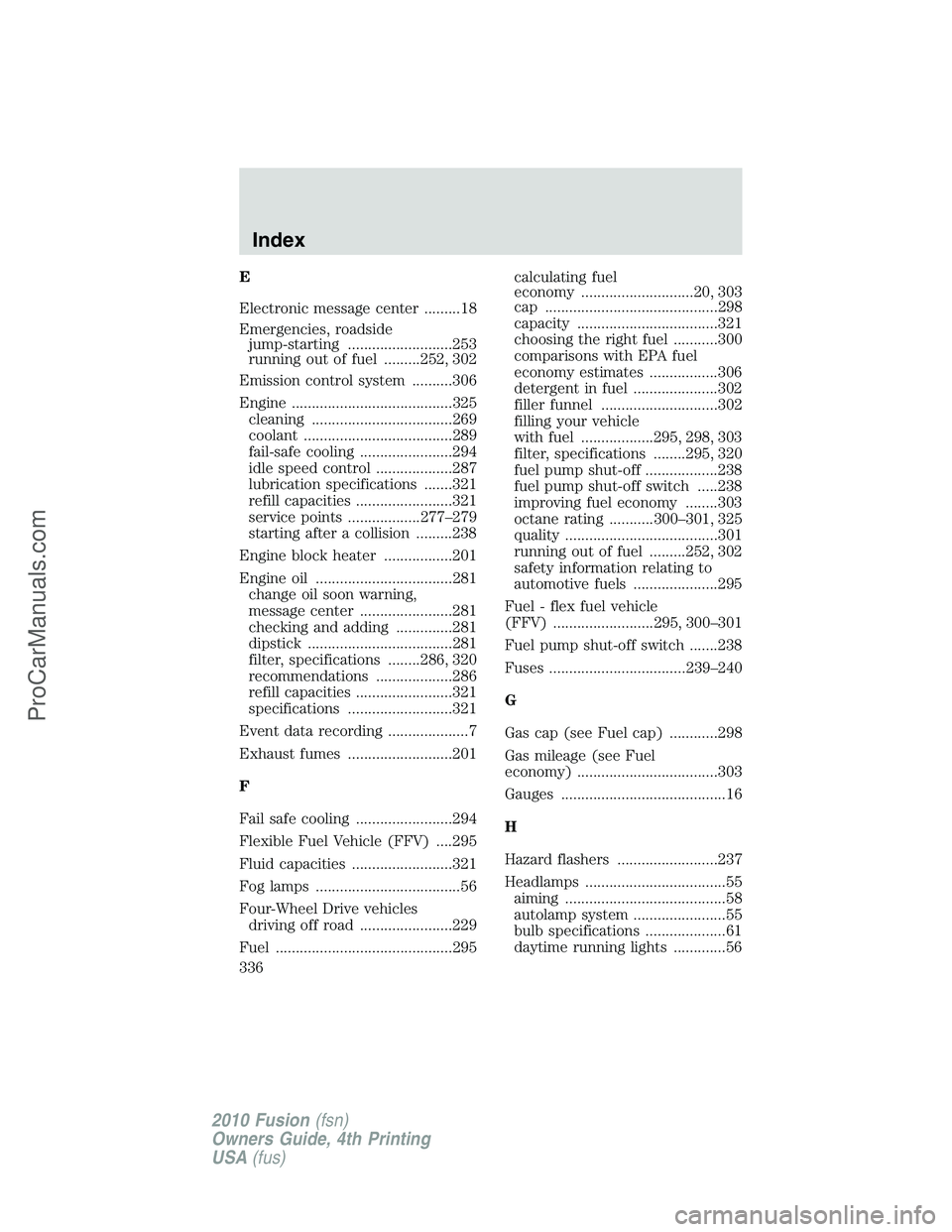
E
Electronic message center .........18
Emergencies, roadside
jump-starting ..........................253
running out of fuel .........252, 302
Emission control system ..........306
Engine ........................................325
cleaning ...................................269
coolant .....................................289
fail-safe cooling .......................294
idle speed control ...................287
lubrication specifications .......321
refill capacities ........................321
service points ..................277–279
starting after a collision .........238
Engine block heater .................201
Engine oil ..................................281
change oil soon warning,
message center .......................281
checking and adding ..............281
dipstick ....................................281
filter, specifications ........286, 320
recommendations ...................286
refill capacities ........................321
specifications ..........................321
Event data recording ....................7
Exhaust fumes ..........................201
F
Fail safe cooling ........................294
Flexible Fuel Vehicle (FFV) ....295
Fluid capacities .........................321
Fog lamps ....................................56
Four-Wheel Drive vehicles
driving off road .......................229
Fuel ............................................295calculating fuel
economy ............................20, 303
cap ...........................................298
capacity ...................................321
choosing the right fuel ...........300
comparisons with EPA fuel
economy estimates .................306
detergent in fuel .....................302
filler funnel .............................302
filling your vehicle
with fuel ..................295, 298, 303
filter, specifications ........295, 320
fuel pump shut-off ..................238
fuel pump shut-off switch .....238
improving fuel economy ........303
octane rating ...........300–301, 325
quality ......................................301
running out of fuel .........252, 302
safety information relating to
automotive fuels .....................295
Fuel - flex fuel vehicle
(FFV) .........................295, 300–301
Fuel pump shut-off switch .......238
Fuses ..................................239–240
G
Gas cap (see Fuel cap) ............298
Gas mileage (see Fuel
economy) ...................................303
Gauges .........................................16
H
Hazard flashers .........................237
Headlamps ...................................55
aiming ........................................58
autolamp system .......................55
bulb specifications ....................61
daytime running lights .............56
Index
336
2010 Fusion(fsn)
Owners Guide, 4th Printing
USA(fus)
ProCarManuals.com