2010 FORD FUSION HYBRID lights
[x] Cancel search: lightsPage 160 of 329

passenger seat or an unbuckled child or small person in the passenger
seat. The air curtain was designed to inflate between the side window
area and occupant to further enhance the protection provided to
occupants in side impact collisions. The seat-mounted side airbag was
designed to inflate between the door panel and occupant to further
enhance the protection provided occupants in side impact collisions.
The side air curtain system SRS is designed to activate when the vehicle
sustains lateral deceleration sufficient to cause the sensors to close an
electrical circuit that initiates air curtain and seat-mounted side airbag
inflation.
The fact that the side air curtain and seat-mounted side airbag did not
inflate in a collision does not mean that something is wrong with the
system. Rather, it means the forces were not of the type sufficient to
cause activation. The side air curtain system is designed to inflate in side
impact collisions, not roll-over, rear impact, frontal or near-frontal
collisions, unless the collision causes sufficient lateral deceleration.
WARNING:Several air bag system components get hot after
inflation. Do not touch them after inflation.
WARNING:If the side air
curtain has deployed,the
air curtain will not function
again. The side air curtain
system (including the A, B and
C pillar trim and headliner)
must be inspected and serviced
by an authorized dealer.If the
air curtain is not replaced, the
unrepaired area will increase the
risk of injury in a collision.
Determining if the system is operational
The SRS uses a readiness light in the instrument cluster or a tone to
indicate the condition of the system. Refer to theWarning lights and
chimessection in theInstrument Clusterchapter. Routine maintenance
of the airbag is not required.
Seating and Safety Restraints
160
2010 Fusion Hybrid(hfv)
Owners Guide, 3rd Printing
USA(fus)
Page 200 of 329
Low tire pressure
warning lightPossible cause Customer action required
Flashing warning
lightSpare tire in use Your temporary spare tire is in
use. Repair the damaged road
wheel and re-mount it on the
vehicle to restore system
functionality. For a description
of how the system functions
under these conditions, refer to
When your temporary spare
tire is installedin this section.
TPMS
malfunctionIf your tires are properly
inflated and your spare tire is
not in use and the TPMS
warning light still flashes,
contact your authorized dealer
as soon as possible.
When inflating your tires
When putting air into your tires (such as at a gas station or in your
garage), the tire pressure monitoring system may not respond
immediately to the air added to your tires.
It may take up to two minutes of driving over 20 mph (32 km/h) for the
light to turn off after you have filled your tires to the recommended
inflation pressure.
How temperature affects your tire pressure
The tire pressure monitoring system (TPMS) monitors tire pressure in
each pneumatic tire. While driving in a normal manner, a typical
passenger tire inflation pressure may increase approximately 2 to 4 psi
(14 to 28 kPa) from a cold start situation. If the vehicle is stationary
over night with the outside temperature significantly lower than the
daytime temperature, the tire pressure may decrease approximately 3 psi
(21 kPa) for a drop of 30°F (17°C) in ambient temperature. This lower
pressure value may be detected by the TPMS as being significantly lower
than the recommended inflation pressure and activate the TPMS warning
for low tire pressure. If the low tire pressure warning light is on, visually
check each tire to verify that no tire is flat. (If one or more tires are flat,
repair as necessary.) Check air pressure in the road tires. If any tire is
Tires, Wheels and Loading
200
2010 Fusion Hybrid(hfv)
Owners Guide, 3rd Printing
USA(fus)
Page 209 of 329
STARTING
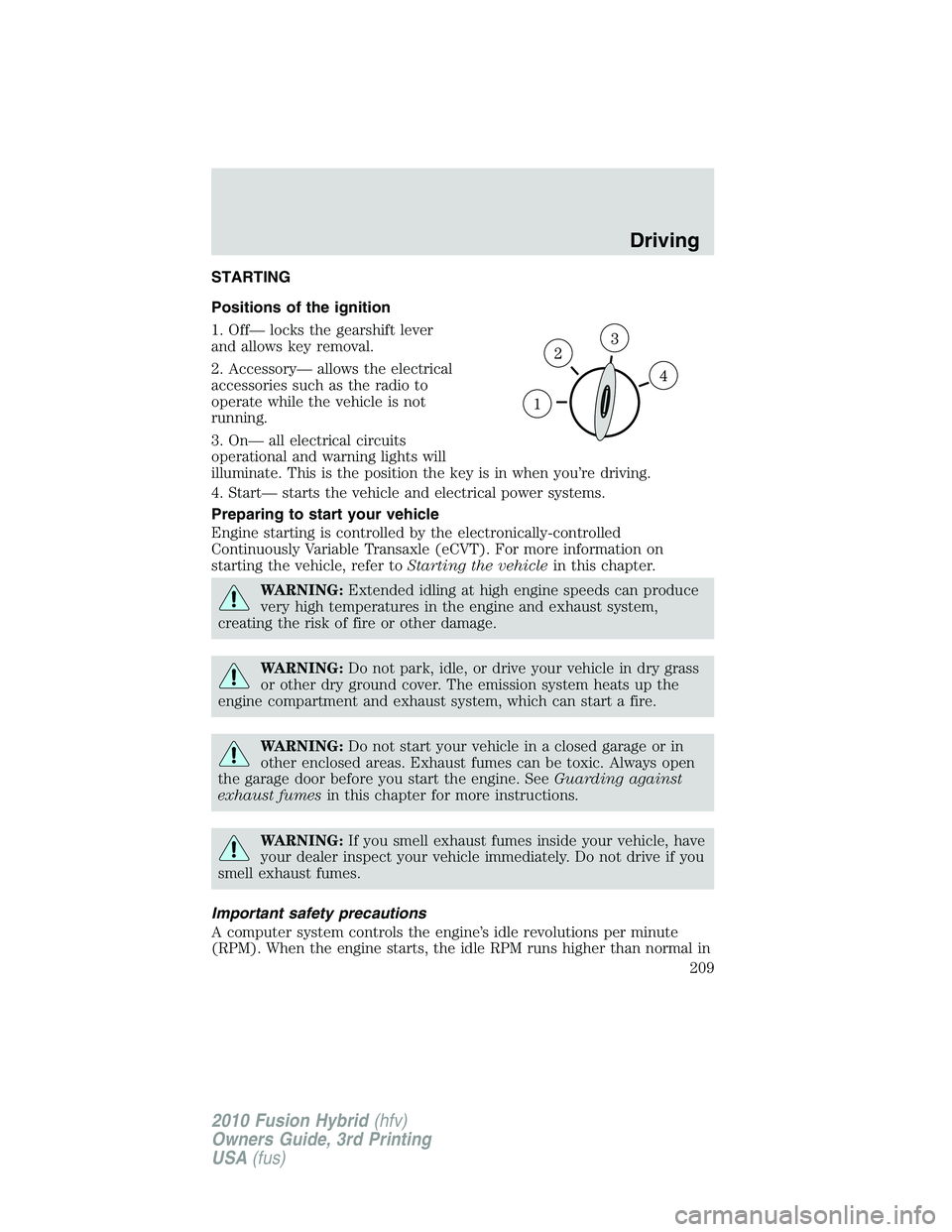
Positions of the ignition
1. Off— locks the gearshift lever
and allows key removal.
2. Accessory— allows the electrical
accessories such as the radio to
operate while the vehicle is not
running.
3. On— all electrical circuits
operational and warning lights will
illuminate. This is the position the key is in when you’re driving.
4. Start— starts the vehicle and electrical power systems.
Preparing to start your vehicle
Engine starting is controlled by the electronically-controlled
Continuously Variable Transaxle (eCVT). For more information on
starting the vehicle, refer toStarting the vehiclein this chapter.
WARNING:Extended idling at high engine speeds can produce
very high temperatures in the engine and exhaust system,
creating the risk of fire or other damage.
WARNING:Do not park, idle, or drive your vehicle in dry grass
or other dry ground cover. The emission system heats up the
engine compartment and exhaust system, which can start a fire.
WARNING:Do not start your vehicle in a closed garage or in
other enclosed areas. Exhaust fumes can be toxic. Always open
the garage door before you start the engine. SeeGuarding against
exhaust fumesin this chapter for more instructions.
WARNING:If you smell exhaust fumes inside your vehicle, have
your dealer inspect your vehicle immediately. Do not drive if you
smell exhaust fumes.
Important safety precautions
A computer system controls the engine’s idle revolutions per minute
(RPM). When the engine starts, the idle RPM runs higher than normal in
Driving
209
2010 Fusion Hybrid(hfv)
Owners Guide, 3rd Printing
USA(fus)
Page 211 of 329

Some warning lights will briefly illuminate. SeeWarning lights and
chimesin theInstrument Clusterchapter for more information
regarding the warning lights.
Starting the vehicle
1. Turn the key to 3 (on) without
turning the key to 4 (start). If there
is difficulty in turning the key,
rotate the steering wheel until the
key turns freely. This condition may
occur when:
•the front wheels are turned
•a front wheel is against the curb
2. Turn the key to 4 (start), then release the key.
After releasing the key from the 4
(start) position, a vehicle symbol
(called the Ready Indicator Light)
will illuminate in the instrument
cluster to indicate the vehicle is
ready to drive. The engine may not start because this hybrid vehicle is
equipped with Silent Key Start (SKS). This fuel saving feature allows
your vehicle to be “ready to drive” without requiring the gas engine to be
running. This light will remain on while the vehicle is on, whether the
engine is running or not, to indicate the vehicle is capable of movement
(using its electric motor, engine, or both). The vehicle’s computer will
determine if an engine start is required at key-on. The engine will start if
it is necessary for cabin heating or windshield defrost. The engine will
also be started when outside temperatures are low.
Note:The vehicle may be turned off at any time by turning the key to
the off position.
3. Once the “Ready Indicator Light” is on, release the parking brake,
apply the brake, shift into gear and drive.
Note:After the engine has started the first time, it may stop running to
conserve fuel after it is warmed-up and the battery is sufficiently
charged.
Note:If the vehicle does not start, put the gearshift lever into P (Park),
turn the ignition off, wait 10 seconds, then attempt to start the vehicle
again. If the vehicle still does not start, it may require refueling, jump
starting, or service. For information on jump starting the vehicle, refer to
Jump startingin theRoadside Emergencieschapter.
Driving
211
2010 Fusion Hybrid(hfv)
Owners Guide, 3rd Printing
USA(fus)
Page 214 of 329

BRAKES
Occasional brake noise is normal. If a metal-to-metal, continuous grinding
or continuous squeal sound is present, the brake linings may be worn-out
and should be inspected by an authorized dealer. If the vehicle has
continuous vibration or shudder in the steering wheel while braking, the
vehicle should be inspected by an authorized dealer.
Refer toWarning lights and
chimesin theInstrument Cluster
chapter for information on the brake
system warning light.
Four-wheel anti-lock brake system (ABS)
Your vehicle is equipped with an anti-lock braking system (ABS). This
system helps you maintain steering control during emergency stops by
keeping the brakes from locking. The ABS operates by detecting the
onset of wheel lockup during brake application and compensates for this
tendency. Noise from the ABS pump motor and brake pedal pulsation
may be observed during ABS braking; any pulsation or mechanical noise
you may feel or hear is normal. In addition, the ABS performs a
self-check after you start the engine and begin to drive away. A brief
mechanical noise may be heard during this test. This is normal.
ABS warning lamp
The ABS lamp in the instrument
cluster momentarily illuminates
when the ignition is turned on. If
the light does not illuminate during
start up, remains on or flashes, the
ABS may be disabled and may need to be serviced.
Even when the ABS is disabled and
the ABS light is on, normal braking
is still effective. If your BRAKE
warning lamp illuminates with the
parking brake released, have your
brake system serviced immediately.
Using ABS
When hard braking is required, apply continuous force on the brake
pedal; do not pump the brake pedal since this will reduce the
effectiveness of the ABS and will increase your vehicle’s stopping
P!
BRAKE
ABS
P!
BRAKE
Driving
214
2010 Fusion Hybrid(hfv)
Owners Guide, 3rd Printing
USA(fus)
Page 240 of 329

The fuses are coded as follows.
Fuse/Relay
LocationFuse Amp
RatingProtected Circuits
1 30A Driver smart window motor
2 15A Brake on/off switch, Center
high-mount stop lamp
3 15A HEV battery fan
4 30A 110V Inverter
5 10A Keypad illumination, Brake shift
interlock
6 20A Turn signal lamps, Stop lamps
7 10A Low beam headlamps (left)
8 10A Low beam headlamps (right)
9 15A Courtesy lights
10 15A Backlighting, Puddle lamps
Roadside Emergencies
240
2010 Fusion Hybrid(hfv)
Owners Guide, 3rd Printing
USA(fus)
Page 281 of 329
Note: Electrical or electronic accessories or components added to
the vehicle by the dealer or the owner (e.g. spot lights, electric
winch, etc.) may adversely affect vehicle performance and
durability.
WARNING:Batteries normally produce explosive gases which
can cause personal injury. Therefore, do not allow flames, sparks
or lighted substances to come near the battery. When working near the
battery, always shield your face and protect your eyes. Always provide
proper ventilation.
WARNING:When lifting a plastic-cased battery, excessive
pressure on the end walls could cause acid to flow through the
vent caps, resulting in personal injury and/or damage to the vehicle or
battery. Lift the battery with a battery carrier or with your hands on
opposite corners.
WARNING:Keep batteries out of reach of children. Batteries
contain sulfuric acid. Avoid contact with skin, eyes or clothing.
Shield your eyes when working near the battery to protect against
possible splashing of acid solution. In case of acid contact with skin or
eyes, flush immediately with water for a minimum of 15 minutes and
get prompt medical attention. If acid is swallowed, call a physician
immediately.
WARNING:Battery posts, terminals and related accessories
contain lead and lead compounds.Wash hands after handling.
Because your vehicle’s engine is electronically-controlled by a computer,
some control conditions are maintained by power from the battery. When
the battery is disconnected or a new battery is installed, the engine must
relearn its idle and fuel trim strategy for optimum driveability and
performance. To begin this process:
1. With the vehicle at a complete stop, set the parking brake.
2. Put the gearshift in P (Park), turn off all accessories and start the
vehicle. Step on the accelerator to start the engine.
3. Run the vehicle until the engine reaches normal operating
temperature.
4. Allow the engine to idle for at least one minute.
Maintenance and Specifications
281
2010 Fusion Hybrid(hfv)
Owners Guide, 3rd Printing
USA(fus)
Page 292 of 329

Fuel quality
If you are experiencing starting, rough idle or hesitation driveability
problems during a cold start, try a different brand of “Regular” unleaded
gasoline. Premium unleaded gasoline is not recommended for vehicles
designed to use “Regular” unleaded gasoline because it may cause these
problems to become more pronounced. If the problems persist, see your
authorized dealer.
Do not add aftermarket fuel additive products to your fuel tank. It
should not be necessary to add any aftermarket products to your fuel
tank if you continue to use high quality fuel of the recommended octane
rating. These products have not been approved for your engine and
could cause damage to the fuel system. Repairs to correct the effects of
using an aftermarket product in your fuel may not be covered by your
warranty.
Many of the world’s automakers approved the World-Wide Fuel Charter
that recommends gasoline specifications to provide improved
performance and emission control system protection for your vehicle.
Gasolines that meet the World-Wide Fuel Charter should be used when
available. Ask your fuel supplier about gasolines that meet the
World-Wide Fuel Charter.
Cleaner air
Ford endorses the use of reformulated “cleaner-burning” gasolines to
improve air quality, per the recommendations in theChoosing the right
fuelsection.
Running out of fuel
Avoid running out of fuel because this situation may have an adverse
effect on powertrain components.
If you have run out of fuel:
•You may need to cycle the ignition from off to on several times after
refueling to allow the fuel system to pump the fuel from the tank to
the engine. On restarting, cranking time will take a few seconds longer
than normal.
•Normally, adding 1 gallon (3.8L) of fuel is enough to restart the
engine. If the vehicle is out of fuel and on a steep grade, more than
1 gallon (3.8L) may be required.
•The service engine soon
indicator may come on. For more
information on the service engine soon indicator, refer toWarning
lights and chimesin theInstrument Clusterchapter.
Maintenance and Specifications
292
2010 Fusion Hybrid(hfv)
Owners Guide, 3rd Printing
USA(fus)