Page 93 of 274

•Do not increase engine speed
until the oil pressure gauge
indicates normal pressure (as
indicated by the arrows); this
should be indicated on the gauge
within 15 seconds after starting.
•Idle the engine for three to five
minutes before operating with a
full load.
•Try to limit engine idle to
10 minutes. Excessive idling reduces fuel economy.
•When starting a cold engine, increase the engine speed (RPM) slowly
to make sure adequate lubrication is available to the bearings.
Cold weather operation
WARNING:Do not use volatile starting aids such as ether,
propane or gasoline in the engine air intake system. Glow plugs
may ignite vapors which can cause engine damage or personal injury.
In order to operate the engine in temperatures of 32°F (0°C) or lower,
read the following instructions:
•Make sure that the batteries are of sufficient size and are fully
charged. Check other electrical components to make sure they’re in
optimum condition.
•Use a permanent-type engine coolant solution to protect the engine
against damage from freezing.
•If your vehicle is equipped with a water-fuel separator, drain it daily.
Fill the fuel tank at the end of daily operation to prevent condensation
in the fuel system.
•Make sure you use proper cold weather engine oil and that it is at its
proper level.
•At temperatures of –4°F (–20°C) or below, it is recommended that you
use a crankcase-mounted coolant heater to improve cold engine
starting.
•If operating in arctic temperatures of –20°F (–29°C) or lower, consult
your truck dealer for information about special cold weather
equipment and precautions.
Driving
93
2010 F-650/750(f67)
Supplement(supplement), 1st Printing
USA(fus)
Page 195 of 274

Engine and Driveline System
•Transmission Enclosure:inspect for cracks, holes, and tears. Clean
any deposits such as oil, dirt, and stones.
•Engine valve covers and block covers are made to damp out engine
mechanical noise and, if needed, should be replaced with
recommended parts. Check for mechanical isolations.
Exhaust System
•Inspect the exhaust system for leaks at various joint connections and
tighten the clamps.
•Do a visual inspection for cracks or holes in the muffler and tail pipe.
•Always use the recommended parts when items need to be replaced.
•The tail pipe elbow or offset tail pipe orientation must not be changed
from the standard position as originally received.
•To avoid abnormal changes in vehicle sound levels, it is necessary for
the owner to perform inspections and necessary maintenance at the
intervals shown in theScheduled Maintenance Guidechapter.
POWER STEERING FLUID
Check the power steering fluid level using the following procedure. If
adding fluid is necessary, refer toLubricant Specificationsin this
chapter for the proper fluid type. Refer to theScheduled Maintenance
Guidechapter for the recommended service intervals.
1. Set the parking brake, shift into N (Neutral) (automatic transmission)
or 1 (First) (manual transmission) and turn the engine off.
2. Open the hood.
3. Clean the top of the power steering fluid reservoir.
4. Remove the dipstick from the reservoir and wipe the dipstick clean.
Maintenance and Specifications
195
2010 F-650/750(f67)
Supplement(supplement), 1st Printing
USA(fus)
Page 206 of 274

Oil lubricated front wheel bearings
During normal vehicle duty cycle, the lube and air inside the hub/wheel
cavity expands and if not vented, causes pressure build-up that could
cause accelerated seal wear.
There are two venting methods:
•a slit or small hole in the rubber check vent or
•the window
You can use either of these methods to prevent pressure build-up.
Normal maintenance
Over a period of time, if not routinely cleaned, a slight film of oil can
collect dirt around the rubber fill plug and face, which could appear to
be a leak. Routine cleaning ensures that the lube level can be easily
observed through the clear window as intended. In situations where the
window is clean on the outside but discolored on the inside, the lube
level may be checked by inserting a finger through the rubber check
vent hole.
The specified lube level for a clear window type hubcaps is from the
minimum line to + 5/16 inch above the minimum line.
If the lube level should suddenly drop dramatically below the minimum
level, see theWorkshop Manualfor diagnostic procedure.
Installation, tightening and alignment
When installing wheels, be certain that the threads on studs and nuts are
clean to permit correct torque. The mounting surfaces of rims, wheels,
spacer rings and clamps must be free of dirt, rust, lubricants or damage.
Use a wire brush to clean the mounting contact surfaces. Do not use
lubricant on threads.
After the rim or wheel has been properly tightened, it should be checked
for alignment. Rotate the wheel with a piece of chalk attached to a steady,
firm surface, and placed to just barely clear the outside surface of the tire
bead seat. This procedure will point out the high spot. A high spot does
not necessarily mean that the lug nuts have been unevenly tightened. This
condition or misalignment could be caused by a bent wheel.
Use the following installation procedure:
1. Slide inner rear or front tire and wheel in position over studs and push
it back as far as possible. Use care so that the threads on studs are not
damaged.
Maintenance and Specifications
206
2010 F-650/750(f67)
Supplement(supplement), 1st Printing
USA(fus)
Page 218 of 274
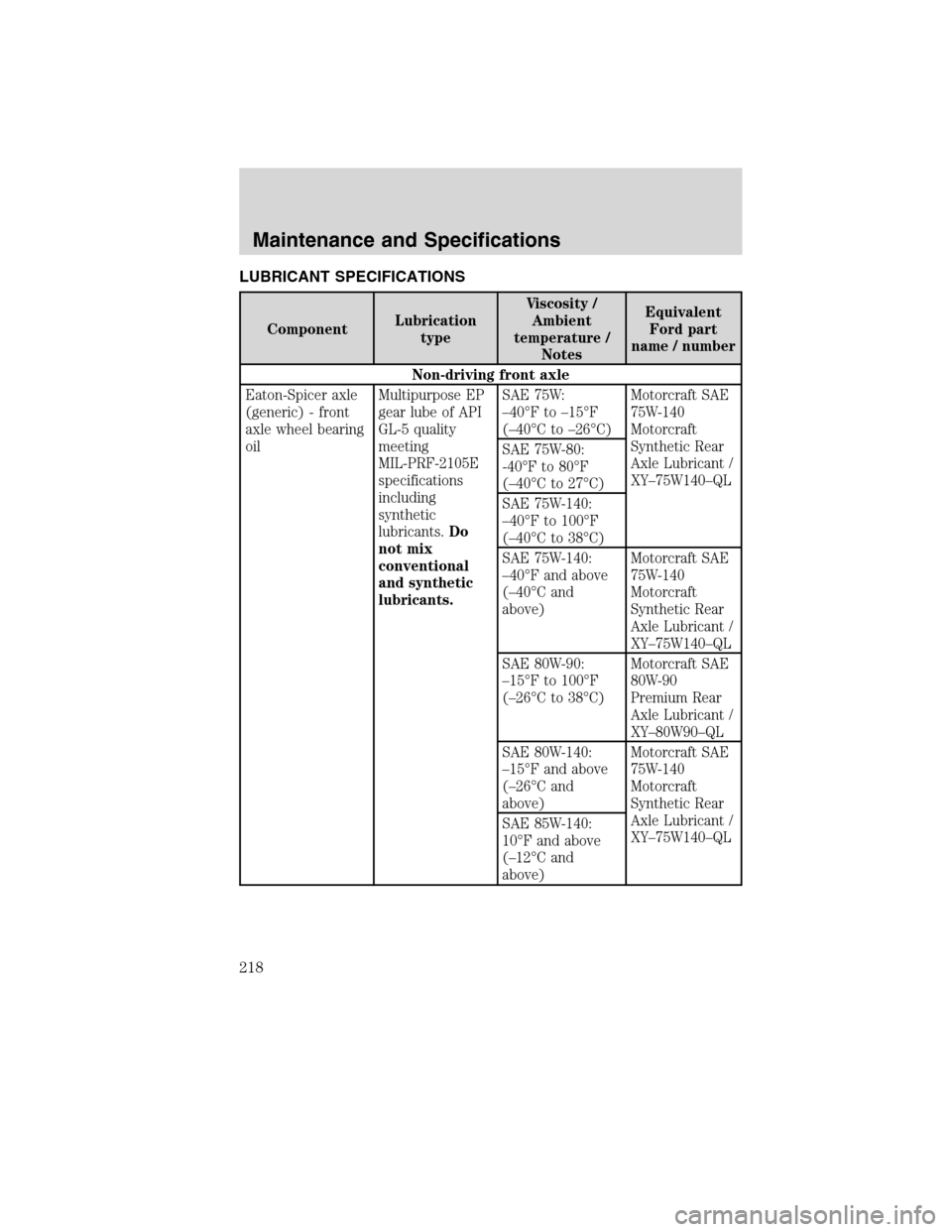
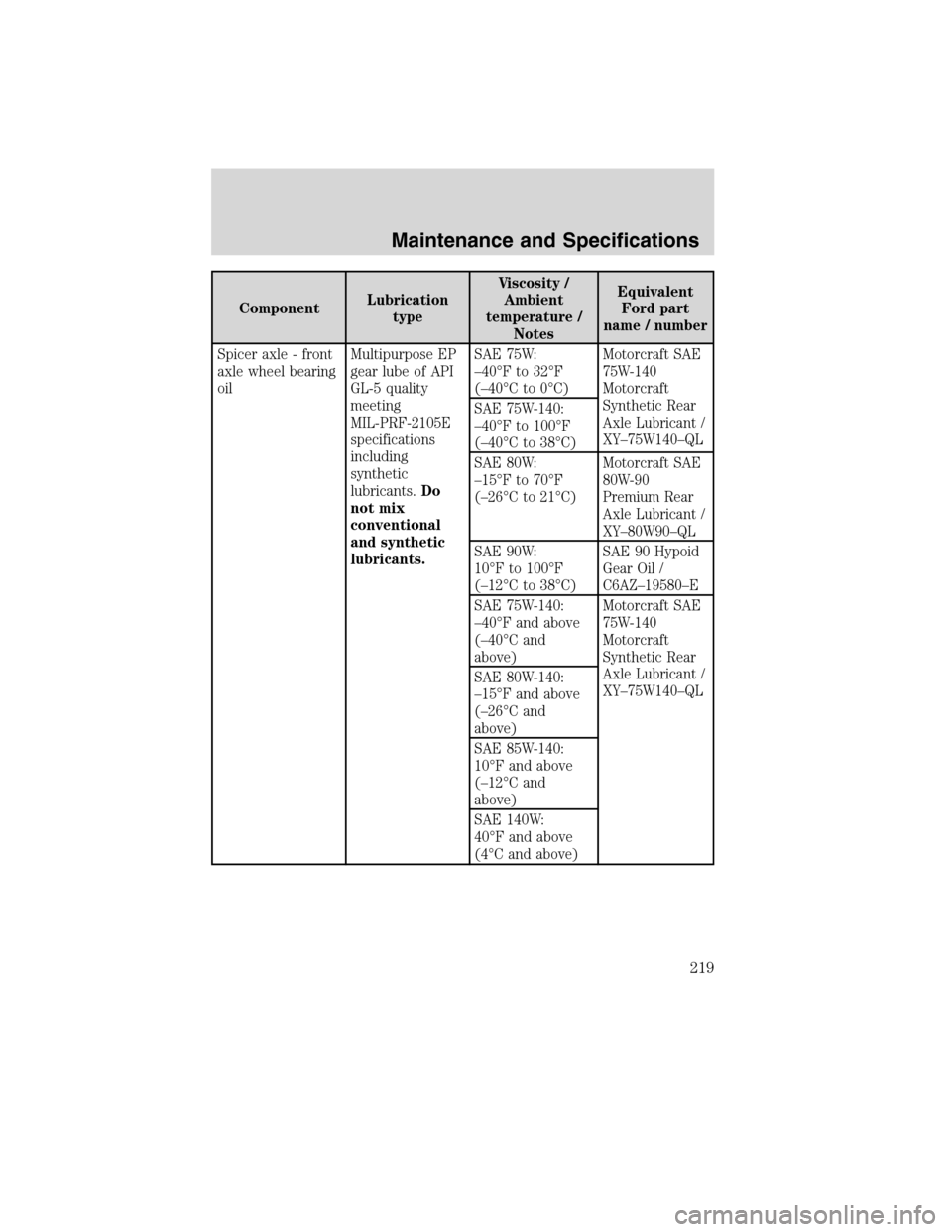
LUBRICANT SPECIFICATIONS
ComponentLubrication
typeViscosity /
Ambient
temperature /
NotesEquivalent
Ford part
name / number
Non-driving front axle
Eaton-Spicer axle
(generic) - front
axle wheel bearing
oilMultipurpose EP
gear lube of API
GL-5 quality
meeting
MIL-PRF-2105E
specifications
including
synthetic
lubricants.Do
not mix
conventional
and synthetic
lubricants.SAE 75W:
–40°F to –15°F
(–40°C to –26°C)Motorcraft SAE
75W-140
Motorcraft
Synthetic Rear
Axle Lubricant /
XY–75W140–QL SAE 75W-80:
-40°F to 80°F
(–40°C to 27°C)
SAE 75W-140:
–40°F to 100°F
(–40°C to 38°C)
SAE 75W-140:
–40°F and above
(–40°C and
above)Motorcraft SAE
75W-140
Motorcraft
Synthetic Rear
Axle Lubricant /
XY–75W140–QL
SAE 80W-90:
–15°F to 100°F
(–26°C to 38°C)Motorcraft SAE
80W-90
Premium Rear
Axle Lubricant /
XY–80W90–QL
SAE 80W-140:
–15°F and above
(–26°C and
above)Motorcraft SAE
75W-140
Motorcraft
Synthetic Rear
Axle Lubricant /
XY–75W140–QL SAE 85W-140:
10°F and above
(–12°C and
above)
Maintenance and Specifications
218
2010 F-650/750(f67)
Supplement(supplement), 1st Printing
USA(fus)
Page 219 of 274
ComponentLubrication
typeViscosity /
Ambient
temperature /
NotesEquivalent
Ford part
name / number
Spicer axle - front
axle wheel bearing
oilMultipurpose EP
gear lube of API
GL-5 quality
meeting
MIL-PRF-2105E
specifications
including
synthetic
lubricants.Do
not mix
conventional
and synthetic
lubricants.SAE 75W:
–40°F to 32°F
(–40°C to 0°C)Motorcraft SAE
75W-140
Motorcraft
Synthetic Rear
Axle Lubricant /
XY–75W140–QL SAE 75W-140:
–40°F to 100°F
(–40°C to 38°C)
SAE 80W:
–15°F to 70°F
(–26°C to 21°C)Motorcraft SAE
80W-90
Premium Rear
Axle Lubricant /
XY–80W90–QL
SAE 90W:
10°F to 100°F
(–12°C to 38°C)SAE 90 Hypoid
Gear Oil /
C6AZ–19580–E
SAE 75W-140:
–40°F and above
(–40°C and
above)Motorcraft SAE
75W-140
Motorcraft
Synthetic Rear
Axle Lubricant /
XY–75W140–QL SAE 80W-140:
–15°F and above
(–26°C and
above)
SAE 85W-140:
10°F and above
(–12°C and
above)
SAE 140W:
40°F and above
(4°C and above)
Maintenance and Specifications
219
2010 F-650/750(f67)
Supplement(supplement), 1st Printing
USA(fus)
Page 222 of 274
ComponentLubrication
typeViscosity /
Ambient
temperature /
NotesEquivalent
Ford part
name / number
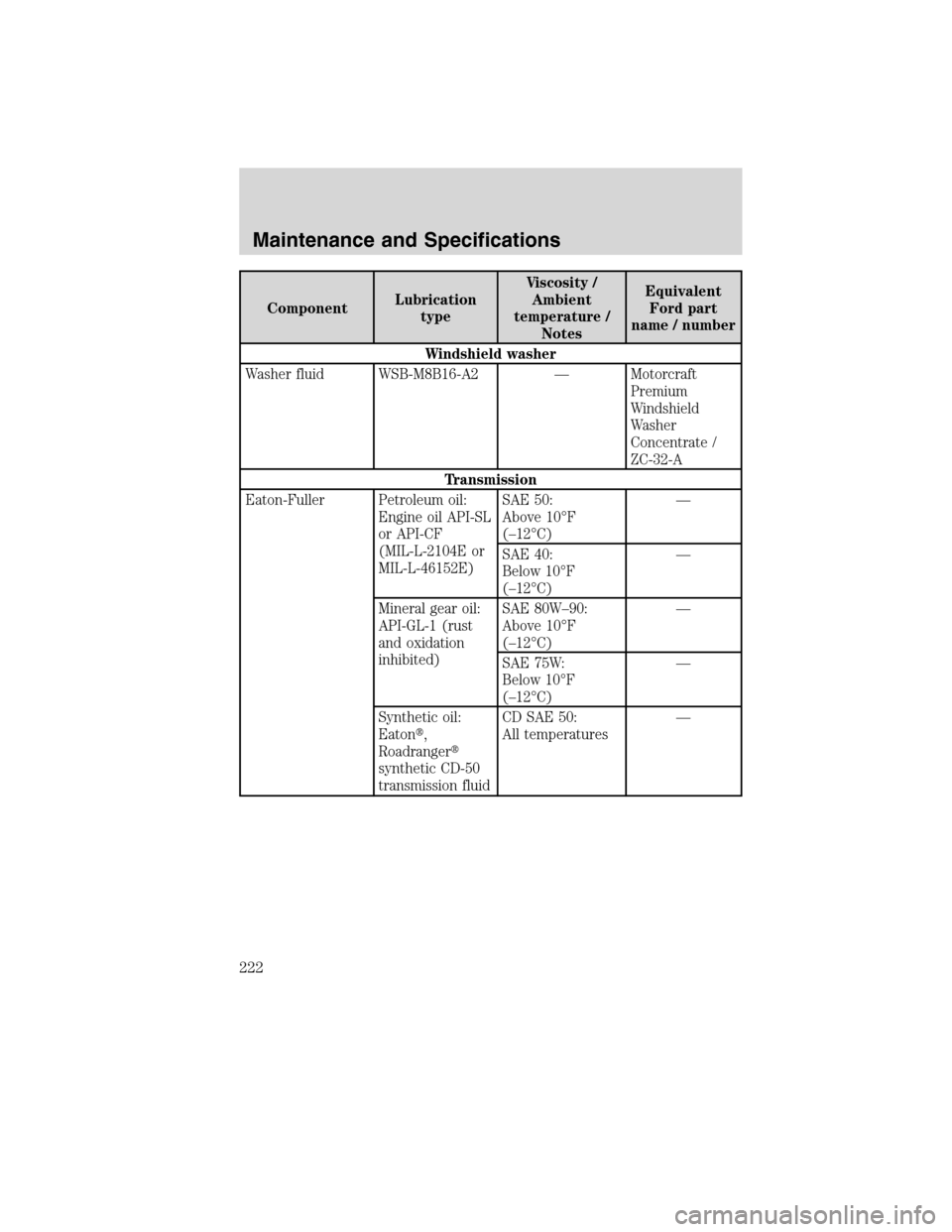
Windshield washer
Washer fluid WSB-M8B16-A2 — Motorcraft
Premium
Windshield
Washer
Concentrate /
ZC-32-A
Transmission
Eaton-Fuller Petroleum oil:
Engine oil API-SL
or API-CF
(MIL-L-2104E or
MIL-L-46152E)SAE 50:
Above 10°F
(–12°C)—
SAE 40:
Below 10°F
(–12°C)—
Mineral gear oil:
API-GL-1 (rust
and oxidation
inhibited)SAE 80W–90:
Above 10°F
(–12°C)—
SAE 75W:
Below 10°F
(–12°C)—
Synthetic oil:
Eaton�,
Roadranger�
synthetic CD-50
transmission fluidCD SAE 50:
All temperatures—
Maintenance and Specifications
222
2010 F-650/750(f67)
Supplement(supplement), 1st Printing
USA(fus)
Page 223 of 274
ComponentLubrication
typeViscosity /
Ambient
temperature /
NotesEquivalent
Ford part
name / number
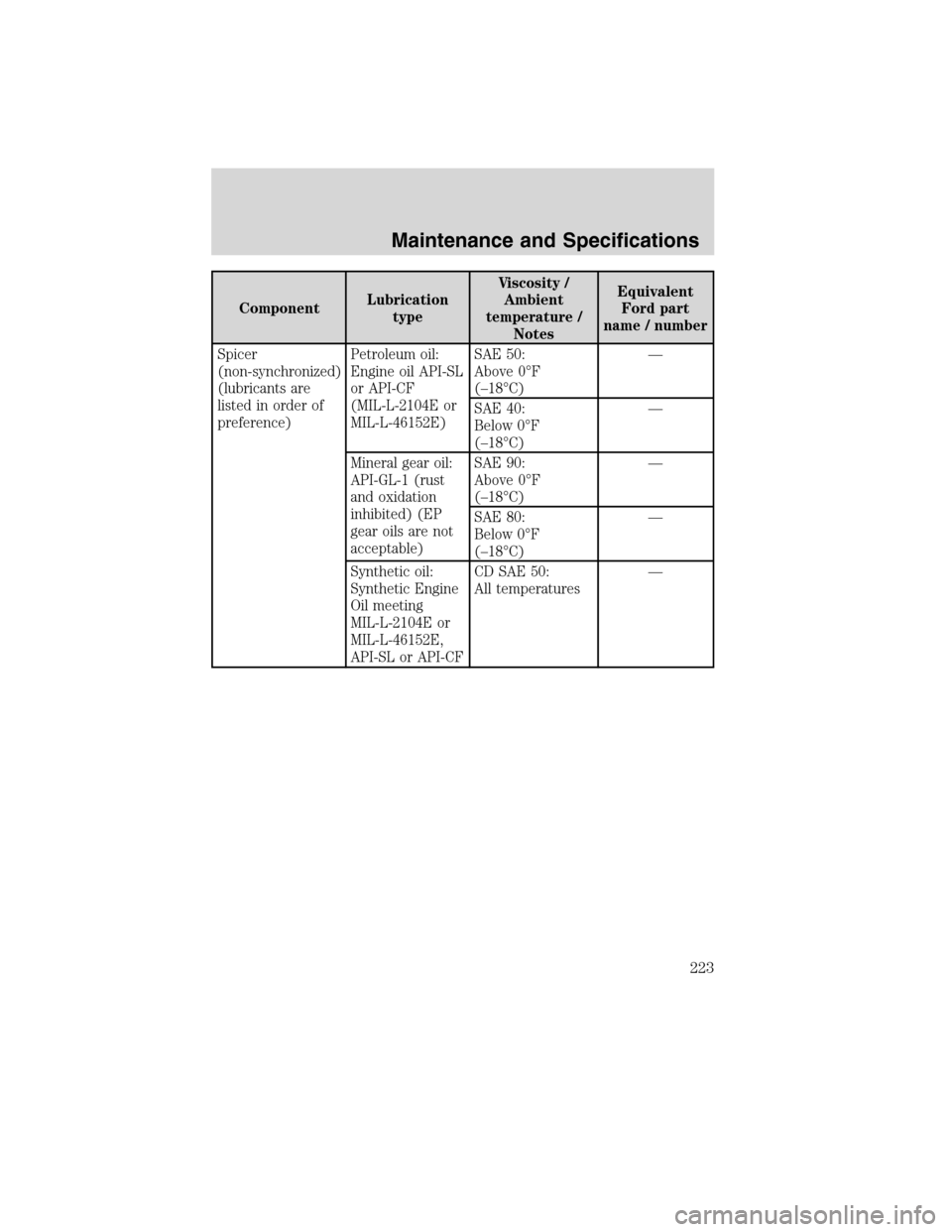
Spicer
(non-synchronized)
(lubricants are
listed in order of
preference)Petroleum oil:
Engine oil API-SL
or API-CF
(MIL-L-2104E or
MIL-L-46152E)SAE 50:
Above 0°F
(–18°C)—
SAE 40:
Below 0°F
(–18°C)—
Mineral gear oil:
API-GL-1 (rust
and oxidation
inhibited) (EP
gear oils are not
acceptable)SAE 90:
Above 0°F
(–18°C)—
SAE 80:
Below 0°F
(–18°C)—
Synthetic oil:
Synthetic Engine
Oil meeting
MIL-L-2104E or
MIL-L-46152E,
API-SL or API-CFCD SAE 50:
All temperatures—
Maintenance and Specifications
223
2010 F-650/750(f67)
Supplement(supplement), 1st Printing
USA(fus)
Page 224 of 274
ComponentLubrication
typeViscosity /
Ambient
temperature /
NotesEquivalent
Ford part
name / number
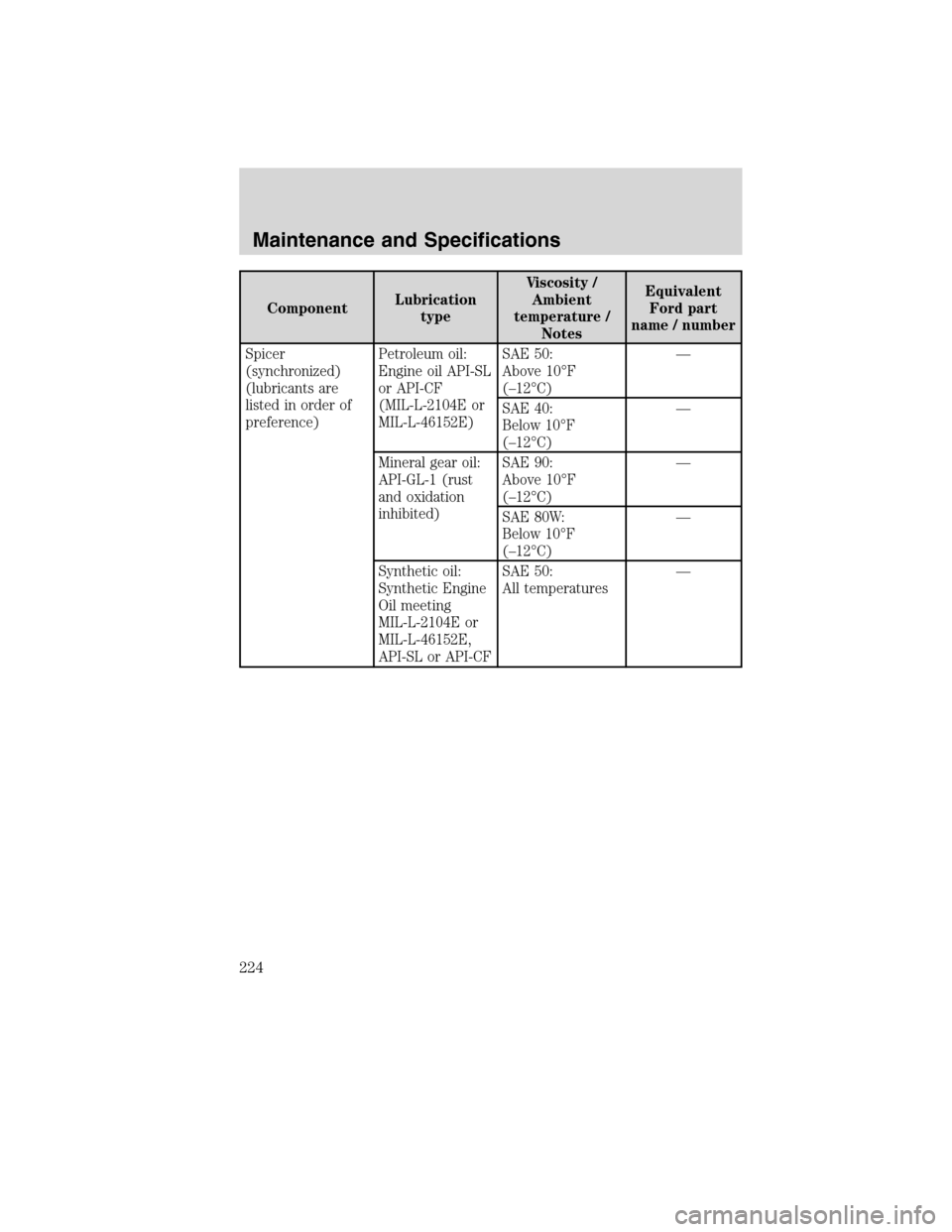
Spicer
(synchronized)
(lubricants are
listed in order of
preference)Petroleum oil:
Engine oil API-SL
or API-CF
(MIL-L-2104E or
MIL-L-46152E)SAE 50:
Above 10°F
(–12°C)—
SAE 40:
Below 10°F
(–12°C)—
Mineral gear oil:
API-GL-1 (rust
and oxidation
inhibited)SAE 90:
Above 10°F
(–12°C)—
SAE 80W:
Below 10°F
(–12°C)—
Synthetic oil:
Synthetic Engine
Oil meeting
MIL-L-2104E or
MIL-L-46152E,
API-SL or API-CFSAE 50:
All temperatures—
Maintenance and Specifications
224
2010 F-650/750(f67)
Supplement(supplement), 1st Printing
USA(fus)