2010 FORD F150 stop start
[x] Cancel search: stop startPage 291 of 419
AUTOMATIC TRANSMISSION OPERATION
Understanding the gearshift positions of the 4–speed automatic
transmission
Your vehicle has been designed to improve fuel economy by reducing
fuel usage during coasting or deceleration. When you take your foot off
the accelerator pedal and the vehicle begins to slow down the torque
converter clutch locks up and aggressively shuts off fuel flow to the
engine while decelerating. This fuel economy benefit may be perceived
as a light to medium braking sensation when removing your foot from
the accelerator pedal.
Your vehicle’s automatic transmission is equipped with a special shift
strategy that ensures maximum heater performance during cold weather
operation.
When ambient temperature is 23°F (–5°C) or below and the engine
coolant temperature is below 100°F (38°C), light throttle upshifts may be
slightly delayed. Once the engine coolant temperature reaches 160°F
(71°C) the normal shift strategy will resume. This is normal operation
and will not affect the function or the durability of the transmission.
If the normal shift strategy does not resume once the engine
coolant temperature reaches the normal operating temperature,
or if the downshifts and other throttle conditions do not function
normally, see your authorized dealer as soon as possible.
P (Park)
This position locks the transmission
and prevents the rear wheels from
turning.
To put your vehicle in gear:
•Start the engine
•Press the brake pedal
•Move the gearshift lever into the desired gear
•Release the parking brake.
To put your vehicle in P (Park):
•Come to a complete stop
•Move the gearshift lever and securely latch it in P (Park)
Driving
291
2010 F-150(f12)
Owners Guide, 1st Printing
USA(fus)
Page 292 of 419
WARNING:Always set the parking brake fully and make sure
the gearshift is latched in P (Park). Turn the ignition to the off
position and remove the key whenever you leave your vehicle.
R (Reverse)
With the gearshift lever in R (Reverse), the vehicle will move backward.
Always come to a complete stop before shifting into and out of R
(Reverse).
N (Neutral)
With the gearshift lever in N (Neutral), the vehicle can be started and is
free to roll. Hold the brake pedal down while in this position.
D (Overdrive)
The normal driving position for the best fuel economy. Transmission
operates in gears one through four.
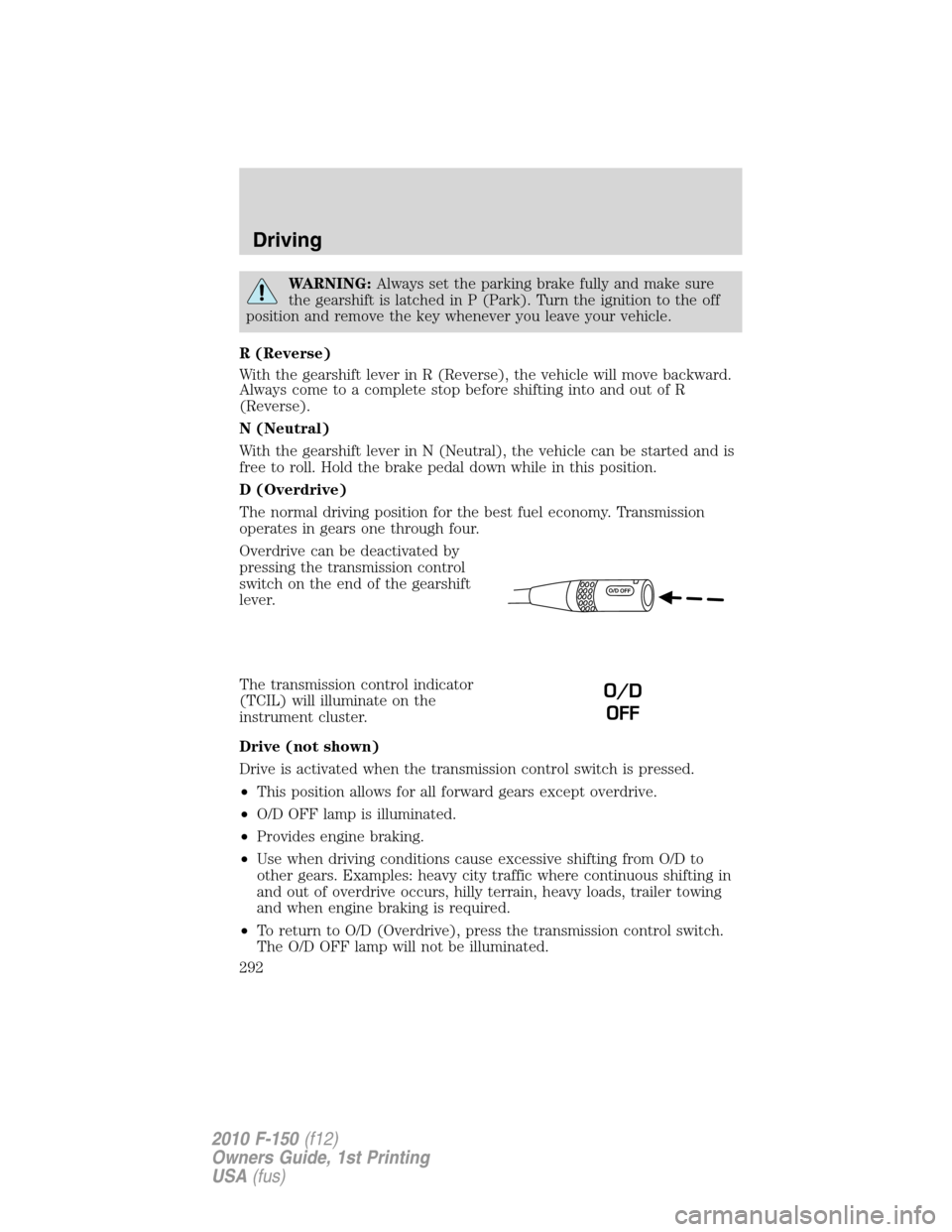
Overdrive can be deactivated by
pressing the transmission control
switch on the end of the gearshift
lever.
The transmission control indicator
(TCIL) will illuminate on the
instrument cluster.
Drive (not shown)
Drive is activated when the transmission control switch is pressed.
•This position allows for all forward gears except overdrive.
•O/D OFF lamp is illuminated.
•Provides engine braking.
•Use when driving conditions cause excessive shifting from O/D to
other gears. Examples: heavy city traffic where continuous shifting in
and out of overdrive occurs, hilly terrain, heavy loads, trailer towing
and when engine braking is required.
•To return to O/D (Overdrive), press the transmission control switch.
The O/D OFF lamp will not be illuminated.
O/D
OFF
Driving
292
2010 F-150(f12)
Owners Guide, 1st Printing
USA(fus)
Page 294 of 419
P (Park)
This position locks the transmission
and prevents the rear wheels from
turning.
To put your vehicle in gear:
•Press the brake pedal
•Start the engine
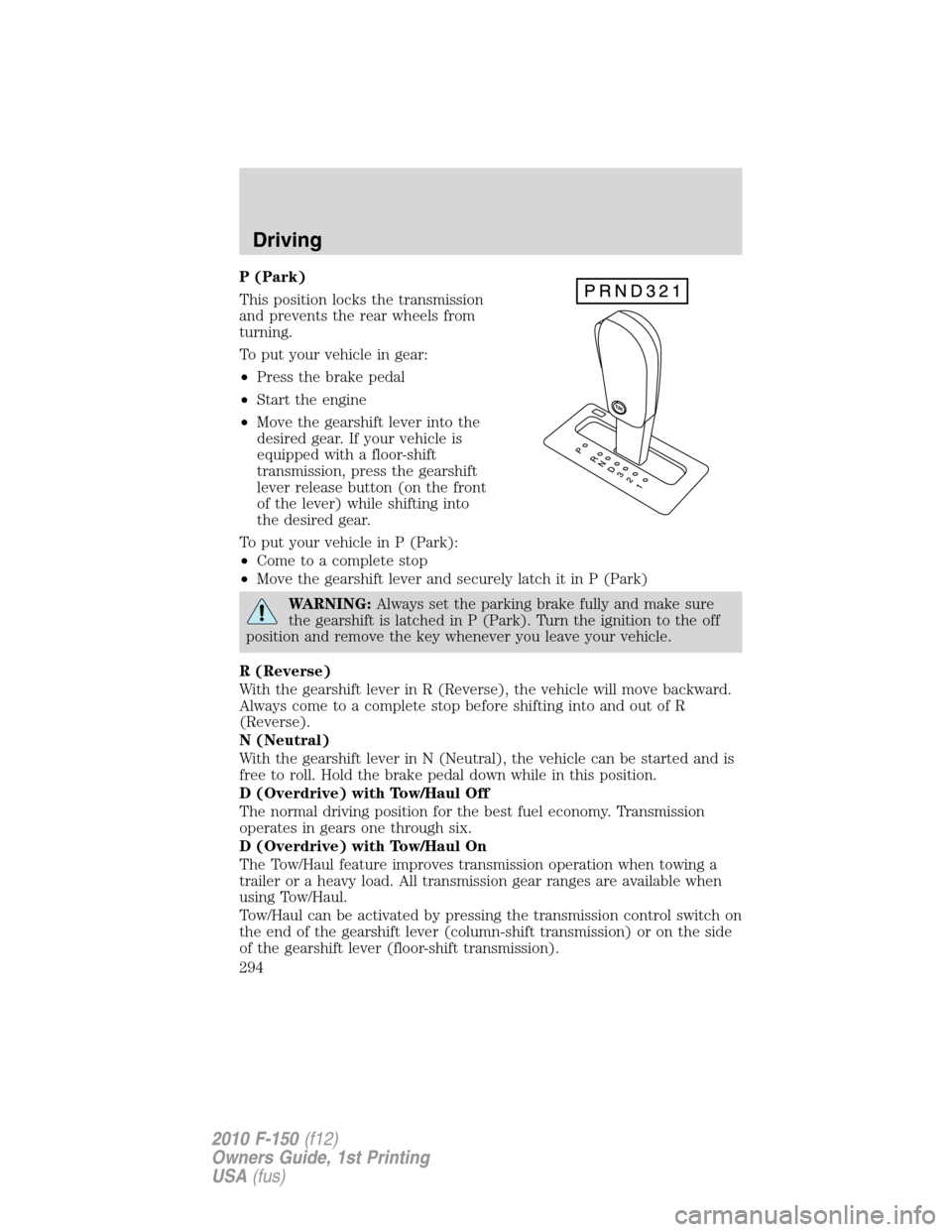
•Move the gearshift lever into the
desired gear. If your vehicle is
equipped with a floor-shift
transmission, press the gearshift
lever release button (on the front
of the lever) while shifting into
the desired gear.
To put your vehicle in P (Park):
•Come to a complete stop
•Move the gearshift lever and securely latch it in P (Park)
WARNING:Always set the parking brake fully and make sure
the gearshift is latched in P (Park). Turn the ignition to the off
position and remove the key whenever you leave your vehicle.
R (Reverse)
With the gearshift lever in R (Reverse), the vehicle will move backward.
Always come to a complete stop before shifting into and out of R
(Reverse).
N (Neutral)
With the gearshift lever in N (Neutral), the vehicle can be started and is
free to roll. Hold the brake pedal down while in this position.
D (Overdrive) with Tow/Haul Off
The normal driving position for the best fuel economy. Transmission
operates in gears one through six.
D (Overdrive) with Tow/Haul On
The Tow/Haul feature improves transmission operation when towing a
trailer or a heavy load. All transmission gear ranges are available when
using Tow/Haul.
Tow/Haul can be activated by pressing the transmission control switch on
the end of the gearshift lever (column-shift transmission) or on the side
of the gearshift lever (floor-shift transmission).
Driving
294
2010 F-150(f12)
Owners Guide, 1st Printing
USA(fus)
Page 296 of 419
WARNING:Do not use the Tow/Haul feature when driving in icy
or slippery conditions as the increased engine braking can cause
the rear wheels to slide and the vehicle to swing around with the
possible loss of vehicle control.
3 (Third)
Transmission operates in third gear only.
Used for improved traction on slippery roads. Selecting 3 (Third)
provides engine braking.
2 (Second)
Transmission operates in 2nd gear only.
Use 2 (Second) to start-up on slippery roads or to provide additional
engine braking on downgrades.
1 (First)
•Transmission operates in 1st gear only.
•Provides maximum engine braking.
•Allows upshifts by moving gearshift lever.
•Will not downshift into 1 (First) at high speeds; allows for 1 (First)
when vehicle reaches slower speeds.
Forced downshifts
•Allowed in D (Drive) only.
•Press the accelerator to the floor.
•Allows transmission to select an appropriate gear.
If your vehicle gets stuck in mud or snow
If your vehicle gets stuck in mud or snow, it may be rocked out by
shifting between forward and reverse gears, stopping between shifts in a
steady pattern. Press lightly on the accelerator in each gear.
Do not rock the vehicle if the engine is not at normal operating
temperature or damage to the transmission may occur.
Do not rock the vehicle for more than a minute or damage to the
transmission and tires may occur, or the engine may overheat.
Driving
296
2010 F-150(f12)
Owners Guide, 1st Printing
USA(fus)
Page 313 of 419
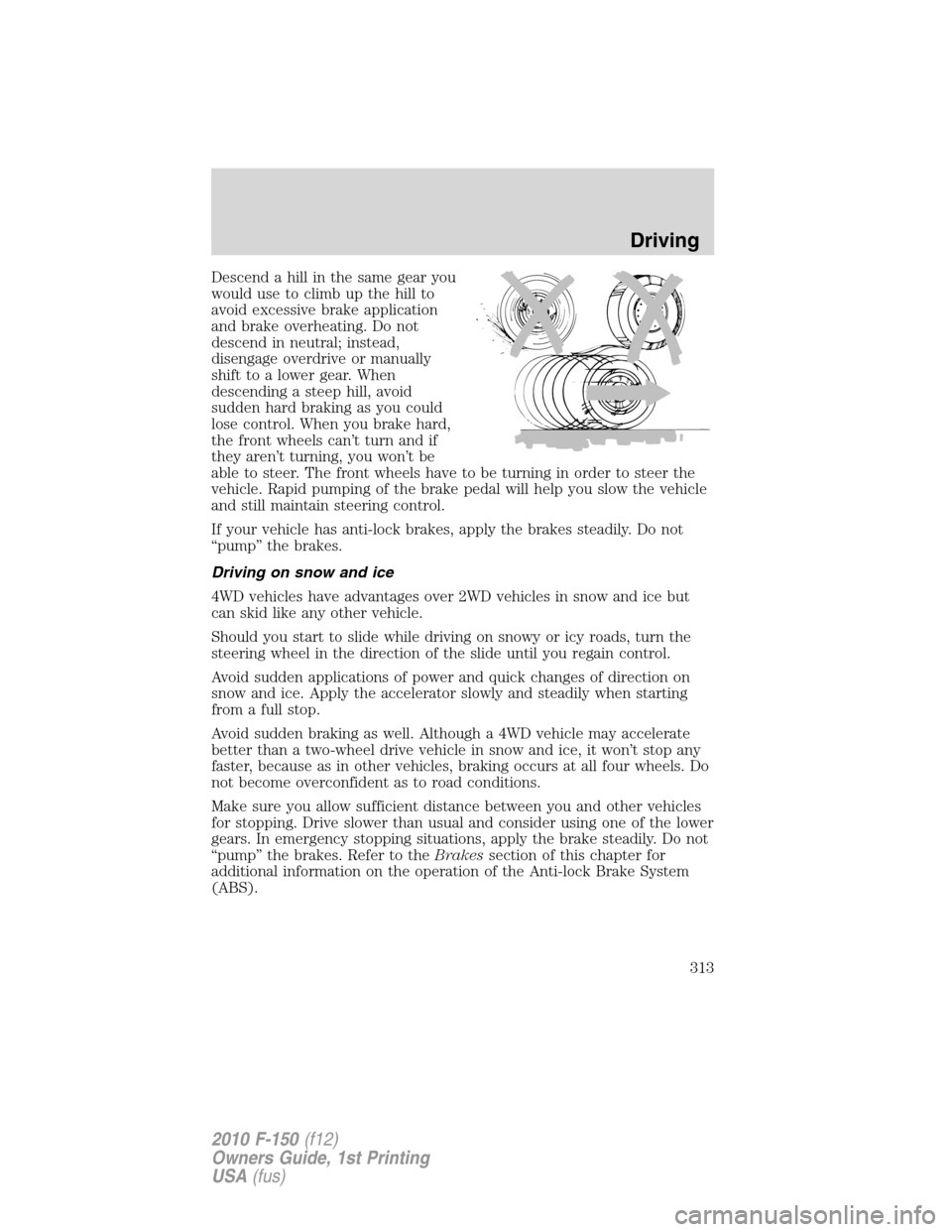
Descend a hill in the same gear you
would use to climb up the hill to
avoid excessive brake application
and brake overheating. Do not
descend in neutral; instead,
disengage overdrive or manually
shift to a lower gear. When
descending a steep hill, avoid
sudden hard braking as you could
lose control. When you brake hard,
the front wheels can’t turn and if
they aren’t turning, you won’t be
able to steer. The front wheels have to be turning in order to steer the
vehicle. Rapid pumping of the brake pedal will help you slow the vehicle
and still maintain steering control.
If your vehicle has anti-lock brakes, apply the brakes steadily. Do not
“pump” the brakes.
Driving on snow and ice
4WD vehicles have advantages over 2WD vehicles in snow and ice but
can skid like any other vehicle.
Should you start to slide while driving on snowy or icy roads, turn the
steering wheel in the direction of the slide until you regain control.
Avoid sudden applications of power and quick changes of direction on
snow and ice. Apply the accelerator slowly and steadily when starting
from a full stop.
Avoid sudden braking as well. Although a 4WD vehicle may accelerate
better than a two-wheel drive vehicle in snow and ice, it won’t stop any
faster, because as in other vehicles, braking occurs at all four wheels. Do
not become overconfident as to road conditions.
Make sure you allow sufficient distance between you and other vehicles
for stopping. Drive slower than usual and consider using one of the lower
gears. In emergency stopping situations, apply the brake steadily. Do not
“pump” the brakes. Refer to theBrakessection of this chapter for
additional information on the operation of the Anti-lock Brake System
(ABS).
Driving
313
2010 F-150(f12)
Owners Guide, 1st Printing
USA(fus)
Page 321 of 419

Note:With extended use, the flasher may run down your battery.
FUEL PUMP SHUT-OFF
In the event of a moderate to severe collision, this vehicle is equipped
with a fuel pump shut-off feature that stops the flow of fuel to the
engine. Not every impact will cause a shut-off.
Should your vehicle shut off after a collision due to this feature, you may
restart your vehicle by doing the following:
1. Turn the ignition switch to the off position.
2. Turn the ignition switch to the on position.
In some instances the vehicle may not restart the first time you try to
restart and may take one additional attempt.
WARNING:Failure to inspect and if necessary repair fuel leaks
after a collision may increase the risk of fire and serious injury.
Ford Motor Company recommends that the fuel system be inspected
by an authorized dealer after any collision.
FUSES AND RELAYS
Fuses
If electrical components in the
vehicle are not working, a fuse may
have blown. Blown fuses are
identified by a broken wire within
the fuse. Check the appropriate
fuses before replacing any electrical
components.
Note:Always replace a fuse with one that has the specified amperage
rating. Using a fuse with a higher amperage rating can cause severe wire
damage and could start a fire.
15
Roadside Emergencies
321
2010 F-150(f12)
Owners Guide, 1st Printing
USA(fus)
Page 327 of 419
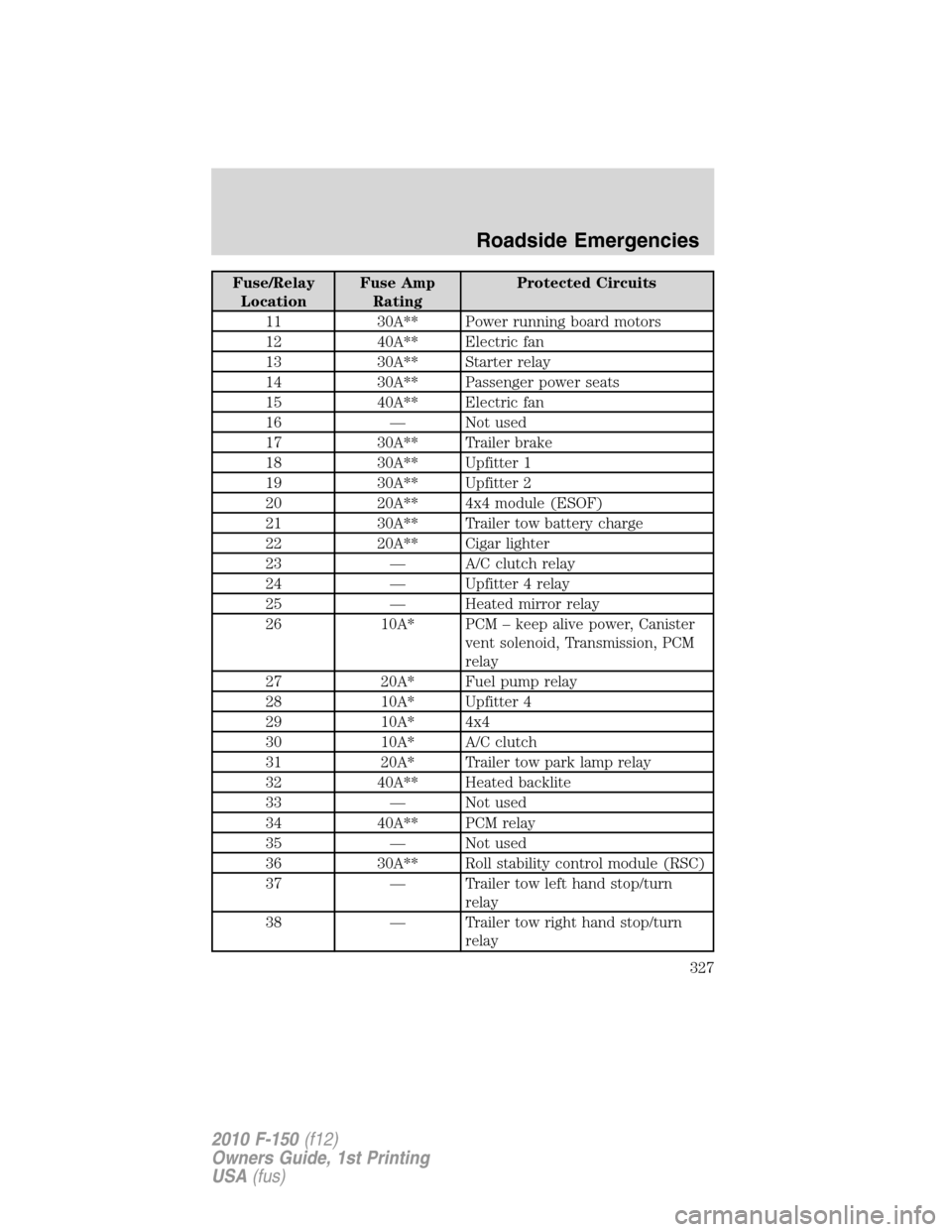
Fuse/Relay
LocationFuse Amp
RatingProtected Circuits
11 30A** Power running board motors
12 40A** Electric fan
13 30A** Starter relay
14 30A** Passenger power seats
15 40A** Electric fan
16 — Not used
17 30A** Trailer brake
18 30A** Upfitter 1
19 30A** Upfitter 2
20 20A** 4x4 module (ESOF)
21 30A** Trailer tow battery charge
22 20A** Cigar lighter
23 — A/C clutch relay
24 — Upfitter 4 relay
25 — Heated mirror relay
26 10A* PCM – keep alive power, Canister
vent solenoid, Transmission, PCM
relay
27 20A* Fuel pump relay
28 10A* Upfitter 4
29 10A* 4x4
30 10A* A/C clutch
31 20A* Trailer tow park lamp relay
32 40A** Heated backlite
33 — Not used
34 40A** PCM relay
35 — Not used
36 30A** Roll stability control module (RSC)
37 — Trailer tow left hand stop/turn
relay
38 — Trailer tow right hand stop/turn
relay
Roadside Emergencies
327
2010 F-150(f12)
Owners Guide, 1st Printing
USA(fus)
Page 328 of 419
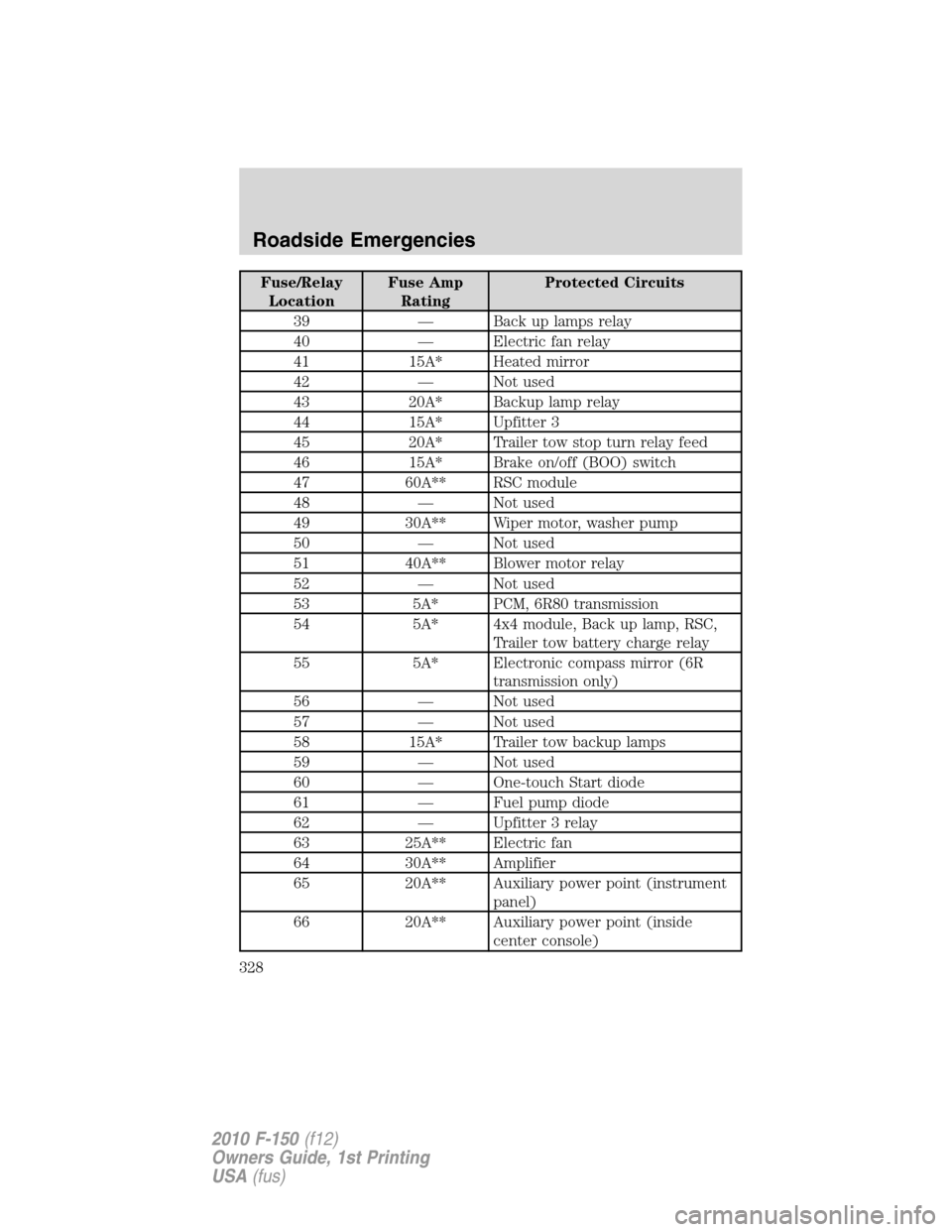
Fuse/Relay
LocationFuse Amp
RatingProtected Circuits
39 — Back up lamps relay
40 — Electric fan relay
41 15A* Heated mirror
42 — Not used
43 20A* Backup lamp relay
44 15A* Upfitter 3
45 20A* Trailer tow stop turn relay feed
46 15A* Brake on/off (BOO) switch
47 60A** RSC module
48 — Not used
49 30A** Wiper motor, washer pump
50 — Not used
51 40A** Blower motor relay
52 — Not used
53 5A* PCM, 6R80 transmission
54 5A* 4x4 module, Back up lamp, RSC,
Trailer tow battery charge relay
55 5A* Electronic compass mirror (6R
transmission only)
56 — Not used
57 — Not used
58 15A* Trailer tow backup lamps
59 — Not used
60 — One-touch Start diode
61 — Fuel pump diode
62 — Upfitter 3 relay
63 25A** Electric fan
64 30A** Amplifier
65 20A** Auxiliary power point (instrument
panel)
66 20A** Auxiliary power point (inside
center console)
Roadside Emergencies
328
2010 F-150(f12)
Owners Guide, 1st Printing
USA(fus)