2010 FORD F150 4WD
[x] Cancel search: 4WDPage 269 of 419
Exceeding these limits may allow water to enter vehicle components:
•causing internal damage to the components.
•affecting driveability, emissions and reliability.
Replace the rear axle lubricant any time the axle has been submerged in
water. Rear axle lubricant quantities are not to be checked or changed
unless a leak is suspected or repair required.
RECREATIONAL TOWING
Follow these guidelines if you have a need for recreational (RV) towing.
An example of recreational towing would be towing your vehicle behind
a motorhome. These guidelines are designed to ensure that your
transmission is not damaged.
Note:Put your climate control system in recirculated air mode to
prevent exhaust fumes from entering the vehicle. Refer to theClimate
controlschapter for more information.
2WD vehicles:Do not tow your vehicle with any wheels on the ground,
as vehicle or transmission damage may occur. It is recommended to tow
your vehicle with all four (4) wheels off the ground such as when using a
car-hauling trailer. Otherwise, no recreational towing is permitted.
4WD vehicles equipped with manual-shift transfer case:
•Release the parking brake.
•Turn the key in the ignition to the off position.
•Place the transmission in N (Neutral).
•Place the transfer case lever in N (Neutral).
•The maximum recommended distance is unlimited.
•The vehicle must be towed in the forward position to ensure no
damage is done to the internal transfer case components.
The transfer case N (Neutral) position overrides the transmission and
puts the vehicle in neutral regardless of transmission gearshift lever
position. The vehicle can move forward or backward. This position
should only be used when towing the vehicle.
WARNING:Do not leave the vehicle unattended with the
transfer case in the N (Neutral) position. Always set the parking
brake fully and turn off the ignition when leaving the vehicle.
After reaching the destination, you must place your vehicle’s 4x4
gearshift lever in gear (2H, 4H or 4L).
Tires, Wheels and Loading
269
2010 F-150(f12)
Owners Guide, 1st Printing
USA(fus)
Page 270 of 419
In case of a roadside emergency with a disabled vehicle, seeWrecker
towingin theRoadside Emergencieschapter.
4WD vehicles equipped with an electronic-shift transfer case:Do
not tow your vehicle with any wheels on the ground, as vehicle or
transmission damage may occur. It is recommended to tow your vehicle
with all four (4) wheels off the ground such as when using a car-hauling
trailer. Otherwise, no recreational towing is permitted.
In case of a roadside emergency with a disabled vehicle, seeWrecker
towingin theRoadside Emergencieschapter.
Tires, Wheels and Loading
270
2010 F-150(f12)
Owners Guide, 1st Printing
USA(fus)
Page 286 of 419
LIMITED-SLIP AXLE (IF EQUIPPED)
This axle provides added traction on slippery surfaces, particularly when
one wheel is on a poor traction surface. Under normal conditions, the
Limited-slip axle functions like a standard rear axle. The axle may
exhibit a slight noise or vibration in tight turns with low vehicle speed.
This is normal behavior and indicates the axle is working.
Electronic locking differential (ELD) axle (if equipped)
This axle provides added traction on slippery and/or off road surfaces,
particularly when one wheel is on a poor traction surface. In normal
driving conditions the rear axle function as a standard axle. The ELD
may be locked or unlocked by the vehicle operator. Refer toFour-wheel
drive (4WD) operationsection in this chapter for further detail on ELD
function and usage. When the axle is unlocked it will function like a
standard rear axle. When the axle is locked it will not allow the rear
wheels to rotate at different speeds when turning. The ELD axle is not
recommended for use on good traction surfaces such as dry pavement.
Doing so may result in abnormal driving behavior while cornering and
excessive tire wear.
PREPARING TO DRIVE
WARNING:Utility vehicles have a significantly higher rollover
rate than other types of vehicles.
WARNING:In a rollover crash, an unbelted person is
significantly more likely to die than a person wearing a seat belt.
Utility vehicles and trucks have larger tires and increased ground
clearance, giving the vehicle a higher center of gravity than a passenger
car.
WARNING:Vehicles with a higher center of gravity such as
utility vehicles and trucks handle differently than vehicles with a
lower center of gravity. Utility vehicles and trucks arenotdesigned for
cornering at speeds as high as passenger cars any more than low-slung
sports cars are designed to perform satisfactorily under off-road
conditions. Avoid sharp turns, excessive speed or abrupt maneuvers in
these vehicles. Failure to drive cautiously could result in an increased
risk of loss of vehicle control, vehicle rollover, personal injury and
death.
Driving
286
2010 F-150(f12)
Owners Guide, 1st Printing
USA(fus)
Page 301 of 419
Servicing
•If the image comes on while the vehicle is not in R (Reverse), have
the system inspected by your authorized dealer.
•If the image is not clear, then check if there is anything covering the
lens such as dirt, mud, ice, snow, etc. If the image is still not clear
after cleaning, have your system inspected by your authorized dealer.
FOUR-WHEEL DRIVE (4WD) OPERATION (IF EQUIPPED)
WARNING:For important information regarding safe operation
of this type of vehicle, seePreparing to drive your vehiclein
this chapter.
Four–wheel drive (4WD) supplies power to all four wheels. 4WD should
not be operated on dry pavement; driveline damage may occur.
If equipped with the Electronic Shift 4WD System, and 4X4 Low
is selected while the vehicle is moving above 3 mph (5 km/h), the
4WD system will not perform a shift. This is normal and should be
no reason for concern.Refer toShifting to/from 4L (4X4 Low)for
proper operation.
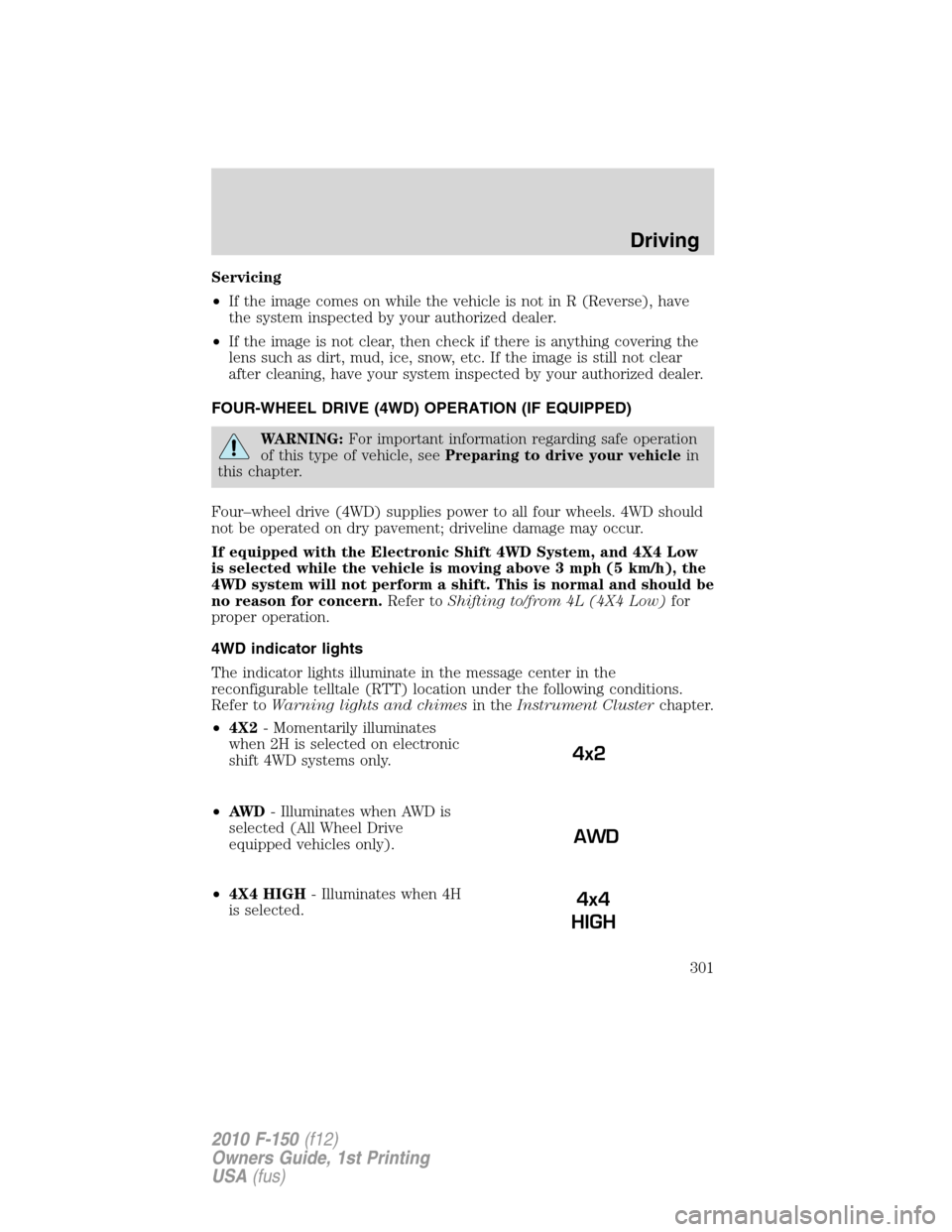
4WD indicator lights
The indicator lights illuminate in the message center in the
reconfigurable telltale (RTT) location under the following conditions.
Refer toWarning lights and chimesin theInstrument Clusterchapter.
•4X2- Momentarily illuminates
when 2H is selected on electronic
shift 4WD systems only.
•AW D- Illuminates when AWD is
selected (All Wheel Drive
equipped vehicles only).
•4X4 HIGH- Illuminates when 4H
is selected.
4x2
AWD
4x4
HIGH
Driving
301
2010 F-150(f12)
Owners Guide, 1st Printing
USA(fus)
Page 302 of 419
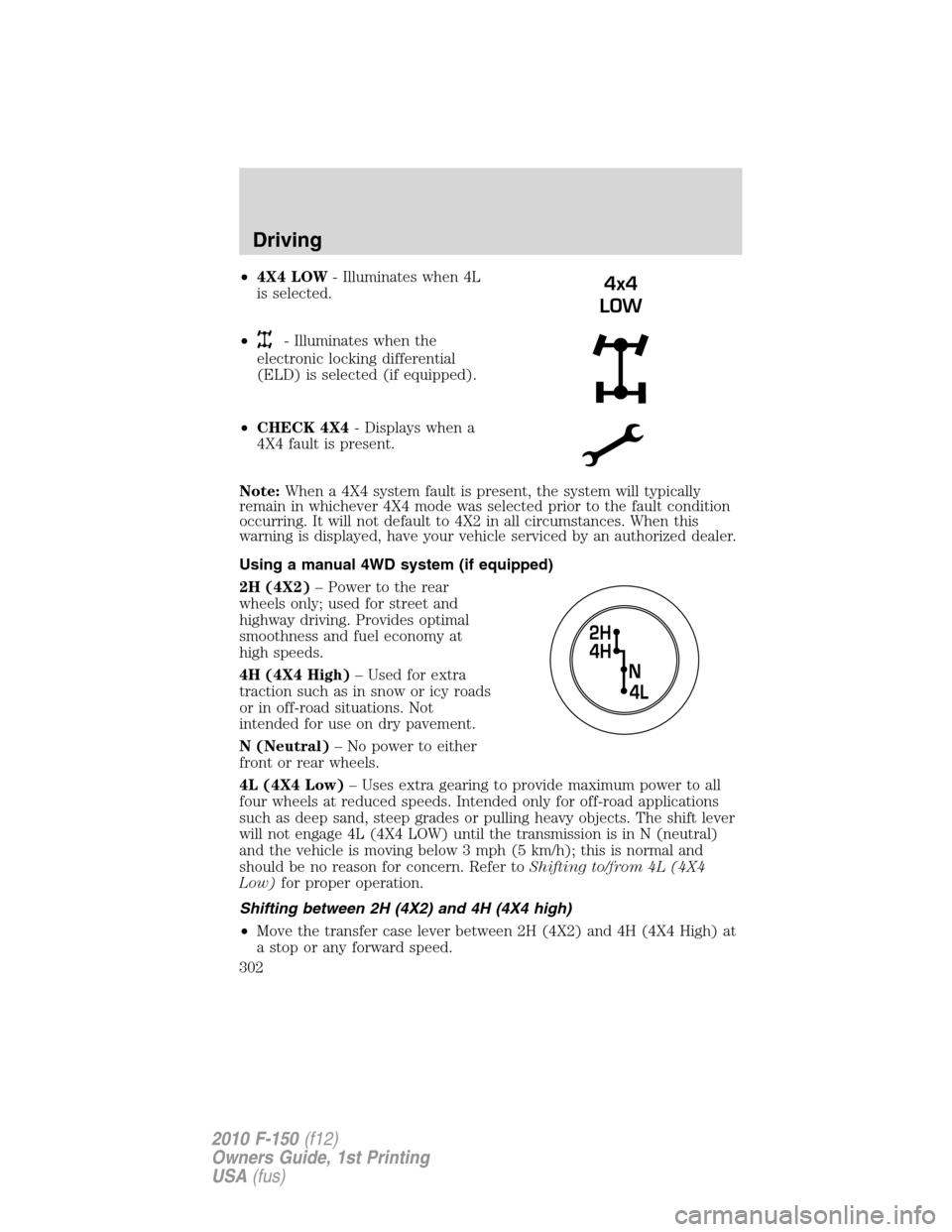
•4X4 LOW- Illuminates when 4L
is selected.
•
- Illuminates when the
electronic locking differential
(ELD) is selected (if equipped).
•CHECK 4X4- Displays when a
4X4 fault is present.
Note:When a 4X4 system fault is present, the system will typically
remain in whichever 4X4 mode was selected prior to the fault condition
occurring. It will not default to 4X2 in all circumstances. When this
warning is displayed, have your vehicle serviced by an authorized dealer.
Using a manual 4WD system (if equipped)
2H (4X2)– Power to the rear
wheels only; used for street and
highway driving. Provides optimal
smoothness and fuel economy at
high speeds.
4H (4X4 High)– Used for extra
traction such as in snow or icy roads
or in off-road situations. Not
intended for use on dry pavement.
N (Neutral)– No power to either
front or rear wheels.
4L (4X4 Low)– Uses extra gearing to provide maximum power to all
four wheels at reduced speeds. Intended only for off-road applications
such as deep sand, steep grades or pulling heavy objects. The shift lever
will not engage 4L (4X4 LOW) until the transmission is in N (neutral)
and the vehicle is moving below 3 mph (5 km/h); this is normal and
should be no reason for concern. Refer toShifting to/from 4L (4X4
Low)for proper operation.
Shifting between 2H (4X2) and 4H (4X4 high)
•Move the transfer case lever between 2H (4X2) and 4H (4X4 High) at
a stop or any forward speed.
4x4
LOW
Driving
302
2010 F-150(f12)
Owners Guide, 1st Printing
USA(fus)
Page 304 of 419
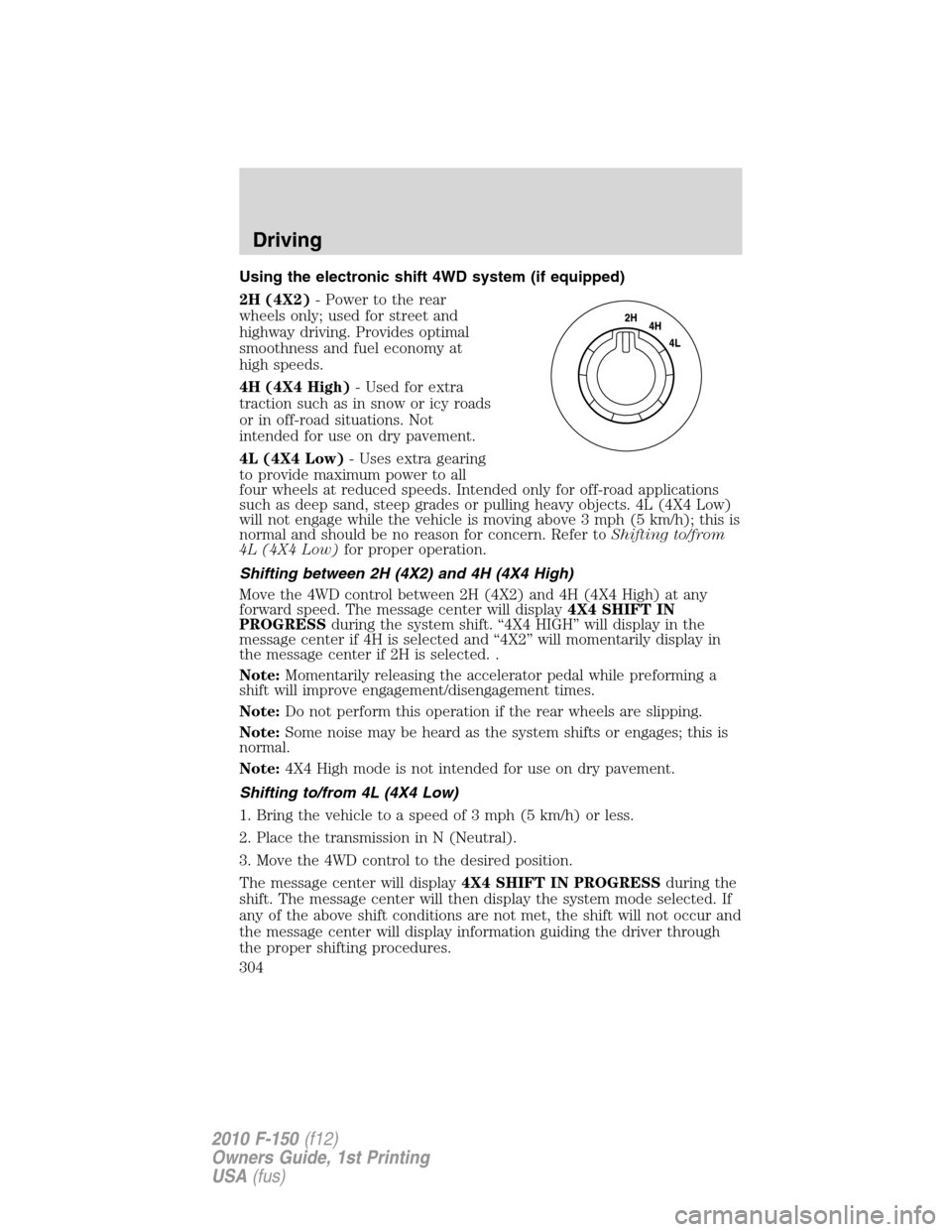
Using the electronic shift 4WD system (if equipped)
2H (4X2)- Power to the rear
wheels only; used for street and
highway driving. Provides optimal
smoothness and fuel economy at
high speeds.
4H (4X4 High)- Used for extra
traction such as in snow or icy roads
or in off-road situations. Not
intended for use on dry pavement.
4L (4X4 Low)- Uses extra gearing
to provide maximum power to all
four wheels at reduced speeds. Intended only for off-road applications
such as deep sand, steep grades or pulling heavy objects. 4L (4X4 Low)
will not engage while the vehicle is moving above 3 mph (5 km/h); this is
normal and should be no reason for concern. Refer toShifting to/from
4L (4X4 Low)for proper operation.
Shifting between 2H (4X2) and 4H (4X4 High)
Move the 4WD control between 2H (4X2) and 4H (4X4 High) at any
forward speed. The message center will display4X4 SHIFT IN
PROGRESSduring the system shift. “4X4 HIGH” will display in the
message center if 4H is selected and “4X2” will momentarily display in
the message center if 2H is selected. .
Note:Momentarily releasing the accelerator pedal while preforming a
shift will improve engagement/disengagement times.
Note:Do not perform this operation if the rear wheels are slipping.
Note:Some noise may be heard as the system shifts or engages; this is
normal.
Note:4X4 High mode is not intended for use on dry pavement.
Shifting to/from 4L (4X4 Low)
1. Bring the vehicle to a speed of 3 mph (5 km/h) or less.
2. Place the transmission in N (Neutral).
3. Move the 4WD control to the desired position.
The message center will display4X4 SHIFT IN PROGRESSduring the
shift. The message center will then display the system mode selected. If
any of the above shift conditions are not met, the shift will not occur and
the message center will display information guiding the driver through
the proper shifting procedures.
Driving
304
2010 F-150(f12)
Owners Guide, 1st Printing
USA(fus)
Page 306 of 419
Shifting between AWD (Auto) and 4H (High)
Move the control from AWD to 4H at a stop or while driving at any
speed. The message center will display “AWD” if AWD has been selected
and “4X4 High” if 4H has been selected
Note:4X4 High mode is not intended for use on dry pavement
Electronic locking differential (ELD) (if equipped)
The electronic locking differential (ELD) is a device housed in the rear
axle which allows both rear wheels to turn at the same speed. The ELD
can provide additional traction should the vehicle become stuck. The
ELD is electronically activated by the driver and can be shifted on the
fly. It is intended for use in mud, rocks, sand, or any off-road condition
where maximum traction is needed. It is not intended for use on dry
pavement.
The ELD is affected by the following conditions:
•The 4WD control must be in either 4H (4X4 High) or 4L (4X4 Low)
mode.
•The ELD will not engage if the vehicle speed is above 20 mph
(30 km/h) in 4X4 High or 56 mph (90 km/h) in 4X4 Low.
•In 4H (4X4 High), the ELD will disengage at speeds above 25 mph
(40 km/h) and will automatically reengage at speeds below 20 mph
(30 km/h).
•In 4L (4X4 Low), the ELD will disengage at speeds above 62 mph
(100 km/h) and will automatically reengage at speeds below 56 mph
(90 km/h).
The ELD is designed for off-road use only and is not intended for use on
dry pavement.
Driving
306
2010 F-150(f12)
Owners Guide, 1st Printing
USA(fus)
Page 307 of 419
Activating the electronic locking differential (ELD)
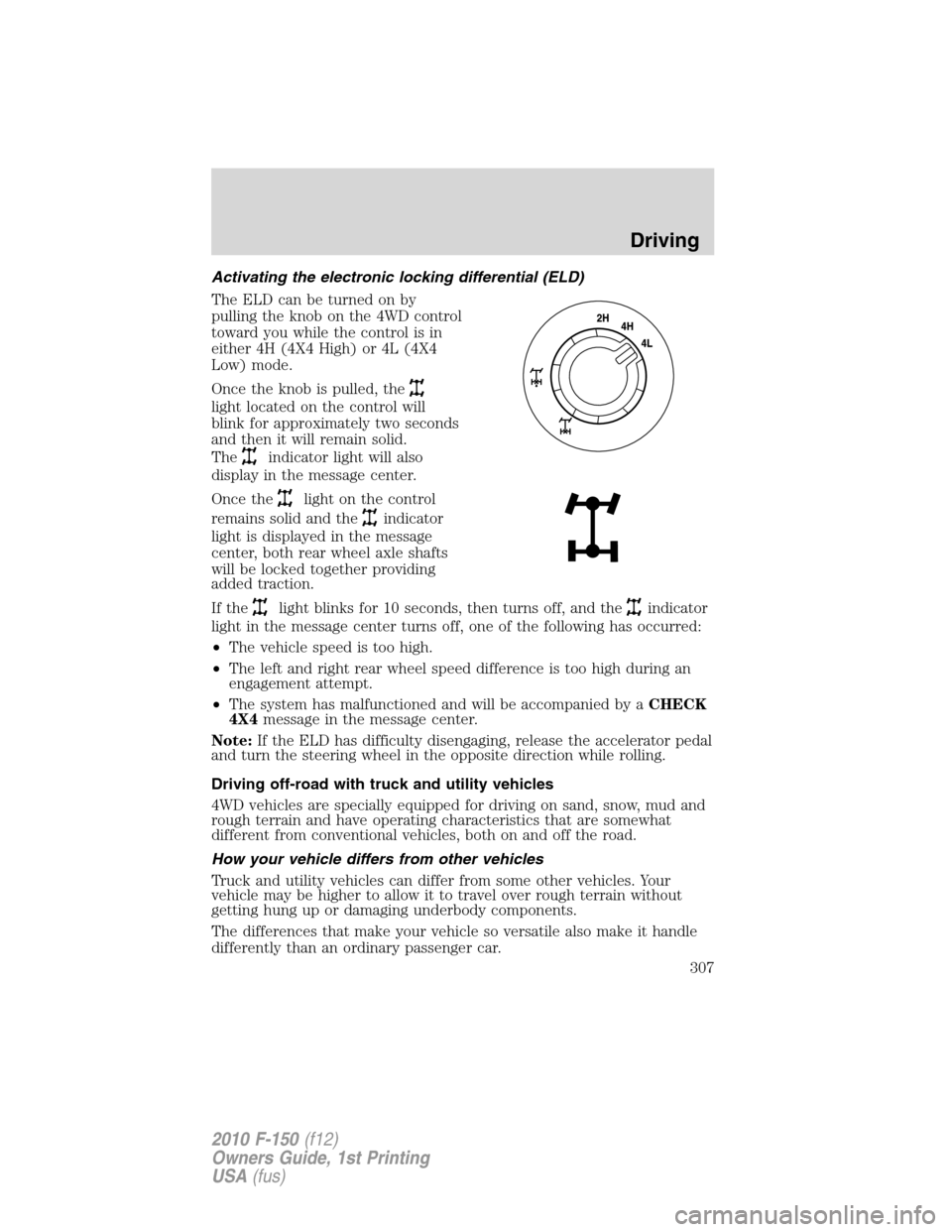
The ELD can be turned on by
pulling the knob on the 4WD control
toward you while the control is in
either 4H (4X4 High) or 4L (4X4
Low) mode.
Once the knob is pulled, the
light located on the control will
blink for approximately two seconds
and then it will remain solid.
The
indicator light will also
display in the message center.
Once the
light on the control
remains solid and the
indicator
light is displayed in the message
center, both rear wheel axle shafts
will be locked together providing
added traction.
If the
light blinks for 10 seconds, then turns off, and theindicator
light in the message center turns off, one of the following has occurred:
•The vehicle speed is too high.
•The left and right rear wheel speed difference is too high during an
engagement attempt.
•The system has malfunctioned and will be accompanied by aCHECK
4X4message in the message center.
Note:If the ELD has difficulty disengaging, release the accelerator pedal
and turn the steering wheel in the opposite direction while rolling.
Driving off-road with truck and utility vehicles
4WD vehicles are specially equipped for driving on sand, snow, mud and
rough terrain and have operating characteristics that are somewhat
different from conventional vehicles, both on and off the road.
How your vehicle differs from other vehicles
Truck and utility vehicles can differ from some other vehicles. Your
vehicle may be higher to allow it to travel over rough terrain without
getting hung up or damaging underbody components.
The differences that make your vehicle so versatile also make it handle
differently than an ordinary passenger car.
Driving
307
2010 F-150(f12)
Owners Guide, 1st Printing
USA(fus)