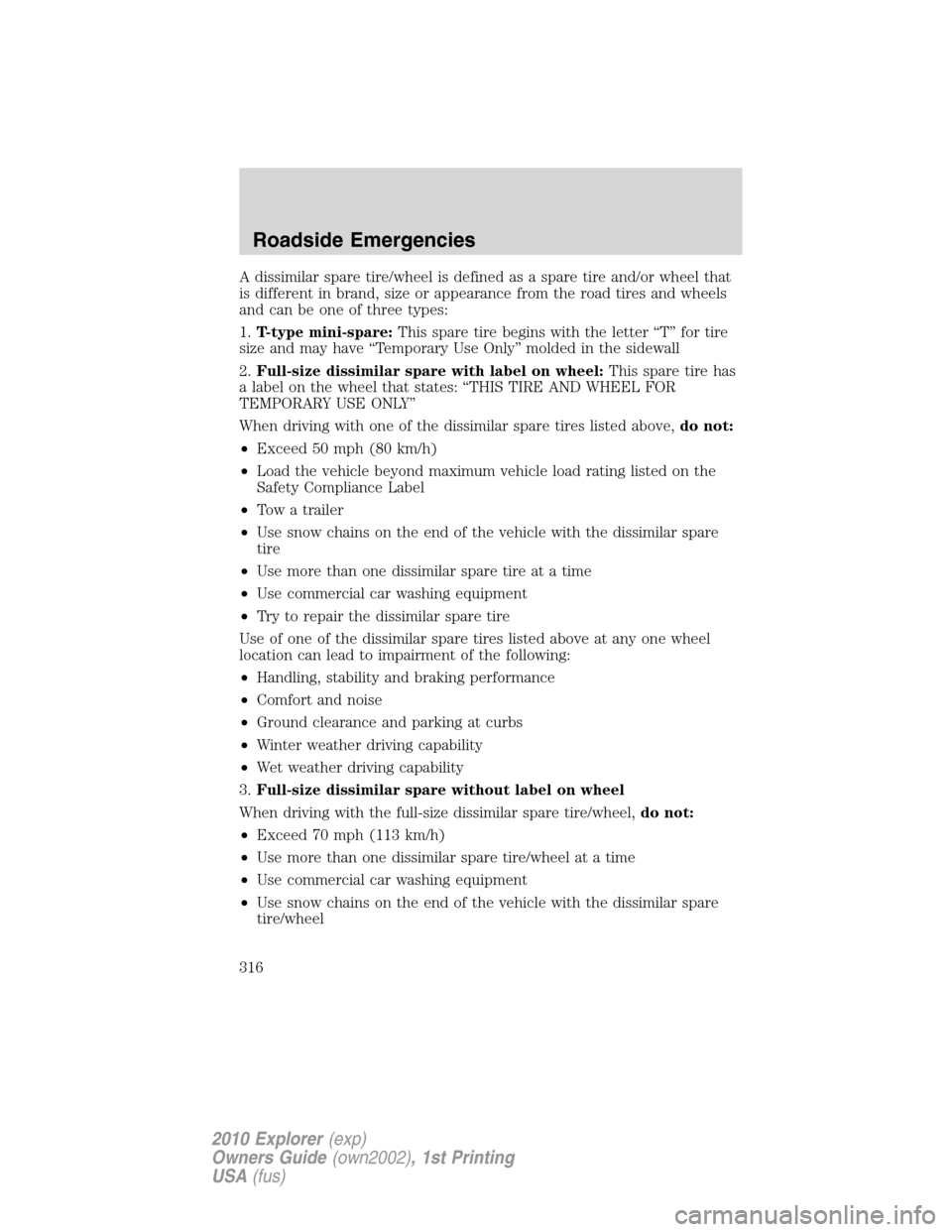
A dissimilar spare tire/wheel is defined as a spare tire and/or wheel that
is different in brand, size or appearance from the road tires and wheels
and can be one of three types:
1.T-type mini-spare:This spare tire begins with the letter “T” for tire
size and may have “Temporary Use Only” molded in the sidewall
2.Full-size dissimilar spare with label on wheel:This spare tire has
a label on the wheel that states: “THIS TIRE AND WHEEL FOR
TEMPORARY USE ONLY”
When driving with one of the dissimilar spare tires listed above,do not:
•Exceed 50 mph (80 km/h)
•Load the vehicle beyond maximum vehicle load rating listed on the
Safety Compliance Label
•Tow a trailer
•Use snow chains on the end of the vehicle with the dissimilar spare
tire
•Use more than one dissimilar spare tire at a time
•Use commercial car washing equipment
•Try to repair the dissimilar spare tire
Use of one of the dissimilar spare tires listed above at any one wheel
location can lead to impairment of the following:
•Handling, stability and braking performance
•Comfort and noise
•Ground clearance and parking at curbs
•Winter weather driving capability
•Wet weather driving capability
3.Full-size dissimilar spare without label on wheel
When driving with the full-size dissimilar spare tire/wheel,do not:
•Exceed 70 mph (113 km/h)
•Use more than one dissimilar spare tire/wheel at a time
•Use commercial car washing equipment
•Use snow chains on the end of the vehicle with the dissimilar spare
tire/wheel
Roadside Emergencies
316
2010 Explorer(exp)
Owners Guide(own2002), 1st Printing
USA(fus)
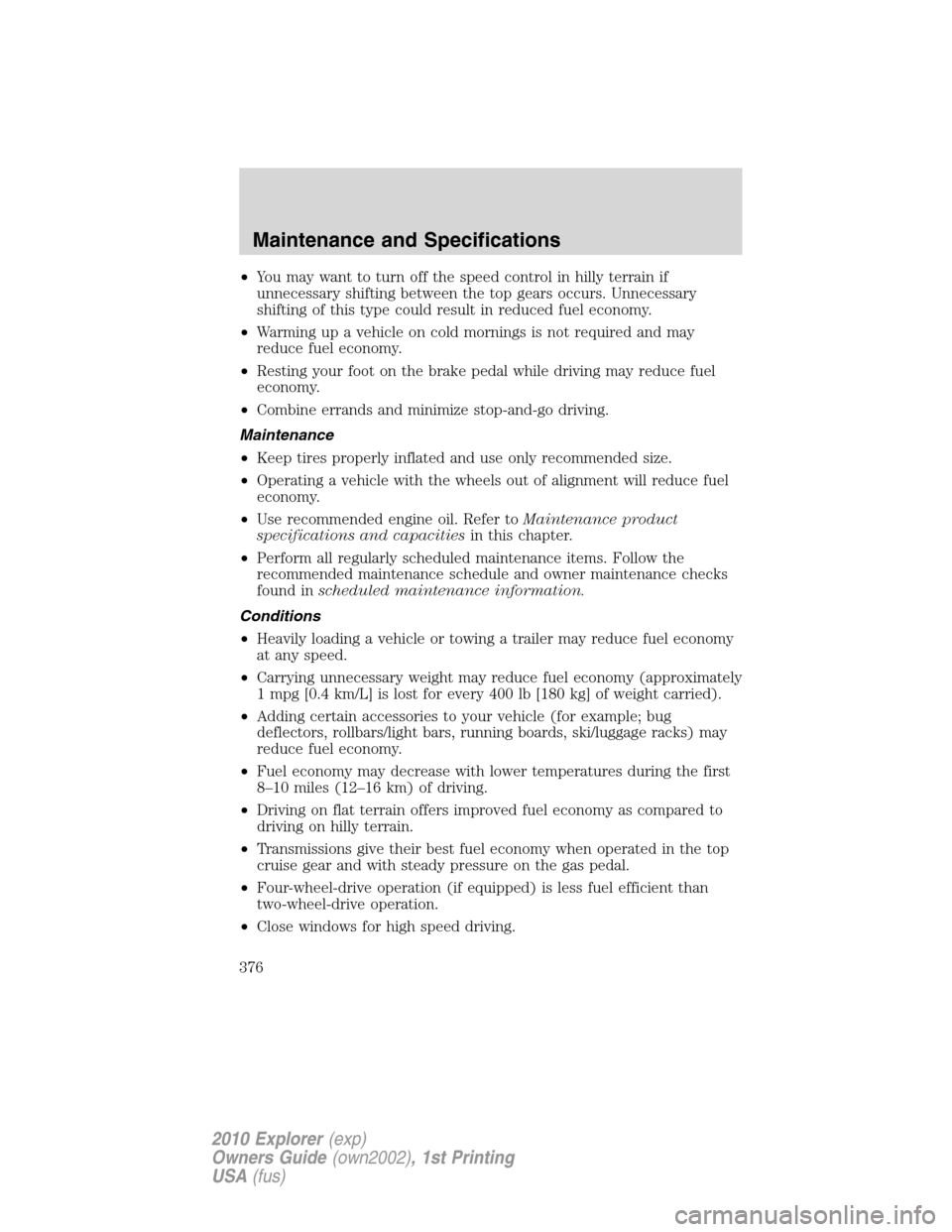
•You may want to turn off the speed control in hilly terrain if
unnecessary shifting between the top gears occurs. Unnecessary
shifting of this type could result in reduced fuel economy.
•Warming up a vehicle on cold mornings is not required and may
reduce fuel economy.
•Resting your foot on the brake pedal while driving may reduce fuel
economy.
•Combine errands and minimize stop-and-go driving.
Maintenance
•Keep tires properly inflated and use only recommended size.
•Operating a vehicle with the wheels out of alignment will reduce fuel
economy.
•Use recommended engine oil. Refer toMaintenance product
specifications and capacitiesin this chapter.
•Perform all regularly scheduled maintenance items. Follow the
recommended maintenance schedule and owner maintenance checks
found inscheduled maintenance information.
Conditions
•Heavily loading a vehicle or towing a trailer may reduce fuel economy
at any speed.
•Carrying unnecessary weight may reduce fuel economy (approximately
1 mpg [0.4 km/L] is lost for every 400 lb [180 kg] of weight carried).
•Adding certain accessories to your vehicle (for example; bug
deflectors, rollbars/light bars, running boards, ski/luggage racks) may
reduce fuel economy.
•Fuel economy may decrease with lower temperatures during the first
8–10 miles (12–16 km) of driving.
•Driving on flat terrain offers improved fuel economy as compared to
driving on hilly terrain.
•Transmissions give their best fuel economy when operated in the top
cruise gear and with steady pressure on the gas pedal.
•Four-wheel-drive operation (if equipped) is less fuel efficient than
two-wheel-drive operation.
•Close windows for high speed driving.
Maintenance and Specifications
376
2010 Explorer(exp)
Owners Guide(own2002), 1st Printing
USA(fus)
SecuriCode keyless entry
system ........................................161
SecuriLock passive anti-theft
system ........................................162
Setting the clock
AM/FM single CD .....................45
AM/FM/In-dash 6 CD ................52
Snowplowing .................................6
SOS Post Crash Alert ...............213
Spark plugs,
specifications .....................384, 390
Special notice
ambulance conversions ..............6
utility-type vehicles ....................6
Specification chart,
lubricants ...................................385
Speed control ............................128
Starting your
vehicle ........................270–271, 273
jump starting ..........................325
Steering wheel
controls ....................................130
tilting .......................................118
SYNC�..........................................98
T
Third-row power fold seat .......182
Tilt steering wheel ....................118
Tire Pressure Monitoring
System (TPMS)
Driving .....................................300
Roadside Emergencies ...........315
Tires, Wheels and Loading ....250
Warning Displays ..........12, 27, 36
Tires ...........................235–237, 315
alignment ................................244care ..........................................240
changing ..........................315, 320
checking the pressure ............240
inflating ...................................238
label .........................................249
replacing ..........................241, 320
rotating ....................................244
safety practices .......................243
sidewall information ...............245
snow tires and cables .............255
spare tire .................315, 318–319
terminology .............................237
tire grades ...............................236
treadwear ........................236, 240
Towing .......................................263
recreational towing .................268
trailer towing ..........................263
wrecker ....................................331
Transfer case
fluid checking .........................381
Transmission .............................286
brake-shift interlock (BSI) ....285
fluid, checking and adding
(automatic) .............................380
fluid, refill capacities ..............385
lubricant specifications ..........385
Turn signal ................................110
U
Universal garage door
opener ........................................133
USB port ......................................60
V
Vehicle Identification Number
(VIN) ..........................................391
Vehicle loading ..........................255
Ventilating your vehicle ...........273
Index
403
2010 Explorer(exp)
Owners Guide(own2002), 1st Printing
USA(fus)