2010 FORD EXPEDITION heating
[x] Cancel search: heatingPage 200 of 420
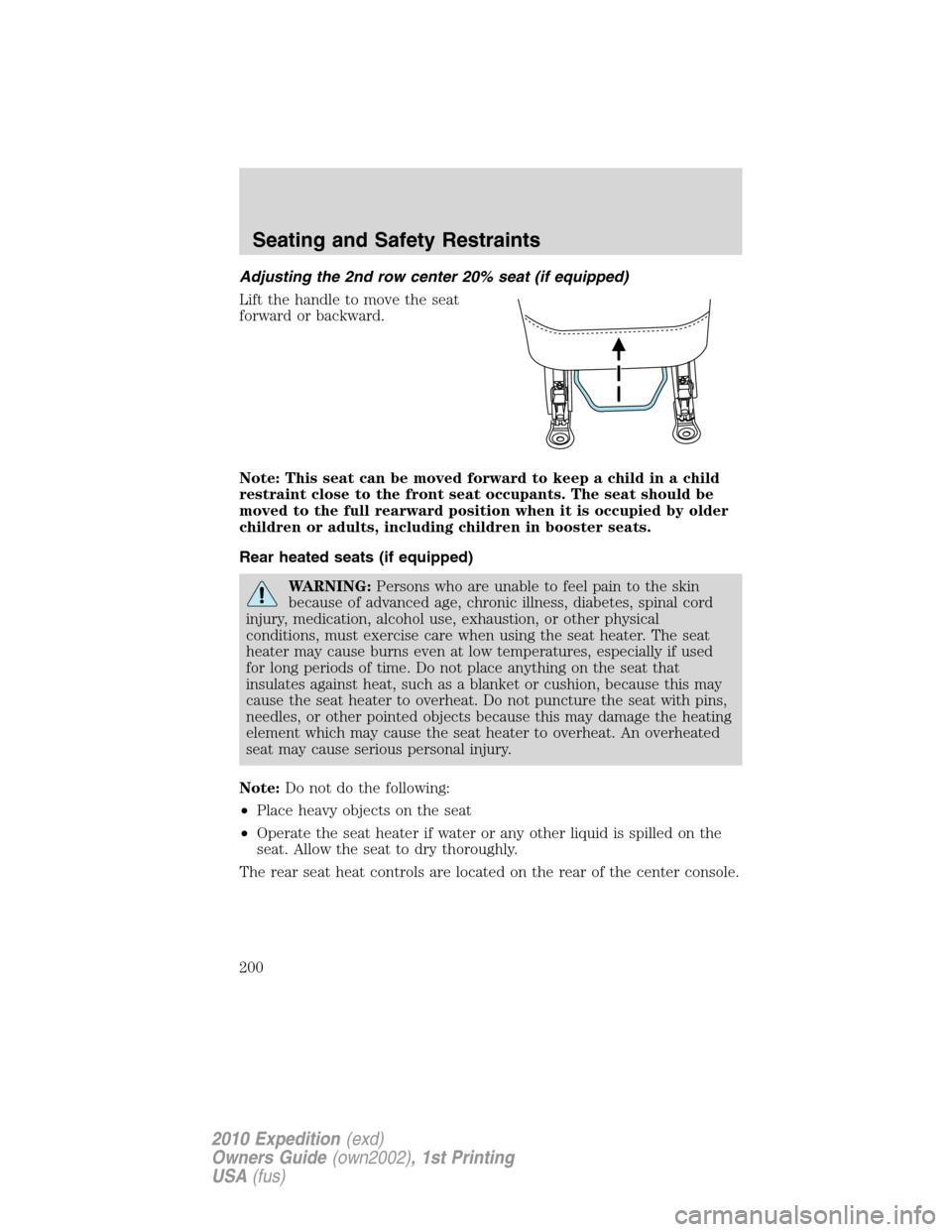
Adjusting the 2nd row center 20% seat (if equipped)
Lift the handle to move the seat
forward or backward.
Note: This seat can be moved forward to keep a child in a child
restraint close to the front seat occupants. The seat should be
moved to the full rearward position when it is occupied by older
children or adults, including children in booster seats.
Rear heated seats (if equipped)
WARNING:Persons who are unable to feel pain to the skin
because of advanced age, chronic illness, diabetes, spinal cord
injury, medication, alcohol use, exhaustion, or other physical
conditions, must exercise care when using the seat heater. The seat
heater may cause burns even at low temperatures, especially if used
for long periods of time. Do not place anything on the seat that
insulates against heat, such as a blanket or cushion, because this may
cause the seat heater to overheat. Do not puncture the seat with pins,
needles, or other pointed objects because this may damage the heating
element which may cause the seat heater to overheat. An overheated
seat may cause serious personal injury.
Note:Do not do the following:
•Place heavy objects on the seat
•Operate the seat heater if water or any other liquid is spilled on the
seat. Allow the seat to dry thoroughly.
The rear seat heat controls are located on the rear of the center console.
Seating and Safety Restraints
200
2010 Expedition(exd)
Owners Guide(own2002), 1st Printing
USA(fus)
Page 201 of 420

To operate the heated seats:
•Push the indicated side of the
control for maximum heat.
•Push again to deactivate.
•Push the indicated side of the
control for minimum heat.
•Push again to deactivate.
The heated seat module resets at every ignition run cycle. While the
ignition is in the on position, activating the high or low heated seat
switch enables heating mode. When activated, they will turn off
automatically when the engine is turned off.
The indicator light will illuminate when the heated seats have been
activated.
3rd row seats
Ensure that no objects such as books, purses or briefcases are on the
floor in front of the third row seats or on the seat cushion before
lowering them. Ensure that the head restraints are lowered. Ensure that
the second row seats are not reclined.
Seating and Safety Restraints
201
2010 Expedition(exd)
Owners Guide(own2002), 1st Printing
USA(fus)
Page 288 of 420
Guarding against exhaust fumes
Carbon monoxide is present in exhaust fumes. Take precautions to avoid
its dangerous effects.
WARNING:If you smell exhaust fumes inside your vehicle, have
your dealer inspect your vehicle immediately. Do not drive if you
smell exhaust fumes.
Important ventilating information
If the engine is idling while the vehicle is stopped for a long period of
time, open the windows at least one inch (2.5 cm) or adjust the heating
or air conditioning to bring in fresh air.
ENGINE BLOCK HEATER (IF EQUIPPED)
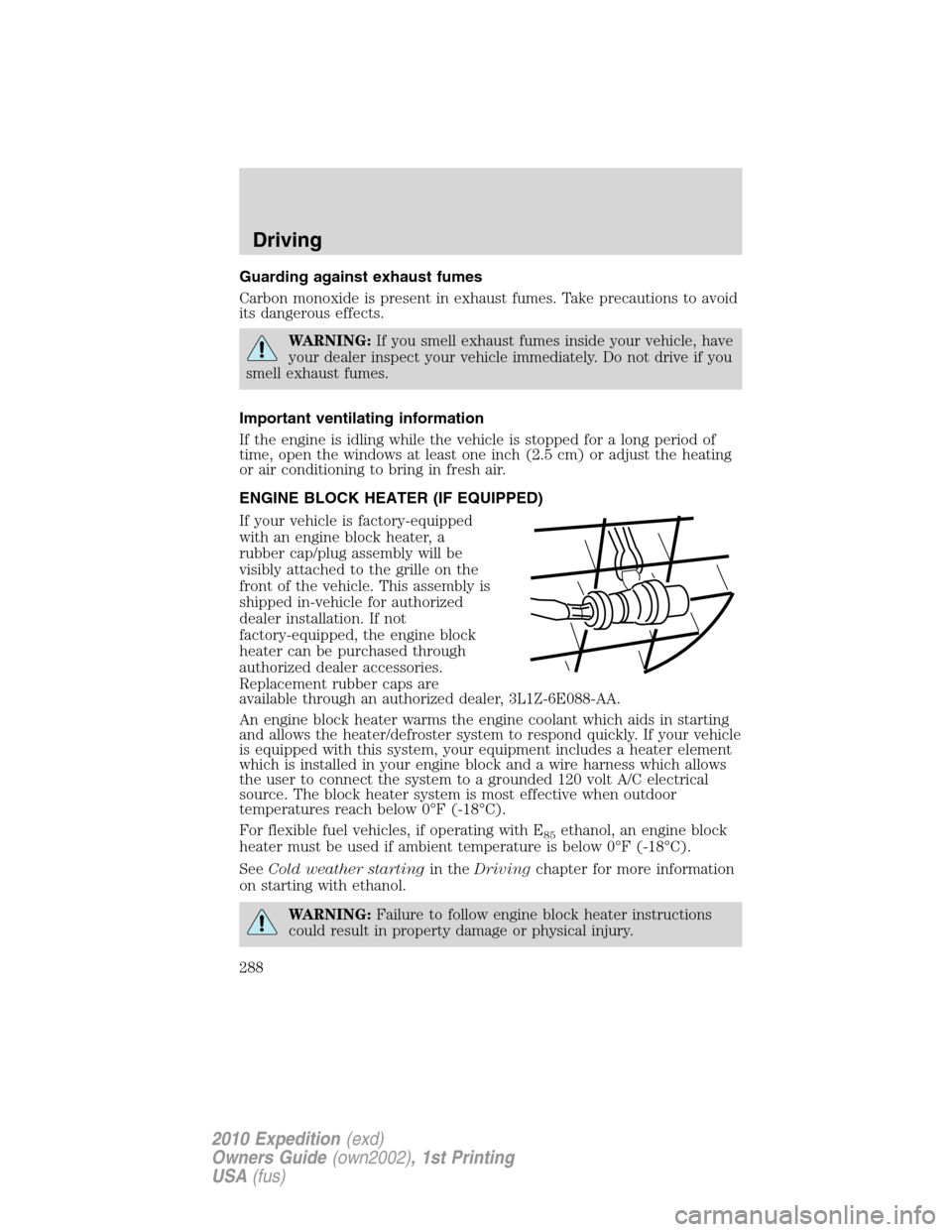
If your vehicle is factory-equipped
with an engine block heater, a
rubber cap/plug assembly will be
visibly attached to the grille on the
front of the vehicle. This assembly is
shipped in-vehicle for authorized
dealer installation. If not
factory-equipped, the engine block
heater can be purchased through
authorized dealer accessories.
Replacement rubber caps are
available through an authorized dealer, 3L1Z-6E088-AA.
An engine block heater warms the engine coolant which aids in starting
and allows the heater/defroster system to respond quickly. If your vehicle
is equipped with this system, your equipment includes a heater element
which is installed in your engine block and a wire harness which allows
the user to connect the system to a grounded 120 volt A/C electrical
source. The block heater system is most effective when outdoor
temperatures reach below 0°F (-18°C).
For flexible fuel vehicles, if operating with E
85ethanol, an engine block
heater must be used if ambient temperature is below 0°F (-18°C).
SeeCold weather startingin theDrivingchapter for more information
on starting with ethanol.
WARNING:Failure to follow engine block heater instructions
could result in property damage or physical injury.
Driving
288
2010 Expedition(exd)
Owners Guide(own2002), 1st Printing
USA(fus)
Page 321 of 420
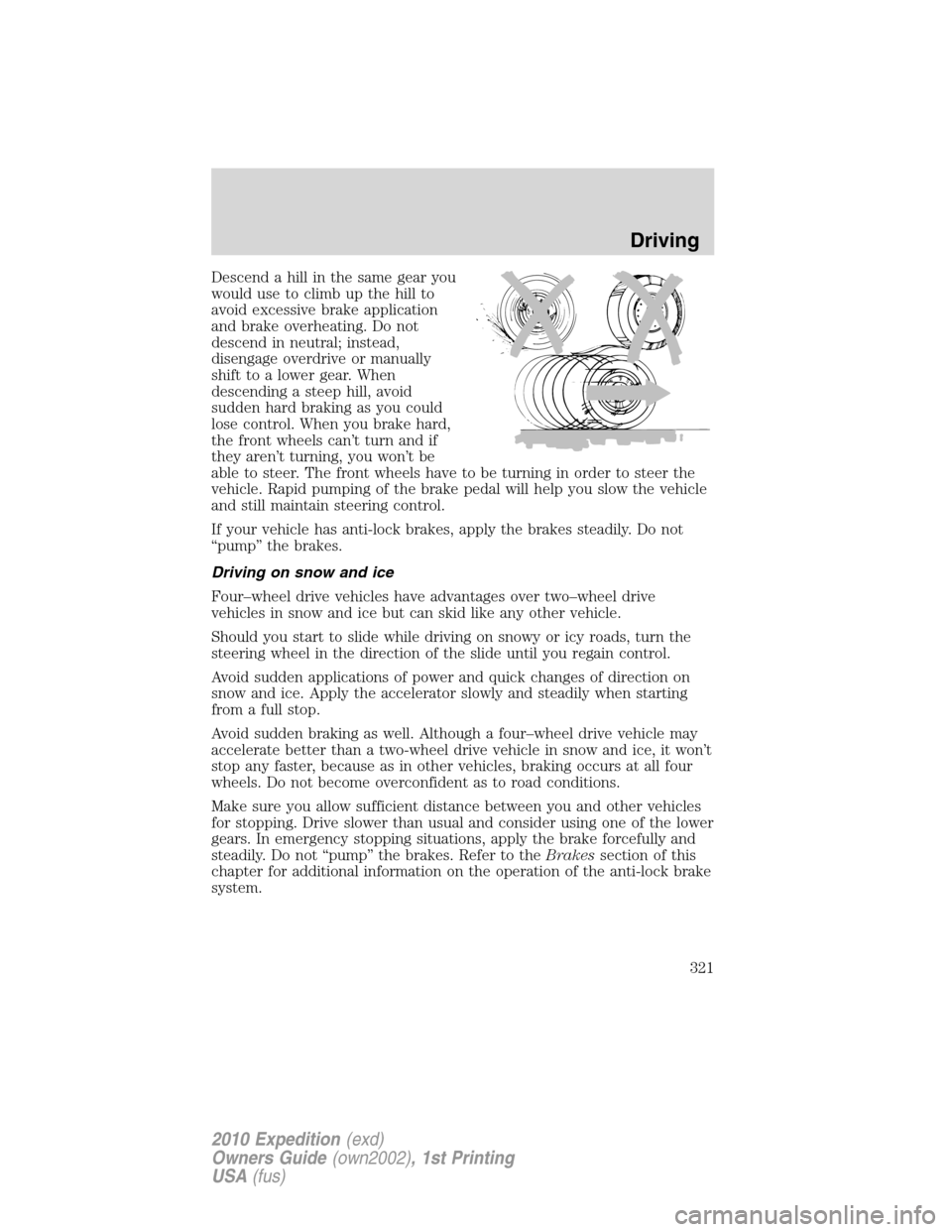
Descend a hill in the same gear you
would use to climb up the hill to
avoid excessive brake application
and brake overheating. Do not
descend in neutral; instead,
disengage overdrive or manually
shift to a lower gear. When
descending a steep hill, avoid
sudden hard braking as you could
lose control. When you brake hard,
the front wheels can’t turn and if
they aren’t turning, you won’t be
able to steer. The front wheels have to be turning in order to steer the
vehicle. Rapid pumping of the brake pedal will help you slow the vehicle
and still maintain steering control.
If your vehicle has anti-lock brakes, apply the brakes steadily. Do not
“pump” the brakes.
Driving on snow and ice
Four–wheel drive vehicles have advantages over two–wheel drive
vehicles in snow and ice but can skid like any other vehicle.
Should you start to slide while driving on snowy or icy roads, turn the
steering wheel in the direction of the slide until you regain control.
Avoid sudden applications of power and quick changes of direction on
snow and ice. Apply the accelerator slowly and steadily when starting
from a full stop.
Avoid sudden braking as well. Although a four–wheel drive vehicle may
accelerate better than a two-wheel drive vehicle in snow and ice, it won’t
stop any faster, because as in other vehicles, braking occurs at all four
wheels. Do not become overconfident as to road conditions.
Make sure you allow sufficient distance between you and other vehicles
for stopping. Drive slower than usual and consider using one of the lower
gears. In emergency stopping situations, apply the brake forcefully and
steadily. Do not “pump” the brakes. Refer to theBrakessection of this
chapter for additional information on the operation of the anti-lock brake
system.
Driving
321
2010 Expedition(exd)
Owners Guide(own2002), 1st Printing
USA(fus)
Page 380 of 420
•Do not mix coolants. Add the coolant type originally equipped
in your vehicle.Refer toMaintenance product specifications and
capacitiesin this chapter.
Note:Do not use stop leak pellets or cooling system sealants/additives
as they can cause damage to the engine cooling and/or heating systems.
This damage would not be covered under your vehicle’s warranty.
•A large amount of water without engine coolant may be added, in case
of emergency, to reach a vehicle service location. In this instance, the
cooling system must be drained and refilled with a 50/50 mixture of
engine coolant and distilled water as soon as possible. Water alone
(without engine coolant) can cause engine damage from corrosion,
overheating or freezing.
•Do not use alcohol, methanol, brine or any engine coolants
mixed with alcohol or methanol antifreeze (coolant).Alcohol
and other liquids can cause engine damage from overheating or
freezing.
•Do not add extra inhibitors or additives to the coolant.These
can be harmful and compromise the corrosion protection of the engine
coolant.
For vehicles with overflow coolant systems with a non-pressurized cap
on the coolant recovery system, add coolant to the coolant recovery
reservoir when the engine is cool. Add the proper mixture of coolant and
water to the FULL COLD level. For all other vehicles which have a
coolant degas system with a pressurized cap, or if it is necessary to
remove the coolant pressure relief cap on the radiator of a vehicle with
an overflow system, follow these steps to add engine coolant.
WARNING:To reduce the risk of personal injury, make sure the
engine is cool before unscrewing the coolant pressure relief cap.
The cooling system is under pressure; steam and hot liquid can come
out forcefully when the cap is loosened slightly.
Add the proper mixture of coolant and water to the cooling system by
following these steps:
1. Before you begin, turn the engine off and let it cool.
2. When the engine is cool, wrap a thick cloth around the coolant
pressure relief cap on the coolant reservoir (a translucent plastic bottle).
Slowly turn cap counterclockwise (left) until pressure begins to release.
3. Step back while the pressure releases.
Maintenance and Specifications
380
2010 Expedition(exd)
Owners Guide(own2002), 1st Printing
USA(fus)
Page 381 of 420
4. When you are sure that all the pressure has been released, use the
cloth to turn it counterclockwise and remove the cap.
5. Fill the coolant reservoir slowly with the proper coolant mixture, to
within the COLD FILL RANGE or the FULL COLD level on the reservoir.
If you removed the radiator cap in an overflow system, fill the radiator
until the coolant is visible and radiator is almost full.
6. Replace the cap. Turn until tightly installed. Cap must be tightly
installed to prevent coolant loss.
After any coolant has been added, check the coolant concentration (refer
toChecking engine coolant). If the concentration is not 50/50
(protection to –34°F/–36°C), drain some coolant and adjust the
concentration. It may take several drains and additions to obtain a 50/50
coolant concentration.
Whenever coolant has been added, the coolant level in the coolant
reservoir should be checked the next few times you drive the vehicle. If
necessary, add enough 50/50 concentration of engine coolant and
distilled water to bring the liquid level to the proper level.
If you have to add more than 1.0 quart (1.0 liter) of engine coolant per
month, have your authorized dealer check the engine cooling system.
Your cooling system may have a leak. Operating an engine with a low
level of coolant can result in engine overheating and possible engine
damage.
Recycled engine coolant
Ford Motor Company does NOT recommend the use of recycled engine
coolant since a Ford-approved recycling process is not yet available.
Used engine coolant should be disposed of in an appropriate
manner. Follow your community’s regulations and standards for recycling
and disposing of automotive fluids.
Coolant refill capacity
To find out how much fluid your vehicle’s cooling system can hold, refer
toMaintenance product specifications and capacitiesin this chapter.
Fill your engine coolant reservoir as outlined inAdding engine coolant
in this section.
Severe climates
If you drive in extremely cold climates (less than –34°F [–36°C]):
•It may be necessary to increase the coolant concentration
above 50%.
Maintenance and Specifications
381
2010 Expedition(exd)
Owners Guide(own2002), 1st Printing
USA(fus)
Page 416 of 420
change oil soon warning,
message center .......................373
checking and adding ..............373
dipstick ....................................373
filter, specifications ........375, 401
recommendations ...................375
refill capacities ........................402
specifications ..........................402
Event data recording ....................7
Exhaust fumes ..........................288
F
Fail safe cooling ........................382
Family entertainment system ....70
Fleet MyKey programming ......177
Flexible Fuel Vehicle (FFV) ....384
Fluid capacities .........................402
Fog lamps ..................................115
Four-Wheel Drive vehicles .......312
control trac .............................313
description ..............................313
driving off road .......................315
indicator light .........................313
preparing to drive your
vehicle .....................................300
Fuel ............................................384
calculating fuel
economy ......................23, 31, 391
cap ...........................................386
capacity ...................................402
choosing the right fuel ...........388
comparisons with EPA fuel
economy estimates .................394
detergent in fuel .....................389
filler funnel .............................389
filling your vehicle with
fuel ...........................384, 386, 391
filter, specifications ........383, 401fuel pump shut-off switch .....326
improving fuel economy ........391
octane rating ...........388, 405–406
quality ......................................389
running out of fuel .........344, 389
safety information relating to
automotive fuels .....................384
Fuel - flex fuel vehicle
(FFV) .................................384, 388
Fuses ..................................327–328
G
Garage door opener ..................144
Gas cap (see Fuel cap) ............386
Gas mileage (see Fuel
economy) ...................................391
Gauges .........................................17
H
Hazard flashers .........................325
Headlamps .................................114
aiming ......................................116
autolamp system .....................114
bulb specifications ..................120
daytime running lights ...........115
flash to pass ............................115
high beam ...............................115
replacing bulbs .......................122
turning on and off ..................114
Heating
heating and air conditioning
system .............................103–104
Homelink wireless control
system ........................................145
Hood ..........................................369
How to get going ........................39
I
Ignition .......................284, 405–406
Index
416
2010 Expedition(exd)
Owners Guide(own2002), 1st Printing
USA(fus)