Page 264 of 345
Never use the differentials as a
jacking point.
WARNING:To lessen the
risk of personal injury, do
not put any part of your body
under the vehicle while changing a
tire. Do not start the engine when
your vehicle is on the jack. The
jack is only meant for changing
the tire.
4. Remove the lug nuts with the lug nut wrench.
5. Replace the flat tire with the spare tire, making sure the valve stem is
facing outward. Reinstall lug nuts until the wheel is snug against the hub.
Do not fully tighten the lug nuts until the wheel has been lowered.
6. Lower the wheel by turning the jack handle counterclockwise.
7. Remove the jack and fully tighten
the lug nuts in the order shown.
Refer toWheel lug nut torque
specificationslater in this chapter
for the proper lug nut torque
specification.
1
4 3
2 5
Roadside Emergencies
264
2010 Escape(204)
Owners Guide, 1st Printing
USA(fus)
Page 265 of 345

Stowing the jack and tools
•Make sure the jack is fully
lowered.
•Reclip the tools onto the jack
making sure that the tools are
fully contained by the clips as
shown.
•Reinstall the jack in the pocket
with the left side first, then snap
the right side down.
•Ensure that the hold-strap
contains the jack and tools before snapping the buckle.
•Ensure that the jack and tools are oriented as illustrated.
Stowing the flat/spare tire
Note:Failure to follow spare tire stowage instructions may result in
failure of cable or loss of spare tire.
If you are stowing a tire that requires reattaching it to the
vehicle with a tether, perform these steps first, then proceed with
the steps following.
1. Place tire on end with valve stem
facing rearward, away from vehicle.
2. Place tether into bolt holes in
wheel and attach lug nut using lug
wrench.
3. Lay the tire on the ground with the valve stem facing down. If your
vehicle is equipped with aluminum wheels, remove the wheel ornament.
4. Slide the wheel partially under the vehicle and install the retainer
through the center of the wheel.
5. Turn the jack handle clockwise until the tire is raised to its original
position underneath the vehicle. The effort to turn the jack handle
increases significantly as the tire contacts the frame. The spare tire
carrier will ratchet when the tire is in the fully stowed position. The
Roadside Emergencies
265
2010 Escape(204)
Owners Guide, 1st Printing
USA(fus)
Page 266 of 345

spare tire carrier has a built-in ratchet feature that will not allow you to
overtighten. If the spare tire carrier ratchets with very little effort, take
the vehicle to your authorized dealer for assistance at your earliest
convenience.If your vehicle is equipped with a trailer hitch, guide
the tire with one hand; keep the rear of the tire tilted down until
the tire clears the bumper.
6. Check that the tire lies flat against the frame assembly. Push against
the tire to make sure it is tightly seated under the vehicle. Loosen and
retighten, if necessary. Failure to properly stow the spare tire may result
in failure of the winch cable and loss of the spare tire.(Make sure that
the tire does not contact the bumper.)
7. Repeat this tightness check procedure (every six months, per
scheduled maintenance information),when servicing the spare tire
pressure or at any time that the spare tire is disturbed through service of
other components.
WHEEL LUG NUT TORQUE SPECIFICATIONS
Retighten the lug nuts to the specified torque at 500 miles (800 km)
after any wheel disturbance (tire rotation, changing a flat tire, wheel
removal, etc.).
Bolt size Wheel lug nut torque*
lb.ft. N•m
M12 x 1.5 100 135
* Torque specifications are for nut and bolt threads free of dirt and
rust. Use only Ford recommended replacement fasteners.
WARNING:When a wheel is installed, always remove any
corrosion, dirt or foreign materials present on the mounting
surfaces of the wheel or the surface of the wheel hub, brake drum or
brake disc that contacts the wheel. Ensure that any fasteners that
attach the rotor to the hub are secured so they do not interfere with
the mounting surfaces of the wheel. Installing wheels without correct
metal-to-metal contact at the wheel mounting surfaces can cause the
wheel nuts to loosen and the wheel to come off while the vehicle is in
motion, resulting in loss of control.
Roadside Emergencies
266
2010 Escape(204)
Owners Guide, 1st Printing
USA(fus)
Page 273 of 345
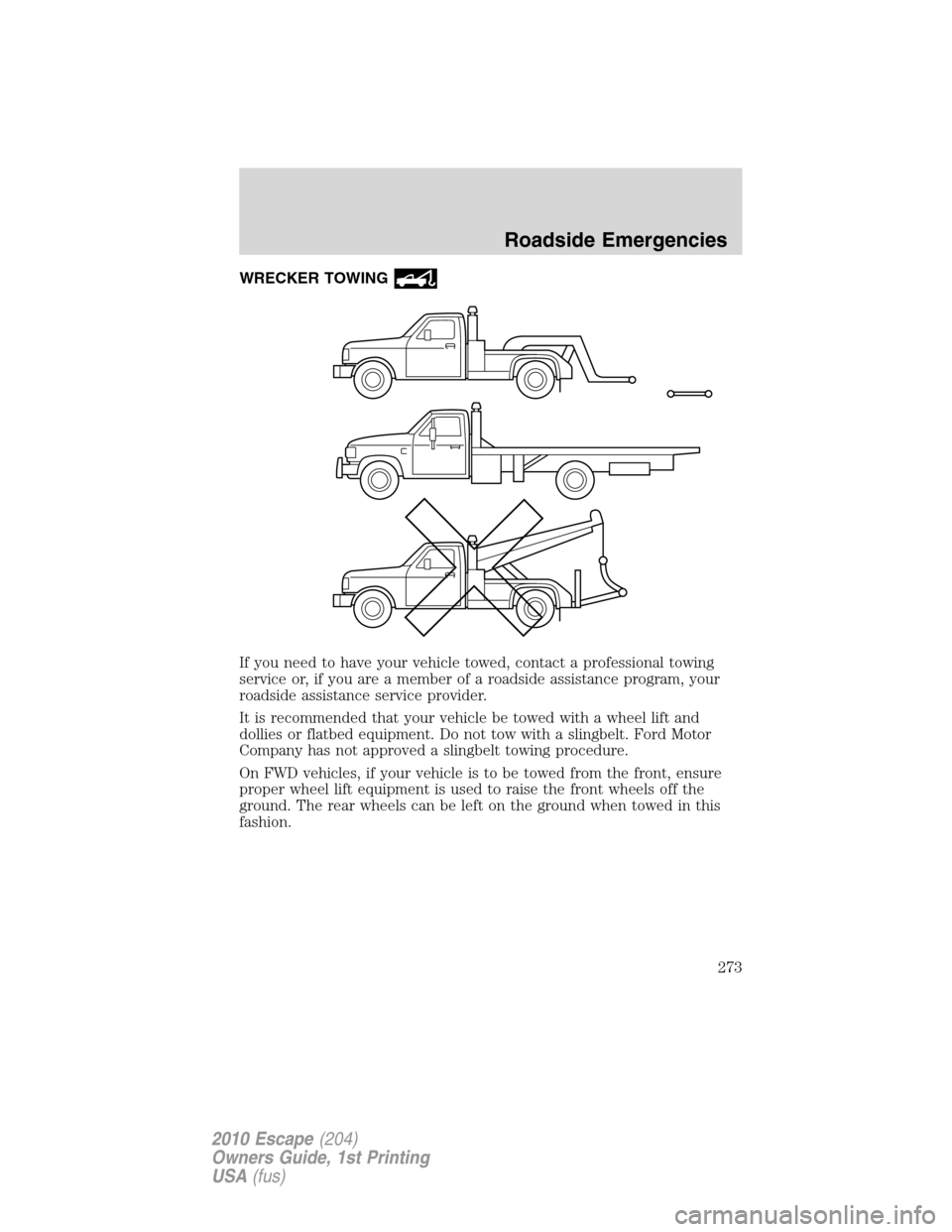
WRECKER TOWING
If you need to have your vehicle towed, contact a professional towing
service or, if you are a member of a roadside assistance program, your
roadside assistance service provider.
It is recommended that your vehicle be towed with a wheel lift and
dollies or flatbed equipment. Do not tow with a slingbelt. Ford Motor
Company has not approved a slingbelt towing procedure.
On FWD vehicles, if your vehicle is to be towed from the front, ensure
proper wheel lift equipment is used to raise the front wheels off the
ground. The rear wheels can be left on the ground when towed in this
fashion.
Roadside Emergencies
273
2010 Escape(204)
Owners Guide, 1st Printing
USA(fus)
Page 274 of 345

If your vehicle is to be towed from the rear using wheel lift equipment, it
isrequiredthat the front wheels (drive wheels) be placed on a dolly to
prevent damage to the transmission.
On 4WD vehicles, it isrequiredthat your vehicle be towed with a wheel
lift and dollies or flatbed equipment with all the wheels off the ground to
prevent damage to the automatic transmission, 4WD system or vehicle.
Ford Motor Company produces a towing manual for all authorized tow
truck operators. Have your tow truck operator refer to this manual for
proper hook-up and towing procedures for your vehicle.
If the vehicle is towed by other means or incorrectly, vehicle
damage may occur.
Emergency towing
In case of a roadside emergency with a disabled vehicle (without access
to wheel dollies, car hauling trailer, or flatbed transport vehicle) your
vehicle (regardless of transmission powertrain configuration) can be flat
towed (all wheels on the ground) under the following conditions:
•Vehicle is facing forward so that it is being towed in a forward
direction.
•Place the transmission in N (Neutral). Refer toBrake-shift interlock
in theDrivingchapter for specific instructions if you cannot move the
gear shift lever into N (Neutral).
•Maximum speed is not to exceed 35 mph (56 km/h).
•Maximum distance is 50 miles (80 km).
Roadside Emergencies
274
2010 Escape(204)
Owners Guide, 1st Printing
USA(fus)
Page 282 of 345

WASHING THE EXTERIOR
Wash your vehicle regularly with cool or lukewarm water and a neutral
pH shampoo, such as Motorcraft�Detail Wash (ZC-3-A), which is
available from your authorized dealer.
•Never use strong household detergents or soap, such as dish washing
or laundry liquid. These products can discolor and spot painted
surfaces.
•Never wash a vehicle that is “hot to the touch” or during exposure to
strong, direct sunlight.
•Always use a clean sponge or car wash mitt with plenty of water for
best results.
•Dry the vehicle with a chamois or soft terry cloth towel in order to
eliminate water spotting.
•It is especially important to wash the vehicle regularly during the
winter months, as dirt and road salt are difficult to remove and cause
damage to the vehicle.
•Immediately remove items such as gasoline, diesel fuel, bird droppings
and insect deposits because they can cause damage to the vehicle’s
paintwork and trim over time. Use Motorcraft�Bug and Tar Remover
(ZC-42) which is available from your authorized dealer.
•Remove any exterior accessories, such as antennas, before entering a
car wash.
•Suntan lotions and insect repellents can damage any painted
surface; if these substances come in contact with your vehicle,
wash off as soon as possible.
Exterior chrome
•Wash the vehicle first, using cool or lukewarm water and a neutral pH
shampoo, such as Motorcraft�Detail Wash (ZC-3-A).
•Use Motorcraft�Custom Bright Metal Cleaner (ZC-15), available from
your authorized dealer. Apply the product as you would a wax to
clean bumpers and other chrome parts; allow the cleaner to dry for a
few minutes, then wipe off the haze with a clean, dry rag.
•Never use abrasive materials such as steel wool or plastic pads
as they can scratch the chrome surface.
•After polishing chrome bumpers, apply a coating of Motorcraft�
Premium Liquid Wax (ZC-53-A), available from your authorized dealer,
or an equivalent quality product to help protect from environmental
effects.
Cleaning
282
2010 Escape(204)
Owners Guide, 1st Printing
USA(fus)
Page 295 of 345
CHANGING THE WIPER BLADES
1. Pull the wiper blade and arm
away from the glass.
2. Squeeze the locking tabs to
release the blade from the arm and
pull the blade away from the arm to
remove it.
3. Attach the new blade to the arm and snap it into place.
Replace wiper blades at least once per year for optimum performance.
Poor wiper quality can be improved by cleaning the wiper blades and the
windshield. Refer toWindows and wiper bladesin theCleaning
chapter.
To prolong the life of the wiper blades, it is highly recommended to
scrape off the ice on the windshield before turning on the wipers. The
layer of ice has many sharp edges and can damage the micro edge of the
wiper rubber element.
Maintenance and Specifications
295
2010 Escape(204)
Owners Guide, 1st Printing
USA(fus)
Page 314 of 345

•The service engine soonindicator may come on. For more
information on the service engine soon indicator, refer toWarning
lights and chimesin theInstrument Clusterchapter.
Refilling with a portable fuel container
With the Easy Fuel™ “no cap” fuel system, use the following directions
when filling from a portable fuel container:
WARNING:Do not insert the nozzle of portable fuel containers
or aftermarket funnels into the Easy Fuel™ system. This could
damage the fuel system and its seal, and may cause fuel to run onto
the ground instead of filling the tank, which could result in serious
personal injury.
WARNING:Do not try to pry open or push open the Easy
Fuel™ system with foreign objects. This could damage the fuel
system and its seal and cause injury to you or others.
When filling the vehicle’s fuel tank from a portable fuel container, use the
funnel included with the vehicle.
1. Locate the white plastic funnel. It
is attached to the inside of the rear
passenger side cargo compartment
access door.
Maintenance and Specifications
314
2010 Escape(204)
Owners Guide, 1st Printing
USA(fus)