2010 FIAT PUNTO EVO light switch
[x] Cancel search: light switchPage 174 of 270

173
KNOWING
YOUR
VEHICLE
SAFETY
STARTING
AND DRIVING
WARNING LIGHTS
AND MESSAGES
IN AN
EMERGENCY
SERVICING
AND CARE
TECHNICAL
SPECIFICATIONS
CONTENTS
RIGHT-HAND DIRECTION
INDICATOR (green – intermittent)
The light (arrow) comes on when the direction
indicator control lever is moved upwards or, to-
gether with the left-hand arrow, when the hazard warn-
ing light button is pressed.
D
DUALDRIVE ELECTRIC POWER
STEERING ON (green)
(for versions/markets where provided)
The word “CITY” appears on the display when the
Dualdrive electric power steering system is activated by
pressing the relevant control button. If the button is
pressed again the word CITY goes out. A specific message
is displayed on certain versions.
CITY
CRUISE CONTROL (green)
(for versions/markets where provided)
When the ignition key is moved to MAR posi-
tion, the warnintg light turns on but should go off
after a few seconds.
The warning light is lit up on the display by rotating the
Cruise Control twist switch to ON. A specific message
is displayed on certain versions.
Ü
Strong radio-frequency noises could hin-
der the regular operation of the TPMS
system. This condition will be indicated by a mes-
sage (where provided). The message will disap-
pear automatically as soon as the interference
ceases to disturb the system.
WARNING
FOG LIGHTS (green)
The light comes on when the front fog lights are
turned on.
5
LEFT-HAND DIRECTION
INDICATOR (green – intermittent)
The light (arrow) comes on when the direction
indicator control lever is moved downwards or,
together with the right-hand arrow, when the hazard
warning light button is pressed.
F
161-174 PUNTO FL EN 4ed 18-01-2010 12:27 Pagina 173
Page 184 of 270
Replace the cylinder containing out-of-
date sealant fluid. Dispose of the cylinder
and the sealant liquid properly. Dispose ac-
cording to the national and local laws in force.
F0U0142mfig. 159F0U0141mfig. 158
INFLATION PROCEDURE
Put on the protective gloves provided
with the quick tyre repair kit.
WARNING
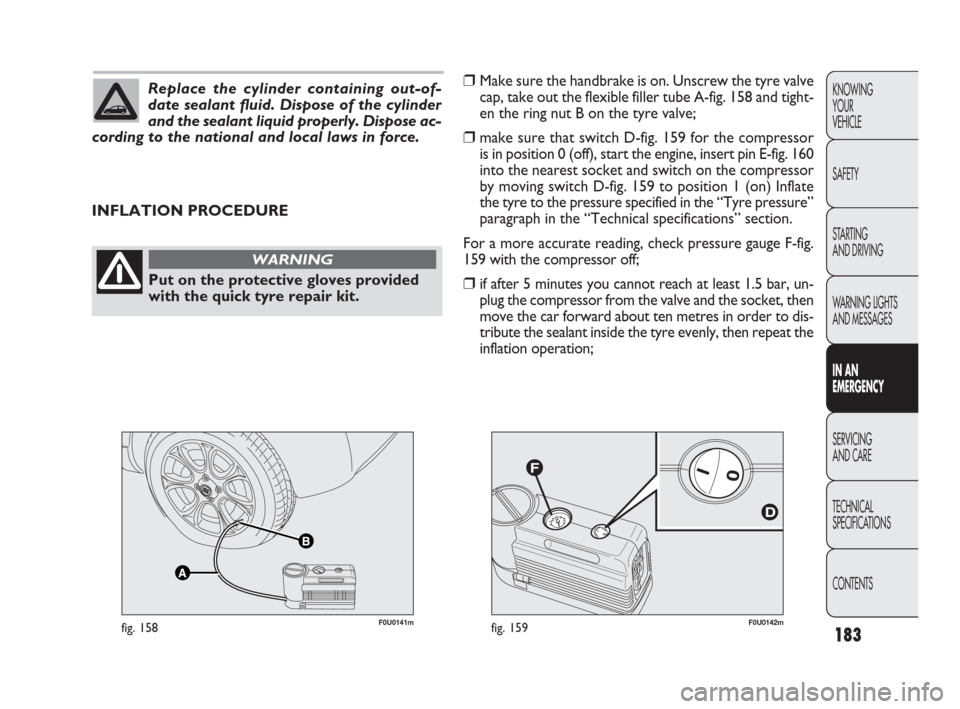
❒Make sure the handbrake is on. Unscrew the tyre valve
cap, take out the flexible filler tube A-fig. 158 and tight-
en the ring nut B on the tyre valve;
❒make sure that switch D-fig. 159 for the compressor
is in position 0 (off), start the engine, insert pin E-fig. 160
into the nearest socket and switch on the compressor
by moving switch D-fig. 159 to position 1 (on) Inflate
the tyre to the pressure specified in the “Tyre pressure”
paragraph in the “Technical specifications” section.
For a more accurate reading, check pressure gauge F-fig.
159 with the compressor off;
❒if after 5 minutes you cannot reach at least 1.5 bar, un-
plug the compressor from the valve and the socket, then
move the car forward about ten metres in order to dis-
tribute the sealant inside the tyre evenly, then repeat the
inflation operation;
183
KNOWING
YOUR
VEHICLE
SAFETY
STARTING
AND DRIVING
WARNING LIGHTS
AND MESSAGES
IN AN
EMERGENCY
SERVICING
AND CARE
TECHNICAL
SPECIFICATIONS
CONTENTS
175-210 PUNTO FL EN 4ed 20-01-2010 15:09 Pagina 183
Page 187 of 270

CHANGING A BULB
GENERAL INSTRUCTIONS
❒When a light is not working, check that the corre-
sponding fuse is intact before changing the bulb. For the
location of fuses, refer to the “Changing a fuse” para-
graph in this section;
❒before changing a bulb check the contacts for rusting;
❒burnt bulbs must be replaced by others of the same type
and wattage;
❒for safety reasons, always check the direction of the
headlight beam after changing a bulb.
186
KNOWING
YOUR
VEHICLE
SAFETY
STARTING
AND DRIVING
WARNING LIGHTS
AND MESSAGES
IN AN
EMERGENCY
SERVICING
AND CARE
TECHNICAL
SPECIFICATIONS
CONTENTS
Halogen lamps must be handled holding
the metallic part only. Touching the trans-
parent part of the bulb with your fingers
may reduce the intensity of the light emitted and
even compromise the longevity of the bulb itself. In
the event of accidental contact, wipe the bulb with
an alcohol-soaked cloth and allow to dry.
Changes or repairs to the electrical system
(electronic control units) carried out in-
correctly and without due consideration for the
technical specifications of the system can lead to
malfunctioning and generate a fire hazard.
WARNING
Halogen lamps contain gas under pres-
sure. If they break, glass fragments could
fly everywhere.
WARNING
IMPORTANT The internal surface of the light may appear
slightly misty: this does not indicate a fault, and is actually
caused by low temperature and the degree of humidity
in the air. Misting will rapidly disappear when the head-
lights are switched on. The presence of drops inside the
headlights indicates infiltration of water. Go to a Fiat Deal-
ership.
TYPES OF BULBS
Various types of bulbs are fitted to your vehicle.
A Glass bulbs: pushed into position. Pull to extract.
B Bayonet-type bulbs: to remove from its holder, press
the bulb in and turn it anti-clockwise.
175-210 PUNTO FL EN 4ed 20-01-2010 15:09 Pagina 186
Page 200 of 270

199
KNOWING
YOUR
VEHICLE
SAFETY
STARTING
AND DRIVING
WARNING LIGHTS
AND MESSAGES
IN AN
EMERGENCY
SERVICING
AND CARE
TECHNICAL
SPECIFICATIONS
CONTENTS
Never replace a blown fuse with metal
wires or other materials.
Should the fuse blow again, contact a Fi-
at Dealership.
WARNING
Never replace a fuse with one that has
a higher amperage: FIRE HAZARD.
WARNING
If a general protection fuse (MEGA-FUSE,
MIDI-FUSE, MAXI-FUSE) is activated,
contact a Fiat Dealership.
WARNING
Remove the key from the ignition and
switch off or disable all devices before re-
placing a fuse.
WARNING
If a general protection fuse for safety sys-
tems (air bag system, braking system),
power unit systems (engine system, transmission
system) or steering system is triggered, contact a
Fiat Dealership.
WARNING
175-210 PUNTO FL EN 4ed 20-01-2010 15:09 Pagina 199
Page 204 of 270
203
KNOWING
YOUR
VEHICLE
SAFETY
STARTING
AND DRIVING
WARNING LIGHTS
AND MESSAGES
IN AN
EMERGENCY
SERVICING
AND CARE
TECHNICAL
SPECIFICATIONS
CONTENTS
7.5
7.5
5
5
10
5
20
20
20
20
5
5
7.5 1
8
13
2
5
11
4
6
14
7
12
3
10
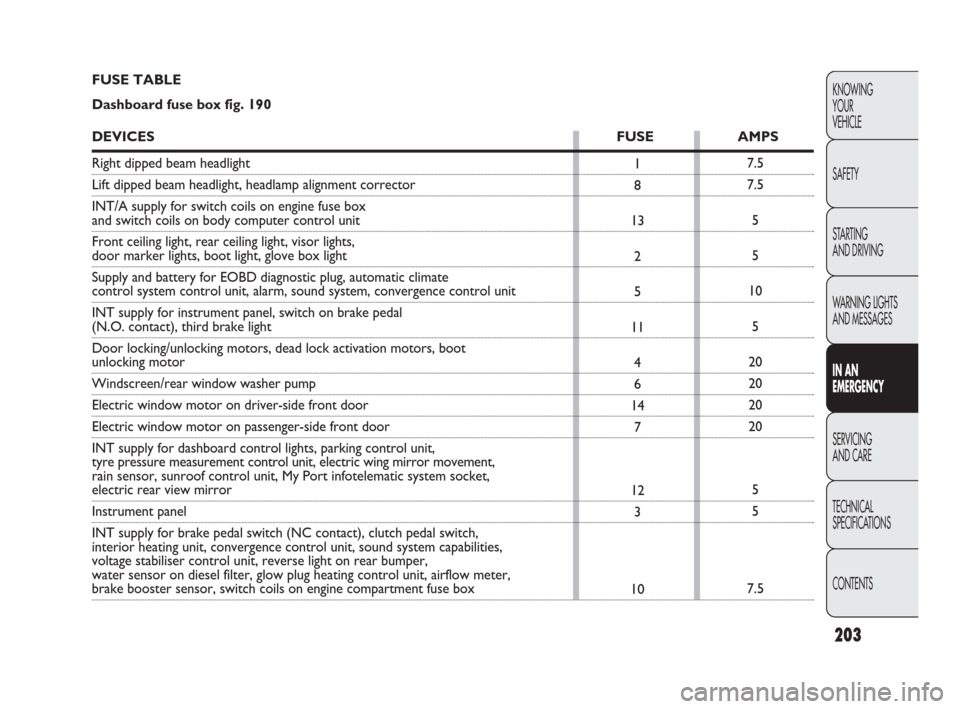
FUSE TABLE
Dashboard fuse box fig. 190
DEVICESFUSE AMPS
Right dipped beam headlight
Lift dipped beam headlight, headlamp alignment corrector
INT/A supply for switch coils on engine fuse box
and switch coils on body computer control unit
Front ceiling light, rear ceiling light, visor lights,
door marker lights, boot light, glove box light
Supply and battery for EOBD diagnostic plug, automatic climate
control system control unit, alarm, sound system, convergence control unit
INT supply for instrument panel, switch on brake pedal
(N.O. contact), third brake light
Door locking/unlocking motors, dead lock activation motors, boot
unlocking motor
Windscreen/rear window washer pump
Electric window motor on driver-side front door
Electric window motor on passenger-side front door
INT supply for dashboard control lights, parking control unit,
tyre pressure measurement control unit, electric wing mirror movement,
rain sensor, sunroof control unit, My Port infotelematic system socket,
electric rear view mirror
Instrument panel
INT supply for brake pedal switch (NC contact), clutch pedal switch,
interior heating unit, convergence control unit, sound system capabilities,
voltage stabiliser control unit, reverse light on rear bumper,
water sensor on diesel filter, glow plug heating control unit, airflow meter,
brake booster sensor, switch coils on engine compartment fuse box
175-210 PUNTO FL EN 4ed 20-01-2010 15:09 Pagina 203
Page 207 of 270

206
KNOWING
YOUR
VEHICLE
SAFETY
STARTING
AND DRIVING
WARNING LIGHTS
AND MESSAGES
IN AN
EMERGENCY
SERVICING
AND CARE
TECHNICAL
SPECIFICATIONS
CONTENTS
RECHARGING THE BATTERY
IMPORTANT The battery recharging procedure is pro-
vided for information purposes only. You are recom-
mended to go to a Fiat Dealership to have this operation
performed.
We recommend recharging the battery slowly for ap-
proximately 24 hours at low amperage. Rapid charging with
high currents could damage the battery.
VERSIONS WITHOUT Start&Stop SYSTEM
(for versions/markets, where provided)
Charge the battery as follows:
❒disconnect the battery negative terminal;
❒connect the charger leads to the battery terminals, ob-
serving the polarity;
❒turn on the charger;
❒when you have finished, turn the charger off before dis-
connecting the battery;
❒reconnect battery negative terminal.
VERSIONS WITH Start&Stop SYSTEM
(with dummy pole) fig. 195a
(for versions/markets, where provided)
To charge, proceed as follows:
❒disconnect the quick-release negative terminal A from
the negative dummy pole B because the battery nega-
tive pole C has a sensor D monitoring the battery con-
ditions, that should never be disconnected from the neg-
ative pole C (unless the battery is replaced);
❒connect the battery charger positive cable to the bat-
tery positive pole E and the negative cable to the dum-
my pole B;
❒switch on the battery charger. At the end of the charging
process, switch the charger off before disconnecting it;
❒after disconnecting the battery charger, reconnect the
quick-release negative terminal A to the dummy pole B.
fig. 195aF0U0547m
175-210 PUNTO FL EN 4ed 20-01-2010 15:10 Pagina 206
Page 208 of 270

207
❒turn on the battery charger. At the end of the charg-
ing process, switch the battery charger off;
❒after disconnecting the battery charger, reconnect the
connector A to the sensor C according to figure. VERSIONS WITH Start&Stop SYSTEM
(without dummy pole) fig.195b
(for versions/markets, where provided)
To charge, proceed as follows:
❒disconnect the connector A (pressing the button B)
from the sensor C monitoring the battery conditions,
on the negative pole D of the battery;
❒connect the battery charger positive cable E and the
negative cable to the terminal of sensor D, according to
figure;
KNOWING
YOUR
VEHICLE
SAFETY
STARTING
AND DRIVING
WARNING LIGHTS
AND MESSAGES
IN AN
EMERGENCY
SERVICING
AND CARE
TECHNICAL
SPECIFICATIONS
CONTENTS
fig. 195bF0U0548m
175-210 PUNTO FL EN 4ed 20-01-2010 15:10 Pagina 207
Page 211 of 270

210
KNOWING
YOUR
VEHICLE
SAFETY
STARTING
AND DRIVING
WARNING LIGHTS
AND MESSAGES
IN AN
EMERGENCY
SERVICING
AND CARE
TECHNICAL
SPECIFICATIONS
CONTENTS
The brake booster and power steering will
not work while the vehicle is being towed.
You will therefore need to apply more force to the
brake pedal and steering wheel. Do not use bendy
cables for towing and avoid jerking. Make sure not
to damage parts in contact with the car while tow-
ing. When towing the vehicle, be sure to respect
the specific rules of the highway code specifical-
ly in relation to the towing device and the be-
haviour to maintain on the road.
WARNING
Clean the threaded housing throughly be-
fore fastening the tow ring. Make sure that
the ring is securely fastened before towing the car.
WARNING
During towing, do not start up the engine.
WARNING
Before towing, switch off the steering lock
(see “Ignition” in the “Dashboard and con-
trols” section). The brake booster and power
steering will not work while the vehicle is being
towed. You will therefore need to apply more
force to the brake pedal and steering wheel. Do
not use bendy cables for towing and avoid jerking.
Make sure not to damage parts in contact with
the car while towing. Respect the rules of the high-
way code when towing the car, specifically in re-
lation to the towing device and road conduct.
WARNING
The front and rear tow hooks should be
used only for emergency operations on the
road. You are allowed to tow the car for short dis-
tances using an appropriate device in accordance
with the highway code (a rigid bar), to move the
vehicle on the road in readiness for towing or
transporting via a breakdown vehicle. Tow hooks
MUST NOT be used to tow vehicles off the road
or where there are obstacles and/or for towing op-
erations using cables or other non-rigid devices.
Respecting the above conditions, towing must
take place with the two vehicles (one towing, the
other towed) aligned as much as possible along
the same centre line.
WARNING
175-210 PUNTO FL EN 4ed 20-01-2010 15:10 Pagina 210