2010 FIAT PUNTO EVO Pressure
[x] Cancel search: PressurePage 118 of 270
117
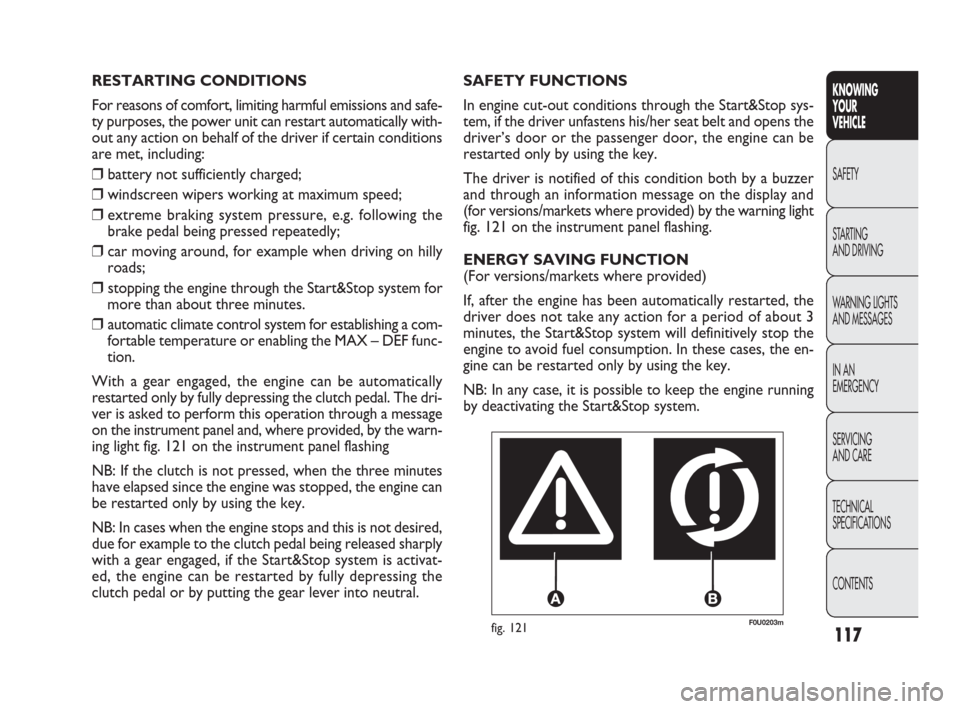
F0U0203mfig. 121
SAFETY FUNCTIONS
In engine cut-out conditions through the Start&Stop sys-
tem, if the driver unfastens his/her seat belt and opens the
driver’s door or the passenger door, the engine can be
restarted only by using the key.
The driver is notified of this condition both by a buzzer
and through an information message on the display and
(for versions/markets where provided) by the warning light
fig. 121 on the instrument panel flashing.
ENERGY SAVING FUNCTION
(For versions/markets where provided)
If, after the engine has been automatically restarted, the
driver does not take any action for a period of about 3
minutes, the Start&Stop system will definitively stop the
engine to avoid fuel consumption. In these cases, the en-
gine can be restarted only by using the key.
NB: In any case, it is possible to keep the engine running
by deactivating the Start&Stop system. RESTARTING CONDITIONS
For reasons of comfort, limiting harmful emissions and safe-
ty purposes, the power unit can restart automatically with-
out any action on behalf of the driver if certain conditions
are met, including:
❒ battery not sufficiently charged;
❒ windscreen wipers working at maximum speed;
❒extreme braking system pressure, e.g. following the
brake pedal being pressed repeatedly;
❒ car moving around, for example when driving on hilly
roads;
❒stopping the engine through the Start&Stop system for
more than about three minutes.
❒automatic climate control system for establishing a com-
fortable temperature or enabling the MAX – DEF func-
tion.
With a gear engaged, the engine can be automatically
restarted only by fully depressing the clutch pedal. The dri-
ver is asked to perform this operation through a message
on the instrument panel and, where provided, by the warn-
ing light fig. 121 on the instrument panel flashing
NB: If the clutch is not pressed, when the three minutes
have elapsed since the engine was stopped, the engine can
be restarted only by using the key.
NB: In cases when the engine stops and this is not desired,
due for example to the clutch pedal being released sharply
with a gear engaged, if the Start&Stop system is activat-
ed, the engine can be restarted by fully depressing the
clutch pedal or by putting the gear lever into neutral.KNOWING
YOUR
VEHICLE
SAFETY
STARTING
AND DRIVING
WARNING LIGHTS
AND MESSAGES
IN AN
EMERGENCY
SERVICING
AND CARE
TECHNICAL
SPECIFICATIONS
CONTENTS
082-128 PUNTO FL EN 4ed 20-01-2010 15:06 Pagina 117
Page 127 of 270
126
KNOWING
YOUR
VEHICLE
SAFETY
STARTING
AND DRIVING
WARNING LIGHTS
AND MESSAGES
IN AN
EMERGENCY
SERVICING
AND CARE
TECHNICAL
SPECIFICATIONS
CONTENTS
REFUELLING THE CAR
PETROL ENGINES
Use only unleaded petrol.
To avoid mistakes, the diameter of the fuel tank opening is
too small to insert the nozzle of a leaded petrol pump. The
petrol octane rating (RON) must not be lower than 95.
IMPORTANT An inefficient catalytic converter leads to
harmful exhaust emissions, thus contributing to air pol-
lution.
IMPORTANT Never use leaded petrol, even in small
amounts or in an emergency, as this would damage the
catalytic converter beyond repair.
DIESEL ENGINES
If the outside temperature is very low, the diesel thick-
ens due to the formation of paraffin clots and could clog
the diesel filter. In order to avoid these problems, differ-
ent types of diesel are distributed according to the season:
summer type, winter type and arctic type (cold, moun-
tainous areas).
If refuelling with diesel fuel whose specifications are not
suitable for the usage temperature, it is advisable to mix
TUTELA DIESEL ART additive in the proportions shown
on the container with the fuel. Pour the additive into the
tank before the fuel.When using or parking the vehicle for a long time in the
mountains or cold areas, it is advisable to refuel using lo-
cally available diesel.
In this case, it is also advisable to keep the tank over
50% full.
For diesel engines, use only diesel fuel for
motor vehicles in accordance with EN590
European specifications. The use of other
products or mixtures may damage the engine be-
yond repair and consequently invalidate the war-
ranty, depending on the damage caused. If you ac-
cidentally introduce other types of fuel into the
tank, do not start the engine. Empty the tank. If the
engine has run, even for a very short time, you will
need to have the entire fuel system emptied in ad-
dition to the tank.
FUEL TANK CAP fig. 128
To carry out refuelling, open lid A and unscrew cap B;
the cap is fitted with a device C which fastens it to the lid
so it cannot be mislaid.
In some versions, cap B have a lock and key: open lid A,
insert the ignition key then turn it anti-clockwise and un-
screw the cap itself.
The hermetic seal may cause a slight increase in pressure
in the tank. A suction noise when you release the cap is
therefore entirely normal.
When refuelling, attach the cap to the device inside the
flap as shown in fig. 128.
082-128 PUNTO FL EN 4ed 20-01-2010 15:07 Pagina 126
Page 149 of 270

148
KNOWING
YOUR
VEHICLE
SAFETY
STARTING
AND DRIVING
WARNING LIGHTS
AND MESSAGES
IN AN
EMERGENCY
SERVICING
AND CARE
TECHNICAL
SPECIFICATIONS
CONTENTS
If the key is turned to MAR, even if the en-
gine is switched off, airbags may be de-
ployed when the car is stationary and hit by an-
other vehicle. For this reason, young children must
never sit on the front seat, even if the car is not
moving. We remind you that if the key is turned
to the STOP position, no safety device (airbag or
pretensioner) activates following a collision. Non-
deployment in such cases should not be consid-
ered as the sign of a malfunction.
WARNING
If the car has been stolen or has been the
subject of an attempted theft, if it has
been vandalised or flooded, have the airbag sys-
tem checked at a Fiar Dealership.
WARNING
When the ignition key is turned to MAR,
the warning light “turns on (with front
airbag on passenger’s side enabled) and blinks for
a few seconds to remind you that the passenger
airbag will activate in the event of a collision. Then
it turns off.
WARNING
Do not pressure wash the seats with steam
or water (either by hand or at automatic
seat washing stations).
WARNING
The front airbags deploy in the event of
more severe collisions than those required
for deploying the pretensioners. For collisions in
the range between the two activation thresholds,
pretensioner activation alone is normal.
WARNING
Do not hook rigid objects to clothes hang-
ers and support handles.
WARNING
The airbag does not replace seat belts; it
increases their effectiveness. Furthermore,
since front airbags are not deployed in low speed
collisions, side-on collisions, rear-end shunts or
roll-overs, the passengers are protected only by
the seat belts which must therefore be fastened
at all times.
WARNING
129-148 PUNTO FL EN 4ed 18-01-2010 12:26 Pagina 148
Page 154 of 270

153
KNOWING
YOUR
VEHICLE
SAFETY
STARTING
AND DRIVING
WARNING LIGHTS
AND MESSAGES
IN AN
EMERGENCY
SERVICING
AND CARE
TECHNICAL
SPECIFICATIONS
CONTENTS
F0U0130mfig. 148
USING THE MANUAL GEARBOX
To engage the gears, depress the clutch pedal fully and shift
the gear lever into the required positions (the diagram is
shown on the gear knob fig. 148).
To engage 6
thgear (for versions/markets where provided),
push firmly to the right when operating the lever in or-
der to avoid selecting 4
thgear by mistake. The same ap-
plies to the shift from 6thto 5thgear.
IMPORTANT Reverse may be engaged only when the car
is at a standstill. With the engine running, wait for at least
2 seconds with the clutch pedal fully depressed before en-
gaging reverse to prevent damage to the gears and grating.
To engage reverse R from neutral with a six-speed gearbox,
proceed as follows: lift ring A under the knob and at the
same time move the gear lever to the left and then forwards
fig. 148
Depress the clutch pedal fully to change
gear correctly. Therefore, the floor area
under the pedals should be clear: ensure that any
rubber mats are flat and do not interfere with the
pedals.
WARNING
Do not drive with your hand resting on the
gear lever, because this pressure, even if
light, can wear out the inner components
of the gearbox over time.
IMPORTANT The clutch pedal should be used only for
changing gear. Do not drive with your foot resting on the
clutch pedal, however slightly. For versions/markets where
provided, the electronic clutch control can intervene if it
interprets the incorrect driving style as a fault.
149-160 PUNTO FL EN 4ed 20-01-2010 14:37 Pagina 153
Page 155 of 270

154
KNOWING
YOUR
VEHICLE
SAFETY
STARTING
AND DRIVING
WARNING LIGHTS
AND MESSAGES
IN AN
EMERGENCY
SERVICING
AND CARE
TECHNICAL
SPECIFICATIONS
CONTENTS
SAVING FUEL
Here are some suggestions which may help you to save fu-
el and reduce the amount of toxic emissions released in-
to the atmosphere.
GENERAL CONSIDERATIONS
Car maintenance
Have checks and adjustments carried out in accordance
with the “Scheduled Servicing Plan”.
Tyres
Check the tyre pressures at least once every 4 weeks: if
the pressure is too low, consumption levels increase as re-
sistance to rolling is higher.
Unnecessary loads
Do not travel with an overloaded boot. The weight of
the car (especially when driving in town) and its arrange-
ment greatly affect fuel consumption and stability.
Roof rack/ski rack
Remove the roof rack or ski rack from the roof after use.
These accessories decrease aerodynamic penetration and
have a negative effect on fuel consumption. It is better to
use a trailer to transport particularly bulky objects.Electrical devices
Use electrical devices only for the amount of time need-
ed. The heated rear window, auxiliary headlights, wind-
screen wipers and fan heater use up a considerable amount
of current, causing increased fuel consumption (up to
+25% in the urban cycle).
Air conditioning
Air conditioning leads to higher fuel consumption (on av-
erage up to +20%). If the temperature outside is not too
extreme, try and use the air vents.
Spoilers
The use of non-certified spoilers may adversely affect aero-
dynamics and fuel consumption.
DRIVING STYLE
Starting
Do not warm up the engine at low or high revs when the
vehicle is stationary; this causes the engine to warm up more
slowly, thereby increasing fuel consumption and emissions.
It is advisable to set off immediately and slowly, avoiding high
revs: this allows the engine to warm up more quickly.
Unnecessary actions
Avoid revving up when stationary at traffic lights or before
stopping the engine. The latter action, like double de-
clutching, is entirely unnecessary and causes increased fu-
el consumption and pollution.
149-160 PUNTO FL EN 4ed 20-01-2010 14:37 Pagina 154
Page 160 of 270

159
KNOWING
YOUR
VEHICLE
SAFETY
STARTING
AND DRIVING
WARNING LIGHTS
AND MESSAGES
IN AN
EMERGENCY
SERVICING
AND CARE
TECHNICAL
SPECIFICATIONS
CONTENTS
SNOW TYRES
Use snow tyres of the same size as the normal tyres pro-
vided with the car.
A Fiat Dealership will be happy to provide advice con-
cerning the most suitable type of tyre for the customer’s
requirements.
For the type, pressures and specifications of the snow tyre
to be used, follow carefully the instructions given in the
“Wheels” paragraph of the “Technical specifications” sec-
tion.
The performance of these tyres is considerably reduced
when the tread depth is less than 4 mm. If this is the case,
replace them.
Due to their specific features, the performance of snow
tyres is much lower than that of standard tyres in normal
conditions or on long motorway stretches. You should
therefore use them only in the conditions for which they
were designed.
IMPORTANT When using snow tyres with a maximum
speed index below the one that can be reached by the
car (increased by 5%), place a notice in the passenger com-
partment, plainly in view, which states the maximum speed
allowed by the snow tyres (as per EC Directive).
All four tyres should be the same (brand and profile) to
ensure greater safety when driving and braking as well as
making the car more responsive.
Remember that you should not change the rotation di-
rection of the tyres.
SNOW CHAINS
The use of snow chains should be in compliance with lo-
cal regulations. Snow chains may be fitted only to the front
wheel tyres (drive wheels). Use of Lineaccessori Fiat snow
chains is recommended. Check the tension of the chains
after the first few metres have been driven.
IMPORTANT When the snow chains are on, use the ac-
celerator with extreme care to prevent, or to limit as much
as possible, the driving wheels from skidding. This could
cause the chains to break, resulting in damage to the ve-
hicle body or mechanical components.
IMPORTANT Snow chains can only be fitted on 15”
tyres. Use compact 9-mm snow chains.
The maximum speed for snow tyres
marked “Q” is 160 km/h, while it is 190
km/h for “T” tyres and 210 km/h for “H” tyres.
You should, however, always stick to the speed
limits of the highway code.
WARNING
149-160 PUNTO FL EN 4ed 20-01-2010 14:37 Pagina 159
Page 161 of 270

❒clean and protect the painted parts using protective
wax;
❒clean and protect the shiny metal parts using special
compounds readily available;
❒sprinkle talcum powder on the rubber windscreen
and rear window wiper blades and lift them off the
glass;
❒open the windows slightly;
❒cover the car with a fabric or perforated plastic sheet.
Do not use compact plastic sheets which do not allow
humidity to evaporate from the surface of the car;
❒inflate tyres to a pressure of +0.5 bar above the nor-
mal specified pressure and check regularly;
❒if you don’t disconnect the battery from the electrical
system, check its charge every month and recharge it
if the indicator shows a dark colour without the cen-
tral green area;
❒do not drain the engine cooling system.
IMPORTANT Where relevant, switch off the car alarm
with the remote control.
CAR INACTIVITY
If the car is to be left inactive for longer than a month,
the following precautions should be observed:
❒park the car in covered, dry and, if possible, well-ven-
tilated premises;
❒engage a gear;
❒check that the handbrake is engaged;
❒disconnect the clip for the negative battery terminal
and check battery charge. Repeat this check once
every three months during storage. Recharge the
battery if the indicator is dark and the middle area is
not green;
160
KNOWING
YOUR
VEHICLE
SAFETY
STARTING
AND DRIVING
WARNING LIGHTS
AND MESSAGES
IN AN
EMERGENCY
SERVICING
AND CARE
TECHNICAL
SPECIFICATIONS
CONTENTS
16” and 17” tyres cannot be fitted with
chains.
WARNING
Keep your speed down when snow chains
are fitted: do not exceed 50 km/h. Avoid
potholes, steps and pavements, and do
not drive for long distances on roads not
covered with snow to prevent damaging
the car and the road surface.
WARNING
149-160 PUNTO FL EN 4ed 20-01-2010 14:37 Pagina 160
Page 164 of 270

163
Degraded engine oil
(only Multijet versions with DPF)
The warning light will flash and a specific message will ap-
pear on the display (for versions/markets where provid-
ed). The warning light may flash in the following ways, de-
pending on the version:
– for 1 minute every two hours;
– for 3 minute cycles with the warning light off for inter-
vals of 5 seconds until oil is changed.
After the initial warning, each time the engine is started
up, the warning light will continue to flash in the same ways
as described above, until the oil is changed. A specific mes-
sage will appear on the display (for versions/markets where
provided) in addition to the warning light.
If the warning light flashes, this does not mean that the car
is defective, but simply informs the driver that it is now
necessary to change the oil as a result of regular vehicle
use.
KNOWING
YOUR
VEHICLE
SAFETY
STARTING
AND DRIVING
WARNING LIGHTS
AND MESSAGES
IN AN
EMERGENCY
SERVICING
AND CARE
TECHNICAL
SPECIFICATIONS
CONTENTS
LOW BATTERY CHARGE (red)
(for versions/markets where provided)
The warning light comes on when the ignition
key is turned to MAR, but it should go out as soon
as the engine has started (with the engine running at idle
speed a brief delay before going out is acceptable). Con-
tact a Fiat Dealership immediately if the warning light stays
on, either permanently or flashing.
A specific message is displayed on certain versions.
w
LOW ENGINE OIL PRESSURE (red)
DEGRADED OIL (red)
(for versions/markets where provided)
When the ignition key is turned to MAR, the warn-
ing light switches on, but it should go out as soon as the
engine is started.
v
If the warning light vturns on when the
car is travelling (on certain versions to-
gether with the message on the display), stop the
car immediately and contact a Fiat Dealership.
WARNING
PARKING SENSOR FAILURE (amber)
(for versions/markets where provided)
The warning light turns on when a fault is de-
tected in the parking sensors.
On certain versions warning light èturns on as an alter-
native.
In this case, contact a Fiat Dealership.
A specific message is displayed on certain versions.
t
Low engine oil pressure
The warning light turns on and stays on constantly along
with a message on the display (for versions/markets where
provided) when the system detects that engine oil pres-
sure is low.
161-174 PUNTO FL EN 4ed 18-01-2010 12:27 Pagina 163