2010 FIAT IDEA roof
[x] Cancel search: roofPage 86 of 210

85
SAFETY
STARTING
AND DRIVING
WARNING
LIGHTS AND
MESSAGES
IN AN
EMERGENCY
MAINTENANCE
AND CARE
TECHNICAL
SPECIFICATIONS
ALPHABETICAL
INDEX
DASHBOARD
AND CONTROLS
SOUND SYSTEM
(where provided)
Refer to the supplement to this Owner’s
Handbook for operating the sound system
with CD or with CD MP3.
SOUND SYSTEM SETUP
(where provided)
The system consists of:
❒sound system power wires
❒front and rear speaker power wires
❒aerial power wire
❒2 tweeters on front pillars (30W max
power each);
❒2 mid-woofers on front doors (165
mm diameter, 40W max power each);
❒2 full-range speaker on front doors
(165 mm diameter, 40W max power
each).
Sound system installation
The sound system must be installed in the
space occupied by the central oddment
compartment fig. 125where the wiring
leads.
To extract the compartment, press in the
points shown at the retainer systems.It is advisable to have the sound system
and interference filter installed by a Fi-
at Dealership.
MOBILE PHONE SETUP
(where provided)
The mobile phone setup with
CD or CD MP3 sound system consists of:
fig. 125F0H0120m
❒a dual function aerial (sound system +
phone phone 900/1800 MHz) located
on the roof;
❒connection cables to the dual function
sound system and wiring with 10 pin
connector.The hands-free kit must be
purchased by the customer
because it must be compati-
ble with the customer’s mo-
bile phone. It is advisable to install the
microphone near the front ceiling light.
The maximum applicable
power to the aerial is 20W.
WARNING
For installing the mobile
phone and connecting to
system setup in the car, contact Fiat
Dealership to prevent any trouble
that could impair car safety.
WARNING
The connector is located between the
steering column and the central unit.
036-092 LUM IDEA GB 2 ed.qxd 14-01-2010 12:15 Pagina 85
Page 87 of 210
86
SAFETY
STARTING
AND DRIVING
WARNING
LIGHTS AND
MESSAGES
IN AN
EMERGENCY
MAINTENANCE
AND CARE
TECHNICAL
SPECIFICATIONS
ALPHABETICAL
INDEX
DASHBOARD
AND CONTROLS
ACCESSORIES
PURCHASED BY THE
OWNER
If after buying the car, you decide to install
electrical accessories that require a per-
manent electric supply (alarm, satellite an-
titheft system, etc.) or accessories that in
any case burden the electric supply, con-
tact Fiat Dealership, whose qualified per-
sonnel, besides suggesting the most suit-
able devices belonging to Lineaccessori Fi-
at, will also evaluate the overall electric
consumption, checking whether the car’s
electric system is able to withstand the
load required, or whether it needs to be
integrated with a more powerful battery.
INSTALLING
ELECTRICAL/ELECTRONIC
DEVICES
Electrical and electronic devices installed
after buying the car by after-market ser-
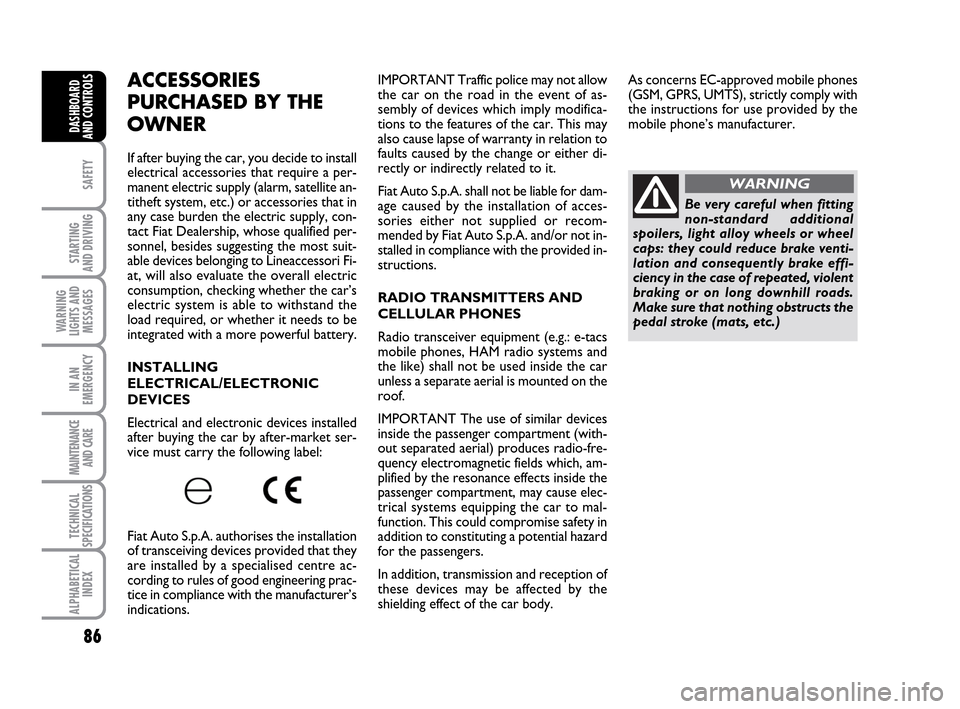
vice must carry the following label:
Fiat Auto S.p.A. authorises the installation
of transceiving devices provided that they
are installed by a specialised centre ac-
cording to rules of good engineering prac-
tice in compliance with the manufacturer’s
indications.IMPORTANT Traffic police may not allow
the car on the road in the event of as-
sembly of devices which imply modifica-
tions to the features of the car. This may
also cause lapse of warranty in relation to
faults caused by the change or either di-
rectly or indirectly related to it.
Fiat Auto S.p.A. shall not be liable for dam-
age caused by the installation of acces-
sories either not supplied or recom-
mended by Fiat Auto S.p.A. and/or not in-
stalled in compliance with the provided in-
structions.
RADIO TRANSMITTERS AND
CELLULAR PHONES
Radio transceiver equipment (e.g.: e-tacs
mobile phones, HAM radio systems and
the like) shall not be used inside the car
unless a separate aerial is mounted on the
roof.
IMPORTANT The use of similar devices
inside the passenger compartment (with-
out separated aerial) produces radio-fre-
quency electromagnetic fields which, am-
plified by the resonance effects inside the
passenger compartment, may cause elec-
trical systems equipping the car to mal-
function. This could compromise safety in
addition to constituting a potential hazard
for the passengers.
In addition, transmission and reception of
these devices may be affected by the
shielding effect of the car body.As concerns EC-approved mobile phones
(GSM, GPRS, UMTS), strictly comply with
the instructions for use provided by the
mobile phone’s manufacturer.
Be very careful when fitting
non-standard additional
spoilers, light alloy wheels or wheel
caps: they could reduce brake venti-
lation and consequently brake effi-
ciency in the case of repeated, violent
braking or on long downhill roads.
Make sure that nothing obstructs the
pedal stroke (mats, etc.)
WARNING
036-092 LUM IDEA GB 2 ed.qxd 14-01-2010 12:15 Pagina 86
Page 108 of 210

107
STARTING
AND DRIVING
WARNING
LIGHTS AND
MESSAGES
IN AN
EMERGENCY
MAINTENANCE
AND CARE
TECHNICAL
SPECIFICATIONS
ALPHABETICAL
INDEX
DASHBOARD
AND
CONTROLS
SAFETY
fig. 18F0H0145m
PASSENGER’S FRONT AIR BAG
fig. 18
It consists of an instant-inflating cushion
contained into a special recess Ain the
dashboard, this cushion has a volume big-
ger than that of the driver.
The airbags are not deployed in the event
of collisions of low severity (for which the
withholding action of the seat belts is suf-
ficient). For this reason, the seat belt must
be worn at all times. During side collisions
the seat belts hold passengers in the cor-
rect position and prevent ejection from
the vehicle during very violent collisions.
Do not apply stickers or oth-
er objects on the steering
wheel in zone A-fig. 18, passenger side
airbag cover or side upholstery on
roof. Do not place objects on the pas-
senger side dashboard because these
could interfere with the correct open-
ing of the airbag (e.g. mobile phones)
and cause severe injury to occupants.
WARNING
Do not arranged cradle
child restraints facing back-
wards if the passenger’s airbag is on.
Deployment of the airbag in an ac-
cident could cause fatal injuries to the
baby.
WARNING
If the car is provided with a
front passenger airbag, de-
activate the airbag when ar-
ranging a child restraint seat
on the front seat. Move the
passenger seat as far back
as possible to avoid contact between
the child seat and the dashboard. Al-
though this is not mandatory by law,
the air bag should be immediately re-
activated when children are no longer
carried to ensure better protection
for adults.
WARNING
093-110 LUM IDEA GB 2 ed.qxd 14-01-2010 12:16 Pagina 107
Page 109 of 210

108
STARTING
AND DRIVING
WARNING
LIGHTS AND
MESSAGES
IN AN
EMERGENCY
MAINTENANCE
AND CARE
TECHNICAL
SPECIFICATIONS
ALPHABETICAL
INDEX
DASHBOARD
AND
CONTROLS
SAFETY
To deactivate the passen-
ger’s front air bag and the
side bag (where provided), refer to
“”Multifunctional display” paragraph
in the “Dashboard and controls”
chapter.
WARNING
MANUAL DEACTIVATION OF
PASSENGER’S FRONT AIRBAG
AND SIDE BAG
(where provided)
Should it be absolutely necessary to car-
ry a child on the front seat, the passenger’s
front air bag and the Side Bag (where pro-
vided) can be deactivated.
The instrument panel warning light
“ill
stay on glowing steadily until reactivat-
ing the passenger’s front air bag and the
Side Bag (where provided).
SIDE AIRBAGS (Side
bags - Window bags)
(where provided)
SIDE BAGS fig. 19
The side bags are arranged in the front
seat backrests and inflate instantly to pro-
tect the chest of occupants in case of
medium-to-high severity crashes.
Side bags are not a replacement of but
complementary to the belts, which you
are recommended to always wear, as
specified by law in Europe and most non-
European countries.
IMPORTANT In the event of side crash,
you can obtain the best protection by the
system keeping a correct position on the
seat, allowing thus a correct window bag
unfolding.
Do not cover the backrest of
the front seats with covers
which are not suitable for use with
side bags.
WARNING
Lineaccessori Fiat has covers suitable for
seats with side bags.
WINDOW BAGS fig. 20
The window bags are accommodated in
the side roof upholstery and are covered
by special trimming. They protect the head
of front and rear occupants in case of side
collisions. The bags are very large.
fig. 19F0H0147m
fig. 20F0H0148m
093-110 LUM IDEA GB 2 ed.qxd 14-01-2010 12:16 Pagina 108
Page 117 of 210

116
WARNING
LIGHTS AND
MESSAGES
IN AN
EMERGENCY
MAINTENANCE
AND CARE
TECHNICAL
SPECIFICATIONS
ALPHABETICAL
INDEX
DASHBOARD
AND
CONTROLS
SAFETY
STARTING
AND DRIVING
CONTAINING
RUNNING COSTS
Here are some suggestions which may
help you to keep the running costs of your
vehicle down and lower the amount of
toxic emissions released into the atmos-
phere.
GENERAL CONSIDERATIONS
Car maintenance
Have checks and adjustments carried out
in accordance with the “Service schedule”.
Tyres
Check tyre pressure regularly, at least
once every four weeks: excessively low
pressure will increase fuel consumption
because rolling resistance will be higher.
Unnecessary loads
Do not travel with an overloaded boot.
Do not travel with too much luggage
stowed in the boot. The weight of the car
(especially when driving in town) and its
trim greatly affects consumption and sta-
bility.Roof rack/ski rack
Remove the roof rack or the ski rack from
the roof after use. These accessories de-
crease aerodynamic penetration of the car
and have a negative effect on consumption.
It is better to use a trailer to transport
particularly bulky objects.
Electrical devices
Use electrical devices only for the amount
of time needed. Rear heated window, ad-
ditional headlights, windscreen wipers and
heater fan need a considerable amount of
energy, therefore increasing the require-
ment of current increases fuel consump-
tion (up to +25% in the urban cycle).
Climate control
The climate control system requires high-
er fuel consumption (up to +20% in av-
erage): use the air vents when the exter-
nal temperature allows to.
Spoilers
The use of non-certified aerodynamic
items may adversely affect air drag and fu-
el consumption levels.DRIVING STYLE
Starting
Do not warm the engine up with the car
standing: the engine warms up very slow-
ly in these conditions, increasing fuel con-
sumption and emissions. It is advisable to
start off immediately and slowly keeping
the engine speed down: the engine will
warm up much faster this way.
Unnecessary actions
Avoid revving up when starting at traffic
lights or before stopping the engine. The
latter action, like doubling the clutch, is un-
necessary and causes increase of con-
sumption and pollution.
Gear selection
Use a higher gear as soon as traffic and
road conditions allow. Using a low gear
for faster acceleration will increase fuel
consumption.
In the same way improper use of a high
gear increases consumption, emissions an
engine wear.
111-122 LUM IDEA GB 2 ed.qxd 14-01-2010 12:32 Pagina 116
Page 147 of 210

146
STARTING
AND DRIVING
MAINTENANCE
AND CARE
TECHNICAL
SPECIFICATIONS
ALPHABETICAL
INDEX
DASHBOARD
AND
CONTROLS
SAFETY
WARNING
LIGHTS AND
MESSAGES
IN AN
EMERGENCY
Bulbs Figure ref. Type Power
Main beam headlightsEH1 55W
Dipped beam headlights DH7 55W
Front sidelights AW5W 5W
Front fog lights (where provided)EH1 55W
Front direction indicators BPY21W 21W
Side direction indicators AWY5W 5W
Rear direction indicators BPY21W 21W
Side/taillights BP21/5W 21W/5W
Brake lights BP21/5W 21W/5W
Third brake light (additional brake light) AW5W 5W
Reversing lights BP21W 21W
Rear fog lights BP21W 21W
License-plate lights CC5W 5W
Front ceiling lightAW5W 10W
Rear courtesy lightAW5W 10W
Rear ceiling lights (with sunroof)AW5W 5W
Boot light AW5W 5W
133-160 LUM IDEA GB 2 ed.qxd 14-01-2010 13:50 Pagina 146
Page 157 of 210

156
STARTING
AND DRIVING
MAINTENANCE
AND CARE
TECHNICAL
SPECIFICATIONS
ALPHABETICAL
INDEX
DASHBOARD
AND
CONTROLS
SAFETY
WARNING
LIGHTS AND
MESSAGES
IN AN
EMERGENCY
FUSE TABLE
Dashboard fusebox
USERSFUSE AMPERES
Right dipped beam headlightF12 7,5
Left dipped-beam/headlight beam correctorF13 7.5
Engine compartment relay/body computerF31 7,5
SpareF32 –
Left rear window winderF33 20
Right rear window winderF34 20
+15 Cruise control, brake pedal signal to ECUs, reversing light (*) F35 7,5
+30 Trailer ECU setup, rear locks, front locks with single door ECU (*) F36 10
+15 Third brake light, instrument panel, brake lights (*) F37 7.5
Unlock boot (*)F38 20
+30 EOBD diagnostic socket, sound system, navigator, tyre pressure ECU (*)F39 10
Heated rear windowF40 30
Heater mirrorsF41 7,5
+15 ABS / ESP ECU (*)F42 7.5
Windscreen wiper/washerF43 30
Cigar lighter/power current on tunnelF44 15
Heated seatsF45 15
Boot power socketF46 15
Driver’s door ECU power (window winder)F47 20
Driver’s door ECU power (window winder)F48 20
+15 Services (left and middle control lights, electric mirrors, heated seat control light,
radio-telephone setup, navigator, rain/dusk sensors, parking sensor ECU,
sunroof control lights) (*)F49 7,5
Airbag ECUF50 7.5
+15 Tyre pressure unit, ECO / Sport (*)F51 7.5
Rear window wiper/washerF52 15
+30 Direction indicators, hazard lights, instrument panel (*) F53 7.5
(*) +30 = battery direct positive pole (not ignition switch)
+15 = positive pole ignition switch
133-160 LUM IDEA GB 2 ed.qxd 14-01-2010 13:50 Pagina 156
Page 158 of 210

157
STARTING
AND DRIVING
MAINTENANCE
AND CARE
TECHNICAL
SPECIFICATIONS
ALPHABETICAL
INDEX
DASHBOARD
AND
CONTROLS
SAFETY
WARNING
LIGHTS AND
MESSAGES
IN AN
EMERGENCY
Fuse box in engine compartment
USERSFUSE AMPERES
Headlamp washersF9 20
HornF10 15
Secondary services electronic injectionF11 15
Right main beam headlightF14 7.5
Left main beam headlightsF15 7.5
Primary services electronic injectionF17 10
+30 Engine ECU/radiator fan relay (1.9 Multijet) (*)F18 10
CompressorF19 7.5
SpareF20 –
Fuel pumpF21 15
Electronic injection primary services (1.2 16V, 1.4 16V)F22 15
Primary services electronic injection (Multijet)F22 20
Primary services electronic injection (petrol)F22 15
+30 Dualogic gearbox (*)F23 30
+15 Electric power steering (*)F24 7.5
Fog lightsF30 15
(*) +30 = battery direct positive pole (not ignition switch)
+15 = positive pole ignition switch
Optional fusebox (on auxiliary bracket)
USERSFUSE AMPERES
+30 External radio amplifier (*)F54 15
+30 Sunroof (*)F58 20
(*) +30 = battery direct positive pole (not ignition switch)
+15 = positive pole ignition switch
133-160 LUM IDEA GB 2 ed.qxd 14-01-2010 13:50 Pagina 157