Page 349 of 498
CAUTION!
Proper operation of four-wheel drive vehicles de-
pends on tires of equal size, type and circumference
on each wheel. Any difference in tire size can cause
damage to the transfer case. Tire rotation schedule
should be followed to balance tire wear.
Refer to “Maintenance Schedule” for the proper mainte-
nance intervals. More frequent rotation is permissible if
desired. The reasons for any rapid or unusual wear
should be corrected prior to rotation being performed.
NOTE: The premium Tire Pressure Monitor System will
automatically locate the pressure values displayed in the
correct vehicle position following a tire rotation.
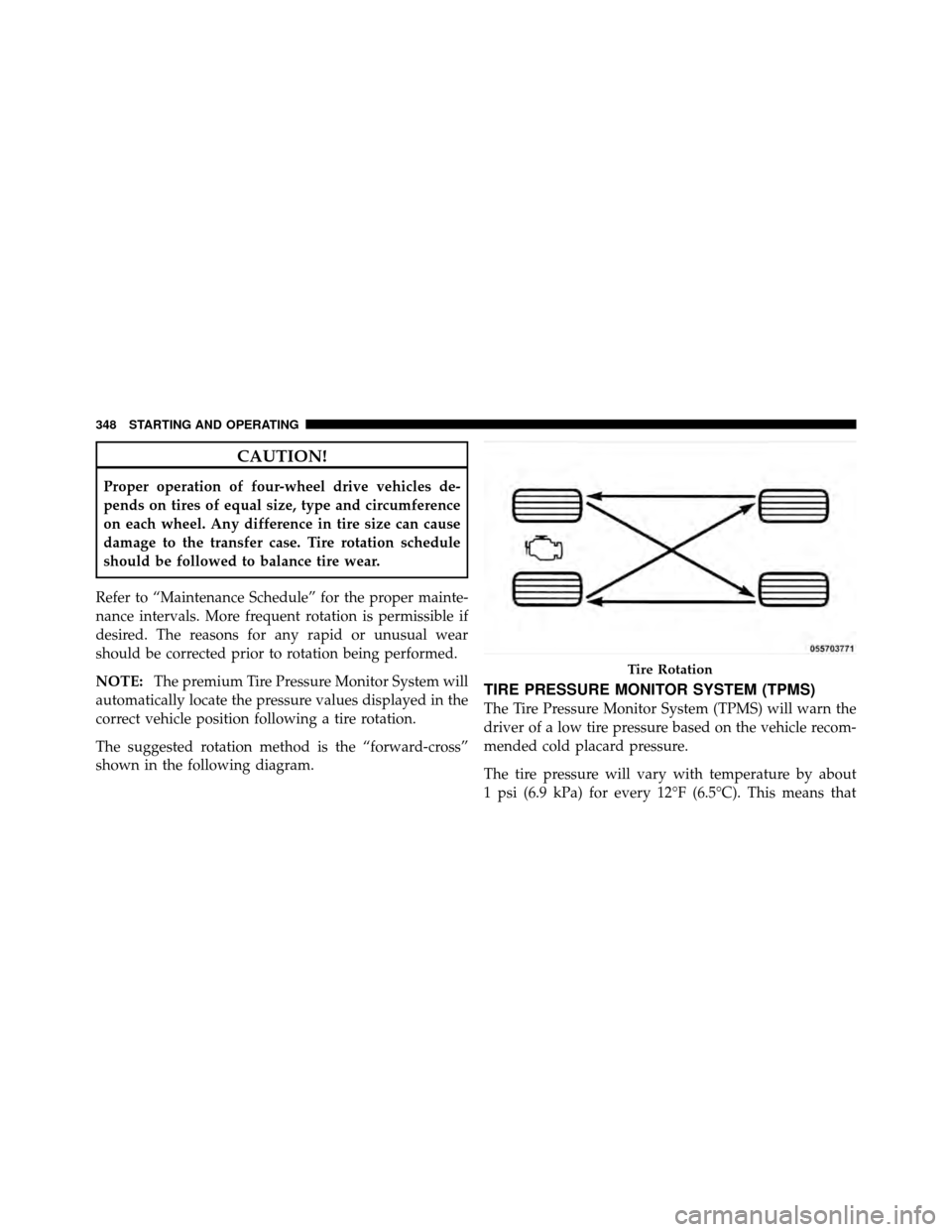
The suggested rotation method is the “forward-cross”
shown in the following diagram.
TIRE PRESSURE MONITOR SYSTEM (TPMS)
The Tire Pressure Monitor System (TPMS) will warn the
driver of a low tire pressure based on the vehicle recom-
mended cold placard pressure.
The tire pressure will vary with temperature by about
1 psi (6.9 kPa) for every 12°F (6.5°C). This means that
Tire Rotation
348 STARTING AND OPERATING
Page 351 of 498

For example, your vehicle may have a recommended
cold (parked for more than three hours) placard pressure
of 33 psi (227 kPa). If the ambient temperature is 68°F
(20°C) and the measured tire pressure is 28 psi (193 kPa),
a temperature drop to 20°F (-7°C) will decrease the tire
pressure to approximately 24 psi (165 kPa). This tire
pressure is low enough to turn ON the “Tire Pressure
Monitoring Telltale Light.” Driving the vehicle may cause
the tire pressure to rise to approximately 28 psi (193 kPa),
but the “Tire Pressure Monitoring Telltale Light” will still
be on. In this situation, the “Tire Pressure Monitoring
Telltale Light” will turn off only after the tires are inflated
to the vehicle’s recommended cold placard pressure
value.CAUTION!
•The TPMS has been optimized for the original
equipment tires and wheels. TPMS pressures and
warning have been established for the tire size
equipped on your vehicle. Undesirable system
operation or sensor damage may result when us-
ing replacement equipment that is not of the same
size, type, and/or style. Aftermarket wheels can
cause sensor damage. Do not use aftermarket tire
sealants or balance beads if your vehicle is
equipped with a TPMS, as damage to the sensors
may result.
•After inspecting or adjusting the tire pressure,
always reinstall the valve stem cap. This will
prevent moisture and dirt from entering the valve
stem, which could damage the Tire Pressure Moni-
toring Sensor.
350 STARTING AND OPERATING
Page 389 of 498
JACKING AND TIRE CHANGING
WARNING!
•Getting under a jacked-up vehicle is dangerous.
The vehicle could slip off the jack and fall on you.
You could be crushed. Never get any part of your
body under a vehicle that is on a jack. If you need
to get under a raised vehicle, take it to a service
center where it can be raised on a lift.
•The jack is designed to use as a tool for changing
tires only. The jack should not be used to lift the
vehicle for service purposes. The vehicle should
be jacked on a firm level surface only. Avoid ice or
slippery areas.
Jack Location
The scissor-type jack and tire changing tools are located
in the left rear trim panel behind the second row seat.
Spare Tire Stowage
The spare tire is stowed underneath the rear of the
vehicle and is held in place by a cable winch mechanism.
Jack Storage Location
388 WHAT TO DO IN EMERGENCIES
Page 453 of 498
•Inspect the battery and clean and tighten the terminals
as required.
•Check the fluid levels of the coolant reservoir and the
brake master cylinder, add as needed.
•Check all lights and other electrical items for correct
operation.
At Each Oil Change
•Change the engine oil filter.
•Inspect the brake hoses and lines.
CAUTION!
•Failure to perform the required maintenance items
may result in damage to the vehicle.
•Proper operation of four-wheel drive vehicles de-
pends on tires of equal size, type and circumfer-
ence on each wheel. Any difference in tire size can
cause damage to the transfer case. Tire rotation
schedule should be followed to balance tire wear.
Required Maintenance Intervals
Refer to the Maintenance Schedules on the following
pages for the required maintenance intervals.
8
M A I
N T
E
N A
N CE
S
C
H E
D
U L
E
S452 MAINTENANCE SCHEDULES
Page 493 of 498

Reporting Safety Defects................... 474
Restraint, Head ......................... 138
Restraints, Child ......................... 76
Restraints, Occupant ...................... 38
Roll Over Warning ........................ 4
Roof Type Carrier ....................... 185
Rotation, Tires .......................... 347
Safety Checks Inside Vehicle ................. 88
Safety Checks Outside Vehicle ............... 90
Safety Defects, Reporting .................. 474
Safety, Exhaust Gas ....................... 87
Safety Information, Tire ................... 329
Safety Tips ............................. 86
Satellite Radio Antenna .................265,270
Satellite Radio (Uconnect� studios)........... 268
Schedule, Maintenance .................... 450
Seat Belt Reminder ....................... 52
Seat Belts ............................ 39,88Adjustable Upper Shoulder Anchorage
........ 45
And Pregnant Women ................... 53
Child Restraint ....................... 76,83
Extender ............................. 54
Front Seat ............................ 39
Inspection ............................ 88
Maintenance ......................... 432
Shoulder Belt Anchorage ................. 45
Seats ................................. 134
Adjustment .......................... 135
Head Restraints ....................... 138
Heated ............................. 141
Rear Folding ......................... 142
Reclining ............................ 136
Security Alarm (Theft Alarm) ................ 17
Selection of Coolant (Antifreeze) ............. 446
Selection of Oil ......................... 408
Sentry Key (Immobilizer) ................... 14
Sentry Key Programming ................... 16
492 INDEX

