2010 DODGE GRAND CARAVAN ft lbs
[x] Cancel search: ft lbsPage 84 of 530

4. Otherwise required by law.
Data parameters that are recorded:
•Diagnostic trouble code(s) and warning light status for
electronically-controlled safety systems, including the
airbag system
•Vehicle speed
•Engine RPM
•Brake switch status
•Pedal position
•And other parameters depending on vehicle
configuration
Integrated Child Booster Seat — If Equipped
The Integrated Child Booster Seat (if equipped) is located
in each second-row passenger seat. The booster seat is
designed for children weighing between 48 and 85 lbs (22
and 39 kg) and between 47 in (119 cm) and 57 in (145 cm)
tall.The booster seat is designed to raise the child high
enough to use the vehicle lap and shoulder belt. The
booster seat latch release handle is located at the front of
the seat cushion.
Booster Seat Release Handle
2
THINGS TO KNOW BEFORE STARTING YOUR VEHICLE 83
Page 88 of 530

WARNING!
In a collision, an unrestrained child, even a tiny baby,
can become a projectile inside the vehicle. The force
required to hold even an infant on your lap could
become so great that you could not hold the child, no
matter how strong you are. The child and others
could be badly injured. Any child riding in your
vehicle should be in a proper restraint for the child’s
size.
Infants and Small Children
There are different sizes and types of restraints for
children from newborn size to the child almost large
enough for an adult safety belt. Always check the child
seat Owner’s Manual to ensure you have the right seat
for your child. Use the restraint that is correct for your
child.
•Safety experts recommend that children ride rearward-
facing in the vehicle until they are at least one year old
and weigh at least 20 lbs (9 kg). Two types of child
restraints can be used rearward-facing: infant carriers
and convertible child seats. Both types of child re-
straints are held in the vehicle by the lap/shoulder belt
or the LATCH child restraint anchorage system. Refer
to “Lower Anchors and Tether for CHildren (LATCH)”.
•The infant carrier is only used rearward-facing in the
vehicle. It is recommended for children who weigh up
to about 20 lbs (9 kg). Convertible child seats can be
used either rearward-facing or forward-facing in the
vehicle. Convertible child seats often have a higher
weight limit in the rearward-facing direction than
infant carriers do, so they can be used rearward-facing
by children who weigh more than 20 lbs (9 kg) but are
less than one year old.
2
THINGS TO KNOW BEFORE STARTING YOUR VEHICLE 87
Page 89 of 530

WARNING!
Rearward-facing child seats must NEVER be used in
the front seat of a vehicle with a front passenger
airbag. An airbag deployment could cause severe
injury or death to infants in this position.
•Rearward-facing child seats and infant carriers must
NEVERbe used while the second row Swivel ’n Go
seats are in the rearward-facing position.
WARNING!
Never place any child seat, booster seat, or infant
carrier in the Swivel ’n Go seat while it is in the
rearward-facing position. The swivel seat should be
locked in the forward position when using any child
seat, booster seat, or infant carriers, with the vehicle
in motion. Failure to do so could result in serious
injury or even death.
Older Children and Child Restraints
Children who weigh more than 20 lbs (9 kg) and who are
older than one year can ride forward-facing in the
vehicle. Forward-facing child seats and convertible child
seats used in the forward-facing direction are for children
who weigh 20 to 40 lbs (9 to 18 kg) and who are older
than one year. These child seats are also held in the
vehicle by the lap/shoulder belt or the LATCH child
restraint anchorage system. Refer to “Lower Anchors and
Tether for CHildren (LATCH)”.
An aftermarket belt-positioning booster seat is for chil-
dren weighing more than 40 lbs (18 kg), but who are still
too small to properly fit the vehicle’s seat belts. If the
child can not sit with knees bent over the vehicles seat
cushion while the child’s back is against the seatback,
they should use a belt-positioning booster seat. The child
and booster seat are held in the vehicle by the lap/
shoulder belt.
88 THINGS TO KNOW BEFORE STARTING YOUR VEHICLE
Page 98 of 530

WARNING!
Rearward-facing infant restraints must never be se-
cured in the passenger seat of a vehicle with a
passenger airbag. In an accident, a passenger airbag
may deploy causing severe injury or death to infants
riding in rearward-facing infant restraints.
Restraining Infants and Small Children with Seat
Delete Feature (Commercial Vehicles Only)
There are different sizes and types of restraints for
children from newborn size to the child almost large
enough for an adult safety belt. Use the restraint that is
correct for your child:
•The rearward-facing infant carrier is for babies weigh-
ing up to about 20 lbs (9 kg), and less than one year
old. THIS TYPE OF SEAT CANNOT BE USED IN A
VEHICLE EQUIPPED WITH THE REAR SEAT DE-
LETE FEATURE (Commercial Vehicles Only).
•The forward-facing child seat is for children from
about 20 to 40 lbs (9 to 18 kg), and more than one year
old.
•A convertible child seat, one that is designed to be
used for children who are too heavy for a rearward-
facing infant seat, may be used IN THE FORWARD
FACING POSITION ONLY, IT MUST NEVER BE
INSTALLED FACING TO THE REAR IN A VEHICLE
EQUIPPED WITH THE REAR SEAT DELETE FEA-
TURE (Commercial Vehicles Only). When a convert-
ible seat is properly installed facing forward, the
vehicle seat should be adjusted to therear most
position.2
THINGS TO KNOW BEFORE STARTING YOUR VEHICLE 97
Page 99 of 530

•Children more than 40 lbs (18 kg) should be secured in
the passenger seat in a child restraint or belt-
positioning booster seat with the seat adjusted to the
rear most position. Older children who do not use
child restraints or belt-positioning booster seats
should ride properly buckled in the passenger seat
with the seat adjusted to the rearmost position. Never
allow children to slide the shoulder belt behind them
or under their arm.
Tether Installation for Commercial Vehicles with
Rear Seat Delete
To secure the child restraint upper tether strap to the
vehicle, follow the instructions shown:
1. Locate the child restraint tether anchor on the lower
rear of the front passenger seat.
2. Follow the child restraint manufacturer’s directions
for proper use of connecting the child restraint to the
extended tether strap.3. Route the tether strap under the head rest.
NOTE:
Ensure that the child restraint tether strap is
centered between the headrest supports underneath the
head rest.
4. Using the hook attached to the child restraint tether
strap, attach the child restraint tether strap to the metal
anchor on the lower rear of the front passenger seat.
5. Following the child seat manufacturer’s instructions,
tighten the child restraint tether strap.
6. Inspect the tether anchor strap for nicks, abrasions,
discoloration, and loose threads. If these, or any other
condition that might affect the performance of the strap is
observed, DO NOT USE. Contact your authorized deal-
ership for a replacement part.
98 THINGS TO KNOW BEFORE STARTING YOUR VEHICLE
Page 141 of 530

5. Lower the release handle located at the bottom front
edge of the seat.
Each seat weighs about 90 lbs (41 kg).
NOTE:Electrical contacts for the available heated seats
automatically disengage or engage as the seat is removed
or installed. The contacts slide past each other as the seat
is rolled to and from the strikers.
When reinstalling the seat, make certain to lower the
release handle to ensure the seat is latched securely.
WARNING!
In a collision, you or others in your vehicle could be
injured if seats are not properly latched to their floor
attachments. Always be sure the seats are fully
latched.
Swivel ’n Go™ Premium Seating Table —
If Equipped
The Swivel ’n Go™ Seating Table consists of an easily
assembled post and top.
Second Row Seating and Table
140 UNDERSTANDING THE FEATURES OF YOUR VEHICLE
Page 208 of 530

Seat Storage Bin Cover Emergency Release Lever
As a security measure, your vehicle may be built with a
Storage Bin Cover Emergency Release is built into the
storage bin cover latching mechanism.NOTE:
In the event of an individual being locked inside
the storage bin, the storage bin cover can be opened from
inside of the bin by pushing on the glow-in-the-dark
lever attached to the storage bin cover latching
mechanism.
Coat Hooks
Coat hooks are located along the headliner for the second
and third row seating positions. The coat hook load limit
is 10 lbs (4.5 kg). Exceeding the recommended load limit
can cause the coat hooks to break or disengage from the
vehicle.
Storage Bin Cover Emergency Release Lever
3
UNDERSTANDING THE FEATURES OF YOUR VEHICLE 207
Page 216 of 530
ROOF LUGGAGE RACK — IF EQUIPPED
The crossbars and side rails are designed to carry the
weight on vehicles equipped with a luggage rack. The
load must not exceed 150 lbs (68 kg), and should be
uniformly distributed over the luggage rack crossbars.
Distribute cargo weight evenly on the roof rack crossbars.
The roof rack does not increase the total load carrying
capacity of the vehicle. Be sure the total load of cargo
inside the vehicle plus that on the external rack does not
exceed the maximum vehicle load capacity.
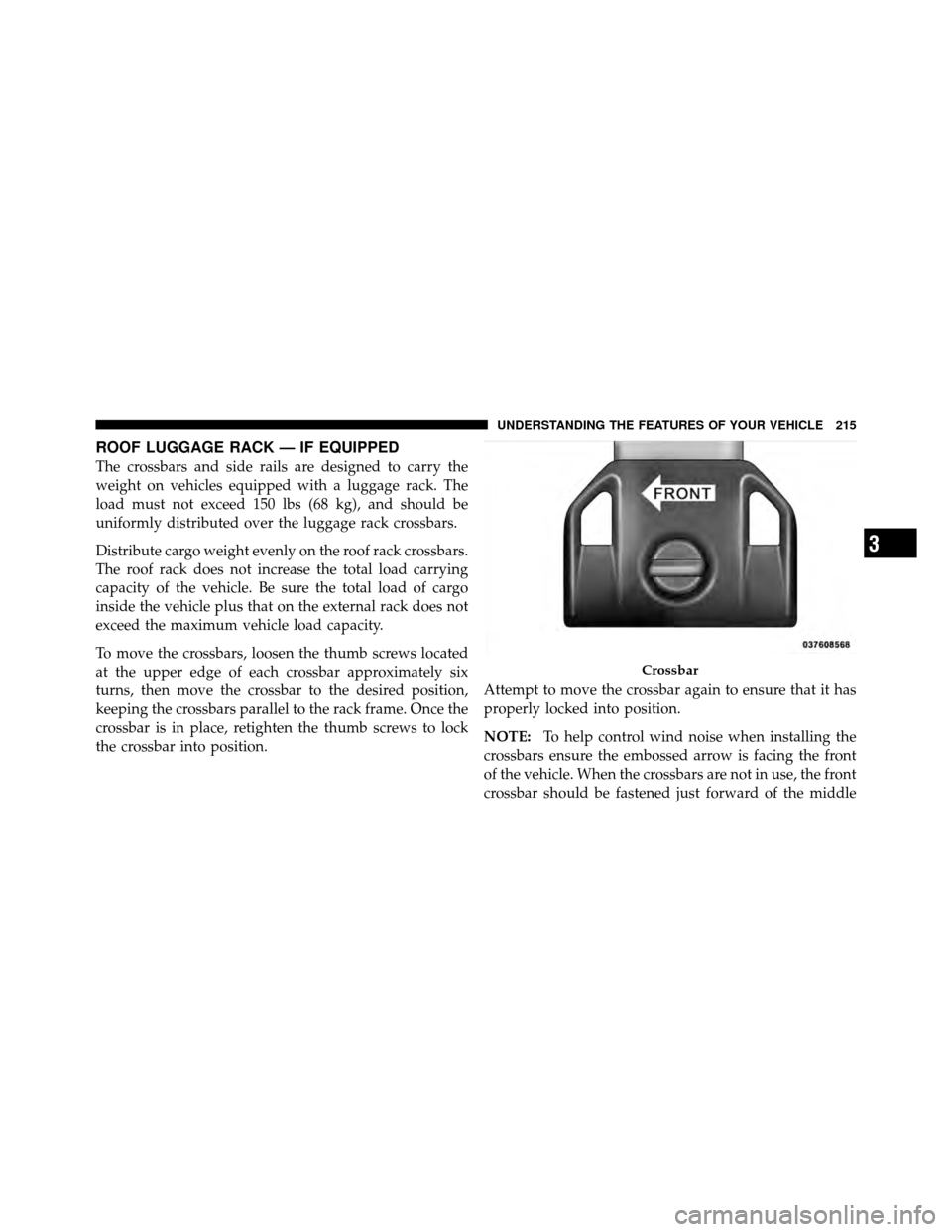
To move the crossbars, loosen the thumb screws located
at the upper edge of each crossbar approximately six
turns, then move the crossbar to the desired position,
keeping the crossbars parallel to the rack frame. Once the
crossbar is in place, retighten the thumb screws to lock
the crossbar into position.Attempt to move the crossbar again to ensure that it has
properly locked into position.
NOTE:
To help control wind noise when installing the
crossbars ensure the embossed arrow is facing the front
of the vehicle. When the crossbars are not in use, the front
crossbar should be fastened just forward of the middle
Crossbar
3
UNDERSTANDING THE FEATURES OF YOUR VEHICLE 215