Page 351 of 450
Two-Wheel Drive Vehicles
Provided that the transmission is operable, tow with the
transmission in NEUTRAL and the ignition key in the
OFF position, along with the front wheels raised and the
rear wheels on the ground. The speed must not exceed
30 mph (50 km/h), and the distance must not exceed
15 miles (25 km).
If the vehicle is to be towed more than 15 miles (25 km)
or faster than 30 mph (50 km/h), it must be towed on a
flatbed, or with the rear wheels raised and the front
wheels on the ground, or with the front end raised and
the rear wheels on a towing dolly.
CAUTION!
Towing the vehicle with the rear wheels on the
ground at more than 30 mph (50 km/h) or for more
than 15 miles (25 km), can cause severe transmission
damage. Such damage is not covered by the New
Vehicle Limited Warranty.
350 WHAT TO DO IN EMERGENCIES
Page 353 of 450

▫Exhaust System ..................... 366
▫ Cooling System ..................... 369
▫ Brake System ....................... 374
▫ Automatic Transmission ............... 376
▫ Transfer Case ....................... 379
▫ Axles ............................. 379
▫ Appearance Care And Protection From
Corrosion .......................... 380
� Fuses .............................. 385
▫ Underhood Fuses
(Power Distribution Center) ............. 385
� Vehicle Storage ....................... 390
� Replacement Bulbs .................... 390 �
Bulb Replacement ..................... 391
▫ Headlamp (Halogen)/Front Park And
Turn Signal Lamps ................... 391
▫ Rear Side Marker, Taillamps/Stop Lamps,
And Turn Signal Bulbs ................ 392
▫ Center High-Mounted Stop Lamp And
Cargo Lamp ........................ 395
▫ License Lamps ...................... 397
▫ Fog Lamps ......................... 399
� Fluid Capacities ...................... 399
� Fluids, Lubricants And Genuine Parts ....... 400
▫ Engine ............................ 400
▫ Chassis ........................... 401
352 MAINTAINING YOUR VEHICLE
Page 354 of 450
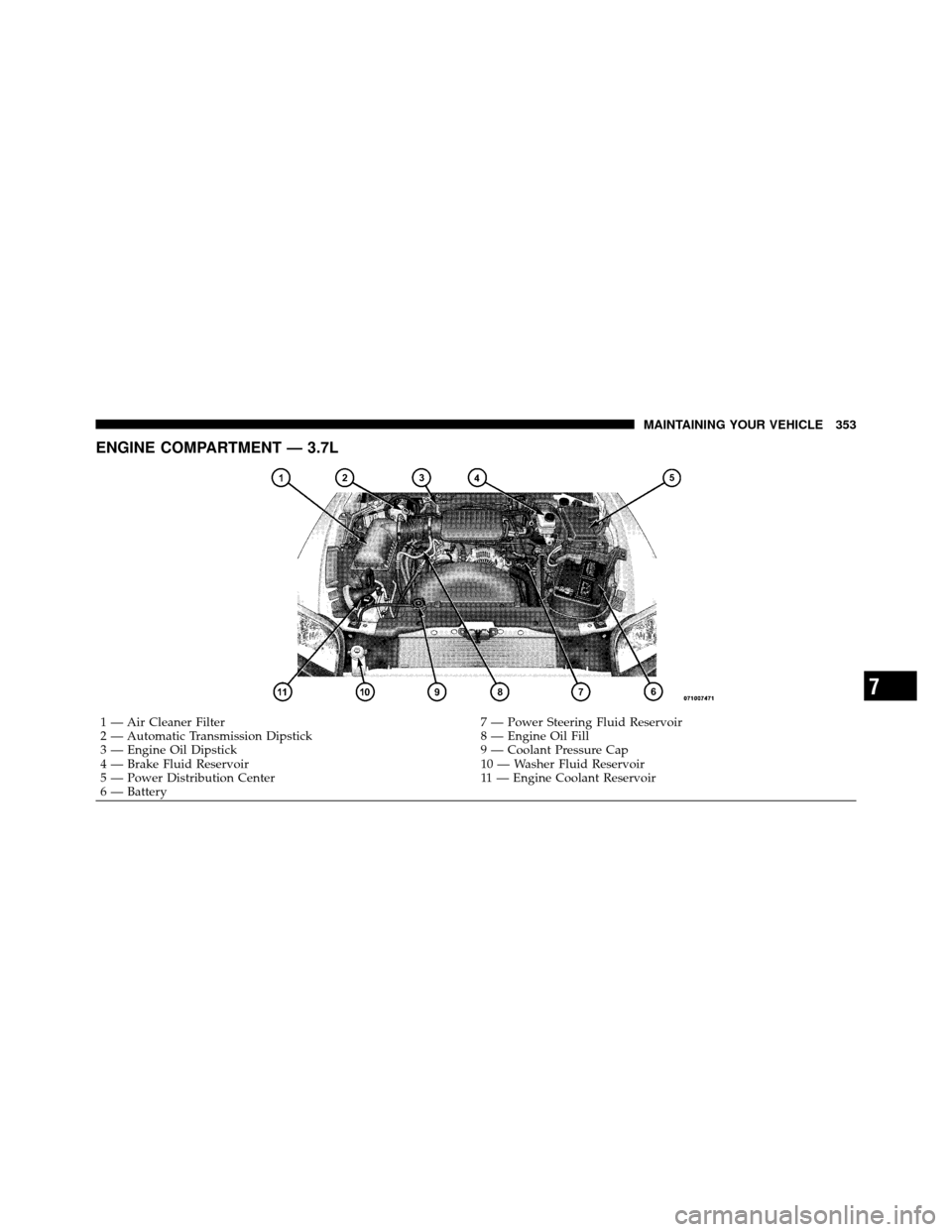
ENGINE COMPARTMENT — 3.7L
1 — Air Cleaner Filter7 — Power Steering Fluid Reservoir
2 — Automatic Transmission Dipstick 8 — Engine Oil Fill
3 — Engine Oil Dipstick 9 — Coolant Pressure Cap
4 — Brake Fluid Reservoir 10 — Washer Fluid Reservoir
5 — Power Distribution Center 11 — Engine Coolant Reservoir
6 — Battery
7
MAINTAINING YOUR VEHICLE 353
Page 355 of 450
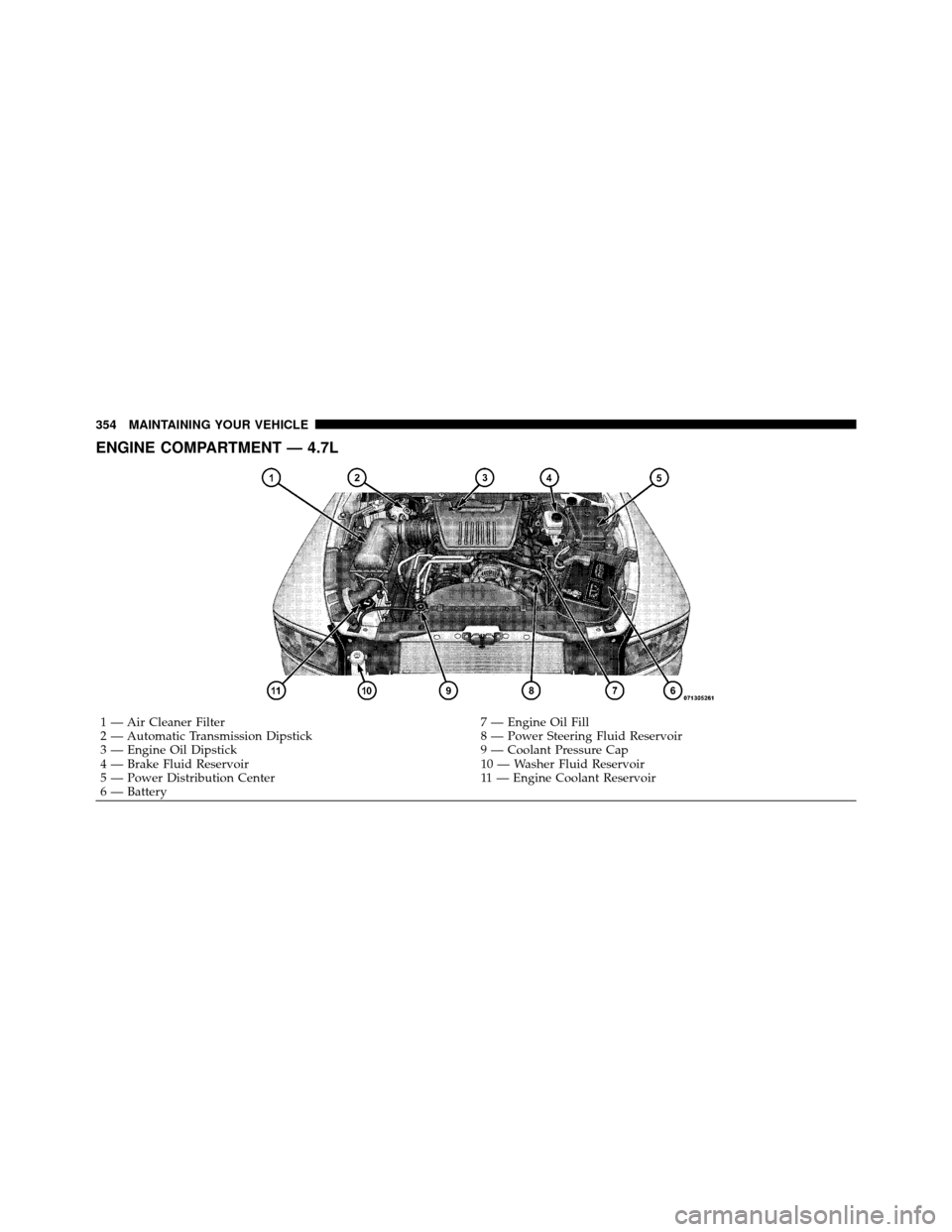
ENGINE COMPARTMENT — 4.7L
1 — Air Cleaner Filter7 — Engine Oil Fill
2 — Automatic Transmission Dipstick 8 — Power Steering Fluid Reservoir
3 — Engine Oil Dipstick 9 — Coolant Pressure Cap
4 — Brake Fluid Reservoir 10 — Washer Fluid Reservoir
5 — Power Distribution Center 11 — Engine Coolant Reservoir
6 — Battery
354 MAINTAINING YOUR VEHICLE
Page 356 of 450
ONBOARD DIAGNOSTIC SYSTEM — OBD II
Your vehicle is equipped with a sophisticated onboard
diagnostic system called OBD II. This system monitors
the performance of the emissions, engine, and automatic
transmission control systems. When these systems are
operating properly, your vehicle will provide excellent
performance and fuel economy, as well as engine emis-
sions well within current government regulations.
If any of these systems require service, the OBD II system
will turn on the Malfunction Indicator Light (MIL). It will
also store diagnostic codes and other information to
assist your service technician in making repairs. Al-
though your vehicle will usually be drivable and not
need towing, see your authorized dealer for service as
soon as possible.CAUTION!
•Prolonged driving with the MIL on could cause
further damage to the emission control system. It
could also affect fuel economy and driveability.
The vehicle must be serviced before any emissions
tests can be performed.
•If the MIL is flashing while the engine is running,
severe catalytic converter damage and power loss
will soon occur. Immediate service is required.
Loose Fuel Filler Cap Message
After fuel is added, the vehicle diagnostic system can
determine if the fuel filler cap is possibly loose, improp-
erly installed, or damaged. A “gASCAP” message will be
displayed in the odometer. Tighten the gas cap until a
�clicking�sound is heard. This is an indication that the
gas cap is properly tightened. Press the odometer reset
button to turn the message off. If the problem persists,
7
MAINTAINING YOUR VEHICLE 355
Page 360 of 450

CAUTION! (Continued)
•Your vehicle has been built with improved fluids
that protect the performance and durability of
your vehicle and also allow extended maintenance
intervals. Do not use chemical flushes in these
components as the chemicals can damage your
engine, transmission, power steering or air condi-
tioning. Such damage is not covered by the New
Vehicle Limited Warranty. If a flush is needed
because of component malfunction, use only the
specified fluid for the flushing procedure.
Engine Oil
Checking Oil Level
To assure proper lubrication of your vehicle’s engine, the
engine oil must be maintained at the correct level. The
best time to check the engine oil level is about fiveminutes after a fully warmed-up engine is shut off, or
before starting the engine after it has sat overnight.
Checking the oil while the vehicle is on level ground will
improve the accuracy of the oil level readings. Always
maintain the oil level within the SAFE zone on the
dipstick. Adding one quart/liter of oil when the reading
is at the bottom of the SAFE zone will result in a reading
at the top of the safe zone on these engines.
CAUTION!
Overfilling or underfilling the crankcase will cause
oil aeration or loss of oil pressure. This could damage
your engine.
Change Engine Oil
The oil change indicator system will remind you that it is
time to take your vehicle in for scheduled maintenance.
Refer to “Maintenance Schedule” for further information.
7
MAINTAINING YOUR VEHICLE 359
Page 369 of 450
WARNING!
A hot exhaust system can start a fire if you park over
materials that can burn. Such materials might be
grass or leaves coming into contact with your exhaust
system. Do not park or operate your vehicle in areas
where your exhaust system can contact anything that
can burn.
In unusual situations involving grossly malfunctioning
engine operation, a scorching odor may indicate severe
and abnormal catalyst overheating. If this occurs, the
vehicle should be stopped, the engine shut off and the
vehicle allowed to cool. Thereafter, service, including a
tune-up to manufacturer’s specifications, should be ob-
tained immediately. To minimize the possibility of catalyst damage:•Do not shut off the engine or interrupt the ignition
when the transmission is in gear and the vehicle is in
motion.
•Do not try to start the engine by pushing or towing the
vehicle.
•Do not idle the engine with any spark plug wires
disconnected or removed, such as when diagnostic
testing, or for prolonged periods during very rough
idling or malfunctioning operating conditions.
368 MAINTAINING YOUR VEHICLE
Page 377 of 450

WARNING! (Continued)
•Do not allow petroleum based fluid to contami-
nate the brake fluid. Brake seal components could
be damaged, causing partial or complete brake
failure. This could result in an accident.
Automatic Transmission
NOTE:If your vehicle is equipped with a dipstick, use
the following procedure. If your vehicle has a capped
dipstick, it is sealed and should not be tampered with.
Your authorized dealer has the proper tools to ensure that
the fluid level is set properly.
Fluid Level Check
Check the fluid level while the transmission is at normal
operating temperature 180° F (82° C). This occurs after at
least 15 miles (24 km) of driving. At normal operating
temperature the fluid cannot be held comfortably be-
tween the fingertips. To check the automatic transmission fluid level properly,
the following procedure must be used:
1. Operate the engine at idle speed and normal operating
temperature.
2. The vehicle must be on level ground.
3. Fully apply the parking brake and press the brake
pedal.
4. Place the shift lever momentarily into each gear posi-
tion, ending with the shift lever in PARK.
5. Remove the dipstick, wipe it clean and reinsert it until
seated.
6. Remove the dipstick again and note the fluid level on
both sides. The fluid level should be between the “HOT”
(upper) reference holes on the dipstick at normal operat-
ing temperature. Verify that solid coating of oil is seen on
both sides of the dipstick. If the fluid is low, add as
376 MAINTAINING YOUR VEHICLE