Page 267 of 436
Automatic Transmission – If Equipped
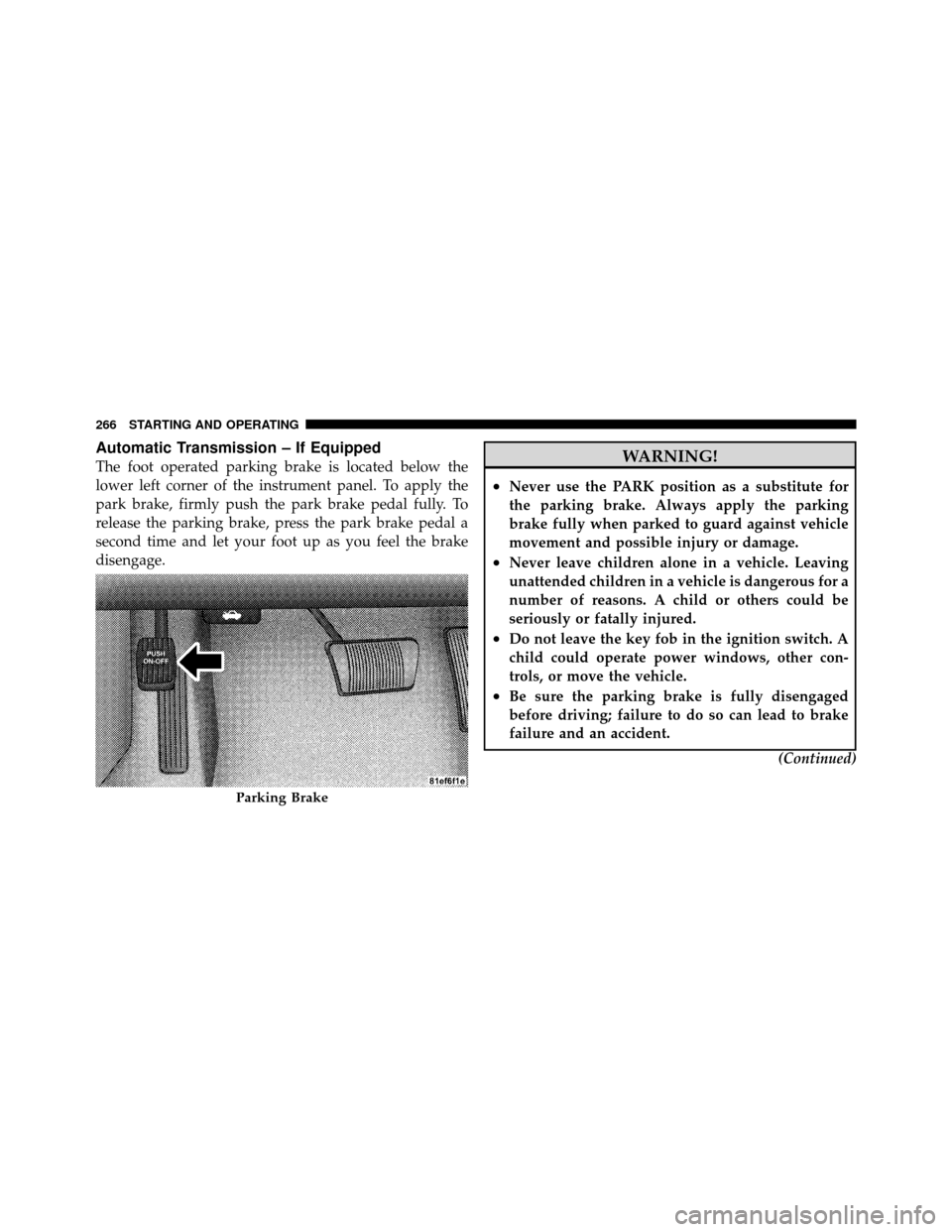
The foot operated parking brake is located below the
lower left corner of the instrument panel. To apply the
park brake, firmly push the park brake pedal fully. To
release the parking brake, press the park brake pedal a
second time and let your foot up as you feel the brake
disengage.WARNING!
•Never use the PARK position as a substitute for
the parking brake. Always apply the parking
brake fully when parked to guard against vehicle
movement and possible injury or damage.
•Never leave children alone in a vehicle. Leaving
unattended children in a vehicle is dangerous for a
number of reasons. A child or others could be
seriously or fatally injured.
•Do not leave the key fob in the ignition switch. A
child could operate power windows, other con-
trols, or move the vehicle.
•Be sure the parking brake is fully disengaged
before driving; failure to do so can lead to brake
failure and an accident.(Continued)
Parking Brake
266 STARTING AND OPERATING
Page 316 of 436
WHAT TO DO IN EMERGENCIES
CONTENTS
�Hazard Warning Flasher ................ 316
� If Your Engine Overheats ................ 316
� TIREFIT Kit ......................... 317
▫ TIREFIT Storage ..................... 318
▫ TIREFIT Kit Components And Operation . . . 318
▫ TIREFIT Usage Precautions ............. 319
▫ Sealing a Tire With TIREFIT ............. 322
� Jump-Starting Procedures ................ 327
▫ Preparations For Jump-Start ............. 328▫
Jump-Starting Procedure ............... 329
� Freeing A Stuck Vehicle ................. 331
� Towing A Disabled Vehicle ............... 332
▫ Without The Key FOB ................. 332
▫ Towing This Vehicle Behind Another Vehicle
(Flat Towing With All Four Wheels On The
Ground) ........................... 333
▫ Towing This Vehicle Behind Another Vehicle
With A Tow Dolly .................... 334
6
Page 333 of 436

CAUTION!
•When “rocking” a stuck vehicle by moving be-
tween “1st” and REVERSE, do not spin the wheels
faster than 15 mph (24 km/h), or drivetrain damage
may result.
•Revving the engine or spinning the wheels too fast
may lead to transmission overheating and failure.
It can also damage the tires. Do not spin the
wheels above 30 mph (48 km/h) while in gear (no
transmission shifting occurring).
WARNING!
Fast spinning tires can be dangerous. Forces gener-
ated by excessive wheel speeds may cause damage, or
even failure, of the axle and tires. A tire could
explode and injure someone. Do not spin your vehi-
cle’s wheels faster than 30 mph (48 km/h) or for
longer than 30 seconds continuously without stop-
ping when you are stuck and do not let anyone near
a spinning wheel, no matter what the speed.
TOWING A DISABLED VEHICLE
Without The Key Fob
Special care must be taken when the vehicle is towed
with the ignition in the OFF position. The only approved
method of towing without the ignition key is with a
flatbed truck. Proper towing equipment is necessary to
prevent damage to the vehicle.
332 WHAT TO DO IN EMERGENCIES
Page 334 of 436
Towing This Vehicle Behind Another Vehicle (Flat
Towing With All Four Wheels On The Ground)
Flat towing of vehicles is permitted within the following
limitations:
With The Key Fob
Your vehicle may be towed under the following condi-
tions:
•The shift lever must be in NEUTRAL
•The distance to be traveled must not exceed 15 miles
(24 km)
•The towing speed must not exceed 30 mph (48 km/h)
CAUTION!
Exceeding these towing limits may cause severe
transmission damage. Such damage is not covered by
the New Vehicle Limited Warranty.
If the transmission is not operative or if the vehicle is to
be towed more than 15 miles (24 km) or faster than
30 mph (48 km/h), the vehicle must be transported using
a flatbed truck.
6
WHAT TO DO IN EMERGENCIES 333
Page 341 of 436

Trip Odometer button to turn off the message. If the
problem continues, the message will appear the next time
the vehicle is started.
A loose, improperly installed, or damaged fuel filler cap
may also turn on the MIL.
EMISSIONS INSPECTION AND MAINTENANCE
PROGRAMS
In some localities, it may be a legal requirement to pass
an inspection of this vehicle’s emissions control system.
Failure to pass could prevent vehicle registration.For states that require an Inspection and Mainte-
nance (I/M), this check verifies the Malfunction
Indicator Light (MIL) is functioning and is not on
when the engine is running, and that the OBD II system
is ready for testing. Normally, the OBD II system will be ready. The OBD II
system may
notbe ready if the vehicle was recently
serviced, recently had a dead battery, or a battery replace-
ment. If the OBD II system should be determined not
ready for the I/M test, the vehicle may fail the test.
This vehicle has a simple ignition key-actuated test,
which you can use prior to going to the test station. To
check if this vehicle’s OBD II system is ready, you must
do the following:
1. Insert the key fob into the ignition switch.
2. Turn the ignition switch to the ON/RUN position, but
do not crank or start the engine.
3. If you crank or start the engine, you will have to start
this test over.
4. As soon as you turn the ignition switch to the ON/
RUN position, you will see the MIL symbol come on as
part of a normal bulb check.
340 MAINTAINING YOUR VEHICLE