Page 408 of 484

NOTE:Intentional tampering with emissions control
systems can result in civil penalties being assessed
against you.
In unusual situations involving grossly malfunctioning
engine operation, a scorching odor may suggest severe
and abnormal catalyst overheating. If this occurs, stop
the vehicle, turn off the engine and allow it to cool.
Service, including a tune-up to manufacturer’s specifica-
tions, should be obtained immediately.
To minimize the possibility of catalytic converter dam-
age:
•Do not shut off the engine or interrupt the ignition,
when the transmission is in gear and the vehicle is in
motion.
•Do not try to start the engine by pushing or towing the
vehicle.
•Do not idle the engine with any spark plug wires
disconnected or removed, such as when diagnostic
testing, or for prolonged periods during very rough
idle or malfunctioning operating conditions.
Cooling System
WARNING!
•When working near the radiator cooling fan, dis-
connect the fan motor lead or turn the ignition
switch to the OFF position. The fan is temperature
controlled and can start at any time the ignition
switch is in the ON position.
•You or others can be badly burned by hot engine
coolant (antifreeze) or steam from your radiator. If
you see or hear steam coming from under the
hood, do not open the hood until the radiator has
had time to cool. Never try to open a cooling
system pressure cap when the radiator is hot.7
MAINTAINING YOUR VEHICLE 407
Page 412 of 484

WARNING!
•The warning words “DO NOT OPEN HOT” on
the cooling system pressure cap are a safety pre-
caution. Never add engine coolant (antifreeze)
when the engine is overheated. Do not loosen or
remove the cap to cool an overheated engine. Heat
causes pressure to build up in the cooling system.
To prevent scalding or injury, do not remove the
pressure cap while the system is hot or under
pressure.
•Do not use a pressure cap other than the one
specified for your vehicle. Personal injury or en-
gine damage may result.
Disposal Of Used Engine Coolant
Used ethylene glycol-based engine coolant (antifreeze) is
a regulated substance requiring proper disposal. Check
with your local authorities to determine the disposalrules for your community. To prevent ingestion by ani-
mals or children do not store ethylene glycol-based
engine coolant (antifreeze) in open containers or allow it
to remain in puddles on the ground. If ingested by a child
or pet, seek emergency assistance immediately. Clean up
any ground spills immediately.
Coolant Level
The coolant bottle provides a quick visual method for
determining that the coolant level is adequate. With the
engine idling and warm to normal operating tempera-
ture, the level of the engine coolant (antifreeze) in the
bottle should be between the “ADD” and “FULL” lines
shown on the bottle.
The radiator normally remains completely full, so there is
no need to remove the radiator cap unless checking for
the coolant freeze point or replacing the engine coolant
(antifreeze). Advise your service attendant of this. As
7
MAINTAINING YOUR VEHICLE 411
Page 414 of 484

•Keep the front of the radiator clean. If your vehicle is
equipped with air conditioning, keep the front of the
condenser clean.
•Do not change the thermostat for Summer or Winter
operation. If replacement is ever necessary, install
ONLY the correct type thermostat. Other designs may
result in unsatisfactory engine coolant (antifreeze)
performance, poor gas mileage, and increased
emissions.
Brake System
In order to assure brake system performance, all brake
system components should be inspected periodically.
Refer to “Maintenance Schedule” for the proper mainte-
nance intervals.
WARNING!
Riding the brakes can lead to brake failure and
possibly an accident. Driving with your foot resting
or riding on the brake pedal can result in abnormally
high brake temperatures, excessive lining wear, and
possible brake damage. You would not have your full
braking capacity in an emergency.
Brake Master Cylinder
The fluid level in the master cylinder should be checked
when performing under hood services, or immediately if
the “Brake Warning Light” is on.
Be sure to clean the top of the master cylinder area before
removing the cap. If necessary, add fluid to bring the
fluid level up to the requirements described on the brake
fluid reservoir. Fluid level can be expected to fall as the
brake pads wear. The brake fluid level should be checked
7
MAINTAINING YOUR VEHICLE 413
Page 415 of 484

when the pads are replaced. However, low fluid level
may be caused by a leak and a checkup may be needed.
NOTE:If your vehicle is equipped with a manual
transmission , the brake fluid reservoir supplies fluid to
both the brake system and the clutch release system. The
two systems are separated in the reservoir, and a leak in
one system will not affect the other system. The manual
transmission clutch release system should not require
fluid replacement during the life of the vehicle. If the
brake fluid reservoir is low and the brake system does
not indicate any leaks or other problems, it may be a
result of a leak in the hydraulic clutch release system. See
your local authorized dealer for service.
Use only manufacturer’s recommended brake fluid. Re-
fer to “Fluids, Lubricants, and Genuine Parts” in “Main-
taining Your Vehicle” for further information.WARNING!
•Use only manufacturer’s recommended brake
fluid. Refer to “Fluids, Lubricants, and Genuine
Parts” in “Maintaining Your Vehicle” for further
information. Using the wrong type of brake fluid
can severely damage your brake system and/or
impair its performance. The proper type of brake
fluid for your vehicle is also labeled on the origi-
nal factory installed hydraulic master cylinder
reservoir.
(Continued)
414 MAINTAINING YOUR VEHICLE
Page 428 of 484

VEHICLE STORAGE
If you will not be using your vehicle for more than
21 days, you may want to take steps to preserve your
battery.
•Disengage the mini-fuse in the Power Distribution
Center labeled IOD (Ignition Off-Draw).
•Disconnect the negative cable from the battery.
REPLACEMENT BULBS
All the inside bulbs are brass or glass wedge base.
Aluminum base bulbs are not approved and should not
be used for replacement.
LIGHT BULBS – Interior Bulb Number
Front Header Lamp...................... T578
Center Dome Lamp ...................... T578
Rear Cargo/Flashlight ................. 8–A35LFLIGHTS BULBS – Exterior
Bulb Number
Low Beam/High Beam Headlamp ............ H13
Front Park/Turn Signal/Side Marker Lamp . . . 3157AK
Front Fog Lamp ...................... PSX24W
Center High-Mounted Stop Lamp
(CHMSL) ...................... LED Assembly
Rear Tail/Stop Lamp ..................... 3157
Rear Turn Signal Lamp .................3757AK
Backup Lamp ...................... 921 W16W
License Lamp .......................... W5W
BULB REPLACEMENT
Front Headlamps, Parking, and Turn Signal
Lamps
NOTE:The headlamp bulb can be accessed from under
the hood without the removal of the inner fender well. It
will be necessary to remove the inner fender well to
service the park/turn signal bulb that is located toward
the outboard side of the head lamp unit.
7
MAINTAINING YOUR VEHICLE 427
Page 429 of 484

1. Disconnect and isolate the negative battery cable.
2. Working in the appropriate wheel well, loosen the
front of the splash shield, but do not fully remove it.
3. Looking up through the front wheel well, locate the
bulb which needs replacing. The headlamp bulb is the
inboard bulb and the park/turn signal bulb is the out-
board bulb.
4. Disconnect the bulb electrical connector.
5. Grasp the bulb, twist 1/4 turn counterclockwise and
pull straight out of front lamp unit.
Fog Lamps
CAUTION!
Do not contaminate the bulb glass by touching it
with your fingers or by allowing it to contact other
oily surfaces. Shortened bulb life will result.1. Disconnect and isolate the negative battery cable.
2. Remove the front wheel and tire on the same side of
the vehicle as the fog lamp being serviced. Refer to
“Jacking and Tire Changing” in “What To Do In Emer-
gencies” for further information.
3. Remove the three screws that secure the outboard side
of the front wheel house splash shield to the front fascia.
4. Remove the push pin fastener that secures the inboard
side of the splash shield to the front end sheet metal.
5. Remove the two push pin fasteners that secure the
forward edge of the splash shield to the front fascia
closure panel.
6. Fold the front of the splash shield rearward far enough
to access the back of the front fascia.
428 MAINTAINING YOUR VEHICLE
Page 431 of 484
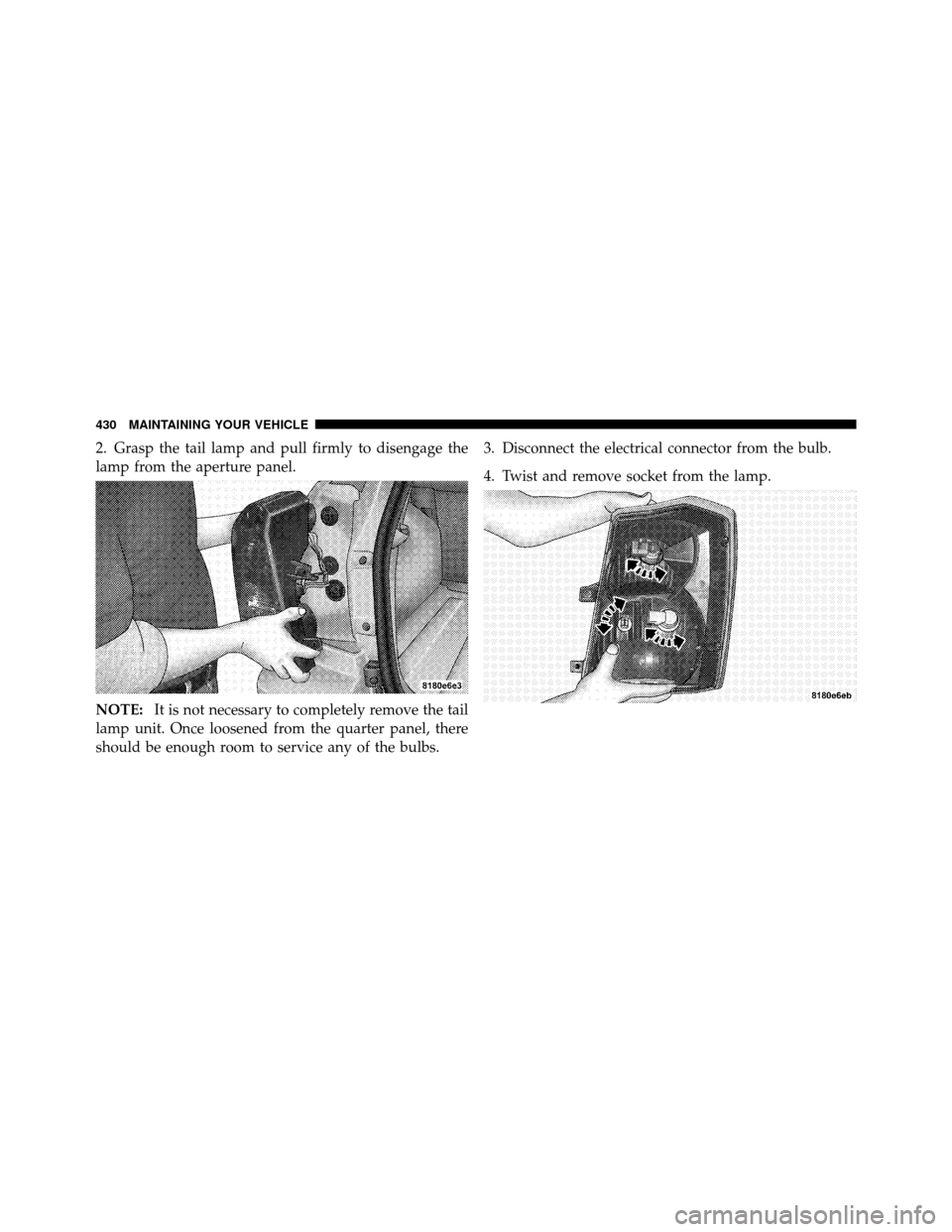
2. Grasp the tail lamp and pull firmly to disengage the
lamp from the aperture panel.
NOTE:It is not necessary to completely remove the tail
lamp unit. Once loosened from the quarter panel, there
should be enough room to service any of the bulbs. 3. Disconnect the electrical connector from the bulb.
4. Twist and remove socket from the lamp.
430 MAINTAINING YOUR VEHICLE
Page 439 of 484

EMISSIONS CONTROL SYSTEM MAINTENANCE
The Scheduled Maintenance services listed inbold type
must be done at the times or mileages specified to ensure
the continued proper functioning of the emissions control
system. These and all other maintenance services in-
cluded in this manual, should be done to provide best
vehicle performance and reliability. More frequent main-
tenance may be needed for vehicles in severe operating
conditions, such as dusty areas and very short trip
driving.
Inspection and service should also be done anytime a
malfunction is suspected.
NOTE: Maintenance, replacement or repair of the emis-
sions control devices and systems on your vehicle may be
performed by any automotive repair establishment or
individual using any automotive part that has been
certified pursuant to U.S. EPA or in the State of Califor-
nia, California Air Resources Board regulations.
MAINTENANCE SCHEDULE
The oil change indicator system will remind you that it is
time to take your vehicle in for scheduled maintenance.
On Electronic Vehicle Information Center (EVIC)
equipped vehicles, “Oil Change Required” will be dis-
played in the EVIC and a single chime will sound,
indicating that an oil change is necessary.
On Non-EVIC equipped vehicles, “Change Oil” will flash
in the instrument cluster odometer and a single chime
will sound, indicating that an oil change is necessary.
Based on engine operation condition, the oil change
indicator message will illuminate; this means that service
is required for your vehicle. Have your vehicle serviced
as soon as possible, within the next 500 miles (805 km).
8
M A I
N T
E
N A
N CE
S
C
H E
D
U L
E
S438 MAINTENANCE SCHEDULES