Page 377 of 484
Jacking Instructions
WARNING!
Carefully follow these tire changing warnings to
help prevent personal injury or damage to your
vehicle:
•Always park on a firm, level surface as far from
the edge of the roadway as possible before raising
the vehicle.
•Block the wheel diagonally opposite the wheel to
be raised.
•Set the parking brake firmly and set an automatic
transmission in PARK; a manual transmission in
REVERSE.
•Never start or run the engine with the vehicle on a
jack.(Continued)
WARNING! (Continued)
•Do not let anyone sit in the vehicle when it is on a
jack.
•Do not get under the vehicle when it is on a jack.
•Only use the jack in the positions indicated and
for lifting this vehicle during a tire change.
•If working on or near a roadway, be extremely
careful of motor traffic.
•To assure that spare tires, flat or inflated, are
securely stowed, spares must be stowed with the
valve stem facing the ground.
•Turn on the Hazard Warning flasher.
376 WHAT TO DO IN EMERGENCIES
Page 383 of 484
WARNING!
•Take care to avoid the radiator cooling fan when-
ever the hood is raised. It can start anytime the
ignition switch is on. You can be injured by
moving fan blades.
•Remove any metal jewelry such as watch bands or
bracelets that might make an inadvertent electrical
contact. You could be seriously injured.
•Batteries contain sulfuric acid that can burn your
skin or eyes and generate hydrogen gas which is
flammable and explosive. Keep open flames or
sparks away from the battery.
1. Set the parking brake, shift the automatic transmission
into PARK and turn the ignition to LOCK.
2. Turn off the heater, radio, and all unnecessary electri-
cal accessories.
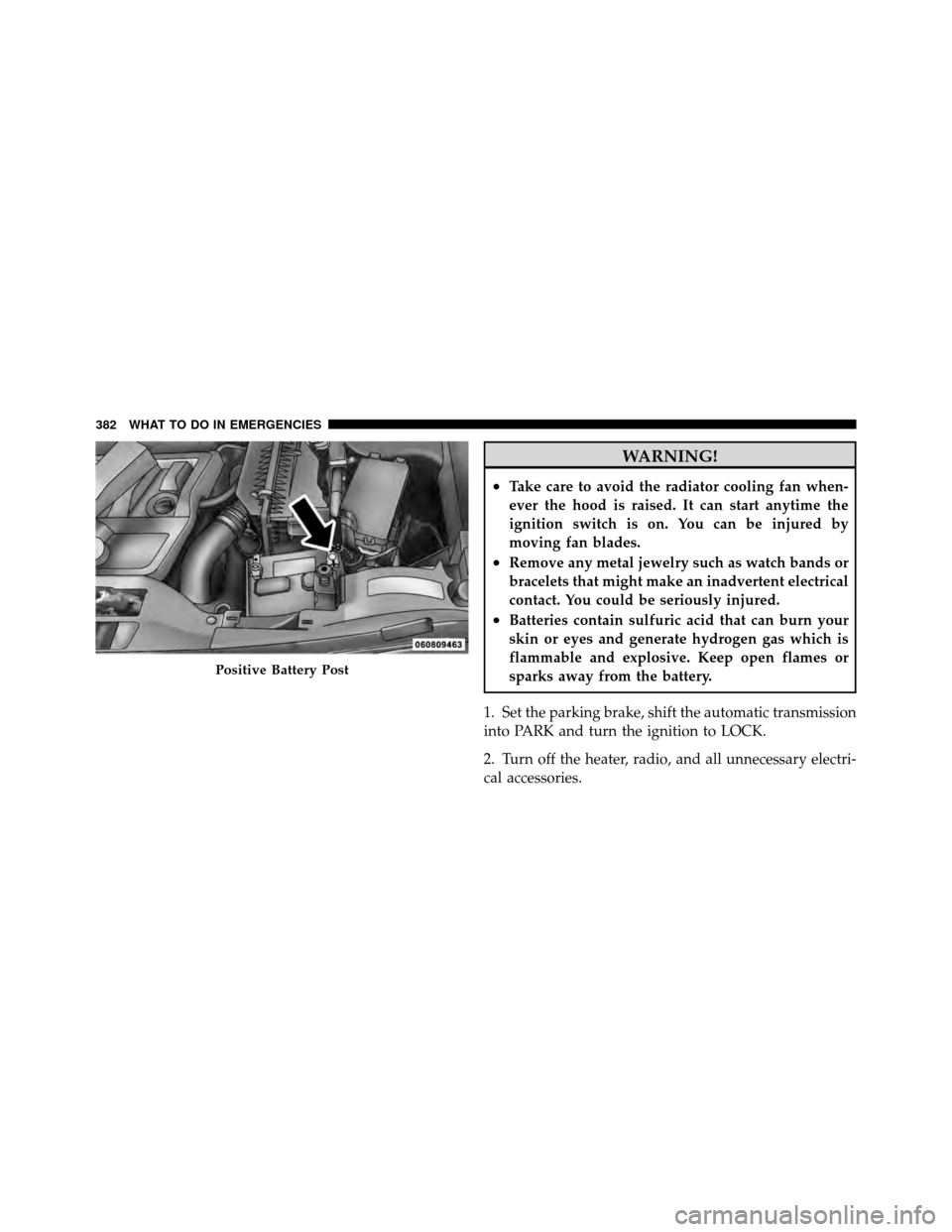
Positive Battery Post
382 WHAT TO DO IN EMERGENCIES
Page 384 of 484

3. If using another vehicle to jump-start the battery, park
the vehicle within the jumper cables reach, set the
parking brake and make sure the ignition is OFF.
WARNING!
Do not allow vehicles to touch each other as this
could establish a ground connection and personal
injury could result.
Jump-Starting Procedure
WARNING!
Failure to follow this procedure could result in per-
sonal injury or property damage due to battery ex-
plosion.
CAUTION!
Failure to follow these procedures could result in
damage to the charging system of the booster vehicle
or the discharged vehicle.
1. Connect the positive (+)end of the jumper cable to the
positive (+)post of the discharged vehicle.
2. Connect the opposite end of the positive (+)jumper
cable to the positive (+)post of the booster battery.
3. Connect the negative end (-)of the jumper cable to the
negative (-)post of the booster battery.
4. Connect the opposite end of the negative (-)jumper
cable to a good engine ground (exposed metal part of the
discharged vehicle’s engine) away from the battery and
the fuel injection system.
6
WHAT TO DO IN EMERGENCIES 383
Page 388 of 484
CAUTION!
•If the vehicle being towed requires steering, the
ignition switch must be in the ACC position, not
in the LOCK position.
•Do not attempt to use sling-type equipment when
towing. When securing the vehicle to a flatbed
truck, do not attach to front or rear suspension
components. Damage to your vehicle may result
from improper towing.
Without The Ignition Key
Special care must be taken when the vehicle is towed
with the ignition in the LOCK position. A dolly should be
used under the front wheels if the rear wheels are raised.
Proper towing equipment is necessary to prevent dam-
age to the vehicle.
Battery power is required to release the brake/
transmission interlock system (automatic transmission
only). There is a removable plug in the right side of the
shift lever housing that allows you to insert your finger to
override the system. The ignition key must be in the ON
position to use the override lever.
6
WHAT TO DO IN EMERGENCIES 387
Page 391 of 484

▫Cooling System ..................... 407
▫ Brake System ....................... 413
▫ Automatic Transmission (CVT) –
If Equipped ........................ 416
▫ Manual Transmission – If Equipped ....... 417
▫ Appearance Care And Protection From
Corrosion .......................... 417
� Fuses .............................. 423
▫ Integrated Power Module (IPM) .......... 423
� Vehicle Storage ....................... 427
� Replacement Bulbs .................... 427 �
Bulb Replacement ..................... 427
▫ Front Headlamps, Parking, And Turn Signal
Lamps ............................ 427
▫ Fog Lamps ......................... 428
▫ Rear Tail, Turn Signal, And Backup Lamps . . 429
▫ License Lamps ...................... 431
▫ Center High-Mounted Stoplamp ......... 432
� Fluid Capacities ...................... 433
� Fluids, Lubricants, And Genuine Parts ....... 434
▫ Engine ............................ 434
▫ Chassis ........................... 435
390 MAINTAINING YOUR VEHICLE
Page 392 of 484
ENGINE COMPARTMENT — 2.0L
1 — Washer Fluid Reservoir6 — Integrated Power Module
2 — Power Steering Fluid Reservoir 7 — Battery (Under Cover)
3 — Engine Oil Fill 8 — Coolant Pressure Cap
4 — Air Cleaner Filter 9 — Engine Oil Dipstick
5 — Brake Fluid Reservoir 10 — Engine Coolant Reservoir
7
MAINTAINING YOUR VEHICLE 391
Page 393 of 484
ENGINE COMPARTMENT — 2.4L
1 — Washer Fluid Reservoir6 — Battery (Under Cover)
2 — Power Steering Fluid Reservoir 7 — Air Cleaner Filter
3 — Engine Oil Fill 8 — Coolant Pressure Cap
4 — Brake Fluid Reservoir 9 — Engine Oil Dipstick
5 — Integrated Power Module 10 — Engine Coolant Reservoir
392 MAINTAINING YOUR VEHICLE
Page 414 of 484

•Keep the front of the radiator clean. If your vehicle is
equipped with air conditioning, keep the front of the
condenser clean.
•Do not change the thermostat for Summer or Winter
operation. If replacement is ever necessary, install
ONLY the correct type thermostat. Other designs may
result in unsatisfactory engine coolant (antifreeze)
performance, poor gas mileage, and increased
emissions.
Brake System
In order to assure brake system performance, all brake
system components should be inspected periodically.
Refer to “Maintenance Schedule” for the proper mainte-
nance intervals.
WARNING!
Riding the brakes can lead to brake failure and
possibly an accident. Driving with your foot resting
or riding on the brake pedal can result in abnormally
high brake temperatures, excessive lining wear, and
possible brake damage. You would not have your full
braking capacity in an emergency.
Brake Master Cylinder
The fluid level in the master cylinder should be checked
when performing under hood services, or immediately if
the “Brake Warning Light” is on.
Be sure to clean the top of the master cylinder area before
removing the cap. If necessary, add fluid to bring the
fluid level up to the requirements described on the brake
fluid reservoir. Fluid level can be expected to fall as the
brake pads wear. The brake fluid level should be checked
7
MAINTAINING YOUR VEHICLE 413