Page 58 of 484
Supplemental Restraint System (SRS) — Airbags
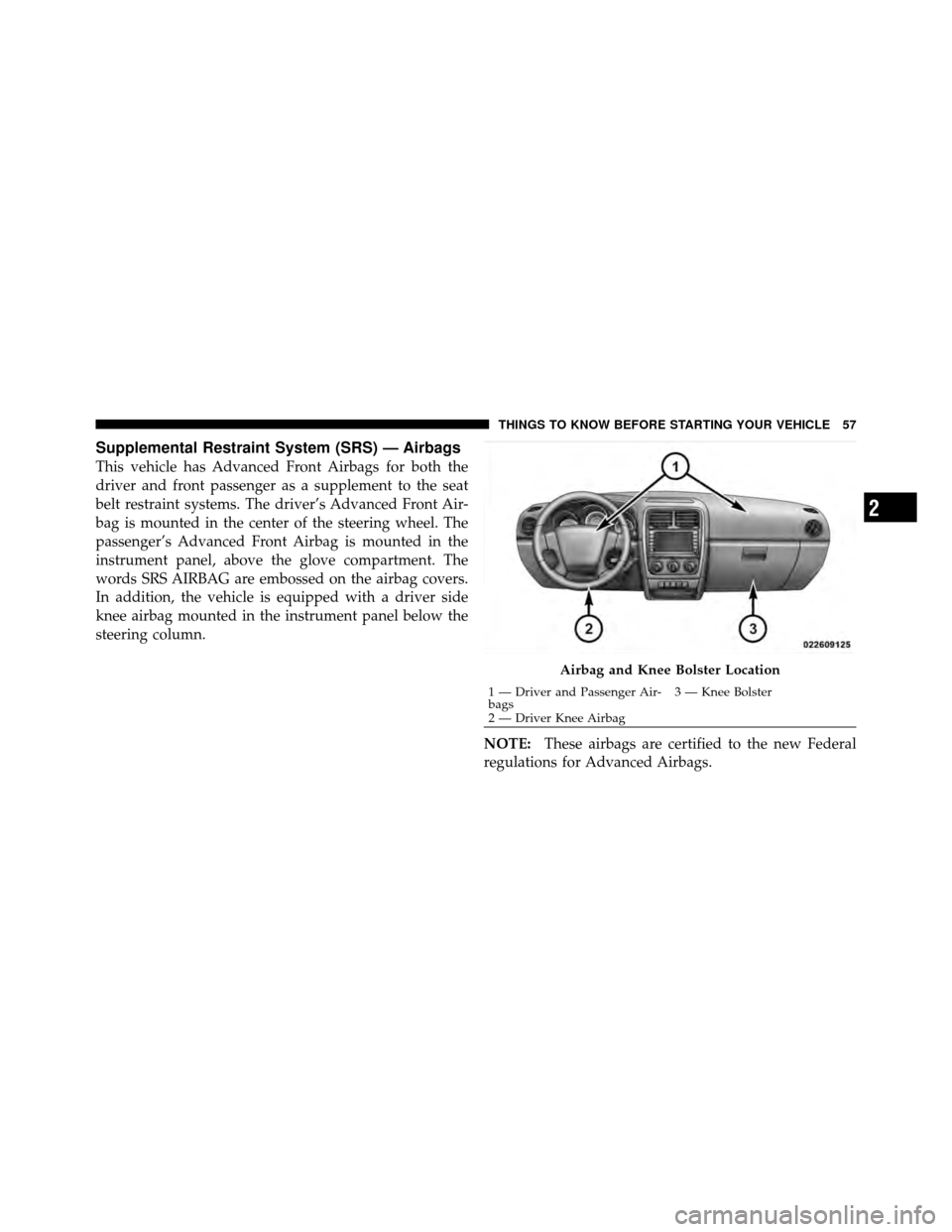
This vehicle has Advanced Front Airbags for both the
driver and front passenger as a supplement to the seat
belt restraint systems. The driver’s Advanced Front Air-
bag is mounted in the center of the steering wheel. The
passenger’s Advanced Front Airbag is mounted in the
instrument panel, above the glove compartment. The
words SRS AIRBAG are embossed on the airbag covers.
In addition, the vehicle is equipped with a driver side
knee airbag mounted in the instrument panel below the
steering column.NOTE:These airbags are certified to the new Federal
regulations for Advanced Airbags.
Airbag and Knee Bolster Location
1 — Driver and Passenger Air-
bags 3 — Knee Bolster
2 — Driver Knee Airbag
2
THINGS TO KNOW BEFORE STARTING YOUR VEHICLE 57
Page 60 of 484

•Instrument Panel
•Knee Impact Bolster
•Driver Advanced Front Airbag
•Passenger Advanced Front Airbag
•Supplemental Seat-Mounted Side Airbags (SAB)
•Supplemental Side Airbag Inflatable Curtains (SABIC)
•Front and Side Impact Sensors
•Front Seat Belt Pretensioners, Seat Belt Buckle Switch,
and Seat Track Position Sensors
•Supplemental Active Head Restraint for Driver and
Front Passenger
Advanced Front Airbag Features
The Advanced Front Airbag system has multistage driver
and front passenger airbags. This system provides output
appropriate to the severity and type of collision asdetermined by the Occupant Restraint Controller (ORC),
which may receive information from the front impact
sensors.
The first stage inflator is triggered immediately during an
impact that requires airbag deployment. The timing of
the second stage determines whether the output force is
low, medium, or high. If a low output is sufficient to meet
the need, the remaining gas in the inflator is expended.
WARNING!
•No objects should be placed over or near the
airbag on the instrument panel, because any such
objects could cause harm if the vehicle is in a
collision severe enough to cause the airbag to
inflate.
(Continued)
2
THINGS TO KNOW BEFORE STARTING YOUR VEHICLE 59
Page 65 of 484

4.Do not lean against the door or window. If your
vehicle has side airbags, and deployment occurs, the
side airbags will inflate forcefully into the space be-
tween you and the door.
5. If the airbag system in this vehicle needs to be
modified to accommodate a disabled person, contact
the Customer Center. Phone numbers are provided
under �If You Need Assistance�.
WARNING!
•Relying on the airbags alone could lead to more
severe injuries in a collision. The airbags work
with your seat belt to restrain you properly. In
some collisions, the airbags won’t deploy at all.
Always wear your seat belts even though you have
airbags.
(Continued)
WARNING! (Continued)
•Being too close to the steering wheel or instrument
panel during Advanced Front Airbag deployment
could cause serious injury, including death. Air-
bags need room to inflate. Sit back, comfortably
extending your arms to reach the steering wheel or
instrument panel.
•Side airbags also need room to inflate. Do not lean
against the door or window. Sit upright in the
center of the seat.
Airbag Deployment Sensors and Controls
Occupant Restraint Controller (ORC)
TheORC is part of a Federally regulated safety system
required for this vehicle.
The ORC determines if deployment of the front and/or
side airbags in a frontal or side collision is required.
Based on the impact sensors signals, a central electronic
64 THINGS TO KNOW BEFORE STARTING YOUR VEHICLE
Page 67 of 484

in the ACC position, or not in the ignition, the airbag
system is not on and the airbags will not inflate.
The ORC contains a backup power supply system that
may deploy the airbags even if the battery loses power or
it becomes disconnected prior to deployment.Also, the ORC turns on the Airbag Warning
Light in the instrument panel for approxi-
mately four to eight seconds for a self-check
when the ignition is first turned on. After the
self-check, the Airbag Warning Light will turn off. If the
ORC detects a malfunction in any part of the system, it
turns on the Airbag Warning Light, either momentarily
or continuously. A single chime will sound if the light
comes on again after initial startup.
It also includes diagnostics that will illuminate the instru-
ment cluster Airbag Warning Light if a malfunction is
noted that could affect the airbag system. The diagnostics
also record the nature of the malfunction.WARNING!
Ignoring the Airbag Warning Light in your instru-
ment panel could mean you won’t have the airbags to
protect you in a collision. If the light does not come
on, stays on after you start the vehicle, or if it comes
on as you drive, have an authorized dealer service the
airbag system immediately.
Driver and Passenger Airbag Inflator Units
The Driver and Passenger Airbag Inflator Units are
located in the center of the steering wheel and the right
side of the instrument panel. When the ORC detects a
collision requiring the Advanced Front Airbags, it signals
the inflator units. A large quantity of non-toxic gas is
generated to inflate the Advanced Front Airbags. Differ-
ent airbag inflation rates are possible, based on the
collision type and severity. The steering wheel hub trim
cover and the upper right side of the instrument panel
66 THINGS TO KNOW BEFORE STARTING YOUR VEHICLE
Page 71 of 484
Do not drive your vehicle after the airbags have de-
ployed. If you are involved in another collision, the
airbags will not be in place to protect you.
WARNING!
Deployed airbags and seat belt pretensioners cannot
protect you in another collision. Have the airbags,
seat belt pretensioners, and the front passenger seat
belt retractor assembly replaced by an authorized
dealer immediately. Also, have the Occupant Re-
straint Controller System serviced as well.
Maintaining Your Airbag System
WARNING!
•Modifications to any part of the airbag system
could cause it to fail when you need it. You could
be injured if the airbag system is not there to
protect you. Do not modify the components or
wiring, including adding any kind of badges or
stickers to the steering wheel hub trim cover or the
upper right side of the instrument panel. Do not
modify the front bumper, vehicle body structure,
or add aftermarket side steps or running boards.
•It is dangerous to try to repair any part of the
airbag system yourself. Be sure to tell anyone who
works on your vehicle that it has an airbag system.(Continued)
70 THINGS TO KNOW BEFORE STARTING YOUR VEHICLE
Page 90 of 484
Periodic Safety Checks You Should Make Outside
the Vehicle
Tires
Examine tires for excessive tread wear and uneven wear
patterns. Check for stones, nails, glass, or other objects
lodged in the tread. Inspect the tread and sidewall for
cuts and cracks. Check the wheel nuts for tightness.
Check the tires (including spare) for proper pressure.
Lights
Have someone observe the operation of exterior lights
while you work the controls. Check turn signal and high
beam indicator lights on the instrument panel.
Door Latches
Check for positive closing, latching, and locking.
Fluid Leaks
Check area under vehicle after overnight parking for fuel,
engine coolant, oil, or other fluid leaks. Also, if gasoline
fumes are detected or if fuel, power steering fluid, or
brake fluid leaks are suspected, the cause should be
located and corrected immediately.2
THINGS TO KNOW BEFORE STARTING YOUR VEHICLE 89
Page 93 of 484

▫Commands ........................ 129
▫ Voice Training ...................... 132
� Seats .............................. 132
▫ Manual Front Seat Adjustment ........... 133
▫ Manual Seat Height Adjustment — If
Equipped .......................... 134
▫ Manual Lumbar — If Equipped .......... 134
▫ Driver’s Seatback Recline ............... 135
▫ Six-Way Power Seats — If Equipped ....... 136
▫ Heated Seats — If Equipped ............ 137
▫ Fold-Flat Front Passenger Seat ........... 138
▫ Adjusting Active Head Restraints ......... 139
▫ Folding Rear Seat .................... 142
▫ Reclining Rear Seat — If Equipped ........ 143�
To Open And Close The Hood ............ 144
� Lights ............................. 146
▫ Multifunction Lever .................. 146
▫ Headlights And Parking Lights .......... 146
▫ Lights-On Reminder .................. 147
▫ Fog Lights — If Equipped .............. 147
▫ Turn Signals ........................ 148
▫ High/Low Beam Switch ............... 148
▫ Flash-To-Pass ....................... 148
▫ Instrument Panel Dimmer .............. 149
▫ Daytime Running Lights — If Equipped .... 149
▫ Map/Reading Lights .................. 150
� Windshield Wipers And Washers .......... 151
▫ Windshield Wiper Operation ............ 151
92 UNDERSTANDING THE FEATURES OF YOUR VEHICLE
Page 95 of 484

▫Wind Buffeting ...................... 167
▫ Sunroof Maintenance ................. 167
▫ Ignition Off Operation ................. 168
� Electrical Power Outlets ................. 168
� Power Inverter — If Equipped ............ 170
� Cupholders .......................... 172
� Storage ............................. 173
▫ Glove Compartment And Storage Bin ...... 173
▫ Upper Instrument Panel Storage .......... 173
▫ Door Storage — If Equipped ............ 174
� Chill Zone� Beverage Cooler Storage
Compartment — If Equipped .............. 175�
Console Features ...................... 176
� Cargo Area Features ................... 178
▫ Cargo Light/Removable Self-Recharging
Flashlight .......................... 178
▫ Cargo Cover ........................ 179
▫ Removable Load Floor ................ 181
▫ Cargo Tie-Down Loops ................ 181
▫ Fold Down Speakers — If Equipped ....... 182
� Rear Window Features .................. 183
▫ Rear Window Wiper/Washer ............ 183
▫ Rear Window Defroster ................ 184
94 UNDERSTANDING THE FEATURES OF YOUR VEHICLE