Page 290 of 484
STARTING AND OPERATING
CONTENTS
�Starting Procedures .................... 293
▫ Manual Transmission – If Equipped ....... 293
▫ Automatic Transmission – If Equipped ..... 293
▫ Normal Starting ..................... 293
▫ Extreme Cold Weather (Below �20°F Or
�29°C) ............................ 294
▫ If Engine Fails To Start ................ 294
▫ After Starting ....................... 295
� Engine Block Heater — If Equipped ........ 295�
Manual Transmission — If Equipped ........ 296
▫ Five–Speed Manual Transmission ......... 296
▫ Recommended Shift Speeds ............. 297
▫ Downshifting ....................... 297
� Automatic Transmission — If Equipped ...... 298
▫ Brake/Transmission Interlock System ...... 299
▫ Automatic Transmission Ignition Interlock
System ............................ 300
▫ Gear Ranges ........................ 300
5
Page 294 of 484

STARTING PROCEDURES
Before starting your vehicle, adjust your seat, adjust both
inside and outside mirrors, and fasten your seat belts.
WARNING!
Never leave children alone in a vehicle. Leaving
unattended children in a vehicle is dangerous for a
number of reasons. A child or others could be seri-
ously or fatally injured. Do not leave the key in the
ignition. A child could operate power windows,
other controls, or move the vehicle.
Manual Transmission – If Equipped
Before starting the engine fully apply the parking brake,
press the clutch pedal to the floor, and place the shift
lever in NEUTRAL.NOTE:
•The engine will not start unless the clutch pedal is
pressed to the floor.
•If the key will not turn and the steering wheel is
locked, rotate the wheel in either direction to relieve
pressure on the locking mechanism and then turn the
key.
Automatic Transmission – If Equipped
The shift lever must be in the PARK or NEUTRAL
position before you can start the engine. Apply the brakes
before shifting to any driving gear.
NOTE:
You must press the brake pedal before shifting
out of PARK.
Normal Starting
Normal starting of either a cold or a warm engine does
not require pumping or pressing the accelerator pedal.
Simply turn the ignition switch to the START position
5
STARTING AND OPERATING 293
Page 299 of 484
To maintain a safe speed and prolong brake life, shift
down to second or first gear when descending a steep
grade.
When turning a corner or driving up a steep grade,
downshift early so that the engine will not be
overburdened.
AUTOMATIC TRANSMISSION — IF EQUIPPED
NOTE:The Continuously Variable Automatic Transmis-
sion (CVT) changes ratios in a continuous manner. This
may sometimes �feel�as if it is slipping, but this is normal
and does not harm anything.
CAUTION!
Damage to the transmission may occur if the follow-
ing precautions are not observed:
•Shift into PARK only after the vehicle has come to
a complete stop.
•Shift into or out of REVERSE only after the
vehicle has come to a complete stop and the engine
is at idle speed.
•Do not shift from REVERSE, PARK, or NEUTRAL
into any forward gear when the engine is above
idle speed.
•Before shifting into any gear, make sure your foot
is firmly on the brake pedal.
298 STARTING AND OPERATING
Page 300 of 484
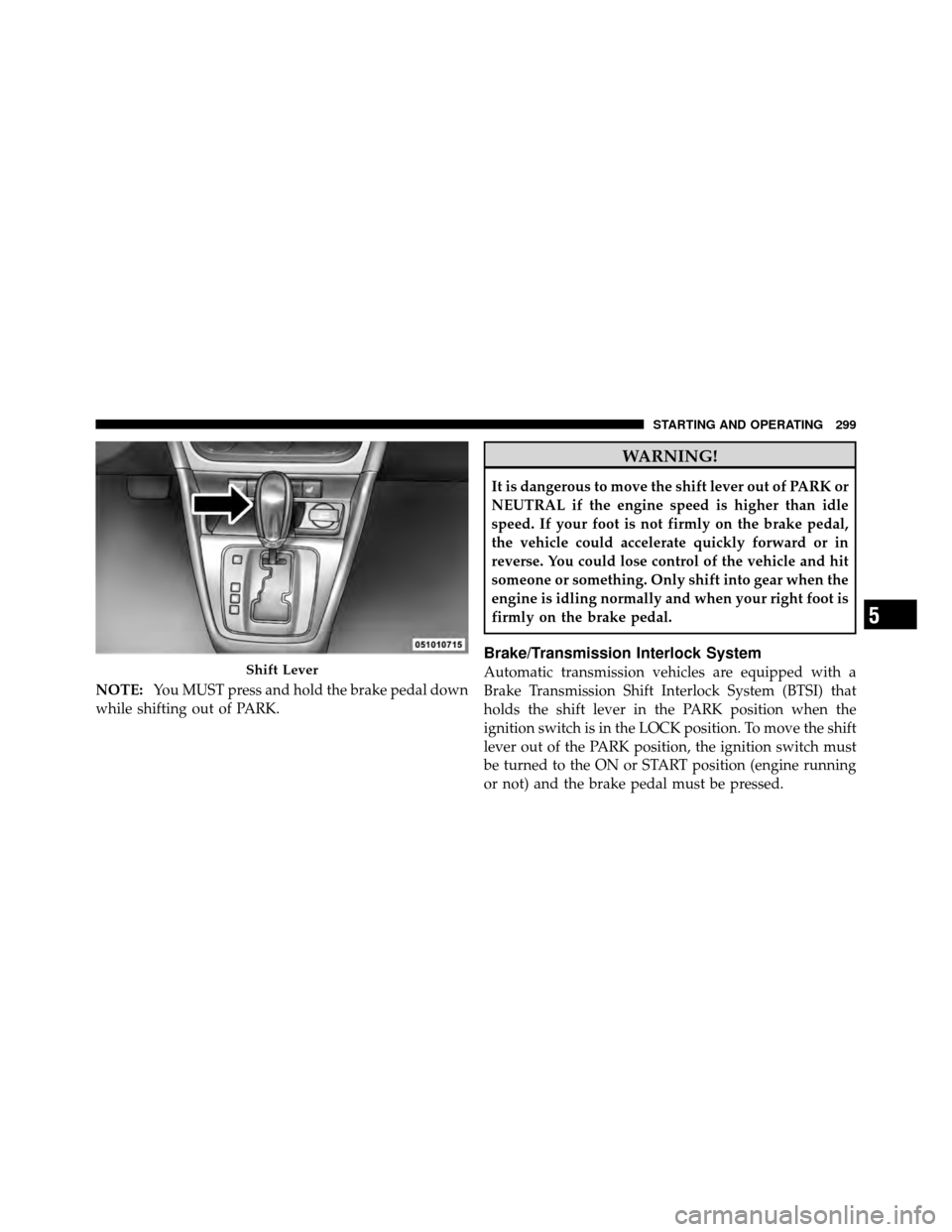
NOTE:You MUST press and hold the brake pedal down
while shifting out of PARK.
WARNING!
It is dangerous to move the shift lever out of PARK or
NEUTRAL if the engine speed is higher than idle
speed. If your foot is not firmly on the brake pedal,
the vehicle could accelerate quickly forward or in
reverse. You could lose control of the vehicle and hit
someone or something. Only shift into gear when the
engine is idling normally and when your right foot is
firmly on the brake pedal.
Brake/Transmission Interlock System
Automatic transmission vehicles are equipped with a
Brake Transmission Shift Interlock System (BTSI) that
holds the shift lever in the PARK position when the
ignition switch is in the LOCK position. To move the shift
lever out of the PARK position, the ignition switch must
be turned to the ON or START position (engine running
or not) and the brake pedal must be pressed.Shift Lever
5
STARTING AND OPERATING 299
Page 301 of 484

NOTE:If a malfunction occurs, the transmission will
not shift out of PARK. Battery power is required to
release the brake/transmission interlock system. There is
a removable plug in the right side of the shifter housing
that allows you to insert your finger to override the
system. If this occurs, obtain service as soon as possible.
Automatic Transmission Ignition Interlock System
This system prevents the key from being removed unless
the shift lever is in PARK. It also prevents shifting out of
PARK unless the key is in the ON position, and the brake
pedal is pressed.
NOTE: If a malfunction occurs, the system will trap the
key in the ignition cylinder to warn you that this safety
feature is inoperable. The engine can be started and
stopped, but the key cannot be removed until you obtain
service.
Gear Ranges
DO NOT race the engine when shifting from PARK or
NEUTRAL position into another gear range.
PARK
This range supplements the parking brake by locking the
transmission. The engine can be started in this range.
Never use PARK while the vehicle is in motion. Apply
the parking brake when leaving the vehicle in this range.
Always apply the parking brake first, and then place the
shift lever in the PARK position.
300 STARTING AND OPERATING
Page 303 of 484

CAUTION!
Before moving the shift lever out of PARK, you must
turn the ignition from LOCK to ON so the steering
wheel and shift lever are released. Otherwise, dam-
age to the steering column or shift lever could result.
You must also press the brake pedal.
REVERSE
This range is for moving the vehicle rearward. Use this
range only after the vehicle has come to a complete stop.
NEUTRAL
This range is used when the vehicle is standing for
prolonged periods with the engine running. The engine
may be started in this range. Set the parking brake if you
must leave the vehicle.
DRIVE
This range is used for most city and highway driving.
AUTOSTICK�— IF EQUIPPED
AutoStick�is a driver-interactive transmission that offers
six manual ratio changes to provide you with more
control. AutoStick� allows you to maximize engine brak-
ing, eliminate undesirable upshifts and downshifts, and
improve overall vehicle performance. This system can
also provide you with more control during passing, city
driving, cold slippery conditions, mountain driving,
trailer towing, and many other situations. Automatic
ratio changes upward will only occur to protect the
Continuously Variable Automatic Transmission (CVT)
and/or the engine from overspeed. Changes down will
only happen at minimum engine speed to prevent stall-
ing.
Operation
NOTE: AutoStick� is not functional until the CVT
warms up in cold weather.
302 STARTING AND OPERATING
Page 304 of 484

AutoStick�operation is activated in the DRIVE position
by moving the shift lever side-to-side. Moving the shift
lever to the (+) side will activate AutoStick� and shift up
to the next higher manual ratio, unless you are already
operating in or near Overdrive, in which case sixth gear
ratio will be selected. In like manner, moving the shift
lever to (-) will activate AutoStick� and shift to the next
lower manual ratio. After AutoStick� is activated, the
manual ratio selected is displayed in the transmission
ratio display and tipping the shift lever to the (+) or (-)
direction will cause an upshift or downshift by one ratio.
AutoStick� is deactivated:
•By holding the shift lever to (+) momentarily
•When the shift lever is shifted out of DRIVE
•When in sixth position, touching the shift lever to the
right
•When heavy Anti-Lock Brake System (ABS) applica-
tion is detected
General Information
•
If a ratio other than first is selected and the vehicle is
brought to a stop, the transmission control logic will
automatically select the first gear ratio.
•If a low range is selected and the engine accelerates to
the rev limit, the transmission will automatically select
the next higher ratio.
•If a downshift would cause the engine to overspeed,
that shift will not occur until it is safe for the engine.
However. the CVT will stay in the manually selected
ratio.
•If the system detects powertrain overheating, the
transmission will revert to the automatic shift mode
and remain in that mode until the powertrain cools off.
•If the system detects a problem, it will disable the
AutoStick�mode and the transmission will return to
the automatic mode until the problem is corrected.
5
STARTING AND OPERATING 303
Page 309 of 484

checked if a leak is suspected, abnormal noises are
apparent, and/or the system is not functioning as antici-
pated. Coordinate inspection efforts through an autho-
rized dealer.
CAUTION!
Do not use chemical flushes in your power steering
system as the chemicals can damage your power
steering components. Such damage is not covered by
the New Vehicle Limited Warranty.
WARNING!
Fluid level should be checked on a level surface and
with the engine off to prevent injury from moving
parts and to ensure accurate fluid level reading. Do
not overfill. Use only manufacturer’s recommended
power steering fluid.If necessary, add fluid to restore to the proper indicated
level. With a clean cloth, wipe any spilled fluid from all
surfaces. Refer to “Fluids, Lubricants, and Genuine
Parts” in “Maintaining Your Vehicle” for further
information.
PARKING BRAKE
Before leaving the vehicle, make sure that the parking
brake is fully applied. Also, be certain to leave an
automatic transmission in PARK, or manual transmission
in REVERSE or first gear.
The parking brake lever is located in the center console.
To apply the parking brake, pull the lever up as firmly as
possible. To release the parking brake, pull the lever up
slightly, press the center button, then lower the lever
completely.
308 STARTING AND OPERATING