Page 325 of 448
•Use speed control in flat terrain and with light loads to
maximize fuel efficiency.
Cooling System
To reduce potential for engine and transmission over-
heating, take the following actions:
•City Driving
When stopped for short periods of time, shift the trans-
mission into NEUTRAL and increase engine idle speed.
•Highway Driving
Reduce speed.
•Air Conditioning
Turn off temporarily.
RECREATIONAL TOWING
(BEHIND MOTORHOME, ETC.)
Towing This Vehicle Behind Another Vehicle
(Flat towing with all four wheels on the ground)
CAUTION!
DO NOT flat tow this vehicle. Damage to the drive-
train will result.
NOTE: If the vehicle requires towing make sure all four
wheels are off the ground.
324 STARTING AND OPERATING
Page 346 of 448
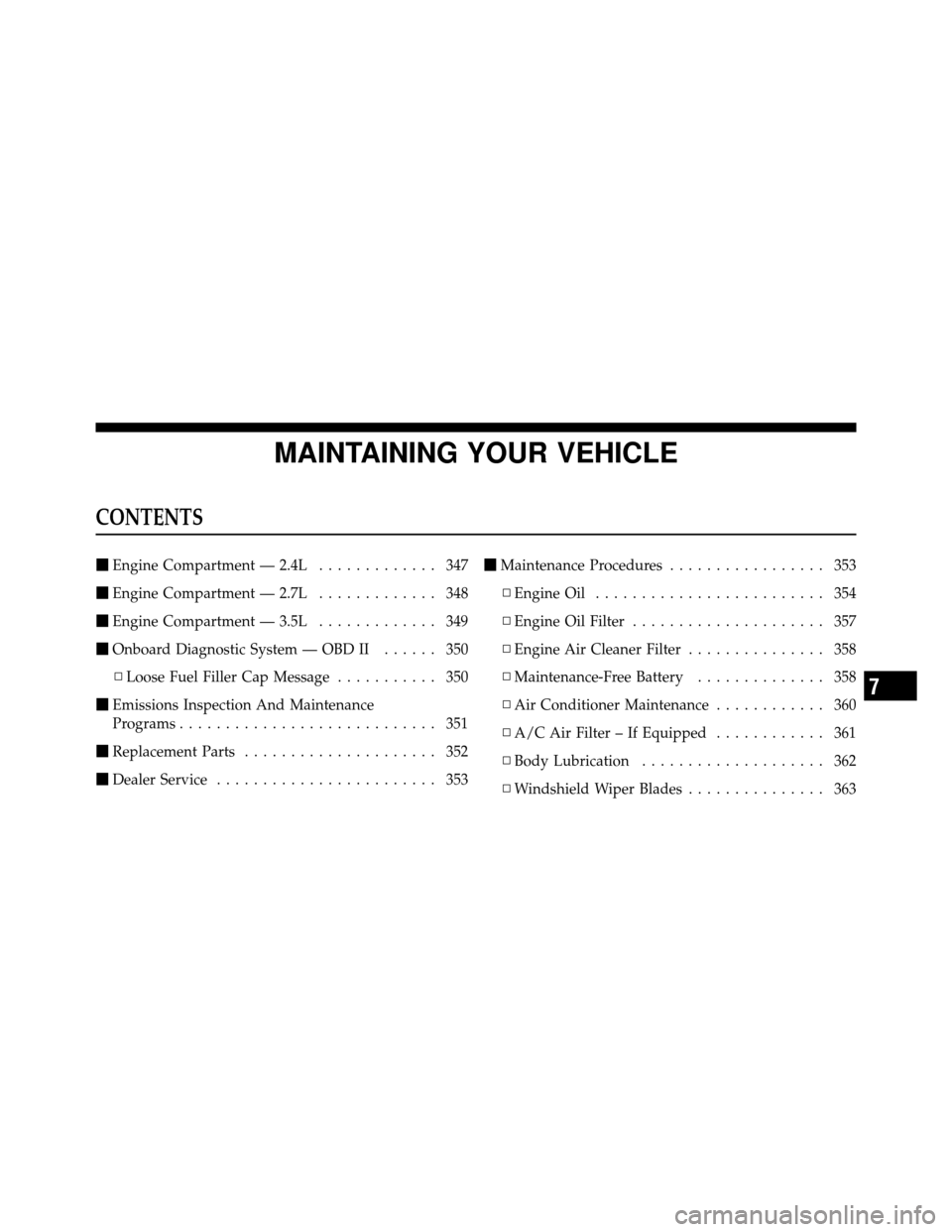
MAINTAINING YOUR VEHICLE
CONTENTS
�Engine Compartment — 2.4L ............. 347
� Engine Compartment — 2.7L ............. 348
� Engine Compartment — 3.5L ............. 349
� Onboard Diagnostic System — OBD II ...... 350
▫ Loose Fuel Filler Cap Message ........... 350
� Emissions Inspection And Maintenance
Programs ............................ 351
� Replacement Parts ..................... 352
� Dealer Service ........................ 353 �
Maintenance Procedures ................. 353
▫ Engine Oil ......................... 354
▫ Engine Oil Filter ..................... 357
▫ Engine Air Cleaner Filter ............... 358
▫ Maintenance-Free Battery .............. 358
▫ Air Conditioner Maintenance ............ 360
▫ A/C Air Filter – If Equipped ............ 361
▫ Body Lubrication .................... 362
▫ Windshield Wiper Blades ............... 363
7
Page 351 of 448
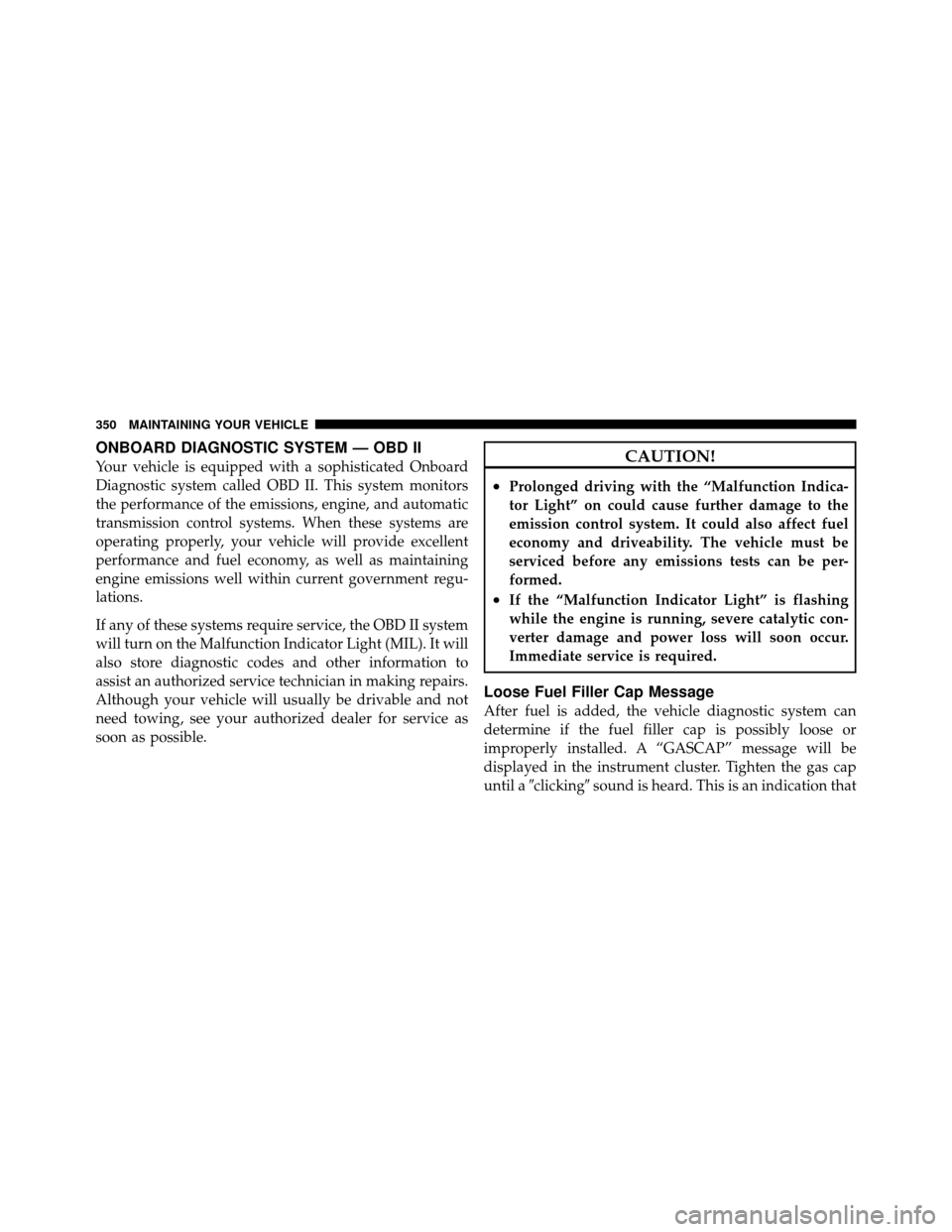
ONBOARD DIAGNOSTIC SYSTEM — OBD II
Your vehicle is equipped with a sophisticated Onboard
Diagnostic system called OBD II. This system monitors
the performance of the emissions, engine, and automatic
transmission control systems. When these systems are
operating properly, your vehicle will provide excellent
performance and fuel economy, as well as maintaining
engine emissions well within current government regu-
lations.
If any of these systems require service, the OBD II system
will turn on the Malfunction Indicator Light (MIL). It will
also store diagnostic codes and other information to
assist an authorized service technician in making repairs.
Although your vehicle will usually be drivable and not
need towing, see your authorized dealer for service as
soon as possible.CAUTION!
•Prolonged driving with the “Malfunction Indica-
tor Light” on could cause further damage to the
emission control system. It could also affect fuel
economy and driveability. The vehicle must be
serviced before any emissions tests can be per-
formed.
•If the “Malfunction Indicator Light” is flashing
while the engine is running, severe catalytic con-
verter damage and power loss will soon occur.
Immediate service is required.
Loose Fuel Filler Cap Message
After fuel is added, the vehicle diagnostic system can
determine if the fuel filler cap is possibly loose or
improperly installed. A “GASCAP” message will be
displayed in the instrument cluster. Tighten the gas cap
until a�clicking� sound is heard. This is an indication that
350 MAINTAINING YOUR VEHICLE
Page 355 of 448

CAUTION! (Continued)
•Your vehicle has been built with improved fluids
that protect the performance and durability of
your vehicle and also allow extended maintenance
intervals. Do not use chemical flushes in these
components as the chemicals can damage your
engine, transmission, power steering or air condi-
tioning. Such damage is not covered by the New
Vehicle Limited Warranty. If a flush is needed
because of component malfunction, use only the
specified fluid for the flushing procedure.
Engine Oil
Checking Oil Level
To assure proper engine lubrication, the engine oil must
be maintained at the correct level. Check the oil level at
regular intervals, such as every fuel stop. The best time to
check the engine oil level is about five minutes after afully warmed engine is shut off. Do not check oil level
before starting the engine after it has sat overnight.
Checking engine oil level when the engine is cold will
give you an incorrect reading.
Checking the oil while the vehicle is on level ground and
only when the engine is hot, will improve the accuracy of
the oil level readings. Maintain the oil level between the
range markings on the dipstick. Either the range mark-
ings consist of a crosshatch zone marked SAFE or a
crosshatch zone marked with MIN at the low end of the
range and MAX at the high end of the range. Adding one
quart of oil when the reading is at the low end of the
range marking will raise the oil level to the high end of
the range marking.
354 MAINTAINING YOUR VEHICLE
Page 357 of 448
CAUTION!
Do not use chemical flushes in your engine oil as the
chemicals can damage your engine. Such damage is
not covered by the New Vehicle Limited Warranty.
Engine Oil Viscosity (SAE Grade) – 2.4L and 2.7L
Engines
SAE 5W-20 engine oil is recommended for all operating
temperatures. This engine oil improves low temperature
starting and vehicle fuel economy. Your engine oil filler
cap also shows the recommended engine oil viscosity for
your vehicle.
The engine oil filler cap also shows the recommended
engine oil viscosity for your engine. For information on
engine oil filler cap location, refer to “Engine Compart-
ment” in “Maintaining Your Vehicle” for further informa-
tion.Lubricants which do not have both the engine oil certi-
fication mark and the correct SAE viscosity grade num-
ber should not be used.
Engine Oil Viscosity (SAE Grade) – 3.5L Engine
SAE 10W-30 engine oil is preferred for all operating
temperatures. The engine oil filler cap also shows the
recommended engine oil viscosity for your vehicle.
Lubricants which do not have both, the engine oil certi-
fication mark and the correct SAE viscosity grade num-
ber should not be used.
The engine oil filler cap also shows the recommended
engine oil viscosity for your engine. For information on
engine oil filler cap location, refer to “Engine Compart-
ment” in “Maintaining Your Vehicle” for further informa-
tion.
356 MAINTAINING YOUR VEHICLE
Page 366 of 448
WARNING!
•Exhaust gases can injure or kill. They contain
carbon monoxide (CO), which is colorless and
odorless. Breathing it can make you unconscious
and can eventually poison you. To avoid breathing
CO, refer to “Safety Tips/Exhaust Gas” in “Things
To Know Before Starting Your Vehicle” for further
information.
•A hot exhaust system can start a fire if you park
over materials that can burn. Such materials might
be grass or leaves coming into contact with your
exhaust system. Do not park or operate your ve-
hicle in areas where your exhaust system can
contact anything that can burn.
CAUTION!
•The catalytic converter requires the use of un-
leaded fuel only. Leaded gasoline will destroy the
effectiveness of the catalyst as an emissions con-
trol device and may seriously reduce engine per-
formance and cause serious damage to the engine.
•Damage to the catalytic converter can result if your
vehicle is not kept in proper operating condition.
In the event of engine malfunction, particularly
involving engine misfire or other apparent loss of
performance, have your vehicle serviced promptly.
Continued operation of your vehicle with a severe
malfunction could cause the converter to overheat,
resulting in possible damage to the converter and
vehicle.
7
MAINTAINING YOUR VEHICLE 365
Page 397 of 448
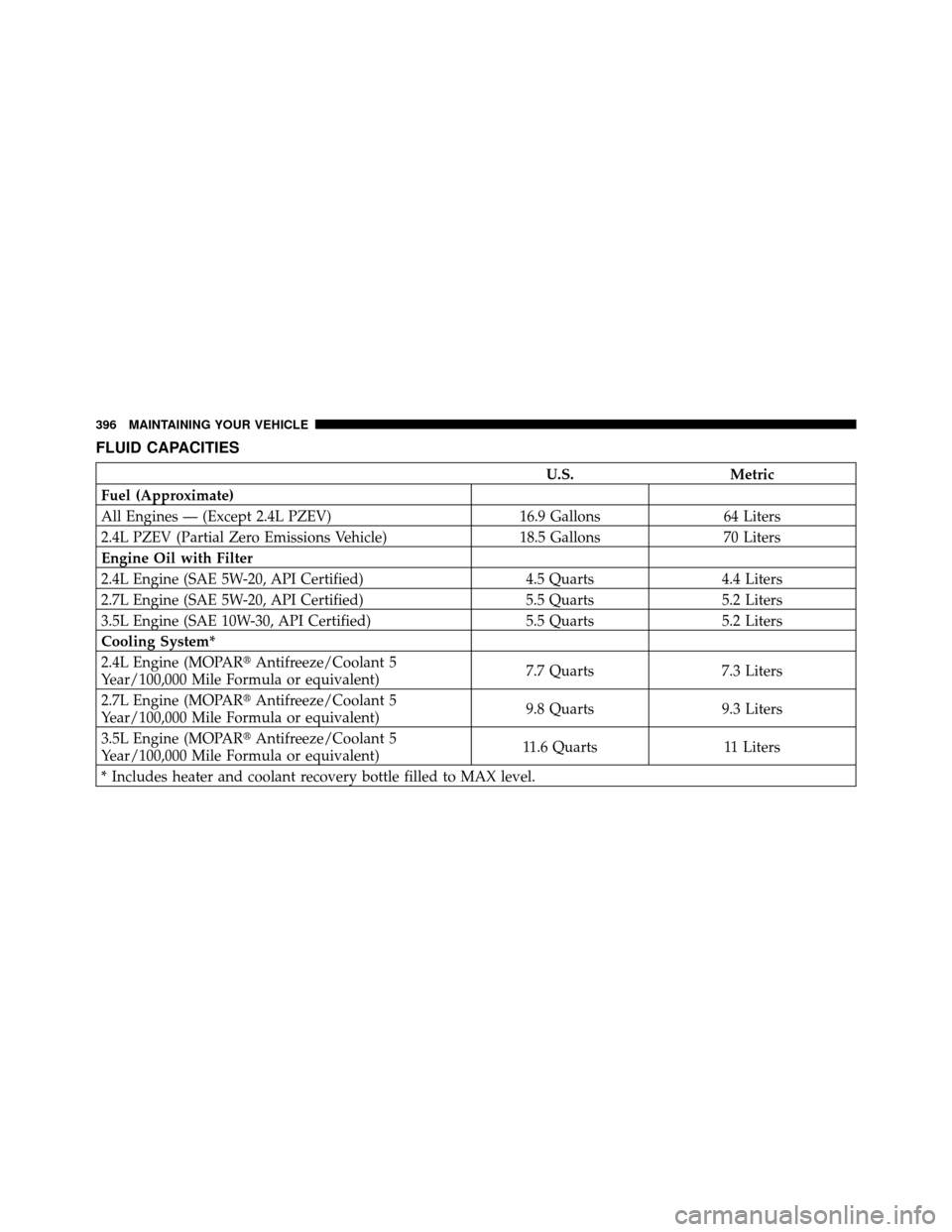
FLUID CAPACITIES
U.S.Metric
Fuel (Approximate)
All Engines — (Except 2.4L PZEV) 16.9 Gallons64 Liters
2.4L PZEV (Partial Zero Emissions Vehicle) 18.5 Gallons70 Liters
Engine Oil with Filter
2.4L Engine (SAE 5W-20, API Certified) 4.5 Quarts4.4 Liters
2.7L Engine (SAE 5W-20, API Certified) 5.5 Quarts5.2 Liters
3.5L Engine (SAE 10W-30, API Certified) 5.5 Quarts5.2 Liters
Cooling System*
2.4L Engine (MOPAR� Antifreeze/Coolant 5
Year/100,000 Mile Formula or equivalent) 7.7 Quarts
7.3 Liters
2.7L Engine (MOPAR� Antifreeze/Coolant 5
Year/100,000 Mile Formula or equivalent) 9.8 Quarts
9.3 Liters
3.5L Engine (MOPAR� Antifreeze/Coolant 5
Year/100,000 Mile Formula or equivalent) 11.6 Quarts
11 Liters
* Includes heater and coolant recovery bottle filled to MAX level.
396 MAINTAINING YOUR VEHICLE
Page 399 of 448
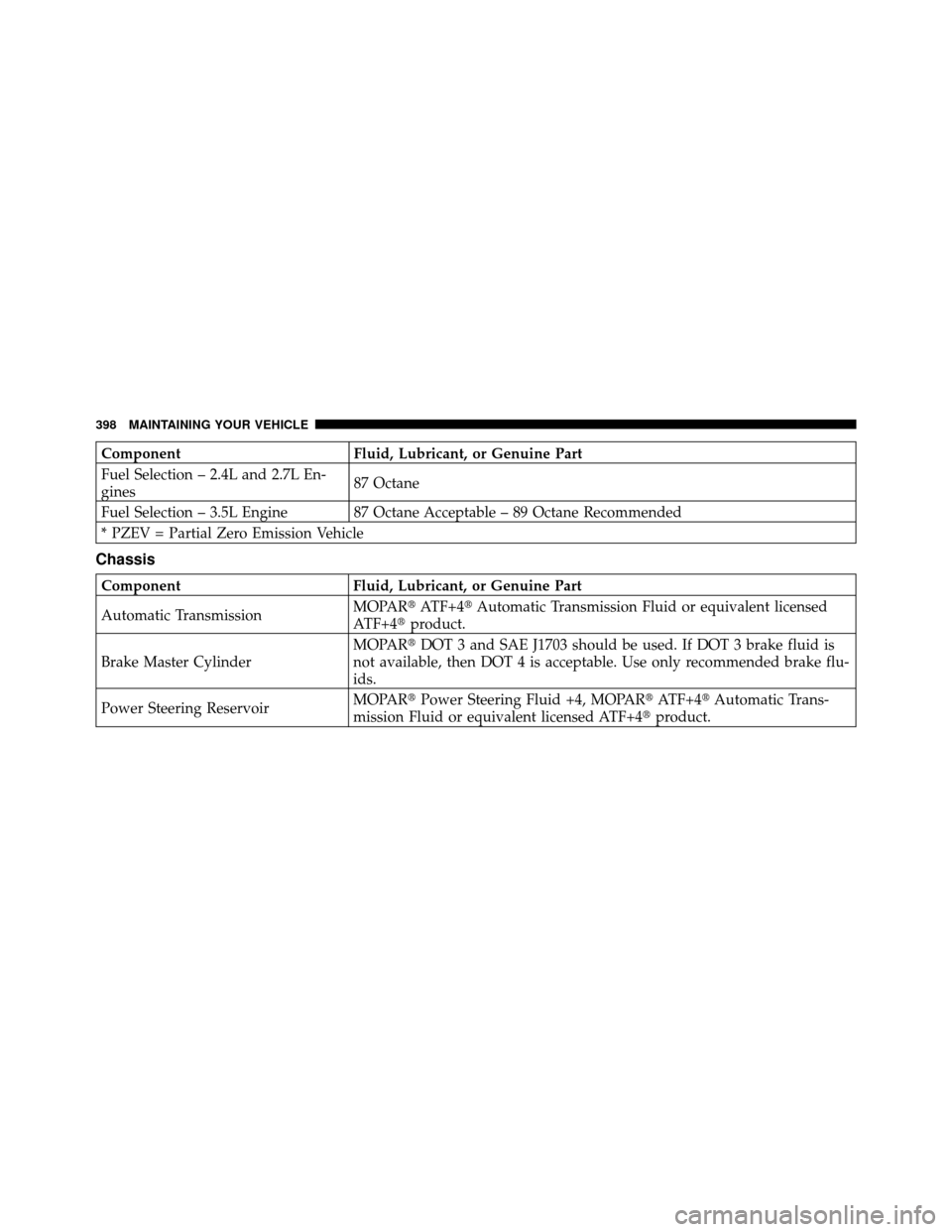
ComponentFluid, Lubricant, or Genuine Part
Fuel Selection – 2.4L and 2.7L En-
gines 87 Octane
Fuel Selection – 3.5L Engine 87 Octane Acceptable – 89 Octane Recommended
* PZEV = Partial Zero Emission Vehicle
Chassis
Component Fluid, Lubricant, or Genuine Part
Automatic Transmission MOPAR�
ATF+4�Automatic Transmission Fluid or equivalent licensed
ATF+4� product.
Brake Master Cylinder MOPAR�
DOT 3 and SAE J1703 should be used. If DOT 3 brake fluid is
not available, then DOT 4 is acceptable. Use only recommended brake flu-
ids.
Power Steering Reservoir MOPAR�
Power Steering Fluid +4, MOPAR� ATF+4�Automatic Trans-
mission Fluid or equivalent licensed ATF+4� product.
398 MAINTAINING YOUR VEHICLE