Page 325 of 448
•Use speed control in flat terrain and with light loads to
maximize fuel efficiency.
Cooling System
To reduce potential for engine and transmission over-
heating, take the following actions:
•City Driving
When stopped for short periods of time, shift the trans-
mission into NEUTRAL and increase engine idle speed.
•Highway Driving
Reduce speed.
•Air Conditioning
Turn off temporarily.
RECREATIONAL TOWING
(BEHIND MOTORHOME, ETC.)
Towing This Vehicle Behind Another Vehicle
(Flat towing with all four wheels on the ground)
CAUTION!
DO NOT flat tow this vehicle. Damage to the drive-
train will result.
NOTE: If the vehicle requires towing make sure all four
wheels are off the ground.
324 STARTING AND OPERATING
Page 326 of 448
WHAT TO DO IN EMERGENCIES
CONTENTS
�Hazard Warning Flasher ................ 327
� If Your Engine Overheats ................ 327
▫ Engine Oil Overheating
(2.4L Engine Only) — If Equipped ........ 328
� Jacking And Tire Changing ............... 329
▫ Jack Location ....................... 329
▫ Spare Tire Stowage ................... 329 ▫
Preparations For Jacking ............... 330
▫ Jacking Instructions ................... 330
� Jump-Starting ........................ 335
▫ Preparations For Jump-Start ............. 336
▫ Jump-Starting Procedure ............... 338
� Freeing A Stuck Vehicle ................. 339
6
Page 328 of 448
HAZARD WARNING FLASHER
The Hazard Warning flasher switch is located on the
instrument panel, below the radio.Press the switch to turn on the Hazard Warning
flasher. When the switch is activated, all directional
turn signals will flash on and off to warn oncoming
traffic of an emergency. Press the switch a second time to
turn off the Hazard Warning flasher.
This is an emergency warning system and should not be
used when the vehicle is in motion. Use it when your
vehicle is disabled and is creating a safety hazard for
other motorists.
If it is necessary to leave the vehicle to go for service, the
Hazard Warning flasher will continue to operate with the
ignition key removed and the vehicle locked.
NOTE: With extended use, the Hazard Warning flasher
may wear down your battery.
IF YOUR ENGINE OVERHEATS
In any of the following situations, you can reduce the
potential for overheating by taking the appropriate ac-
tion.
•On the highways — Slow down.
•In city traffic — While stopped, put transaxle in
NEUTRAL, but do not increase engine idle speed.
CAUTION!
Driving with a hot cooling system could damage
your vehicle. If temperature gauge reads “H”, pull
over and stop the vehicle with the engine at idle,
when safe. Turn the air conditioner off and wait until
the pointer drops back into the normal range. After
appropriate action has been taken, if the pointer
remains on the “H”, turn the engine off immediately,
and call for service.6
WHAT TO DO IN EMERGENCIES 327
Page 329 of 448
NOTE:There are steps that you can take to slow down
an impending overheat condition:
•If your air conditioner (A/C) is on, turn it off. The A/C
system adds heat to the engine cooling system and
turning the A/C off can help remove this heat.
•You can also turn the temperature control to maximum
heat, the mode control to floor and the blower control
to high. This allows the heater core to act as a
supplement to the radiator and aids in removing heat
from the engine cooling system.
WARNING!
You or others can be badly burned by hot engine
coolant (antifreeze) or steam from your radiator. If
you see or hear steam coming from under the hood,
do not open the hood until the radiator has had time
to cool. Never try to open a cooling system pressure
cap when the radiator or coolant bottle is hot.
Engine Oil Overheating (2.4L Engine Only) —
If Equipped
During sustained high-speed driving or trailer tow up
long grades on a hot day, the engine oil temperature may
become too hot. If this happens, the “HOTOIL” message
flashes in the odometer and the vehicle speed will be
reduced to 53 mph (85 km/h) until the engine oil
temperature is reduced.
NOTE: The vehicle speed is reduced to a maximum of
53 mph (85 km/h). You may of course, reduce your
vehicle speed further if needed.
328 WHAT TO DO IN EMERGENCIES
Page 341 of 448

front wheels. Then shift back and forth between RE-
VERSE and FIRST gear. Using minimal accelerator pedal
pressure to maintain the rocking motion, without spin-
ning the wheels, is most effective.
NOTE:If your vehicle is equipped with Electronic
Stability Control (ESC), turn the system to Partial OFF
before attempting to “rock” the vehicle. Refer to “Elec-
tronic Brake Control” in “Starting and Operating” for
further information.
CAUTION!
•When “rocking” a stuck vehicle by moving be-
tween 1st and REVERSE, do not spin the wheels
faster than 15 mph (24 km/h), or drivetrain damage
may result.
(Continued)
CAUTION! (Continued)
•Revving the engine or spinning the wheels too fast
may lead to transmission overheating and failure.
It can also damage the tires. Do not spin the
wheels above 30 mph (48 km/h) while in gear (no
transmission shifting occurring).
WARNING!
Fast spinning tires can be dangerous. Forces gener-
ated by excessive wheel speeds may cause damage, or
even failure, of the axle and tires. A tire could
explode and injure someone. Do not spin your vehi-
cle’s wheels faster than 30 mph (48 km/h) or for
longer than 30 seconds continuously without stop-
ping when you are stuck and do not let anyone near
a spinning wheel, no matter what the speed.
340 WHAT TO DO IN EMERGENCIES
Page 367 of 448

Under normal operating conditions, the catalytic con-
verter will not require maintenance. However, it is im-
portant to keep the engine properly tuned to assure
proper catalyst operation and prevent possible catalyst
damage.
NOTE:Intentional tampering with emissions control
systems can result in civil penalties being assessed
against you.
In unusual situations involving grossly malfunctioning
engine operation, a scorching odor may suggest severe
and abnormal catalyst overheating. If this occurs, stop
the vehicle, turn off the engine and allow it to cool.
Service, including a tune-up to manufacturer’s specifica-
tions, should be obtained immediately. To minimize the possibility of catalytic converter dam-
age:
•Do not shut off the engine or interrupt the ignition,
when the transmission is in gear and the vehicle is in
motion.
•Do not try to start the engine by pushing or towing the
vehicle.
•Do not idle the engine with any spark plug wires
disconnected or removed, such as when diagnostic
testing, or for prolonged periods during very rough
idle or malfunctioning operating conditions.
366 MAINTAINING YOUR VEHICLE
Page 434 of 448
Oil Selection....................... 355,396
Oil Synthetic ......................... 357
Overheating .......................... 327
Starting ............................. 243
Temperature Gauge .................... 150
Engine Oil Viscosity ...................... 356
Enhanced Accident Response Feature .......... 64
Entry System, Illuminated .................. 19
Ethanol ............................... 301
Exhaust Gas Caution ................... 81,304
Exhaust System ....................... 81,364
Extender, Seat Belt ........................ 52
Exterior Lights .......................... 84
Fabric Care ............................ 380
Filler Location Fuel .................... 150,309
Filters Air Cleaner .......................... 358
Air Conditioning .................... 236,361Automatic Transaxle
.................... 376
Engine Oil ........................ 357,397
Engine Oil Disposal .................... 357
Flashers .............................. 327
Hazard Warning ....................... 327
Turn Signal ........................ 84,392
Flash-To-Pass ........................... 109
Flexible Fuel Vehicles ..................... 305
Cruising Range ....................... 308
Engine Oil ........................... 308
Fuel Requirements .................. 305,307
Maintenance ....................... 305,309
Replacement Parts ..................... 309
Starting ............................. 308
Flooded Engine Starting ................... 244
Floor Console .......................... 136
Fluid Capacities ......................... 396
Fluid Leaks ............................. 84
10
INDEX 433
Page 440 of 448
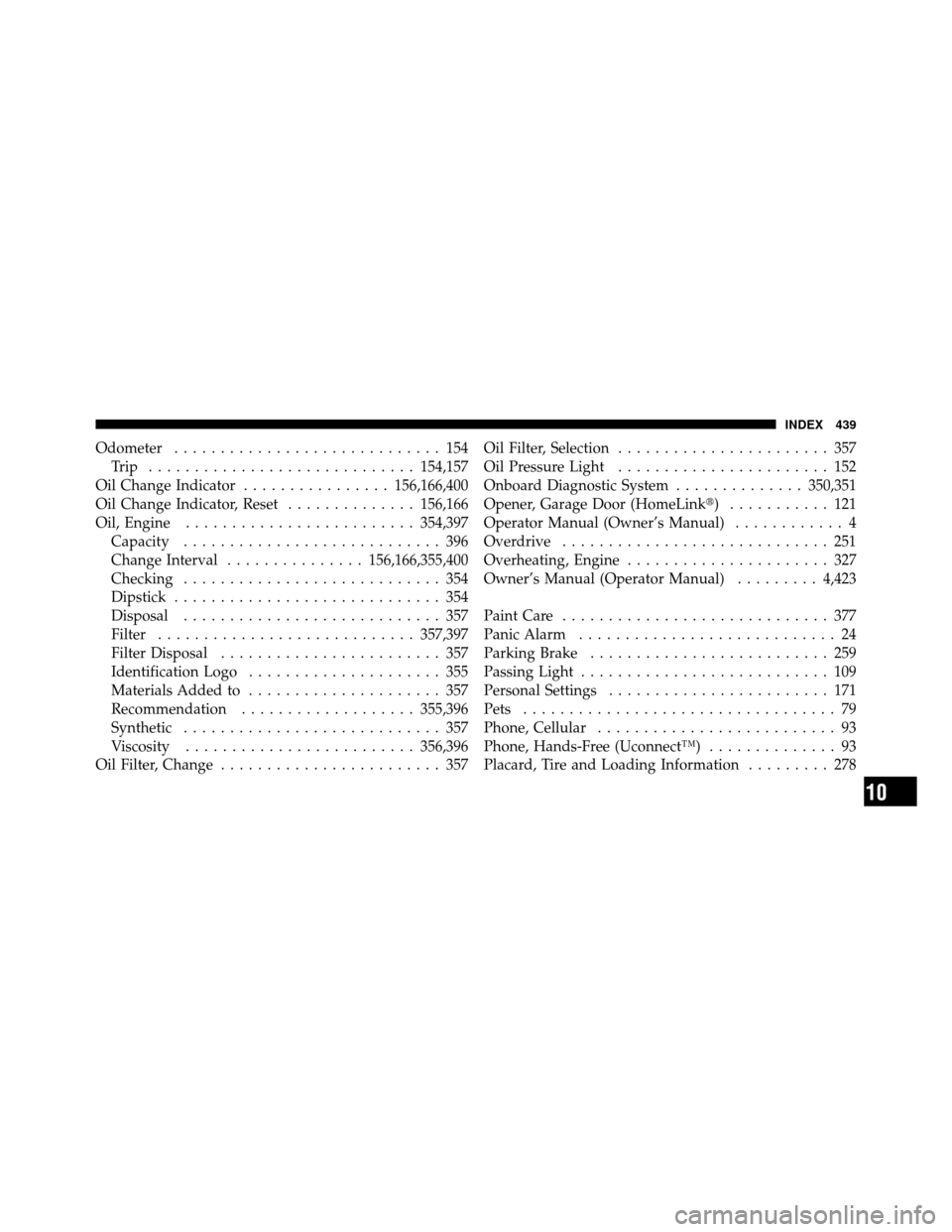
Odometer............................. 154
Trip ............................. 154,157
Oil Change Indicator ................ 156,166,400
Oil Change Indicator, Reset ..............156,166
Oil, Engine ......................... 354,397
Capacity ............................ 396
Change Interval ............... 156,166,355,400
Checking ............................ 354
Dipstick ............................. 354
Disposal ............................ 357
Filter ............................ 357,397
Filter Disposal ........................ 357
Identification Logo ..................... 355
Materials Added to ..................... 357
Recommendation ................... 355,396
Synthetic ............................ 357
Viscosity ......................... 356,396
Oil Filter, Change ........................ 357 Oil Filter, Selection
....................... 357
Oil Pressure Light ....................... 152
Onboard Diagnostic System ..............350,351
Opener, Garage Door (HomeLink�) ........... 121
Operator Manual (Owner’s Manual) ............ 4
Overdrive ............................. 251
Overheating, Engine ...................... 327
Owner’s Manual (Operator Manual) .........4,423
Paint Care ............................. 377
Panic Alarm ............................ 24
Parking Brake .......................... 259
Passing Light ........................... 109
Personal Settings ........................ 171
Pets .................................. 79
Phone, Cellular .......................... 93
Phone, Hands-Free (Uconnect™) .............. 93
Placard, Tire and Loading Information ......... 278
10
INDEX 439
Page:
< prev 1-8 9-16 17-24